Why 100% Automated QA is the Only Way BPOs Can Defend Their Margins
A sampled QA program cannot tell you what is happening on your floor, only what happened on the calls you happened to pick. This post explains why automated QA across all conversations helps BPOs defend their margins and client relationships.

Key highlights
Why 100% Automated QA is the Only Way BPOs Can Defend Their Margins
- A sampled QA program cannot tell you what is happening on your floor. It tells you what happened on the calls you happened to pick.
- Manual QA costs a BPO far more than the analyst's salary line, because every hidden cost inside that program scales directly with the volume of conversations your client generates.
- Full-coverage evidence moves a QBR from a conversation about what your team believes happened to a presentation of what every conversation actually shows.
- When scoring is automated, the QA analyst stops filling spreadsheets and starts doing the work that actually improves performance: targeted coaching, complex resolution review, and human judgment on the calls that genuinely require it.
- A managed platform scores every tenant against its own rules, in full separation, across every conversation your delivery centers handle.
- A managed scoring platform gives a BPO a system to run, with the scorecards, per-tenant rules, dispute log and audit trail already in place, and the difference shows up immediately in engineering cost, governance risk, and QBR credibility.
- A BPO moves off manual sampling by running automated scoring alongside its existing process first, validating agreement on a single tenant, then expanding one account at a time until the sample is retired entirely.
- A BPO that still scores a thin sample of its calls is carrying contractual and evidentiary exposure that its clients will eventually price into renewal terms or use to exit the relationship.
- Accountability for outsourcers means producing a scored record of every conversation, not a defended sample, and using that record to negotiate renewals from a position of evidence rather than estimation.
Why is a sampled QA program no longer defensible?
A sampled QA program cannot tell you what is happening on your floor. It tells you what happened on the calls you happened to pick.
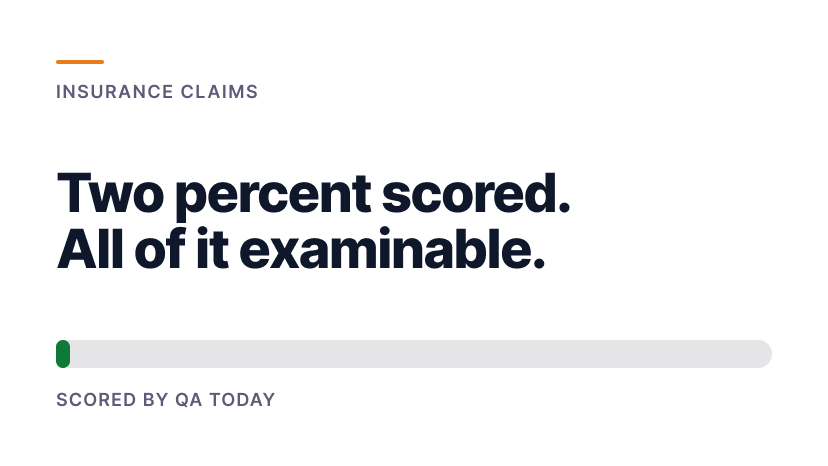
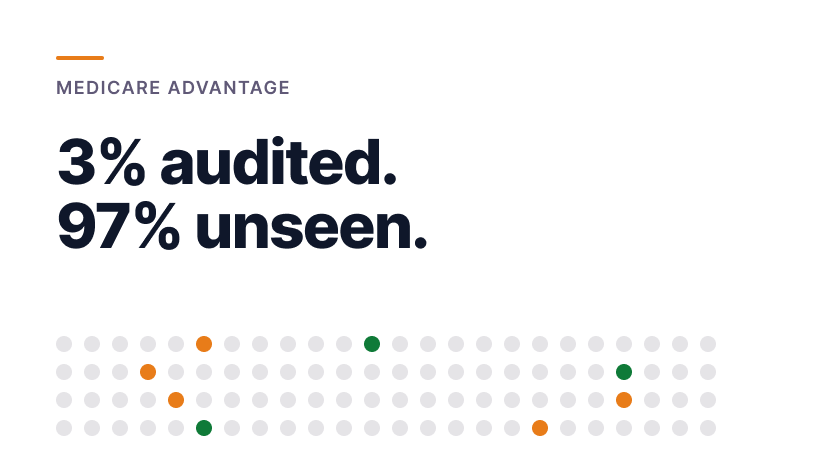
Walk into a QBR with a client who has just run their own listening session and pulled four calls your analysts never scored. That is the room you are defending today. The sample your team scored last month covered thirty contacts out of three thousand. The thirty were not selected for risk. They were selected for convenience.
Statistical weight is the first problem. Thirty calls cannot surface a systemic agent behavior with any confidence. A coaching issue affecting a small share of contacts would need to appear in the sample by chance, and at thirty calls out of three thousand, chance rarely cooperates. The analyst scores what they see. What they see is not representative.
The luck-of-the-draw problem compounds it. One unusually clean call can carry an agent's monthly score above threshold. One difficult call, also pulled by chance, collapses it. Neither outcome reflects the agent's actual performance across the month. The score becomes a function of which calls got selected, not how the agent performed.
Compliance risk lives in the long tail. The contact where a representative quoted the wrong disclosure, or failed to read the required statement, is by definition rare. A rare event almost never lands in a thirty-call sample. Your program carries the exposure, and your current scoring approach (opens in a new tab) was never designed to find it.
Automated call center quality management closes that gap by scoring every conversation.
What does manual QA actually cost a BPO per tenant?
Manual QA costs a BPO far more than the analyst's salary line, because every hidden cost inside that program scales directly with the volume of conversations your client generates.
In practice, the scorecard your analyst fills out is only the beginning. The real margin erosion sits in the activity surrounding each scored call, and it compounds across every tenant on your book of business.
- Scoring and logging hours. Quality analysts spend the majority of their time on documentation, not development. A program sampling 2% of a client's monthly call volume still consumes dozens of analyst hours in call selection, form entry, and calibration meetings. Those hours do not improve a single rep's performance.
- Dispute resolution cycles. When a rep challenges a manually scored call, a supervisor must retrieve the recording, re-score it, and defend the result. A contested score can consume hours of combined analyst and supervisor time for a single interaction.
- Client-mandated headcount minimums. Enterprise clients often write sample size floors into their contracts. That language forces you to staff to the contract, not to the actual coaching need, regardless of volume fluctuation.
- Volume-driven headcount growth. Each new seat added to a program adds proportionally to the QA burden. There is no point at which manual sampling becomes more efficient.
100 percent call coverage QA changes that math entirely. Your analysts move from scoring calls to improving the reps who take them.
How does full-coverage evidence change a QBR?
Full-coverage evidence moves a QBR from a conversation about what your team believes happened to a presentation of what every conversation actually shows.
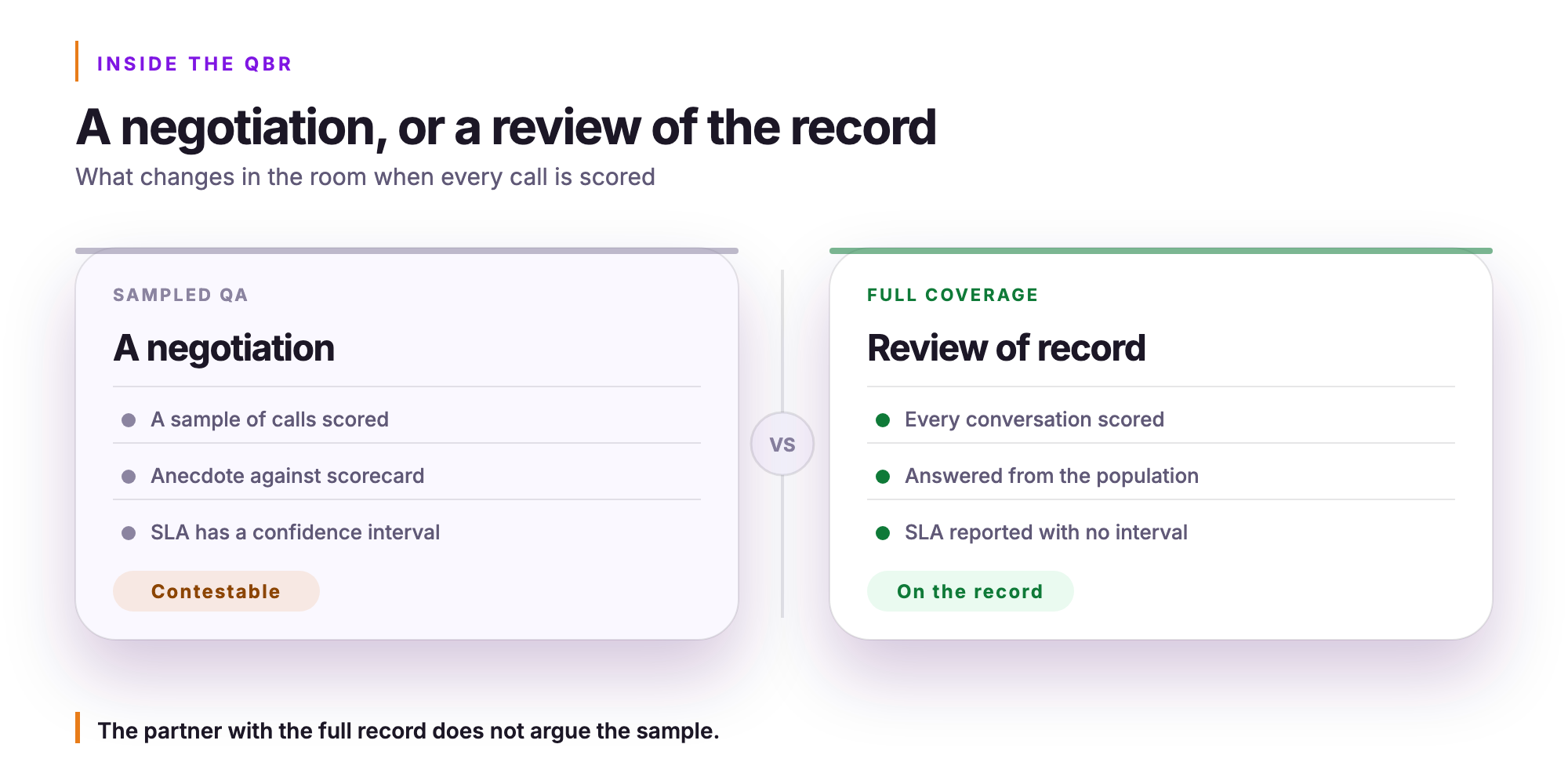
In practice, a quarterly business review built on a 2% sample is a negotiation. The client brings an anecdotal complaint, your team brings a scorecard drawn from a few hundred calls, and the room spends an hour debating whose slice of the truth is more representative. BPO quality assurance automation changes the terms of that room entirely. When scoring runs across every conversation, the QBR becomes a review of the record, not an argument about the sample.
Anecdotal complaints lose their structural advantage the moment you can answer them with the full population. A client who escalates three calls as evidence of a systemic disclosure failure can be shown the disclosure rate across every interaction in the period. The number either confirms the concern, in which case you own it and show the remediation already in motion, or it refutes it, in which case you have done something most BPO relationships never achieve. You have produced documented negative evidence: a complete record showing no instance of that error was identified across the population.
SLA adherence works the same way. Estimating compliance from a subset always carries a confidence interval the client can question. Reporting it from 100% of conversations carries none. That distinction matters most in contract disputes and in regulated programs where the SLA itself carries a penalty.
“The partner who walks into a QBR with the full record does not argue about the sample. The partner closes the conversation and moves to what comes next.”
That shift, from what the partner believes to what the partner can show, is where margin protection becomes durable.
What happens to the QA analyst when scoring is automated?
When scoring is automated, the QA analyst stops filling spreadsheets and starts doing the work that actually improves performance: targeted coaching, complex resolution review, and human judgment on the calls that genuinely require it.
Before automation, a typical analyst spends the majority of the shift on mechanical verification. Did the rep deliver the required greeting? Was the disclosure statement read verbatim? Were the mandatory compliance phrases present? Replacing manual call sampling with AI removes every one of those hours from the analyst's calendar. The platform scores compliance items across 100% of conversations without analyst input.
Coaching focus shifts in a direct and measurable way. Instead of reviewing a random sample, the analyst receives a queue of conversations where the platform identified a genuine resolution failure, an unexpected sentiment drop, or a complex escalation path that did not follow the expected sequence. That queue is small enough to act on in a single shift. The analyst reads the specific calls where a rep needs help, rather than the statistically arbitrary slice that happened to land in the sample.
Agent trust also changes. A rep who knows that every conversation is scored by the same criteria, applied consistently across every shift and every delivery center, cannot reasonably argue that the sample was unrepresentative or the scorer was inconsistent. Fair, complete coverage makes the feedback harder to dispute and easier to accept. That matters for retention, and it matters for the quality program's credibility with the client.
The analyst's role does not disappear. It sharpens.
How do you score every tenant against a different scorecard?
A managed platform scores every tenant against its own rules, in full separation, across every conversation your delivery centers handle.
The practical problem of quality assurance in BPO is not scoring calls. It is maintaining dozens of distinct client scorecards, each with its own weighted criteria, mandatory fail conditions, and compliance language, without letting one client's logic bleed into another's results. A manual sampling model makes this manageable only because the volume stays low. Push to 100% coverage and the complexity multiplies immediately.
Consistency across delivery centers and shifts is where single-sample programs fail most visibly. An analyst in one center scores a call one way. An analyst on a different shift scores the same pattern differently. Automated scoring applies the same per-tenant logic identically whether the call was handled in Phoenix or Manila, at 9 a.m. or 3 a.m. Orvera custom-trains its own contextualization models on de-identified data, so scoring reflects real contact center language and product context rather than a generic interpretation of it.
That consistency matters most when a client disputes a result. A scored record tied to a specific scorecard version, applied uniformly across every conversation in the period, is stronger evidence than a number drawn from a 2% sample.
Why does an API-only tool fail inside a BPO?
A managed scoring platform gives a BPO a system to run, with the scorecards, per-tenant rules, dispute log and audit trail already in place, and the difference shows up immediately in engineering cost, governance risk, and QBR credibility.
Engineering debt. Raw model APIs deliver a prediction. They do not deliver a scorecard, a per-tenant rule set, a dispute log, or an audit trail. A BPO that builds on top of one absorbs every hour of prompt engineering, integration work, regression testing, and model-version management that follows. Automated call scoring only produces defensible output when the scoring logic is stable, versioned, and traceable. A home-built tool built on a shifting API is none of those things.
Operational fit. An outsourcer already staffs QA analysts, coaches, and client-services leads. Adding an engineering operation on top of that headcount is a cost center with no client-billable return. What the floor needs is a platform that arrives already configured for contact center workflows, one that understands escalation paths, hold events, and disposition codes without requiring internal teams to teach it those concepts from scratch. Understanding the workflow matters more than the model underneath it.
Governance exposure. Ungoverned scoring is a risk you carry. If the logic that produced a failing score cannot be explained, version-referenced, and reproduced on demand, a rep can dispute it and win. That outcome erodes the standing of the QA program with clients and, in a contract dispute, it leaves the BPO without evidence it can defend. Moving to 100% coverage only protects margin when every scored conversation carries an audit trail that no one can reasonably challenge.
How do you move off sampling without disrupting delivery?
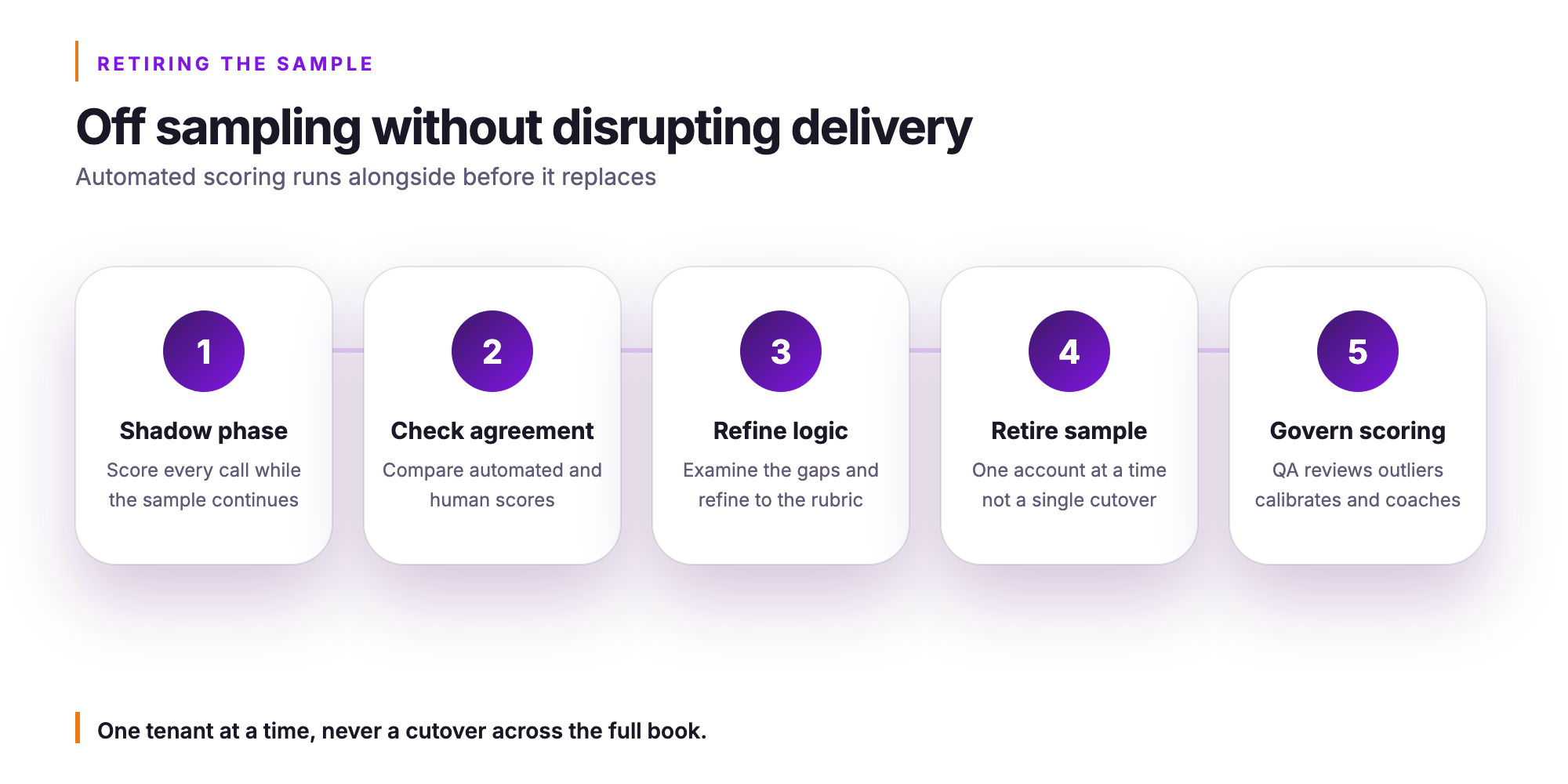
A BPO moves off manual sampling by running automated scoring alongside its existing process first, validating agreement on a single tenant, then expanding one account at a time until the sample is retired entirely.
Retirement of the manual sample happens one tenant at a time, not across your full book in a single cutover. Start with the account whose scorecard is most stable and whose client relationship allows for a direct conversation about coverage depth. Retire the sample there, confirm the automated scoring holds in live production, then move to the next account. That sequencing protects delivery and limits exposure during the transition.
Your QA team does not disappear in this model. Orvera AI runs the scoring machinery, and your QA analysts keep the decisions that machinery answers to: what a good call means for each client, which flagged outliers are worth acting on, and how reps get coached on the patterns the full-coverage data surfaces. You own the client relationship, so when a client tells you the standard has moved, calibration becomes a structured review of whether the scoring logic reflects what they now want rather than a debate about individual graders. That is a more valuable use of your QA team's time than random sampling ever was.
The client conversation matters as much as the operational one. Present the change as an increase in evidence depth. A client who previously received a monthly scorecard built on a thin sample of calls now receives one built on all of them. The story is stronger coverage, faster dispute resolution, and a complete audit trail. That framing shifts the transition from something you have to explain into something your client can carry into their own internal reviews.
What should a BPO take away from this?
A BPO that still scores a thin sample of its calls is carrying contractual and evidentiary exposure that its clients will eventually price into renewal terms or use to exit the relationship.
Full coverage is a commercial position. The quality argument is real, but the margin argument is what moves a contract. When a client brings a dispute to a QBR and the outsourcer cannot produce evidence on the specific calls in question, the sample gap becomes a liability the partner carries alone.
Four things follow from that:
- A thin sample is a statistical approximation that holds until a client asks about the calls you did not score.
- Full coverage ends the argument about the sample. The QBR becomes a review of the record, not an argument about which slice of it was representative.
- 100% automated QA converts analyst time from scoring to coaching. That reallocation improves rep performance, which improves the metrics your client measures you on.
- The transition requires an operated platform. Configuration, governance, and scorecard alignment are operational work, and Orvera AI carries that work for you.
The outsourcers that will hold margin through the next wave of client scrutiny are the ones who make full conversation coverage a standard contractual commitment.
What does accountability look like for outsourcers next?
Accountability for outsourcers means producing a scored record of every conversation, not a defended sample, and using that record to negotiate renewals from a position of evidence rather than estimation.
The commercial argument is straightforward. A BPO that sells labor capacity competes on price and loses margin every time a client tightens its rate card. A BPO that sells a measurable outcome, first-contact resolution rate, adherence score, or coaching velocity, has a number to defend and a mechanism to show. Complete scoring data makes that possible. When every conversation is scored, the QBR conversation shifts from "here is what we saw in our sample" to "here is what happened across every contact this quarter."
That data does more than protect a contract. Complete scoring surfaces the patterns that feed agent assist decisions. A thin sample cannot tell you which call types resolve cleanly or which knowledge gaps appear most often in wrap. The full population can. And once you know which contacts resolve reliably, you have the evidentiary foundation to bring automation to those queues with confidence, not on a vendor's promise.
Orvera AI builds, deploys, and runs Auto QA, Agent Assist, and the AI agents that resolve contacts from greeting to resolution. Your QA analysts read results and coach. They do not stand up infrastructure or defend a thin sample in front of a client who has already decided the number is too small.
Frequently asked questions
Your QA analysts move off mechanical scoring and into the work that actually changes performance on the floor.
Orvera's multi-tenancy is purpose-built for channel partners and BPOs, and for multiple organizations under a single parent umbrella, so each client's conversations are scored and reported separately.
Calibration stops being a debate about individual graders and becomes a structured review of whether the scoring logic reflects the client's current intent.
Full-population scoring gives you documented evidence of what happened across every conversation, not an inference drawn from a fraction of them.
Full-population scoring is not only workable in a regulated program, it produces the most complete and defensible record of what actually happened on every interaction.
Full enterprise deployment lands in three to six weeks, and a client scorecard is mapped, calibrated and running inside that window.

Written by
Anindita Majumder
Anindita Majumder is a communications professional with nearly four years of experience in public relations, corporate communications, and journalism. She creates content that helps brands communicate their vision, products, and expertise through press releases, thought leadership, and editorial pieces. Outside of work, she is a vocalist, which keeps her creativity flowing.