How an AI Agent Completes Utility Start, Stop and Transfer Requests in Chat
Utility service transfer automation AI addresses the challenge of move requests appearing as one-contact solutions but requiring two contacts.

Key highlights
- Utility service transfer automation AI addresses the challenge of move requests appearing as one-contact solutions but requiring two contacts.
- The AI agent start-stop service workflow manages every residential and small commercial move request that the utility allows a rep to complete in a single contact, now taken through to confirmation within the same chat session.
- The automated utility account move process follows a defined sequence of CIS operations, executed by the AI agent before the chat closes.
- A renter moving across the service territory on a Friday afternoon completes a full transfer, two service orders, one deposit calculation, and one scheduling conflict resolved, start to finish in the chat window.
- The utility's own deposit, credit, and scheduling policies decide every outcome in agentic AI utility customer service. The agent executes what those policies say.
- Landlord and continuous-service agreements.
- Life-support and medical-necessity flags.
- Orvera AI builds, deploys, and runs the agentic AI platform on the utility's behalf, and full enterprise deployment lands in three to six weeks.
Why does a start, stop or transfer request still end up in a queue?
Utility service transfer automation AI addresses the challenge of move requests appearing as one-contact solutions but requiring two contacts.
A customer opens chat the week of a move. They give the new address and the requested connect date. The conversation closes with a ticket number and a promise that someone will confirm. Nothing is confirmed. The move lands in a work basket.
The mechanism behind the queue is structural. Premise validation, the deposit step, and the connect date each live inside the customer information system. A representative has to open the account to complete them. Until one does, the request sits.
And the timing makes it worse. The same weeks that bring the highest volume of start, stop and transfer requests are the weeks with the longest waits. Each queued move generates a status callback from a customer who wants to know whether the lights will be on by move-in day. That second contact consumes handle time the queue cannot absorb.
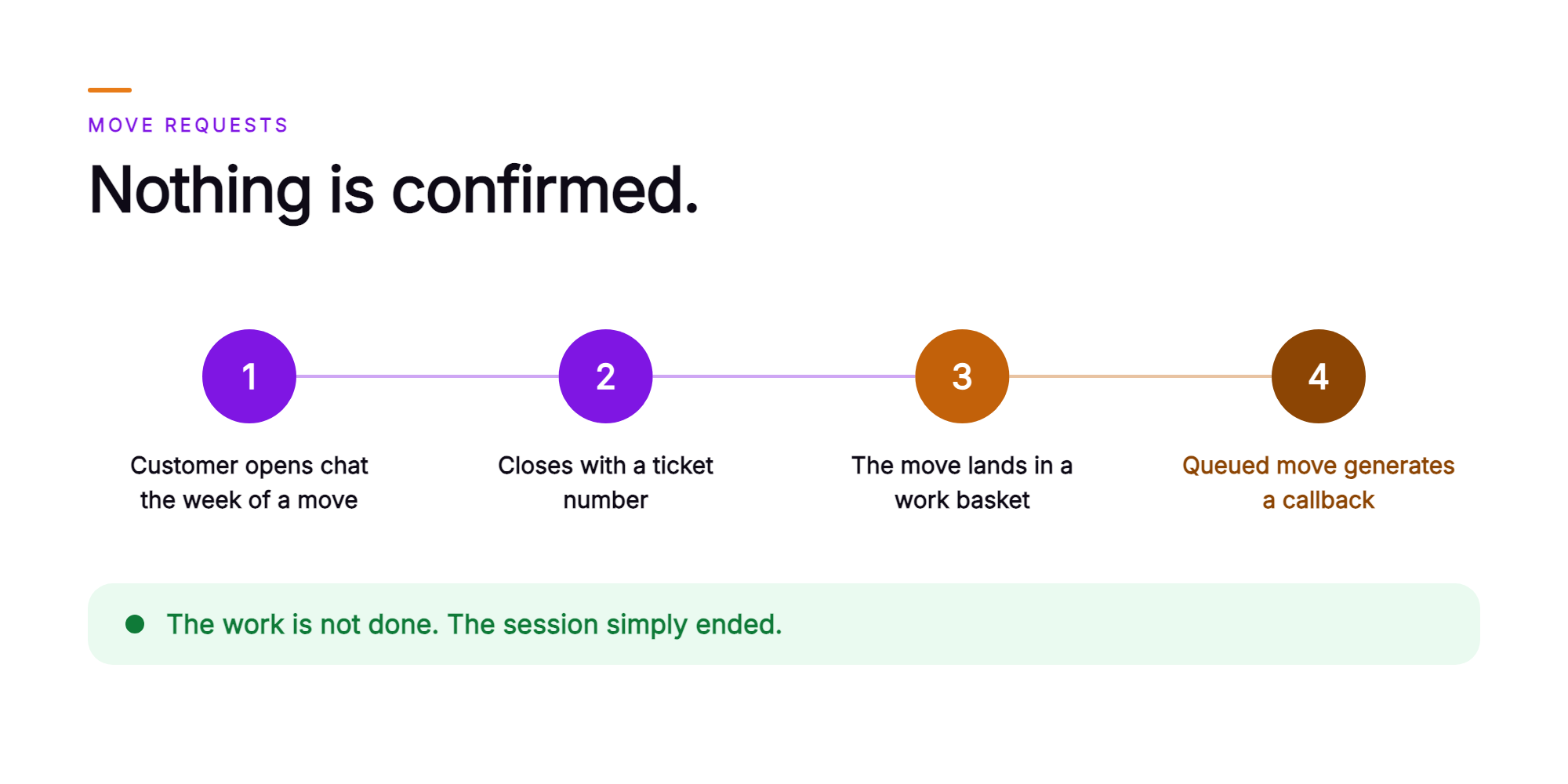
What the customer carries out of that first chat: an uncertain connect date, no written confirmation, and the knowledge that they will have to call again. The work is not done. The session simply ended.
What does start, stop and transfer in chat mean for a utility?
The AI agent start-stop service workflow manages every residential and small commercial move request that the utility allows a rep to complete in a single contact, now taken through to confirmation within the same chat session.
A start is a new service connection at a premise the customer is moving into. A stop closes service at the address they are leaving, with a final meter read scheduled at disconnect. A transfer combines both, opening service at the new address and closing it at the old one in the same session. Electric, gas, and water service at the same premise each carry their own lead times, and each service line must be scheduled within those windows before the session ends.
Every one of those three request shapes has to clear the same four steps to be complete. The AI agent must validate the premise and its service point, resolve the deposit step under the utility's credit rules, confirm the connect or final-read date within available order lead times, and send written confirmation to the customer before the chat closes. Skip any one of those steps and the request is deferred.
The scope matters because it defines what success looks like. The residential and small commercial moves the utility already authorizes a rep to complete in one contact are the moves the AI agent can own. That boundary sets the floor for the next question: what exactly does the agent do inside the customer information system to clear all four steps?
What does the agentic AI agent do inside the CIS during the move?
The automated utility account move process follows a defined sequence of CIS operations, executed by the AI agent before the chat closes.
The sequence is fixed. The agent verifies the customer's identity against the account record, locates the premise and service point in the customer information system, and confirms the meter and read status before touching any order. Those three steps establish that the agent is working on the correct account, at the correct location, with a meter that is ready to receive an order.
From there, the agent schedules the connect or disconnect date within the utility's available order lead times, creates the service order in the CIS, and sends written confirmation inside the same chat session. The service order exists in the system and the written confirmation has been delivered before the chat closes.
Every reply is grounded in the utility's approved knowledge base and the customer's live account record. A governed orchestration layer sits above the models, which means the utility can adopt newer foundation models while the business logic that controls each step stays in place. That separation keeps the deposit rules, the lead-time logic, and the confirmation language under the utility's direct control regardless of what model runs underneath.
The next section shows what that sequence looks like in a real transfer, one renter, two service orders, and one chat session.
How does a transfer play out in one chat session?
A renter moving across the service territory on a Friday afternoon completes a full transfer, two service orders, one deposit calculation, and one scheduling conflict resolved, start to finish in the chat window.
The session begins with identity verification. The AI agent confirms the account holder's name, service address, and a secondary credential against the live CIS record before any order is touched. That step is mandatory. It runs on SOC 2 compliant AI for utility contact centers. Orvera AI is SOC 2 Type II certified, and the verification exchange is part of the auditable record of this session.
With identity cleared, the agent locates the old premise and sets the stop. The customer provides the move-out date. The agent schedules the final read within available lead times and confirms the date in the chat before moving to the new address.
The new premise validation surfaces a wrinkle. The prior occupant's disconnect order is still pending, and the scheduled final read falls two days after the customer's requested connect date. The agent addresses that conflict. It sets the new connect date after the pending final read, states the reason plainly, and asks the customer to confirm the adjusted date. One exchange, and the agent settles it on the spot.
Both service orders are created in the CIS while the customer remains in the chat. When the session closes, the customer holds written confirmation with both order numbers, the final read date at the old address, and the confirmed connect date at the new one. The work is done. Under the utility's own credit rules, the deposit is assessed and recorded against the account before the connect date is set, and it is reflected in that same confirmation.
The next section examines which rules the utility retains full ownership of and what actions the agent executes.
Which rules stay with the utility and which actions does the agent take?
The utility's own deposit, credit, and scheduling policies decide every outcome in agentic AI utility customer service. The agent executes what those policies say.
That distinction matters. The agent does not interpret rules or exercise discretion. It reads the policy, runs the defined logic, and returns a result the customer can act on inside the same chat session. The utility retains full ownership of every rule that governs how a move request resolves.
In practice, the pairing of rule to action is as follows:
- Deposit policy. The utility's policy determines the amount. The agent applies the calculation and explains the result to the customer in plain language.
- Credit check. The utility's existing credit check runs. The agent reads the outcome and proceeds or routes accordingly.
- Landlord and continuous-service agreements. The agent recognizes these account flags and honors the terms attached to them.
- Connect-date lead times. The agent schedules the service order within the available windows the utility's work-order system returns.
- Identity verification standard. The agent enforces the utility's defined verification requirement before any account action runs.
- Life-support and medical-necessity flags. The agent routes the customer to a human rep immediately, with full context attached.
When a rule marks an outcome for review rather than automated resolution, the agent keeps the session moving while the case sits open. It transfers to a human rep and passes the verified identity, the account record, and every step already completed. The rep picks up from there with that context in hand.
A stop-only request follows the same governed path. A customer leaving the service territory confirms their identity, states the vacate date, and provides a forwarding address for the final bill. The agent schedules the final read within the utility's available order lead times, captures the forwarding address, and sends written confirmation with the order number before the session closes. That single contact completes the stop.
The policy boundary is what makes that outcome repeatable. When the next section addresses who builds and runs this for the utility, that question of governance stays central.
Why would a utility want the platform built and run for it?
Orvera AI builds, deploys, and runs the agentic AI platform on the utility's behalf, and full enterprise deployment lands in three to six weeks.
That timeline matters to an operations leader who needs the change live inside a single budget cycle. The platform connects to the CIS, billing system, and work-order platform the utility already runs. More than 500 integrations are available across the categories a contact center depends on, which means the utility goes live on its existing stack.
The operational heritage behind the platform is over 18 years of contact center floor experience. That history shapes how the agent is configured: as a working queue that escalates on the same triggers a staffed shift uses. The AI agent handoff for complex utility transfers is designed with that same floor logic. When a request crosses a complexity threshold the policy does not authorize the agent to complete, the handoff carries the customer's verified identity, confirmed premise, and current account state to the human rep. The customer answers each question once. The rep picks up where the agent stopped.
Auto QA audits every conversation across every channel. Human-handled contacts and AI-handled contacts are scored against the same standard. Coverage is complete. The platform holds SOC 2 Type II certification, and each interaction produces a full conversation summary and transcript for the utility's compliance team.
The four measures that confirm this is working in the utility's own queue are the subject of the next section.
Which numbers tell the operations leader it is working?
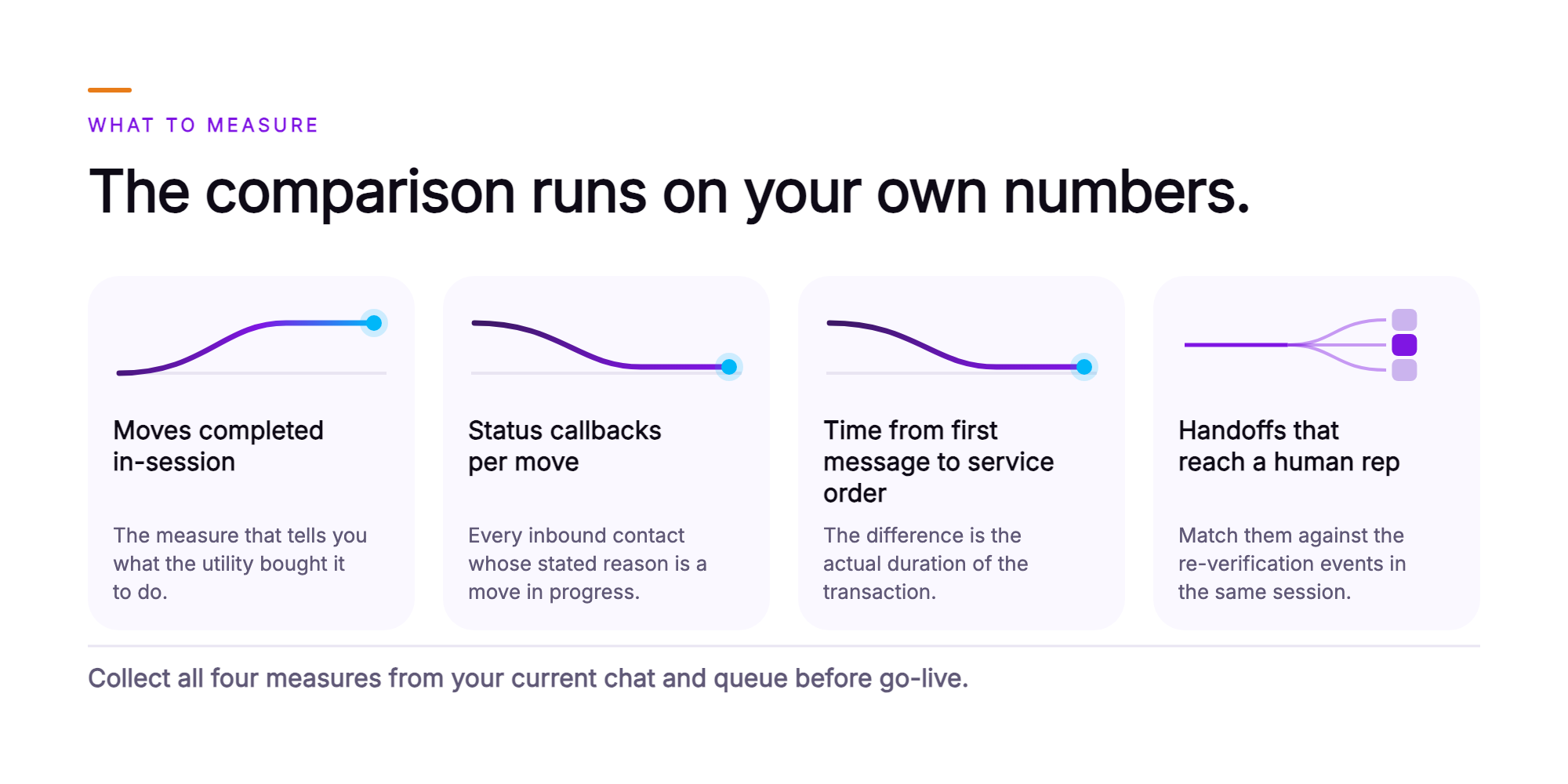
Moves completed in-session is the measure that tells you whether the use case is doing what the utility bought it to do.
Pull it from your CIS and your conversation logs. A session counts only when every step the request requires, each service order and the deposit rule among them, carries the same timestamp block and the same session ID. No callback, no follow-up queue entry, no second contact. That count is the floor of the whole evaluation.
Three more measures sit alongside it.
- Status callbacks per move. Count every inbound contact where the stated reason is a move in progress. Before go-live, that number represents the gap between a session that ended and a session that resolved. After go-live, track the same count for AI-handled contacts against that baseline.
- Time from first message to service order in the CIS. Your CIS timestamps the order creation. Your conversation logs timestamp the first message. The difference is the actual duration of the transaction, and you can compute it from those two systems alone.
- Handoffs that reach a human rep with identity, premise, and account state already attached. Pull these from your conversation logs and match them against the re-verification events in the same session. A handoff that carries no re-collection event is a complete handoff.
Collect all four measures from your current chat and queue before go-live. The comparison runs on your own numbers. The next section turns to what you carry into the leadership conversation.
What does the operations leader take to the leadership team?
Four facts about the utility's operation after go-live, each one specific enough to read aloud in a leadership review.
- The move finishes inside the chat session. The service order writes to the CIS, deposit instructions reflect the utility's own credit rules, and written confirmation reaches the customer before the session closes. One contact completes the move. The customer's next call to the utility is a new request.
- Every outcome is decided by the utility's own policies. Deposit thresholds, connect-date lead times, and credit assessment logic stay under the utility's direct control. The agent applies those rules. It does not interpret them or exercise discretion.
- Full deployment runs in three to six weeks. Orvera AI builds, deploys, and runs the agent. The platform connects to the utility's CIS and existing contact center stack, and that integration work completes within the same timeline.
- Every conversation is logged and audited. AI-handled contacts and human-handled contacts are scored against the same standard. Coverage is complete. The record of each move, including the identity verification step and the CIS write, exists inside a SOC 2 Type II certified security framework the utility's compliance team can verify directly.
What that record looks like from the customer's side, and what moving-season volume looks like when the channel finishes the work, is the subject of the final section.
What does the move look like once the agent runs it?
Utility service transfer automation AI hands the customer a confirmed service order, a connect date, and written confirmation, all before the chat window closes.
The subscriber starts a transfer on a Friday afternoon, answers identity and premise questions once, and reads a confirmation with an order number and a move-in date before logging off. The customer can plan the rest of the move around that date. The work is done inside the session. When moving-season volume peaks and a hundred transfers arrive in the same window, the channel completes every move the utility's rules clear for automated resolution and hands the rest to a rep while the customer is still in the chat.
On the operations side, the queue shrinks where it has historically swelled. Status callbacks drop because the customer already holds the confirmation. Every conversation is logged, scored, and audited against the same standard your human reps are held to. The record of the identity verification step and the CIS write is available in full to the compliance team, on a platform that is SOC 2 Type II certified.
Before the build begins, the team maps the utility's own deposit rules, credit criteria, and CIS workflow. Those rules do not change. The AI agent executes inside them. The utility retains ownership of every policy decision, and Orvera AI carries the build, the deployment, and the run.
Talk to the team at orvera.ai/contact-us (opens in a new tab) to start that mapping conversation.
Frequently asked questions
AI agent utility service transfer automation covers the full session: identity verification, premise validation against the CIS, the deposit step per your rules, the connect or final-read date, the service order, and written confirmation, all before the chat closes. The agent reads the premise and account record in the CIS during the session and writes the service order before the conversation ends. The order exists in your system of record the moment it is created, the same record your representatives work from. Your utility's own policies define the boundary. What the agent completes on its own is exactly what your rules allow, nothing beyond them.
The utility's own deposit and credit policy decides every outcome. The AI agent reads the credit result and explains it to the customer inside the same session, handling every step in between. The credit check runs through your existing system. The agent reads the result, presents the finding to the customer in plain language, and moves to the next step the policy requires. For enterprise AI agent platform for regulated energy markets deployments, Orvera configures that policy boundary from your own written rules before the platform goes live. When a deposit is required, the agent presents the amount and walks the customer through your existing payment step within the session. The agent sets the connect date before the chat closes, in the order your deposit policy requires. An outcome your policy marks for review moves forward the moment it is flagged. The session transfers to a human representative with the full account context attached, so the move resumes from the last confirmed step. The next section covers exactly when that transfer triggers and what the representative receives.
An automated utility start stop service chat workflow transfers to a human representative the moment the session reaches a condition your policies mark as outside AI-handled resolution. Triggers that move the session include these four: - Identity verification fails. The agent cannot confirm the caller against the account record and stops there. - The premise record carries a conflict. A disputed meter reading, an active investigation, or any flag your rules mark for manual review stops the automated workflow at that step. - A life-support or medical-necessity flag is present. Those accounts route to a representative immediately. - The customer asks for a person. That request is honored on the spot. In each case, the representative receives the transcript, the verified identity, the premise lookup result, and the exact step the move reached. Everything the customer already answered arrives with the transfer. The representative picks up from the same point in the workflow. Agent Assist then supports the representative through the remaining steps, surfacing approved knowledge and next-best actions in real time. Every subsequent exchange is captured, a point the next section addresses in full.
Every start, stop, or transfer conversation produces a transcript, a session summary, and a report log. Auto QA then scores that conversation, whether an AI agent completed it or a human representative did, across every channel. A supervisor reviewing a specific move can access the identity verification result, the rule applied at the deposit step, the connect date set, and the written confirmation sent to the customer. Each item is captured as the session runs. The platform writes the record itself, and it exists in full. That audit coverage extends across every channel Orvera runs, so any move a supervisor pulls has a scored record behind it. For utility operations leaders evaluating SOC 2 compliant AI for energy providers, the platform carries SOC 2 Type II certification. Every record is auditable, and the audit trail covers the complete session from the first verification step to the final confirmation sent. The service order the platform creates sits in your CIS, the system your team works in every day. The next section covers how the platform connects to the CIS, billing, and work-order systems your utility already runs.
Governed AI coordination for utility account management works because the agent connects directly to the systems your team already uses, reading and writing the same account records your representatives work from. Orvera supports 500+ enterprise system integrations, and the utility deployment covers every system a move touches: the CIS, billing, and work-order platforms. During a session, the agent reads the premise and account in real time, creates the service order on confirmation, records the deposit step against the account, and sends the written confirmation to the customer in the channel where the conversation happened. The order the agent creates is the order of record. Orvera builds, deploys, and runs the integration itself. The next section covers what that build and deployment process looks like for a utility operation.
Orvera builds, deploys, and runs the agent for your utility operation, and full enterprise deployment lands in three to six weeks. The build follows a defined sequence. Orvera maps your move rules, deposit policy, and CIS workflow first. Integration and configuration run next, connecting the agent to the systems the prior sections described. Testing runs against real move scenarios drawn from your own call drivers, including the premise conflicts and connect-date exceptions a representative handles today. Go-live puts Orvera on the operation, running the session from first verification to final confirmation. What are the security risks of AI in utility account transfers? That question is addressed in the testing phase. Data paths, escalation triggers, and identity verification steps follow your security rules, and each one is tested before the first live session opens. Enablement runs alongside the build and spans onboarding, knowledge-base setup, representative coaching and support, and change management. Orvera carries over 18 years of contact center operations into that work. Your team reads results on day one. Orvera stands up the infrastructure and runs it.

Written by
Anindita Majumder
Anindita Majumder is a communications professional with nearly four years of experience in public relations, corporate communications, and journalism. She creates content that helps brands communicate their vision, products, and expertise through press releases, thought leadership, and editorial pieces. Outside of work, she is a vocalist, which keeps her creativity flowing.


