How Much Does a Virtual Receptionist Cost in 2026?
Advances in voice automation have also shifted pricing from labor-based staffing to usage-based efficiency. As a result...

Key highlights
TL;DR — Virtual Receptionist Pricings in a Nutshell
- Virtual receptionist pricing varies widely based on call volume, coverage hours, interaction complexity, and whether humans, AI, or a hybrid model handles calls.
- Typical monthly costs range from $50–$500 for AI solutions, $150–$1,200 for hybrid services, and $200–$2,000+ for live human receptionists.
- Pricing is often driven by call handling time rather than call count, making average call duration a key cost factor.
- Common billing structures include flat-rate plans, per-minute billing, per-call pricing, tiered packages, and hybrid base fee + usage models.
- Costs increase with after-hours coverage, complex workflows (scheduling, lead capture), multilingual support, and CRM integrations.
- Hidden fees may include setup costs, overage charges, feature add-ons, peak-time surcharges, and contract termination rules.
- AI-powered reception can improve responsiveness and lead capture while reducing missed calls and scaling without increases in staffing.
- Businesses that estimate call minutes, understand pricing models, and evaluate hidden costs can better control spend while improving customer experience.
In 2026, virtual receptionist costs vary widely based on coverage hours, call complexity, and whether humans, AI, or a hybrid model handles calls. While these services may seem simple, modern solutions range from basic message-taking to fully managed workflows, including scheduling, lead capture, and CRM updates, with each capability affecting pricing.
Advances in voice automation have also shifted pricing from labor-based staffing to usage-based efficiency. As a result, businesses must evaluate call volume, call duration, service hours, and interaction complexity rather than relying on monthly fees alone. The type of calls handled, not just the number, ultimately determines the total virtual receptionist cost.
Modern AI reception solutions can also change the economics of call handling altogether. Across Orvera customers, first-contact resolution runs around 80 percent, depending on workflow design, with a 65 to 90 percent reduction in cost per call compared with a fully human-staffed reception.
Businesses can lose significant revenue opportunities due to unanswered calls, particularly in service-driven sectors such as healthcare, home services, and professional consulting. McKinsey reports that businesses using automated customer engagement (like virtual receptionists) see a 10% to 15% increase in revenue due to better lead capture and faster response times. (opens in a new tab)
This guide explains how virtual receptionist pricing works in 2026, what factors influence total cost, and how to compare AI and human services based on real business needs.
What Is a Virtual Receptionist?
A virtual receptionist is a service that answers incoming calls and performs front-desk communication tasks without requiring an in-house receptionist.
These services act as the first point of contact for callers, ensuring inquiries are handled promptly and routed appropriately.
Depending on the provider, virtual receptionist services may be delivered through:
- Live human receptionists working remotely
- AI-powered voice assistants capable of handling structured conversations
- Hybrid models combining automation with human escalation
Typical responsibilities include:
- Greeting callers professionally
- Routing calls to the correct department or individual
- Taking and delivering messages
- Scheduling appointments
- Capturing lead information
- Answering common questions
- Handling after-hours inquiries
More advanced solutions can integrate with CRM platforms, scheduling systems, and helpdesk tools, allowing interactions to trigger workflows, update customer records, and reduce manual data entry.
For example:
- A healthcare practice can schedule patient visits automatically
- A real estate agency can capture and qualify buyer inquiries
- A service provider can route emergency calls immediately
Virtual receptionists are often compared with auto-attendants or IVR systems. However, modern solutions go beyond menu-based routing by enabling conversational interactions and task completion.
How Much Does a Virtual Receptionist Cost on Average?
Virtual receptionist pricing varies widely based on service model, call volume, and feature requirements.
Typical monthly cost ranges in 2026
AI-powered receptionists
- $50 to $500 per month
- Usage-based billing common
- Scalable for high-volume environments
Hybrid AI + human services
- $150 to $1,200 per month
- Automation handles routine calls
- Human agents manage complex conversations
Live human receptionist services
- $200 to $2,000+ per month
- Priced by minutes or call volume
- Premium pricing for 24/7 availability
These ranges typically include call answering, routing, and message capture. Additional capabilities such as appointment scheduling, CRM integration, bilingual support, or lead qualification may increase pricing.
While entry-level plans may appear affordable, total costs can rise quickly as usage increases. Billing structures often tie costs to call duration, transfers, and service hours. For organizations with growing call volume, what begins as a low monthly fee can scale into a significantly higher phone answering service cost.
For instance:
- Longer calls increase billable minutes
- After-hours coverage often carries higher rates
- Frequent transfers extend handling time
- Complex interactions require additional service tiers
Organizations that receive high call volumes or handle complex inquiries should evaluate scalability and overage pricing before selecting a provider.
Book a demo and see how Orvera customers cut cost per call by 65 to 90 percent
How Virtual Receptionist Pricing Works
Most providers structure pricing around usage, service scope, and add-on capabilities rather than a single fixed fee.
Billing commonly considers:
- Total call handling time
- Number of calls answered
- Service hours and coverage windows
- Complexity of call handling workflows
- Additional features and integrations
Because usage directly influences cost, estimating monthly call minutes is one of the most effective ways to choose the right service tier.
For example:
- 80 short calls may cost less than 30 long consultations
- Routing across multiple departments can increase handling time
- After-hours calls may incur premium rates
- Multilingual support may require specialized staffing or AI models
Organizations that analyze call patterns before selecting a service are more likely to avoid unexpected charges and ensure the chosen solution aligns with operational needs.
If you are looking to cut avoidable call demand and handle inquiries more efficiently, our guide on 8 Effective Call Reduction Strategies for Contact Centers in 2026 (opens in a new tab) outlines practical, real-world ways to do it.
Virtual Receptionist Pricing Models: Which One Fits Your Business?
Virtual receptionist services use different billing structures to accommodate varying call volumes, service complexity, and coverage requirements. Understanding these virtual receptionist pricing models helps businesses align costs with actual usage and avoid paying for unused capacity.
Each model offers advantages depending on call patterns, service hours, and interaction complexity.
Flat-Rate (Subscription) Pricing
A flat rate virtual receptionist plan charges a predictable monthly fee that includes a set number of minutes, calls, or features.
This model works best for organizations with steady call volume and predictable service needs.
Advantages:
- Predictable monthly budgeting
- Simplified billing
- Often includes essential features
Considerations:
- Unused minutes may not roll over
- Overages apply once limits are exceeded
Businesses with consistent daily call patterns often benefit from flat-rate pricing because it provides cost stability.
Pay-by-Minute Pricing
Under a pay-per-minute virtual receptionist structure, billing is based on total call handling time.
This model is suitable for organizations with lower call volume or short interactions.
Advantages:
- Pay only for usage
- Ideal for seasonal or fluctuating demand
Considerations:
- Long conversations increase costs
- Transfers and hold times may be billable
- Complex calls can quickly raise monthly spend
Because minutes accumulate quickly, businesses handling detailed inquiries should estimate average call duration before choosing this model.
Pay-by-Call Pricing
Per-call billing charges a fixed fee for each answered call, regardless of length.
This approach works best when interactions are short and structured.
Advantages:
- Simple cost tracking
- Predictable per-interaction pricing
Considerations:
- Transfers may count as additional calls
- Spam or hang-ups may be billable
- Complex calls may require escalation fees
Understanding what qualifies as a billable call is essential when evaluating this model.
Tiered or Scaled Plans
Tiered plans bundle usage allowances and features into structured levels.
For example:
- Tier 1: 100 minutes
- Tier 2: 300 minutes
- Tier 3: 1,000 minutes
This model is well-suited for growing businesses that want predictable pricing with room to scale.
Advantages:
- Easier budgeting
- Discounted rates at higher tiers
- Feature upgrades at higher levels
Considerations:
- Paying for unused capacity
- Exceeding tiers triggers overages
Selecting a tier aligned with typical usage rather than peak usage helps avoid overspending.
Hybrid Pricing
Hybrid pricing combines a base monthly fee with usage-based billing.
This structure is increasingly common for businesses with fluctuating call volume.
Advantages:
- Predictable baseline cost
- Scalable usage billing
- Flexibility during demand spikes
Considerations:
- Requires usage monitoring
- Overages still apply
Hybrid models provide flexibility while maintaining cost control for organizations with seasonal or unpredictable demand.
Key Factors That Affect Virtual Receptionist Costs
Beyond pricing models, several operational factors determine total monthly spend. Understanding these cost drivers helps businesses estimate their actual bill more accurately.
Call Volume and Call Length
Total call handling time often has a greater impact on cost than the number of calls received.
For example:
- 100 one-minute calls may cost less than 25 five-minute calls
- Detailed inquiries increase handling time
- Multiple transfers extend billable minutes
Organizations should track both call volume and average duration to forecast expenses accurately.
Business Hours vs 24/7 Coverage
Coverage requirements significantly influence pricing.
Services limited to business hours are typically less expensive than 24/7 coverage.
Additional charges may apply for:
- After-hours support
- Weekends
- Holidays
- Overnight availability
Businesses that rely on emergency or after-hours inquiries often require continuous coverage, increasing total costs.
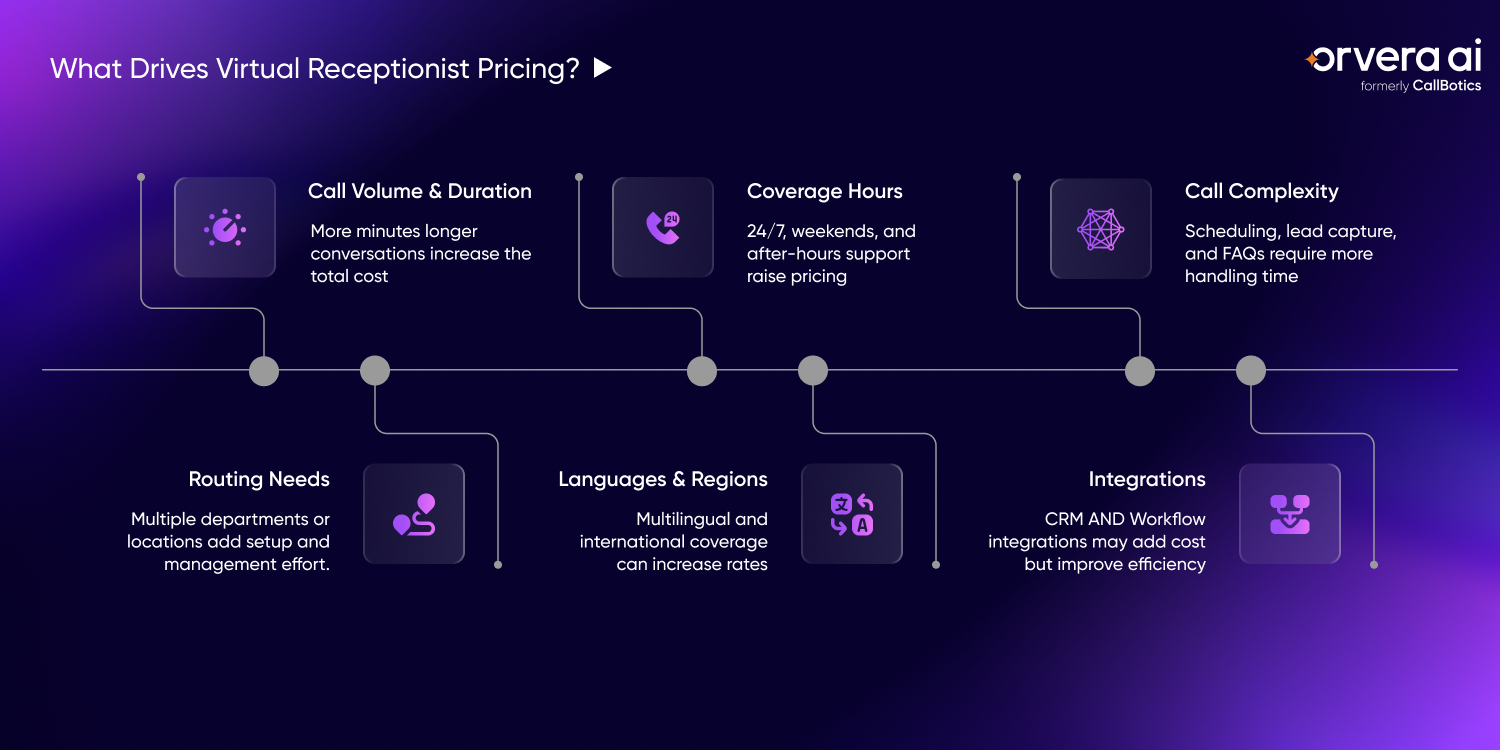
Call Handling Complexity
The type of interactions handled affects service pricing.
Basic services include:
- Message taking
- Simple transfers
Advanced handling may include:
- Appointment scheduling
- Lead qualification
- FAQ responses
- Order processing
- Troubleshooting assistance
More complex workflows increase handling time and may need specialized capabilities. Across Orvera customers, first-contact resolution runs around 80 percent on production-grade workflows, which cuts the need for human intervention.
Number of Departments and Routing Rules
Routing complexity increases setup and management requirements.
Cost may rise when services must:
- Route calls across multiple departments
- Support multiple locations
- Manage custom routing rules
- Prioritize urgent inquiries
Organizations with layered call flows should confirm whether configuration changes incur additional charges.
Languages and Regions
Multilingual support or regional coverage can increase pricing.
Costs may rise when services are provided:
- Bilingual or multilingual receptionists
- Region-specific call handling
- International coverage
Global businesses often require language coverage to maintain a consistent customer experience across markets.
Integrations and Data Sync
Integration with business systems can add cost but significantly improve operational efficiency.
Common integrations include:
- CRM platforms
- Scheduling systems
- Helpdesk tools
- Lead management systems
While integration may increase upfront costs, it reduces manual data entry and improves workflow automation.
Conversation data can also reveal process bottlenecks, recurring issues, and opportunities to resolve requests faster on the first attempt. For a deeper look at how this translates into measurable operational improvements, explore how AI voice agents improve first call resolution → (opens in a new tab)
What Most Virtual Receptionist Quotes Don’t Tell You
Pricing tables rarely reflect the full cost of a virtual receptionist service. Many organizations select a provider based on the base monthly fee, only to discover additional charges after onboarding.
Understanding common hidden costs helps prevent unexpected expenses and ensures accurate comparisons.
Setup Fees and Onboarding Costs
Some providers charge a one-time configuration fee.
These may include:
- Call flow design and scripting
- Routing setup and testing
- CRM or scheduling integration
- Training and onboarding
Setup fees can range from nominal to several hundred dollars, depending on the level of customization required.
Organizations with complex routing rules or multiple departments should confirm whether configuration changes incur additional costs.
Overages and Peak-Time Charges
Most plans include a fixed number of minutes or calls. When usage exceeds these limits, overage charges apply.
Overages are often billed at higher rates than included usage.
Peak-time surcharges may apply during:
- Seasonal spikes
- Holiday periods
- High call traffic windows
Businesses with fluctuating demand should evaluate overage rates carefully to avoid unpredictable monthly bills.
Extra Fees for Features You Assumed Were Included
Some features that appear standard may require add-ons.
These may include:
- Call recordings and storage
- Advanced analytics and reporting
- Additional phone numbers
- Appointment scheduling capabilities
- Multilingual support
- Priority routing or VIP handling
Confirming feature inclusions upfront helps prevent incremental cost creep.
Contract Terms and Cancellation Rules
Service agreements may include terms that affect the total cost.
Important considerations include:
- Minimum contract commitments
- Auto-renewal clauses
- Early termination fees
- Pricing adjustments after promotional periods
Understanding contract terms ensures flexibility if service needs change.
Things to Consider When Choosing a Virtual Receptionist Service
Selecting the right provider requires more than comparing pricing tiers. A structured evaluation helps ensure the service aligns with operational needs and customer experience expectations.
Service and Features
Evaluate what the service can handle and where limitations exist.
Key questions include:
- Can calls be transferred accurately?
- Are messages captured and delivered reliably?
- Can appointments be scheduled automatically?
- Does the service capture and qualify leads?
- Can it answer common customer questions?
Understanding capability boundaries prevents workflow gaps.
Tech, Security, and Integrations
Receptionist services often handle sensitive customer information.
Evaluate:
- CRM and scheduling integrations
- Data encryption and security protocols
- Access controls and compliance standards
- Data retention policies
Secure data handling is especially critical in healthcare, financial services, and legal industries.
Support and Flexibility
Business needs evolve. The service should adapt accordingly.
Consider:
- How quickly can scripts and routing be updated
- Availability of support for urgent changes
- Flexibility to scale during peak demand
- Responsiveness of provider support teams
Operational agility is essential for maintaining service quality.
Pricing and Contracts
Understanding billing mechanics prevents surprises.
Confirm:
- What counts as billable usage
- How overages are billed
- Which features require add-ons
- Contract duration and renewal terms
Transparent billing supports accurate budgeting and cost control.
How Orvera Helps You Control Virtual Receptionist Costs
Traditional receptionist services are priced around staffing time. As call volumes increase, costs scale linearly with labor requirements.
AI voice agents shift this model by automating routine interactions, improving coverage, and providing operational visibility into call handling performance. Built by contact center operators with 18+ years of contact-center experience, Orvera reflects real-world operational needs.
Orvera helps control virtual receptionist costs by automating call handling while providing 100% automated QA, sentiment analysis, custom dashboards, churn intelligence, live monitoring, latency tracking, and multi-tenancy oversight for complete performance visibility.
The platform enables:
- First-contact resolution around 80 percent across Orvera customers, depending on the workflow
- White-glove implementation run by the Orvera team from setup to production
- Built-in quality and analytics with real-time visibility and reporting
- Enterprise-grade compliance and governance: SOC 2 Type II certified, HIPAA compliant, GDPR compliant
- Deep workflows with advanced branching logic for complex, multi-turn conversations
- Production-ready AI voice agents live in 3 to 6 weeks without heavy engineering dependency
Orvera is designed for production-grade operations from day one. By combining deep workflow automation, rapid deployment, built-in analytics, and enterprise compliance, organizations get faster time to value and measurable resolution outcomes from one platform that Orvera builds, deploys and runs.
By transforming call handling into measurable workflows, businesses can better forecast spend, reduce missed opportunities, and optimize resource allocation.
Organizations with high call volume or repetitive inquiries often find that AI virtual receptionist cost models provide greater scalability and predictability than traditional staffing-based services.
Discover how AI voice agents reduce missed calls → (opens in a new tab)
Frequently asked questions
Costs typically range from $50 to $500 per month for AI-based services and $200 to $2,000+ per month for live receptionist coverage, depending on call volume and service scope.
AI-driven services often provide lower per-interaction costs and greater scalability, especially for high-volume environments. Human receptionists remain valuable for complex or relationship-driven interactions.
Usage-based or hybrid pricing models often provide better cost efficiency for high call volumes, particularly when automation can handle routine inquiries.
Common hidden costs include setup fees, overage charges, after-hours surcharges, feature add-ons, and contract termination fees.
Many modern services support CRM, scheduling, and helpdesk integrations, enabling automated data capture and workflow triggers.

Written by
Alex Penn
Alex Penn is a B2B SaaS writer with 3 years of experience turning complex AI topics into clear, practical content for modern businesses. She specializes in AI, automation, and emerging tech, with a knack for making technical ideas accessible without watering them down. Outside of work, Alex bakes cookies for friends and unwinds with a steady diet of indie music.