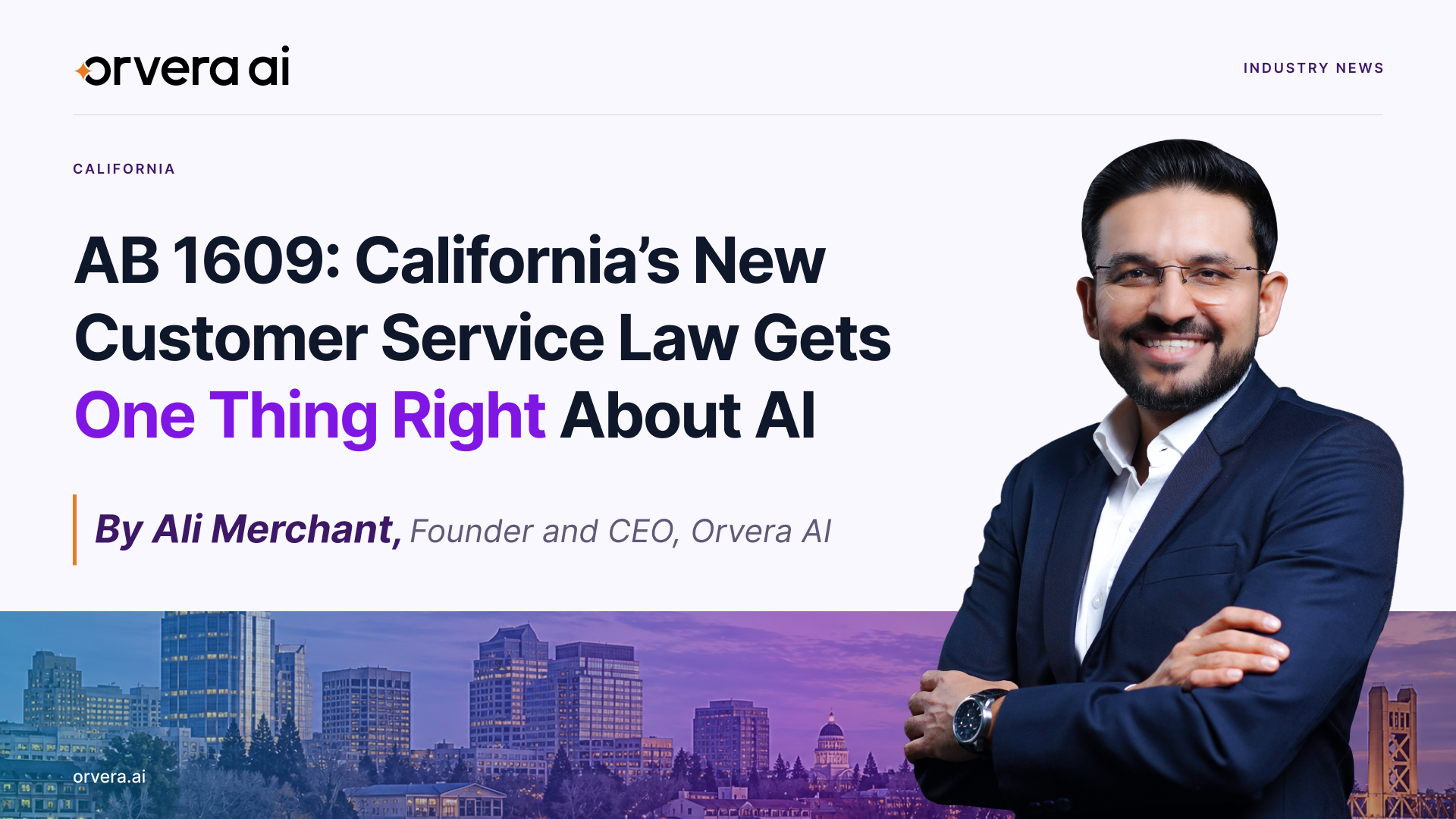
By Ali Merchant, Founder and CEO, Orvera AI
California is putting new boundaries around how large businesses use AI in customer service. On September 28, Governor Gavin Newsom signed AB 1609, which sets new requirements for companies using customer-service chatbots. Among other things, the law gives customers a clearer route to a human representative when they ask for one, requires businesses to make clear when a customer is interacting with a chatbot, and requires certain large companies to provide customer-service contact information.
The legislation arrives as AI takes on more of the work that has traditionally been handled by customer-service teams. For businesses, that raises a practical question that goes beyond whether an AI agent can answer a customer. It is about what happens when the technology cannot resolve the issue, or when the customer wants human help.
California’s new customer-service law puts into writing something good operators should already understand. Using AI should not mean making a human impossible to reach. The technology should make it easier to resolve a customer’s problem, not become another layer the customer has to fight through.
I have spent eighteen years running service and contact-center operations, and my view of AI comes from that experience. The goal is not to keep every conversation with a person, and it is not to keep every conversation with an AI agent either. The goal is to get the issue resolved. That is why I have always said, “My only north star is resolution of conversations. Deflection, we don’t consider that a result.”
A well-designed AI agent should be able to handle routine work, take actions in business systems and finish the case. But there will always be moments where confidence is low, the issue falls outside the normal path, or the customer simply wants a person. Even Orvera's own operating model treats those as handoff conditions, with context moving with the conversation instead of forcing the customer to start again.
That is why I do not see this kind of rule as a problem for companies using AI properly. The harder adjustment is for companies that treated automation mainly as a way to keep customers away from people. There is an important difference between using AI to resolve an issue and using AI to block access to the rest of the operation.
The bigger lesson is that AI should earn more responsibility as it becomes more capable, but customers should never lose a clear path to judgment when judgment is what the situation needs. As I have said before, “Just because you can do it doesn’t mean you should do it.”
About Orvera AI
Orvera AI is an agentic AI platform for enterprise customer experience that Orvera builds, deploys, and runs as a managed service. Its omnichannel AI agents resolve conversations across voice, chat, and digital channels, with deep specialization in Voice AI, while Agent Assist and AI Auto QA, at 100% coverage, support the human agents who handle the rest. Orvera is model-agnostic, orchestrating third-party models in its governed layer on the customer's existing stack, so enterprises stay on the frontier without lock-in. Full deployment lands in three to six weeks. Headquartered in San Francisco, California, Orvera serves enterprises running high-interaction-volume customer operations, and is SOC 2 Type II certified, HIPAA compliant, and GDPR compliant. For more information, visit orvera.ai (opens in a new tab).
Media Contact
Hemant Warier
Head of Marketing
Analyst Relations
Anubhav Mohanty
Chief Product Officer