10 Best Omnichannel Voice AI Platforms for Enterprise (2026)
Ten omnichannel voice AI platforms described by what each is built for, with the criteria to test them on and vendor facts checked October 5, 2026.

Key highlights
TL;DR: Best Omnichannel Voice AI Platforms for Enterprise
- True omnichannel platforms keep one shared conversation context, so AI agents remember previous interactions when a customer changes channel.
- Enterprises evaluate platforms based on context continuity, NLU accuracy, CRM integrations, compliance certifications, scalability, and how cost scales with their volume.
- The platforms reviewed here are Genesys Cloud CX, NICE CXone, PolyAI, Cognigy, Plivo, Ada, Five9, Retell AI, Bland AI and our own platform, Orvera AI, which we list last.
- Platforms differ in focus: some prioritize enterprise contact center automation, others specialize in voice-first AI, developer infrastructure, or large-scale outbound automation.
- Orvera AI fits enterprise CX operations that want one platform across AI agents, Agent Assist for human agents and Auto QA across AI-handled and human-handled conversations.
Customer interactions rarely stay on one channel anymore. A customer may start with a phone call, continue the conversation over SMS, and follow up through chat or email later in the day.
For enterprises, this shift has exposed a major limitation of traditional voice bots. Most early AI voice systems were designed for a single channel, meaning each conversation existed in isolation.
Short answer: choose an omnichannel voice AI platform by your call volume and channel mix, how well it keeps context across channels, its compliance fit, its results on your real production audio, and total cost of ownership.
The ten platforms in this guide take different approaches to that problem, from full contact center suites to developer voice APIs.
What Is an Omnichannel Voice AI Platform?
An omnichannel voice AI platform is a conversational AI system that manages customer interactions across multiple communication channels while maintaining a single shared conversation context.
This differs significantly from traditional multi-channel systems.
Multi-channel systems support several communication methods such as phone, SMS, and chat, with each interaction handled separately.
Omnichannel platforms add:
- Shared conversation memory across channels
- Unified orchestration logic
- Centralized analytics and reporting
- Smooth transitions between communication channels
For example:
A customer may call a support line, receive an SMS follow-up from the AI agent, and later resume the conversation through web chat. With an omnichannel system, the AI remembers the original issue and continues the conversation without requiring the customer to repeat details.
How We Evaluated These Platforms
The criteria below are the ones to test in a pilot. Each vendor entry describes what the platform is built for, from the vendor's own pages.
Enterprises deploying voice AI across multiple channels must evaluate conversation quality and how well a platform integrates with existing infrastructure, maintains conversation context across channels, scales under heavy load, and supports regulatory requirements.
As of October 5, 2026, we reviewed each vendor's own product, documentation and pricing pages. Any figure in a vendor entry, such as a country count, is dated and taken from that vendor's own site. Where a vendor publishes no figure, we describe the product without one.
Orvera AI publishes this guide. We list our own platform last and label it, so you can weigh it alongside the others.
Omnichannel Coverage
True omnichannel platforms support multiple communication channels through one unified architecture.
Check whether a platform can operate across channels such as:
- Voice calls
- SMS messaging
- Web chat
- Messaging apps
- Social platforms
This guide describes how each vendor presents its channels. Check whether those channels run through a single orchestration layer or exist as separate modules. Platforms that treat each channel independently often struggle to maintain continuity when customers move between channels.
Strong omnichannel platforms allow organizations to manage customer conversations consistently across voice, messaging, and digital channels without fragmentation.
Context Retention
Maintaining context across channels is one of the defining characteristics of a true omnichannel AI platform.
Check whether a system can preserve:
- Conversation history
- Customer identity
- Previous requests
- Workflow progress
When context retention works properly, a customer can begin an interaction through a phone call and continue the conversation later through SMS or chat without repeating information.
Platforms that fail to maintain context often create fragmented customer experiences and reduce the effectiveness of automation.
NLU Accuracy
Natural language understanding (NLU) determines how accurately a system interprets customer intent and manages conversational complexity.
Ask how each vendor handles:
- Multi-step customer requests
- Ambiguous language
- Interruptions during conversations
- Conversational context shifts
Enterprise environments require systems capable of handling long conversations, changing topics, and resolving requests without constant human intervention.
High NLU accuracy reduces misrouting, improves automation success rates, and increases customer satisfaction.
CRM Integrations
Enterprise customer interactions rarely occur in isolation. Most workflows depend on backend systems such as CRM platforms, ticketing tools, billing systems, and order databases.
Check connectors for the enterprise systems you run, including:
- CRM platforms such as Salesforce and HubSpot
- Helpdesk tools
- Customer data platforms
- Order management systems
- Payment systems
Strong integrations allow AI agents to retrieve customer information, update records, and trigger automated workflows during conversations.
Platforms lacking deep integrations often require additional engineering effort or limit the automation's ability to complete real tasks.
Compliance And Security
Enterprise deployments must meet strict security and regulatory standards.
Check the certifications and security controls your industry requires, including:
- SOC 2
- HIPAA
- GDPR
- Enterprise encryption standards
- Access control and audit logging
Compliance support is especially important for organizations operating in regulated industries such as healthcare, financial services, and insurance.
Platforms designed for enterprise environments typically include built-in governance features that support secure deployment and auditing.
Scalability And Performance
Contact center operations often involve thousands of simultaneous interactions across multiple channels.
Test whether a platform can handle:
- High call concurrency
- Large message volumes
- Real-time response requirements
- Consistent performance during peak demand periods
Ask for concurrency and latency figures from a production customer at your volume.
Commercial Structure
Commercial terms change often. Ask each vendor how cost scales with your volume, channels and integrations.
Enterprise buyers typically look for pricing models that provide predictable operational costs while allowing automation to scale over time.
Common commercial structures in this category are:
- Fixed subscription licensing
- Usage-based billing
- Outcome-based pricing
- Custom enterprise contracts
Best Omnichannel Voice AI Platforms for Enterprise
Enterprises deploying AI-driven customer service automation are increasingly looking for platforms that can manage conversations across multiple communication channels while maintaining consistent context.
The platforms below are built for enterprise teams implementing omnichannel voice AI automation across voice, SMS, chat, and messaging environments.
Each platform offers different strengths depending on operational priorities such as voice quality, automation depth, infrastructure scalability, or developer flexibility.
1. Genesys Cloud CX: Best for large-scale CCaaS with embedded voice AI
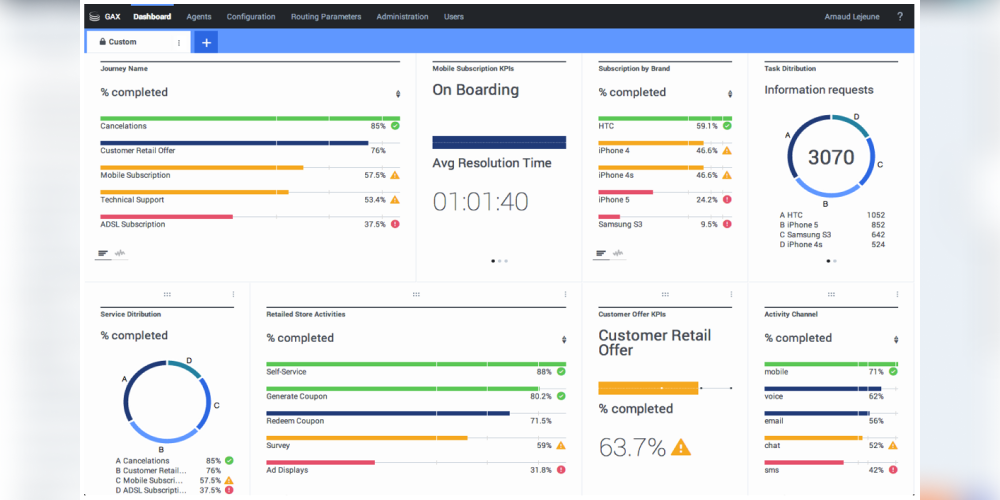
Caption: The Genesys interface displays contact center KPIs such as task completion rates, resolution times, and activity distribution across voice, chat, SMS, and email channels.
Genesys Cloud CX is a cloud contact center platform with embedded AI.
The platform offers a comprehensive CCaaS infrastructure that combines telephony services, omnichannel routing, workforce management tools, and AI-powered automation capabilities.
Genesys has built a strong ecosystem around enterprise contact center operations, making it a common choice for organizations managing complex global customer support environments.
Key capabilities include:
- AI-powered predictive routing that directs calls to the most suitable agent
- Omnichannel orchestration across voice, chat, messaging, and social channels
- Speech and text analytics for conversation insights
- Workforce engagement and scheduling tools
Genesys is often selected by enterprises to replace legacy contact center systems or to consolidate multiple support platforms into a single cloud infrastructure.
2. NICE CXone: Best for Teams Already on NICE
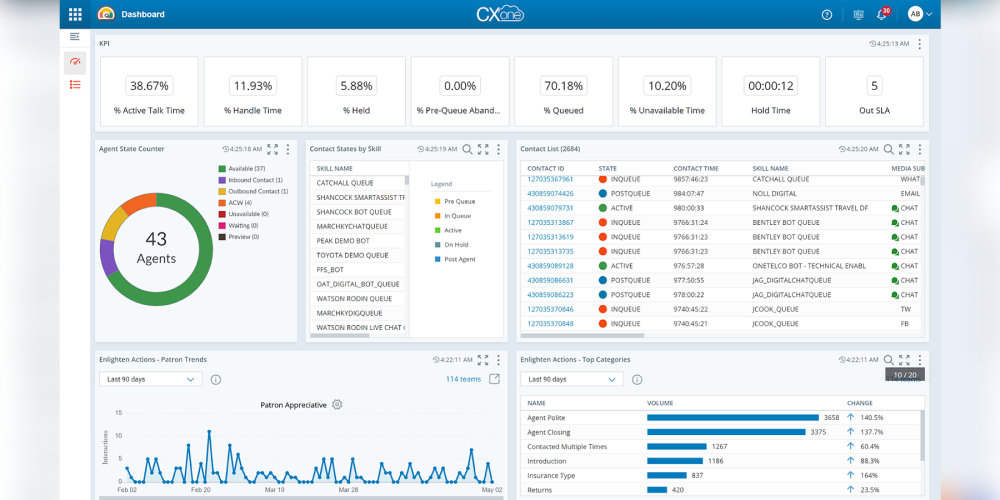
Caption: The CXone dashboard provides real-time insights into agent availability, call queues, service-level metrics, and operational performance across contact center environments.
NICE CXone is a comprehensive cloud contact center platform designed for large enterprise contact centers.
The platform combines AI-driven customer interaction tools with workforce management, analytics, and quality assurance systems.
NICE also offers its Enlighten AI suite, which provides conversational AI features and predictive analytics designed to improve customer experience and operational performance.
Key strengths include:
- Advanced analytics and real-time operational insights
- Integrated quality management and workforce optimization tools
- Strong compliance support for regulated industries
- Omnichannel engagement across voice, messaging, and digital channels
Because of its strong governance and compliance capabilities, NICE CXone fits organizations in financial services, healthcare, and insurance sectors.
3. PolyAI: Best for voice-first enterprise deployments
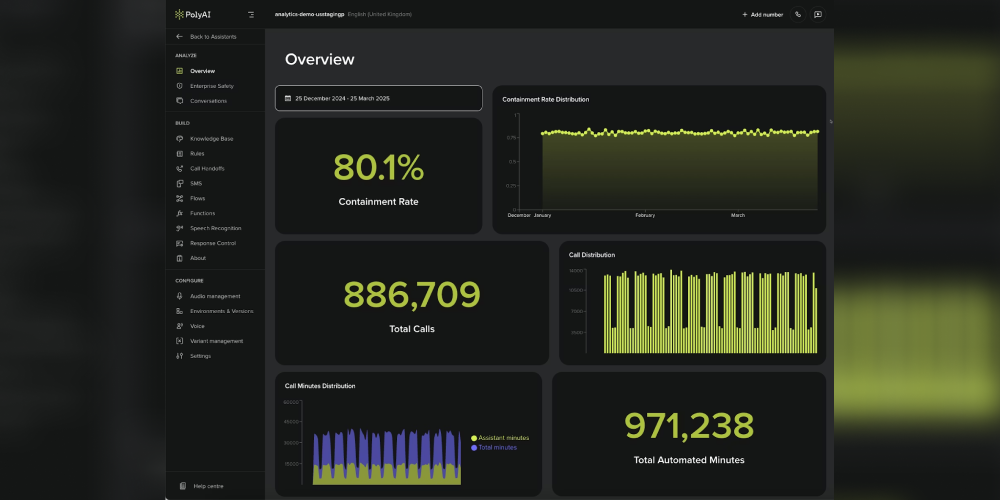
Caption: PolyAI's analytics interface tracks AI voice assistant performance, including containment rates, automated call volume, and interaction distribution over time.
PolyAI focuses specifically on building conversational AI systems designed for high-quality voice interactions.
PolyAI takes a voice-first approach, emphasizing natural speech patterns, conversational flow, and long-form interactions.
The platform builds enterprise voice assistants capable of handling complex customer service conversations while maintaining a natural and human-like speaking style.
Key strengths include:
- Highly natural conversational voice interactions
- Multilingual support for global deployments
- Enterprise implementation and optimization services
- Voice-first architecture designed for phone-based support
PolyAI fits industries where phone-based customer service remains a primary interaction channel, including telecommunications, banking, and hospitality.
4. Cognigy: Best for enterprise contact centers needing deep automation
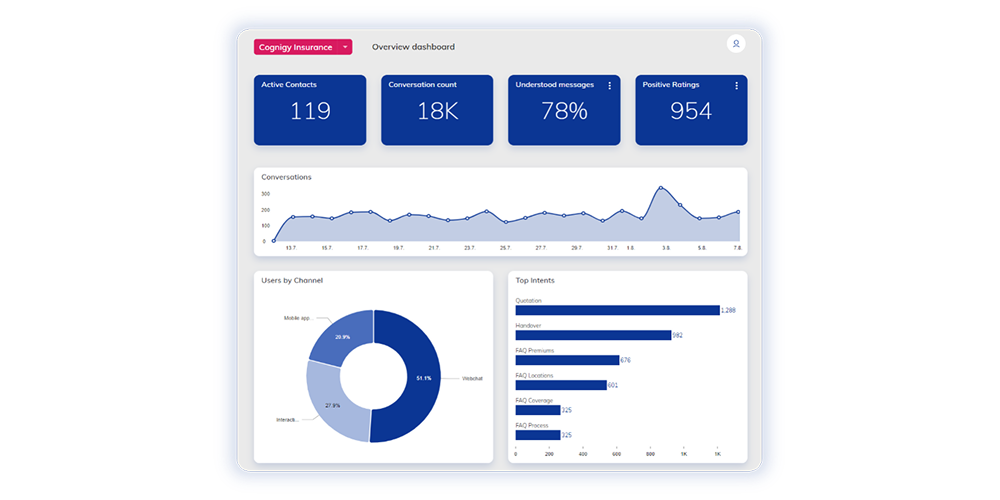
Caption: The Cognigy dashboard helps teams monitor conversational automation performance, including message understanding rates, conversation volume, and top user intents.
Cognigy is a conversational AI orchestration platform for large-scale enterprise automation. As of October 5, 2026, cognigy.com brands it NiCE Cognigy, part of NICE (opens in a new tab).
The platform provides low-code tools that allow organizations to design complex conversational workflows across voice and digital channels.
Cognigy's architecture enables organizations to integrate conversational AI directly into operational systems, allowing automation to trigger backend actions such as updating CRM records or creating support tickets.
Key strengths include:
- Complex workflow orchestration across channels
- Enterprise-grade integration capabilities
- Advanced conversation design and testing tools
- Omnichannel automation architecture
Cognigy fits enterprises running large conversational automation programs across voice and digital channels.
5. Plivo: Best for teams building AI agents on voice and messaging APIs
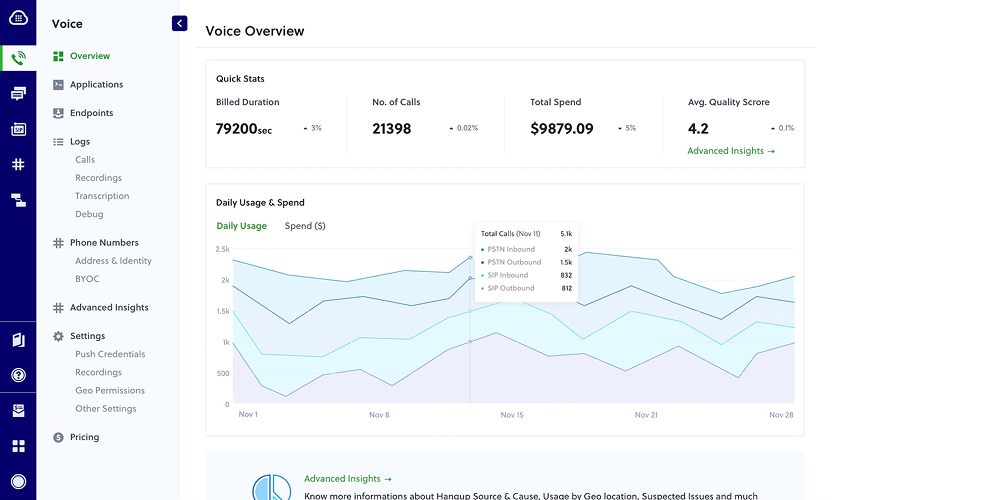
Caption: Plivo provides developer-focused insights into telephony usage, call volumes, billing duration, and voice infrastructure performance across communication channels.
Plivo provides programmable communication infrastructure supporting voice, SMS, messaging, and chat services.
As of October 5, 2026, Plivo's homepage (opens in a new tab) describes AI voice and chat agents that teams build with a no-code builder or with its developer APIs, running on Plivo's own voice, SMS and WhatsApp infrastructure.
Its global carrier connectivity and flexible APIs allow organizations to design highly customized communication workflows.
Key strengths include:
- Global telephony infrastructure and carrier connectivity
- Programmable SMS and messaging APIs
- Flexible communication workflow development tools
- As of October 5, 2026, Plivo lists voice coverage in 190+ countries (opens in a new tab) and messaging coverage in 226 countries (opens in a new tab)
Plivo is commonly used by engineering teams building communication systems for large-scale applications such as marketplaces, logistics platforms, and SaaS products.
6. Ada: Best for enterprises standardizing automation across all support channels
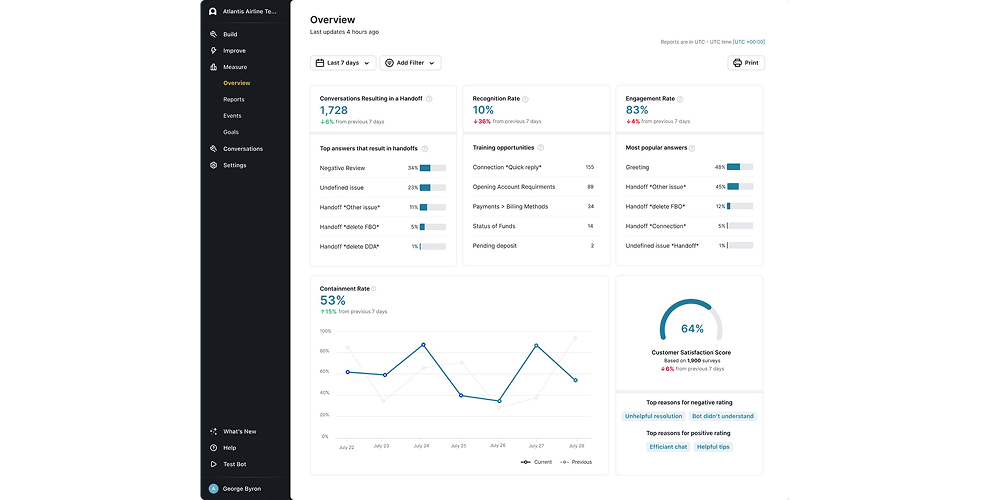
Caption: Ada's analytics dashboard highlights automation performance across support channels, including containment rate, handoff frequency, and customer experience metrics.
Ada is an AI-powered automation platform focused on improving customer support across multiple communication channels.
As of October 5, 2026, Ada's site (opens in a new tab) lists AI voice agents alongside messaging and email, run from one shared reasoning engine.
Ada's approach centers on building a centralized automation layer that integrates with knowledge bases, helpdesk tools, and support workflows.
Key strengths include:
- AI-powered customer support automation
- Multilingual conversation capabilities
- Knowledge base integrations
- Centralized automation management across channels
Ada fits organizations that want to standardize support automation across voice and digital channels from one platform.
7. Five9: Best for mid-to-enterprise teams transitioning from legacy IVR
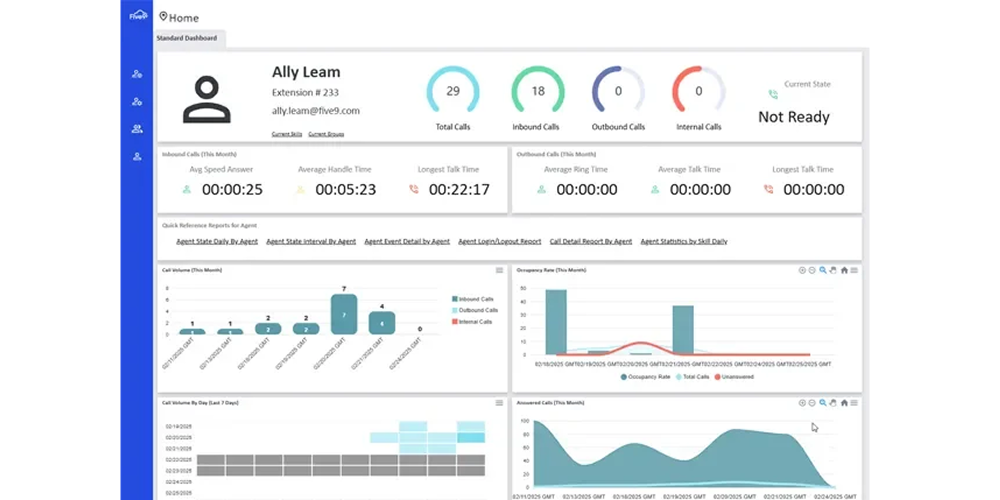
Caption: The Five9 interface displays key operational metrics such as total calls, average handle time, agent activity states, and interaction trends across support teams.
Five9 provides a cloud-based contact center platform designed to help organizations modernize legacy telephony infrastructure.
Many companies adopt Five9 as part of their transition from traditional IVR systems to cloud-based customer support environments with AI capabilities.
The platform combines telephony infrastructure with automation tools that support voice and digital customer interactions.
Key capabilities include:
- AI-powered virtual agents for handling customer inquiries
- Intelligent call routing and queue management
- Integrations with major CRM platforms
- Workforce optimization and performance analytics
Five9 is particularly useful for organizations introducing AI automation gradually while maintaining existing contact center infrastructure.
8. Retell AI: Best for teams building their own voice agents in a no-code studio or through APIs
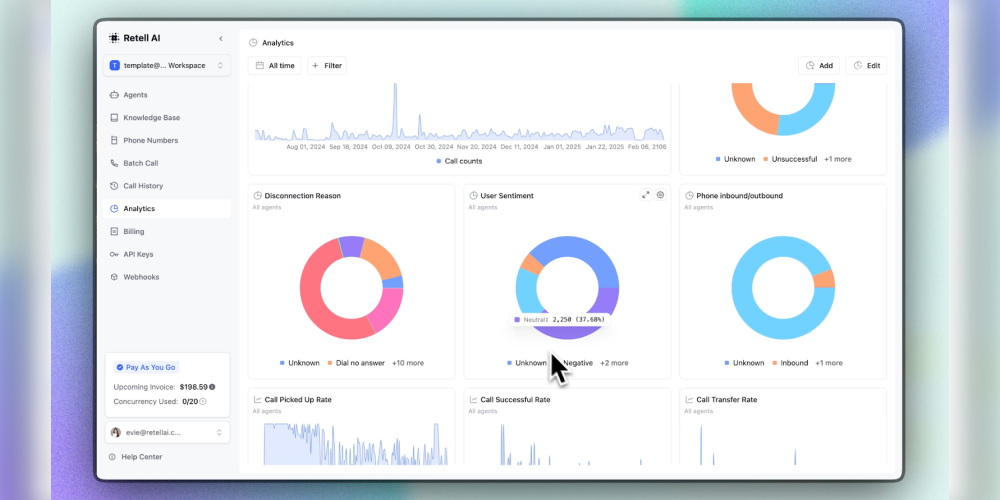
Caption: Retell AI provides visibility into automated voice interactions, including call success rates, sentiment signals, and inbound and outbound conversation activity.
As of October 5, 2026, Retell's homepage (opens in a new tab) offers an AI-powered no-code studio alongside APIs for developers.
Its APIs and SDKs give developers programmatic control across the platform, and the homepage lists voice, chat and SMS channels.
The same page lists on-premises deployment and native connectors for CRMs, calendars and telephony.
Key capabilities include:
- Programmable voice AI infrastructure
- Low-latency conversational response architecture
- Telephony and messaging integrations
- Customizable language model orchestration
Retell AI fits teams that want to build and change their own voice agents, in its no-code studio or through its APIs.
9. Bland AI: Best for teams running high-volume voice calls through an API
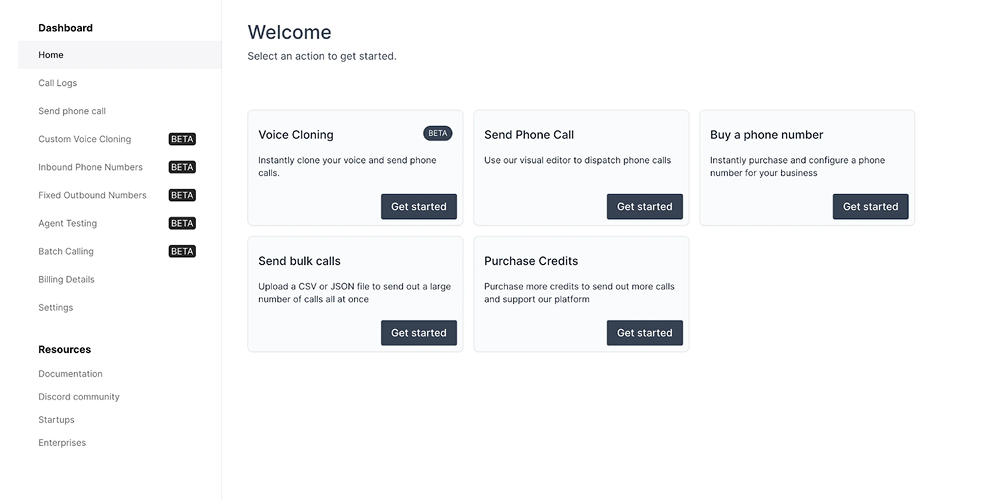
Caption: The Bland AI dashboard allows teams to manage automated calling workflows, configure voice agents, and deploy large-scale outbound call campaigns.
Bland AI supports high volumes of automated phone calls across inbound and outbound workflows. As of October 5, 2026, Bland's homepage also lists (opens in a new tab) SMS, iMessage and chat agents with unified memory across channels.
The platform is designed for organizations that require large-scale call automation, such as customer outreach campaigns, appointment reminders, or automated notifications.
Bland AI emphasizes performance and scalability, enabling organizations to manage massive call concurrency levels.
Key strengths include:
- Large-scale outbound calling infrastructure
- Conversational automation for inbound and outbound interactions
- Granular dialogue control for customizing call flows
- API-driven automation workflows
Bland AI is commonly used by organizations running large automated outreach campaigns or operating customer engagement systems requiring high call concurrency.
10. Orvera AI (our product)
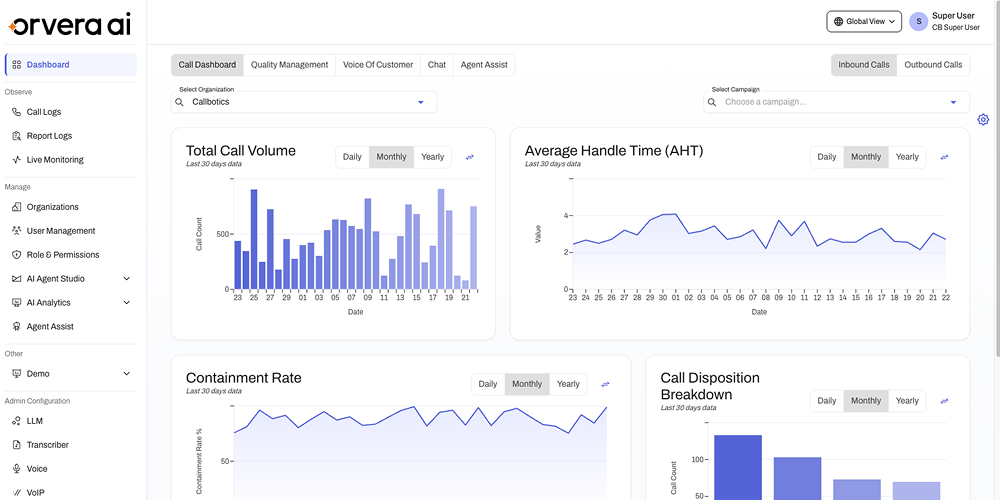
Caption: This dashboard provides operational visibility into automated conversations, including call volume trends, talk time metrics, and interaction outcomes across voice and digital channels.
Orvera AI fits enterprise CX operations that want one platform across AI agents, Agent Assist for human agents and Auto QA, on voice, chat, email, messaging and every other channel Orvera runs.
Orvera custom-trains its own contextualization models on de-identified data, and it orchestrates third-party voice and language models within a governed enterprise layer.
The platform enables organizations to deploy AI voice agents capable of resolving customer requests, capturing information, updating backend systems, and executing workflows on one architecture across voice, chat, email and messaging.
Key strengths include:
- One platform for AI agents, Agent Assist and Auto QA
- Auto QA on human-handled and AI-handled conversations, across every channel
- Listings on Salesforce AppExchange, Microsoft Marketplace and AWS Marketplace
- SOC 2 Type II certified, HIPAA compliant and GDPR compliant
- Built-in reporting with full logs, summaries and transcripts
Across Orvera's customer engagements, first-contact resolution averages roughly 80%, and average handle time falls 8 to 15% within the first 90 days. Full deployment typically takes 3 to 6 weeks. These are customer averages, and each account is modeled on its own numbers.
Further Reading
Organizations evaluating conversational automation strategies may also explore broader industry guidance, such as:
- Best Conversational AI Platforms (opens in a new tab) for understanding how different AI automation systems compare across enterprise environments.
- Best AI Voice Agents for Business (opens in a new tab) for evaluating platforms specifically designed for phone-based customer interactions.
- AI Use Cases in Contact Centers (opens in a new tab) to see how voice automation improves support workflows, resolution rates, and operational efficiency.
Conclusion
Shortlist two or three platforms and run each on your own calls, channels and systems before you sign.
The right platform is the one whose channels, context handling and integrations match your real customer interaction workflows.
Frequently asked questions
Software that runs voice, SMS, chat and messaging from one orchestration layer, so a conversation keeps its context when the customer changes channel.
CCaaS platforms provide contact center infrastructure, while omnichannel voice AI platforms focus on conversational automation and workflow execution.
Check each vendor's own SOC 2, HIPAA and GDPR statements against your industry's requirements, and ask for the audit reports during procurement.
Pricing varies widely depending on interaction volume, integrations, and deployment complexity, typically ranging from subscription licensing to usage-based automation pricing.
Yes. Most enterprise platforms integrate with CRM and helpdesk systems to retrieve customer data and update records during conversations.
As this comparison describes them, Genesys Cloud CX and NICE CXone cover voice alongside chat, messaging and other digital channels, Ada markets AI voice agents alongside messaging and email (https://www.ada.cx/platform/voice/, as of October 5, 2026), Bland AI lists voice, SMS, iMessage and chat agents with unified memory across channels (https://www.bland.ai/, as of October 5, 2026), and PolyAI leads with voice and also lists chat (https://poly.ai/, as of October 5, 2026). Compare shortlisted platforms on whether a conversation's context carries from one channel to the next, because channel count alone does not show whether a customer can move from a call to SMS without starting over.
Written by
Anindita Majumder
Anindita Majumder is a communications professional with nearly four years of experience in public relations, corporate communications, and journalism. She creates content that helps brands communicate their vision, products, and expertise through press releases, thought leadership, and editorial pieces. Outside of work, she is a vocalist, which keeps her creativity flowing.