What AI Call Center Voice Agents Do and How to Deploy Them
What AI call center voice agents do, the nine call types they resolve end to end, how to evaluate a vendor, and what breaks after go-live.

Key highlights
TL;DR —- In a Nutshell
- AI call center voice agents are differentiated in production by resolution, observability, integration depth, and how reliably they handle real-world call volume
- Unlike voicebots and IVRs, voice agents can understand open-ended speech, take actions in business systems, and complete customer tasks end to end
- The strongest use cases are high-volume, structured workflows such as billing, order management, scheduling, lead qualification, reminders, and after-hours support
- First contact resolution, repeat contact rate, and cost per resolved contact provide a more meaningful measure of voice AI performance than containment alone
- Enterprise buyers should evaluate auto-QA, escalation, integrations, scalability, security, multilingual support, and regression testing alongside voice quality and latency
- Most post-launch failures come from recognition drift, silent system writes, falling resolution, model changes, load-related latency, and compliance gaps, making continuous monitoring essential
An AI call center voice agent earns its place on the evidence it produces in production. Every platform in this category demos well, because conversation quality has converged across the serious vendors. The differences open up around week six, when real volume, unfamiliar accents, edge cases and a model update all land in the same fortnight.
The pressure to move is coming from the workforce numbers. The US Bureau of Labor Statistics projects employment of customer service representatives to fall 5 percent between 2024 and 2034 (opens in a new tab), while still expecting roughly 341,700 openings a year across the decade. Demand for the work holds steady and the pool of people available to do it keeps thinning, with attrition churning the same seats season after season. McKinsey sizes the opportunity at a 30 to 45 percent productivity gain against current customer care function costs (opens in a new tab), and estimates that generative AI could cut the volume of human-serviced contacts by up to half. Those two forces are why voice moved to the top of the contact center roadmap in 2026.
This guide works through the full evaluation. It defines the category and separates a voice agent from a voicebot and an IVR. It covers the technology, the integrations that decide what an agent can finish on its own, and the call types that repay the investment. It then turns to first contact resolution as the number worth reporting, the criteria that hold up under real load, the build and buy routes and who fits which lane, what breaks after go-live, and what deployment and return look like on a realistic timeline.
What an AI Call Center Voice Agent Is
An AI call center voice agent is software that holds a natural spoken phone conversation with a customer and completes the task end to end inside your business systems. It listens, works out intent from open speech, takes the action the caller came for, and speaks back in real time.
Four components run in sequence on every turn of the conversation.
- Automatic speech recognition converts the caller's audio into text while they are still speaking.
- A language understanding layer identifies what the caller wants and what information is still missing.
- A large language model reasons over that intent, your business rules, and live account data to decide the next action.
- Text-to-speech turns the response back into audio, with barge-in support so the caller can interrupt mid-sentence.
The whole loop closes fast enough that the caller experiences a conversation. Most of the engineering investment in call center voice AI has gone into that speed, and the serious platforms have reached the point where latency has stopped separating them.
How the category evolved
Voicebot and voice agent describe two generations of the same job. A voicebot for a call center matches speech against a defined list of intents and passes anything outside that list to a queue. A voice agent reasons over context and finishes the transaction. Knowing which generation a vendor is selling tells you what to expect before the demo starts.
| Capability | Contact center voicebot | AI call center voice agent |
|---|---|---|
| Input handling | Scripted speech matched to a defined intent list | Open conversation in the caller's own words |
| Understanding | Intent matching | Reasoning over intent, context and account history |
| Action taken | Answers and routes, with limited transactions | Completes the transaction in your systems |
| Unfamiliar requests | Passes to a human queue | Asks a clarifying question, then resolves or escalates |
| Oriented toward | Deflection | Resolution |
| Adding a language | Built per language | Configured from the same design |
| Making a change | Rebuild the flow | Update rules and knowledge |
The comparison with an IVR runs in the same direction. An IVR moves the caller through a fixed menu and routes the call to a queue, so the customer does the navigating. A voice agent understands any phrasing, completes the work, and hands over with full context when it reaches a genuine limit.
Voice is one surface of a wider category, covered in our conversational AI platform overview, and the reasoning layer that makes resolution possible is explained in agentic AI for customer service.
How They Work and What They Connect To
A voice agent is only as useful as the systems it can act inside. An agent that answers beautifully and cannot post a payment, update an address, or check an order has moved the conversation forward and left the work undone, which is the point where most disappointing deployments started. Integration depth decides how much the agent finishes on its own.
The stack behind the conversation
Four layers do the work on every call, and the vendor differences now sit in how well they are tuned to phone audio rather than in the components themselves. Poor tuning shows up as the agent mishearing an account number or talking over a caller who paused to think.
- Speech recognition needs tuning for phone-line audio, background noise, and the accents in your customer base, since generic models lose accuracy on spoken letters and digits
- The reasoning layer holds context across the call, so a caller who mentions their order number early does not get asked for it again at the end
- Speech synthesis handles pacing and interruption, letting the caller cut in mid-sentence without the agent carrying on regardless
Telephony, how the call reaches the agent
Your calls arrive over SIP trunks, a Twilio-style carrier layer, or a CCaaS platform such as Genesys, NICE, or Five9. The connection method shapes your rollout, because sitting inside an existing CCaaS stack lets you route a small share of traffic to the agent first and grow from there.
- SIP and carrier integrations suit contact centers running their own telephony and wanting direct control over call flow
- CCaaS integrations keep your existing queues, reporting, and workforce management in place while the agent handles a defined slice of volume
- Support for warm transfer matters most, since the agent should pass the caller to a human with the conversation history attached
CRM and the customer record
The best voice AI CRM integration solutions read from and write to Salesforce, HubSpot, Zendesk, or ServiceNow during the call. Read-only connections are common in demos and much weaker in production, because the record stays stale and your human agents pick up the manual updating.
- Live reads let the agent greet a known customer with their account context already loaded
- Write-backs log the call outcome, update fields, and create cases without a person retyping anything
- An audit trail on every write gives your QA and compliance teams something to inspect when a caller disputes what happened
Click-to-call, routing and business phone systems
Buyers searching for the best voice AI with click-to-call and phone routing are asking how the agent handles traffic in both directions. The best AI voice agent solutions for business phone systems sit alongside Microsoft Teams, RingCentral or Zoom Phone and take pressure off queues that back up at peak.
- Click-to-call and outbound dialing let the agent run reminders, confirmations and follow-ups without a human placing each call
- Intent-based routing sends the caller to the correct team on the first transfer, cutting the repeat explanations that drag down satisfaction scores
- Overflow handling absorbs spikes automatically, which is where the best voice AI systems for improving call management earn their keep
What AI Call Center Voice Agents Do, The Use Cases
The workflows that pay off are high volume, structured, and repeatable, with a clear definition of done. McKinsey estimates that generative AI could reduce the volume of human-serviced contacts by up to 50 percent and lift customer care productivity by 30 to 45 percent of current function costs (opens in a new tab), and that ceiling gets reached by automating a focused set of call types properly. The nine below are split across inbound demand and outbound campaigns. Each one covers the workflow, how the agent handles it end to end, the outcome worth reporting, and the failure that only continuous monitoring catches.
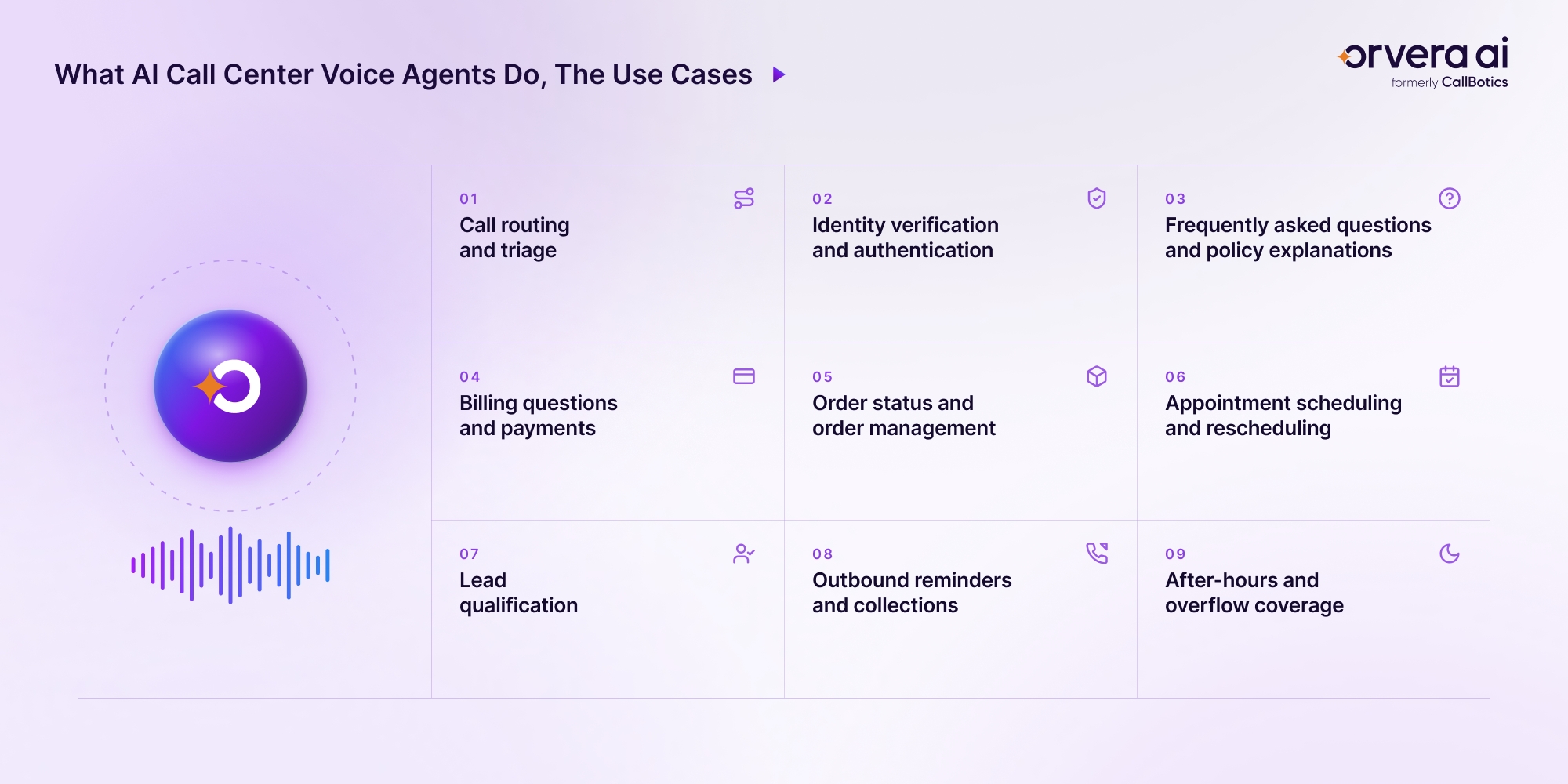
Call routing and triage
A caller explains their problem in their own words with no menu to navigate. The agent identifies the reason for the call, resolves it where it can, and transfers to the correct queue with a written summary attached. Report the share of calls reaching the right team on the first transfer. The failure to watch is confirmed misrouting, where a technical fault goes to billing and comes back as a repeat call with no error logged anywhere.
Identity verification and authentication
Callers give account numbers, dates of birth, and one-time passcodes before anything sensitive happens. The agent captures spoken letters and digits, checks them against your records, and moves an authenticated caller straight into the task. Report authentication completed without human help. The failure to watch is recognition accuracy slipping on names, postcodes, and account numbers as your caller mix shifts, which pushes people into the queue for no visible reason.
Frequently asked questions and policy explanations
Coverage, eligibility, opening hours, returns windows and process questions make up a large share of inbound volume. The agent answers from your approved knowledge base and confirms the caller has what they needed. Report informational calls closed with no follow-up contact. The watch-out is the agent answering from model knowledge after a prompt change, which becomes a compliance exposure in regulated industries.
Billing questions and payments
A customer queries a charge, wants a balance, or needs to pay. The agent reads the account, explains the charges in plain language, takes the payment, and confirms it. Report billing contacts closed without a callback. The failure to watch is the caller hearing a confirmation while the write to the billing system fails silently, which is the most expensive fault on this list.
Order status and order management
Order questions carry heavy volume in retail, logistics and ecommerce. The agent looks up the order, gives the current status and delivery window, and processes changes, cancellations and returns on the same call. Report order inquiries resolved end-to-end. The failure to watch is stale data, where the agent reports a status the fulfillment system updated minutes earlier.
Appointment scheduling and rescheduling
Bookings, moves and cancellations follow fixed rules and suit automation well. The agent checks live availability, secures the slot, and confirms by SMS or email before the call ends. Report bookings completed per hundred calls. The watch-out is double-booking under concurrency, which stays hidden until peak load arrives.
Lead qualification
Inbound inquiries and marketing responses need qualifying before a salesperson spends time on them. The agent asks your qualifying questions, books the meeting for a good fit, and passes a hot caller straight to a human. Report qualified conversations per hour of capacity. The failure to watch is an agent qualifying people out too aggressively, which looks efficient on the dashboard and starves the pipeline.
Outbound reminders and collections
Appointment reminders, renewal notices, delivery confirmations, and overdue balances go out at volume, and the agent completes the action during the call. Report completed actions per campaign against contacts attempted. The failure to watch is tone and pacing on sensitive collections calls, which sampling-based quality checks almost never surface.
After-hours and overflow coverage
Calls arriving outside staffed hours have historically gone to voicemail or an answering service. The agent takes that volume in full and absorbs unexpected daytime spikes as they happen. Report out-of-hours resolution against your previous voicemail baseline. The watch-out is escalation design, since there is no human available at 3am and the agent needs a path that still closes the loop by morning.
These workflows carry different regulatory weight by industry. Patient scheduling, eligibility checks, and clinical intake sit inside HIPAA, covered in voice AI in healthcare. Payments, disputes, and account servicing come with their own audit requirements, covered in conversational AI in financial services.
Why First Contact Resolution Is The Number That Pays
First contact resolution belongs at the top of your voice AI reporting, defined as the customer's problem being closed on the first call with no follow-up needed. A voice agent can hold a caller for four minutes, avoid a transfer, and end with the issue still open. That call gets logged as contained, and it returns as a second contact within the week.
Buyers searching for the best voice AI agents for call deflection are usually asking a resolution question in deflection language. Four numbers read together give an honest picture.
- Containment shows the share of calls handled without a human, and it climbs whenever an agent avoids escalation
- Resolution shows the share of customer problems closed, confirmed by the absence of a repeat contact on the same issue
- Repeat contact rate within seven days exposes containment that was bought with a second call
- Cost per resolved contact turns all three into the language your finance team already uses
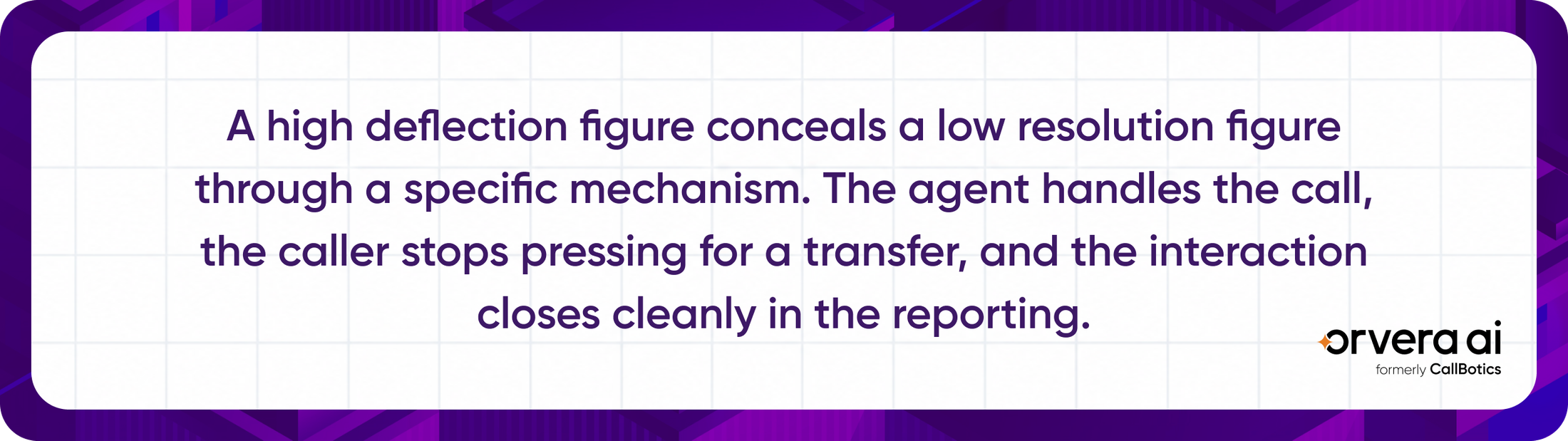
Two days later that same person rings back, and the system opens the call as fresh volume with no link to the first. Containment rises, total volume rises alongside it, and the two stay disconnected until someone matches repeat contacts back to their origin.
McKinsey frames the value of generative AI in customer care around helping resolve issues during an initial interaction (opens in a new tab), which is the mechanism every other benefit in this category depends on. Contacts avoided carry none of that, since an avoided contact and a resolved one look identical in a call log and behave differently the following week.
Pace your expectations on the timeline as well. McKinsey partners have put the practical horizon at reducing current phone volumes by 50 percent within five years, with early progress slower than many anticipated (opens in a new tab), because few organizations have deployed at a scale where the impact can be measured properly. A vendor promising that curve inside a quarter is describing the demo.
Build resolution reporting into the pilot from week one. Tie every repeat contact back to its original issue, publish resolution and containment side by side, and hold the voice agent to the standard you already apply to your human team.
How to evaluate an AI call center voice agent
In production, good is defined by what you can observe and prove on every call. Latency and voice quality tell you how a platform behaves in a controlled demo with a cooperative caller and a clean line. Observability tells you how it behaves on a Tuesday afternoon with a new model version, an accent the training data underweighted, and triple your forecast volume.
The case for putting observability at the top of the list is well evidenced. The case for putting observability at the top of the list is well evidenced. McKinsey reports that adoption inside customer care has been uneven, with some contact centers capturing value and others struggling against rising call volumes, persistent attrition, and talent shortages. McKinsey reports the same pattern inside customer care, where adoption has been uneven, with some contact centers capturing value and others struggling (opens in a new tab) against rising call volumes, persistent attrition, and talent shortages.
Traditional quality assurance is part of what goes wrong. McKinsey notes that manual QA is typically limited to less than 5 percent of total conversations, with human bias compromising the accuracy of the evaluation (opens in a new tab). Reviewing five calls in a hundred worked as a compromise when people handled every conversation, and each mistake stayed contained to a single call. An automated agent repeats the same fault across thousands of conversations before a reviewer happens to pull one of them, which moves full coverage from a reporting preference to the control that holds the deployment together.
Four questions do most of the work in a vendor evaluation.
- Ask what share of calls the platform scores automatically, and treat sampling as a gap you will have to fill yourself
- Ask how resolution is measured and reported, separately from containment, with repeat contacts tied back to the original issue
- Ask what happens on the failure path, since escalation with the full conversation attached is what protects the customer when the agent reaches its limit
- Ask for load-tested numbers, because buyers comparing the best voice AI technology for high-volume call centers need concurrency behavior rather than a headline latency figure
| Criterion | What to ask the vendor | Proof to request |
|---|---|---|
| Observability and auto-QA | Do you score every call or a sample | Scoring rubric applied at 100 percent coverage, with drift alerts |
| Resolution measurement | How is resolution reported against containment | Repeat contact tracking tied to the originating issue |
| Escalation design | What happens when the agent cannot finish | Context-preserving transfer, demonstrated on a failed call |
| Integration depth | Can it write to our systems, not only read | Live CRM write with a visible audit trail |
| Latency and voice quality | Does turn-taking hold under load | Latency measured at peak, with barge-in behavior shown |
| Scalability | What happens at maximum concurrency | Stated ceiling and documented behavior at that ceiling |
| Call management | How does it handle queue overflow and routing | Overflow logic tested against your busiest hour |
| Security and compliance | What certifications and controls are in place | SOC 2 Type II, HIPAA where relevant, GDPR compliance, consent handling |
| Multilingual | How is a new language added | Configuration path and quality evidence for each language |
| Change management | What happens when the model updates | Regression testing against your own call set before rollout |
Latency and voice realism belong on the list as table stakes, and every credible platform clears them. The criteria that shorten a shortlist are the ones about proving behavior over months, and the best voice AI systems for improving call management are the ones that make that proof routine. Those requirements pull in different directions depending on how much of the system you want to own, which is the choice the next section works through.
Build Versus Buy and a Shortlist by Lane
There is no single best AI call center voice agent, because the right pick depends on your call volume, the stack you already run, and how much of the system you want to own. Vendors cluster into four lanes, and picking the lane before the vendor saves months of comparing products that were never built for the same job.
The build versus buy decision
Most teams underestimate the work that sits behind a voice deployment, since the conversation is the visible part and the operational layer is where the effort lands. The route you choose decides who carries speech tuning, telephony, compliance, and monitoring for the next three years.
- Building from scratch gives you complete control and requires a standing in-house team covering speech, orchestration, telephony and compliance
- Using a developer platform such as Google Dialogflow or Amazon Lex shortens the build while leaving conversation design, testing, and monitoring with your engineers
- Buying a managed enterprise platform gives you a working deployment with governance and support in place, and trades away some low-level control
Voice-first specialists
These vendors have concentrated on the phone call itself, and it shows in how the agents handle pauses, interruptions and accents. Buyers who care most about a caller believing the conversation is natural tend to shortlist here first.
- They lead on voice realism, turn-taking, and the small conversational details that make a call feel unforced
- Their governance, audit, and quality assurance depth varies widely, so ask for specifics rather than assuming parity
- They suit customer-facing calls where the brand impression carries as much weight as the transaction
Developer and self-serve platforms
Built for engineering teams that want to construct the agent themselves, these platforms publish per-minute pricing and let you ship a prototype in days. The speed is genuine, and so is the ongoing ownership it hands you.
- They lead on per-minute economics, ultra-low-latency tooling, and freedom to experiment
- Your team owns conversation design, testing, compliance and monitoring after launch
- They fit teams with engineering capacity to spare and a tolerance for building the operational layer
Enterprise CX agent platforms
These are broad customer experience suites where voice sits alongside chat, email and messaging. The appeal is a single vendor across every channel and one view of the customer.
- They lead on breadth across channels and on fitting into an existing CX suite you already pay for
- Voice-specific depth is often thinner than a specialist offers, particularly on speech tuning and call-level quality checks
- They suit organizations standardizing on one platform across the whole customer journey
Enterprise contact center platforms with governance
This lane serves regulated, high-volume operations where auditability decides the purchase. Orvera sits here as an agentic AI platform for enterprise customer experience. Orvera builds, configures, deploys, and runs its AI agents, with 100% AI Auto QA scoring every interaction, SOC 2 Type II certified, HIPAA compliant and GDPR compliant, and coverage across more than 80 languages.
- These platforms lead on full-coverage quality assurance, audit trails, and compliance controls that survive a review
- Voice-first specialists remain stronger on pure voice realism, and developer platforms remain stronger on ultra-low latency and extreme concurrency
- They suit contact centers in healthcare, financial services, and BPO where every call needs to be provable after the fact
What Breaks After Go-Live
Most voice AI failures appear after launch, not during testing. A deployment that passed every acceptance check in week four can degrade quietly through week twelve while the dashboards stay green, because these faults do not throw errors. They show up as small drops in the numbers nobody is watching closely.
That gap between a clean launch and a healthy system six months later is what separates deployments that hold from ones that quietly stall. Six failures account for most of it, and full-coverage quality assurance is what surfaces each of them.
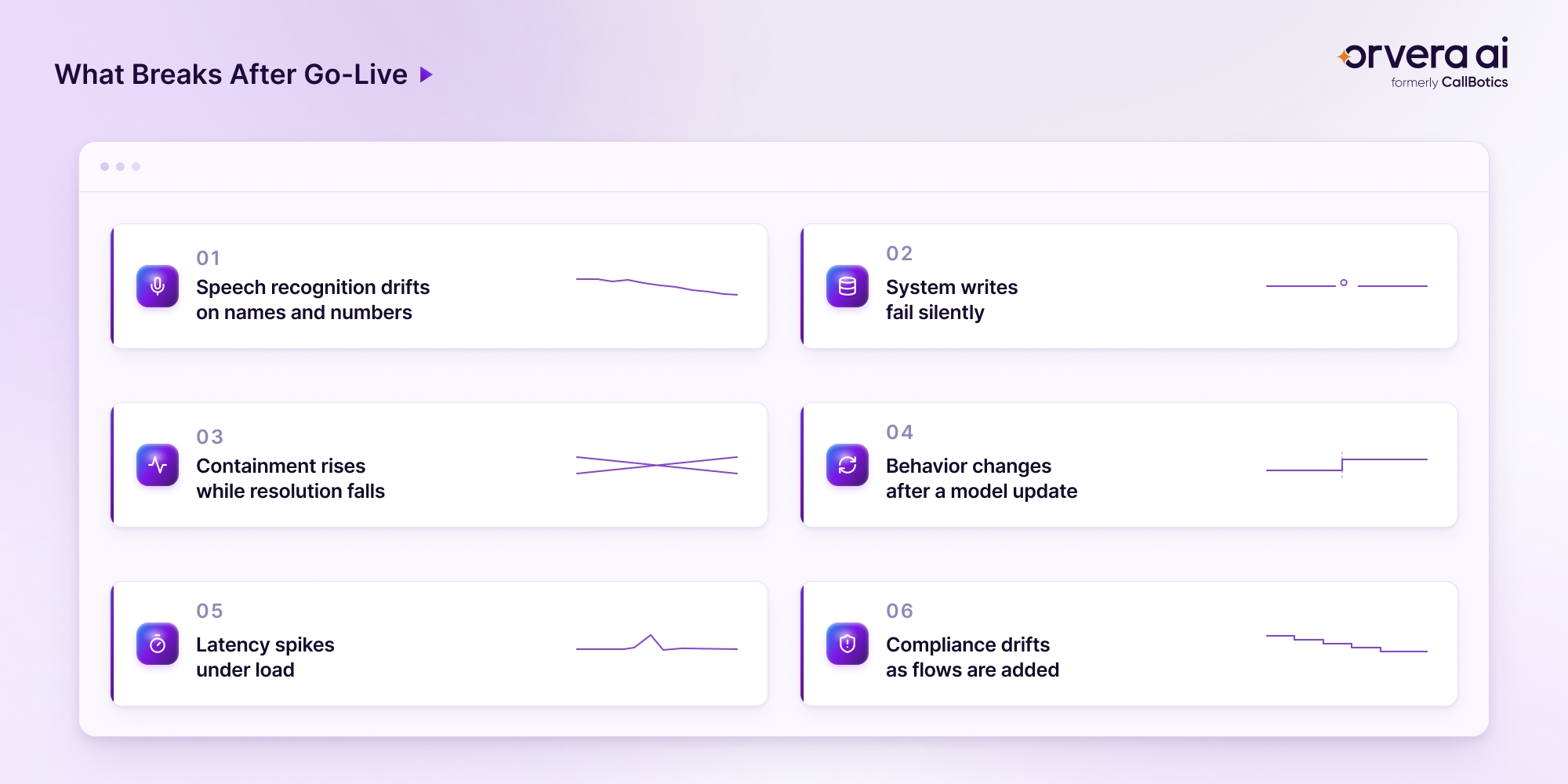
Speech recognition drifts on names and numbers
Your caller mix shifts over months. New regions, new campaigns, a different age profile after a product launch, and the accents arriving on your lines stop matching what the recognition model was tuned against. Names, postcodes, and account numbers suffer first, because they carry no surrounding context to help the model guess.
Nothing logs an error when this happens. Authentication failures rise a little each week, more callers get pushed into the human queue, and the cause stays hidden unless something scores accuracy on every call and shows you the trend line moving.
System writes fail silently
The agent confirms a payment, a change of address, or a case update, and the write to your billing platform or CRM never completes. The caller hangs up satisfied. The record shows nothing happened.
This is the most expensive fault on the list, because the customer only finds out when the money leaves their account, or the promised change never arrives. Catching it means checking that every action the agent confirmed has a matching write in the system behind it, across all calls rather than a sample.
Containment rises while resolution falls
An agent that avoids escalating looks efficient on paper. It handles the call, the caller stops asking for a person, and the interaction closes cleanly in the reporting. The same customer rings back two days later, and that call enters the system as fresh volume.
Your containment rate climbs, your total volume climbs alongside it, and the two stay disconnected until someone links repeat contacts back to the issue that caused them. Tracking resolution and repeat contact rate together is what breaks the illusion.
Behavior changes after a model update
A model version changes, a prompt gets edited, a new skill goes live. Calls that were handled correctly last month start going differently, usually on the edge cases nobody thought to retest.
The control is regression testing against your own recorded call set before any change reaches production, then scoring the calls that follow to confirm the behavior held. Without both, you hear about it from a customer complaint.
Latency spikes under load
Turn-taking that feels natural at fifty concurrent calls falls apart at five hundred. The agent responds a beat late, callers talk over it, and the conversation loses its rhythm.
Peak load is when this surfaces, which is exactly when you have the least attention to spare. Continuous monitoring of response times against concurrency tells you where the ceiling sits before your busiest hour finds it for you.
Compliance drifts as flows are added
New call types get added over time, and recording consent, data handling, and disclosure requirements do not always travel with them. Each addition looks small on its own, and the exposure accumulates.
Auditing every call against your compliance rules keeps this visible while it is still a fix rather than a finding. For a fuller treatment of the months after launch, see what breaks after go-live.
Deployment, Timeline, and ROI
A configured enterprise platform like Orvera goes live in 3 to 6 weeks, covering discovery, integration, conversation design, testing, and a phased rollout. The return holds up when you measure it on resolution and cost to serve, using the same reporting your finance team already trusts.
What the 3 to 6 week timeline covers
Orvera builds, configures, deploys, and runs its AI agents, which is why the timeline stays predictable. The work runs in parallel across integration and conversation design, with a phased rollout that starts on a defined slice of call volume.
- Weeks one and two cover discovery on your call types, telephony connection, and CRM integration
- Weeks three and four cover conversation design, knowledge base setup, and testing against your recorded calls
- Weeks five and six cover the phased rollout, monitoring and tuning before volume steps up
Component-assembled and custom-built systems follow a different curve. Complex in-house programs commonly run for months, and the largest of them take years before they carry production traffic, because the speech tuning, telephony work, compliance layer and monitoring all get built from nothing.
How voice AI pricing works
Buyers asking how much AI voice agents cost meet three pricing shapes, and each one suits a different volume profile. The figure that matters for comparison sits further down, in cost per resolved contact.
- Per-minute pricing suits variable and lower volumes, with published rates across developer platforms typically quoted in cents per minute
- Per-conversation or per-resolution pricing ties spend to outcomes and keeps the finance conversation simple
- Annual enterprise licensing suits high, predictable volume
Building the business case
Start from your current fully loaded cost to resolve one contact through a human agent, including recruitment, training and the ramp period before a new hire reaches proficiency. Model the share of contacts the agent resolves end to end, and hold back the calls that will still need a person.
- Cost per resolved contact is the headline number, calculated on problems closed and checked against repeat contacts within seven days
- Agent capacity released is the second number, showing hours returned to complex, high-value and revenue-generating work
- Reduced dependence on peak-season hiring is the third, since the agent absorbs volume spikes that previously drove temporary recruitment
McKinsey estimates that applying generative AI to customer care functions could lift productivity by 30 to 45 percent of current function costs (opens in a new tab). Set that against a customer service workforce the US Bureau of Labor Statistics expects to shrink 5 percent through 2034 (opens in a new tab) while demand for the work continues, and the arithmetic usually settles the question.
Conclusion
Conversation quality has converged across the serious platforms, so the demo has stopped telling you much. What separates one AI call center voice agent from another now is auditability, the ability to report resolution alongside containment, and the operational discipline to catch drift before your customers feel it. The vendors worth shortlisting are the ones that make that evidence routine, on every call, from the first week of the pilot rather than the first quarterly review.
Orvera is an agentic AI platform for enterprise customer experience built to that standard. Orvera builds, configures, deploys, and runs your AI agents, with 100% AI Auto QA scoring every interaction, SOC 2 Type II certified, HIPAA compliant and GDPR compliant, coverage across more than 80 languages, and full production deployment in 3 to 6 weeks. If you are evaluating AI call center voice agents and want to see what full-coverage quality assurance looks like against your own call types, book a working session with our team.
Frequently asked questions
It is software that holds a natural spoken phone conversation and completes the customer's task end to end in your business systems. It combines speech recognition, language understanding, a reasoning model and speech synthesis.
A voicebot matches speech against a defined list of intents and passes anything outside that list to a human queue. A voice agent reasons over intent, context and live account data, then completes the transaction.
An IVR moves the caller through a fixed menu and routes the call to a queue. A voice agent understands any phrasing, finishes the work, and transfers with full context when it reaches a genuine limit.
Enterprise platforms connect to SIP and CCaaS telephony and to CRM systems such as Salesforce, HubSpot and ServiceNow. Ask for a live demonstration of a write-back with the audit trail visible, since read-only integrations are common.
Report first contact resolution, repeat contact rate within seven days, and cost per resolved contact. Containment on its own can rise while customer outcomes fall, so it needs those figures alongside it.
Pricing runs per minute, per conversation or resolution, or as an annual enterprise licence. Per-minute rates suit variable volume and enterprise licensing suits high predictable volume.
A configured enterprise platform reaches full production deployment in 3 to 6 weeks. Component-assembled and custom builds run for months, and the largest programmes take years.
Enterprise platforms carry SOC 2 Type II, support HIPAA requirements for healthcare workloads, and align to GDPR. Confirm how call recording consent, data residency and access controls are handled as new flows get added.

Written by
Anindita Majumder
Anindita Majumder is a communications professional with nearly four years of experience in public relations, corporate communications, and journalism. She creates content that helps brands communicate their vision, products, and expertise through press releases, thought leadership, and editorial pieces. Outside of work, she is a vocalist, which keeps her creativity flowing.