AI Contact Center Statistics, Trends, and Predictions
The 2026 statistics on AI in contact centers, the trends behind them, the challenges leaders still have to manage, and where the operating model goes from 2027.


Key highlights
TL;DR — In a Nutshell
- AI contact centers are moving from experimental pilots to practical operations strategies focused on resolution, service speed, agent support, and performance visibility
- Recent AI contact center statistics show rising executive pressure to adopt AI, with leaders using it to reduce effort, improve self-service, and support frontline teams
- The biggest trends shaping AI contact centers include conversational AI, multichannel support, predictive analytics, AI Agent Assist, and voice AI becoming a standard part of service operations
- AI can improve key contact center KPIs such as resolution rate, wait time, cost per interaction, QA coverage, escalation quality, agent productivity, and customer satisfaction
- Enterprise teams still need to manage challenges around data privacy, system integration, performance trust, transparency, escalation logic, and governance before scaling AI
- Future-ready contact centers will use AI to connect automation, human guidance, QA, analytics, and operational control so customer interactions are easier to resolve, measure, and improve
AI contact centers are no longer being evaluated as experimental automation projects. For enterprise customer service leaders, the focus is shifting toward how AI improves resolution, reduces customer effort, supports human agents, and gives operations teams better visibility into every interaction.
A 2026 Gartner survey found that 91% of customer service and support leaders are under executive pressure to implement AI, while more than 80% of organizations plan to expand human agent responsibilities as AI reshapes frontline roles (opens in a new tab). Gartner also notes that service leaders are prioritizing customer satisfaction, operational efficiency, and self-service success in 2026, with AI being used to support first-contact resolution and lower customer effort.
These numbers show why AI contact center strategies are moving beyond basic call automation. The next phase will depend on how well organizations combine AI agents, human agent guidance, QA visibility, analytics, and governance into one controlled operating model that improves customer interactions without adding operational risk.
Why AI Matters in Contact Centers Today
Contact centers are under more pressure than ever. Customers expect faster answers, fewer transfers, and clearer outcomes, while businesses are expected to manage cost, staffing, quality, and service consistency at the same time. AI gives teams a practical way to balance these demands without making the service experience feel less human.
AI matters because it helps contact centers handle more customer interactions without depending only on larger teams. When used well, AI can answer common questions, guide customers through simple service steps, support agents during live conversations, and give leaders better visibility into what is happening across interactions. This makes it easier for leaders to improve service performance while keeping customers, agents, and supervisors aligned.
Rising customer expectations
Customers do not compare one contact center only with another contact center. They compare every service experience with the fastest and easiest experiences they have had anywhere else. That is why long wait times, unclear answers, and disconnected handoffs can quickly damage trust. When customers call, chat, or send a message, they expect the business to already understand the context. They do not want to explain the same issue again after every transfer. They want accurate answers, faster support, and a clear next step. A strong AI contact center setup helps preserve that context so the customer experience feels more connected.
AI helps contact centers meet these expectations by reducing wait time, identifying intent earlier, and guiding the interaction toward the right outcome. For simple service requests, AI agents can help customers get answers without waiting for a human agent. For more complex issues, AI can support better routing and handoff so the next agent has the context needed to continue the conversation. This helps teams resolve more interactions while still giving human agents the space to focus on situations that need judgment, empathy, or approval.
Competitive pressure
Enterprise contact centers are no longer asking whether AI will become part of customer service. They are asking where it can create measurable value without creating operational risk. That shift has made AI a practical operations decision, not just a technology discussion. Competitors are using AI to reduce queue pressure, improve self-service, support agents, expand QA coverage, and understand customer issues faster. As these capabilities become more common, slower service, long hold times, and inconsistent answers become harder to justify. Customers notice the difference when one brand resolves issues quickly and another makes them wait or start over.
AI gives enterprises a practical way to improve service performance without rebuilding the entire contact center. It can support high-volume interaction types, help agents respond with more confidence, and give supervisors better insight into quality, sentiment, escalation patterns, and service gaps. This allows teams to improve the parts of service delivery that create the most pressure first. The contact centers that benefit most from AI are not simply adding automation for the sake of it. They are using AI to improve resolution, protect customer experience, and give operations teams stronger control over how service is delivered.
Key AI Contact Center Statistics (2026-2027)
AI adoption in contact centers is being shaped by three practical pressures: higher service demand, tighter cost control, and stronger customer expectations. Enterprise teams are not looking at AI only as a way to answer more calls (opens in a new tab). They are using it to improve resolution, reduce avoidable effort, guide agents, and measure service quality more clearly. The statistics below show where AI contact center investment is moving and why leaders are treating it as an operations priority.
Adoption rates
AI adoption in contact centers is now moving from experimentation to operational planning. A 2026 Gartner survey found that 91% of customer service and support leaders are under executive pressure to implement AI (opens in a new tab), showing how strongly AI has entered the boardroom conversation around service operations. Gartner also reported that more than 80% of organizations plan to expand human agent responsibilities, which means AI is not only changing automation strategy but also reshaping how frontline teams work.
Salesforce’s State of Service research also points to faster AI adoption across service operations (opens in a new tab). According to Salesforce, 30% of service cases were resolved by AI in 2025, and that number is expected to reach 50% by 2027. For contact center leaders, this shows that AI is becoming part of everyday service delivery, especially for customer interactions where the path to resolution can be clearly defined.
Cost savings & ROI
Cost pressure remains one of the clearest reasons enterprises are investing in AI contact center tools. Salesforce reports that service teams using AI agents expect both service costs and case resolution times (opens in a new tab) to decrease by an average of 20%. This matters because AI value is not only measured by how many interactions it can handle, but by whether it reduces effort, shortens resolution time, and improves the economics of service delivery.
For enterprise teams, the stronger ROI story comes when AI is connected to real service workflows, QA visibility, and human agent support. A 20% reduction in cost or resolution time can become meaningful at scale, especially in contact centers handling thousands or millions of customer interactions each month. The goal is not just to reduce headcount pressure, but to lower the cost per resolved interaction while keeping service quality under control.
CX impact stats
AI is also changing how service teams think about customer experience. Salesforce reports that 89% of service professionals say conversational AI increases self-service resolution rates (opens in a new tab), while 88% say it accelerates resolution times. These numbers are especially relevant for contact centers because faster resolution only matters when customers can still get accurate answers, clear next steps, and smooth escalation when needed.
Zendesk’s 2026 CX Trends report shows why this speed matters. It found that 74% of consumers expect customer service to be available 24/7, and 88% expect faster response times (opens in a new tab) than they did a year ago. This puts pressure on contact centers to provide faster access without losing context, quality, or control across customer interactions.
See how Orvera helps enterprise contact centers turn AI adoption into measurable resolution, QA, and performance outcomes. (opens in a new tab)Trends Shaping AI Contact Centers
AI contact center trends are becoming more practical and operations-focused. Leaders are not only looking for better automation. They are looking for AI that understands customer intent, works across channels, supports agents, and gives teams clearer signals before service issues grow. The strongest trends are the ones that help contact centers reduce friction (opens in a new tab) while keeping service quality easier to control.
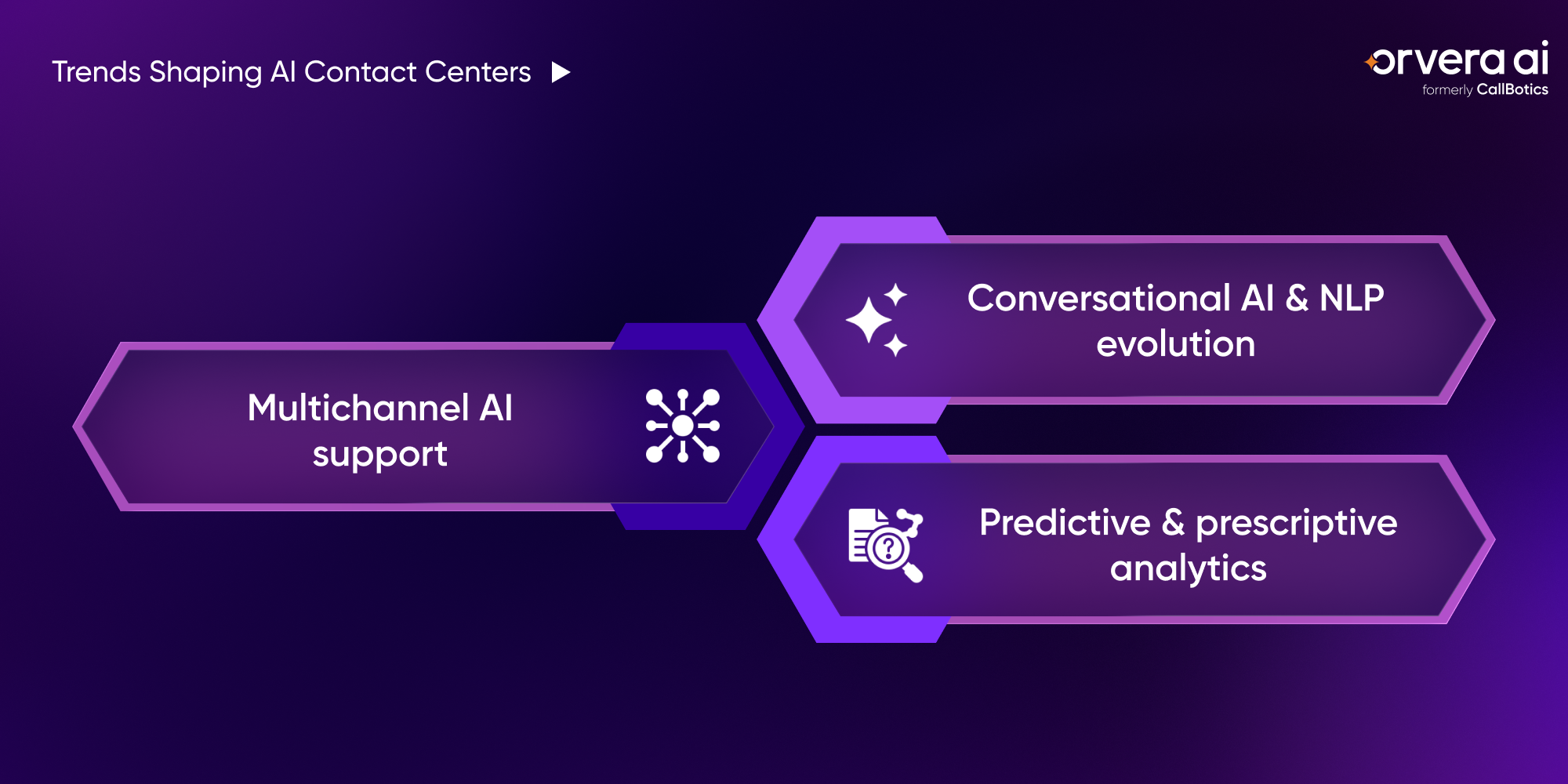
Conversational AI & NLP evolution
Conversational AI and NLP are improving how contact centers understand what customers actually need. The pain point is that many customers do not describe their issue in a neat or predictable way, which can lead to wrong routing, repeated questions, and poor handoffs. Better language understanding helps the interaction move toward the right outcome faster, even when the customer explains the problem in their own words.
- AI can identify what the customer is trying to do earlier in the interaction, even when the request is worded differently
- Customers can explain their issue in normal language instead of following rigid menu options
- When a human agent is needed, AI can pass along the intent, summary, and next step so the customer does not have to start again
Multichannel AI support
Customers now move between voice, chat, email, and social channels, but many contact centers still manage these channels separately. The pain point is that context often gets lost between channels, creating more effort for the customer and more manual work for agents. AI can reduce that gap by helping teams carry customer context across the channels customers already use.
- AI can help teams manage customer interactions across voice, chat, email, and social without treating each channel as a separate experience
- Approved knowledge, policies, and service logic can be applied more consistently across different customer touchpoints
- AI can summarize previous interactions, surface relevant details, and help agents continue the conversation with better context
Predictive & prescriptive analytics
AI is helping contact centers move from only reviewing past performance to identifying what may happen next. The pain point is that leaders often see issues after they have already affected customers, whether it is rising wait time, repeat contact, weak sentiment, or service failures. Predictive and prescriptive analytics give leaders earlier signals and clearer actions before the same issues keep spreading across customer interactions.
- AI can identify patterns in customer interactions, sentiment, and escalation trends before they become larger service problems
- Prescriptive analytics can suggest where to adjust routing, update service logic, coach agents, or improve customer communication
- Better planning decisions: Leaders can use AI-driven insights to prepare for demand spikes, staffing pressure, and recurring customer issues with more confidence
AI-Driven Workforce Transformation
Contact center work is becoming more supported, guided, and data-driven as AI becomes part of daily service operations. The bigger shift is that agents are being supported with better context, faster guidance, and clearer next steps, while leaders are rethinking the skills needed to manage AI-supported service operations. This helps teams improve performance without expecting agents to carry every process, policy, and system detail on their own.
Agent augmentation
Agents often spend too much time searching for answers, switching between systems, summarizing calls, or trying to remember the right process under pressure. AI helps reduce that burden by giving agents real-time guidance, relevant knowledge, customer context, and suggested next steps during live conversations. This can reduce manual effort during the interaction (opens in a new tab) and help agents stay focused on the customer’s actual issue.
This makes the agent’s job more focused and less stressful. Instead of handling every interaction from scratch, agents can spend more time on customer judgment, empathy, exceptions, and complex service requests where human support matters most. It also helps newer agents perform with more confidence because they are not relying only on memory or supervisor support.
Skill shifts & hiring trends
As AI becomes part of contact center operations, teams need more than traditional call-handling skills. Leaders now need people who can understand customer interactions, review AI performance, improve service logic, manage QA signals, and work with data from conversations, sentiment, escalations, and outcomes. This creates a stronger link between frontline service knowledge and the operational decisions that improve customer experience.
New roles are also starting to appear around AI training, conversation design, workflow optimization, automation QA, and AI operations management. For contact centers, the hiring priority is shifting toward people who can combine service experience with process thinking, data awareness, and the ability to improve how AI and human agents work together. The most valuable teams will be the ones that understand both customer service realities and how to manage AI safely inside daily operations.
AI Contact Center Challenges to Watch
AI contact centers can create real operational value, but only when the risks are handled carefully. Leaders need to look beyond automation and make sure data, systems, performance, and customer outcomes remain controlled. This is especially important when AI is handling high-volume customer interactions that affect trust, compliance, and service quality.
Data privacy & security
AI contact centers often handle sensitive customer information, including account details, payment data, health information, policy records, and personal identifiers. The pain point is that every new AI layer can create new questions around data access, retention, compliance, and auditability. Clear governance helps teams protect customer data while still using AI to improve speed and resolution.
- AI systems need clear controls for what data is captured, processed, stored, and accessed
- Teams must evaluate how AI supports requirements such as SOC 2 Type 2, HIPAA, GDPR, PCI, and internal security policies
- Role-based access, reporting, audit trails, and monitoring help leaders prove that customer data is handled responsibly
Integration complexity
Many contact centers already depend on CRM platforms, CCaaS systems, ticketing tools, knowledge bases, QA platforms, and backend databases. The pain point is that AI can fail to create real value if it cannot connect with the systems needed to complete customer requests. Strong integration planning ensures AI can support the full service path instead of becoming another disconnected tool.
- Older systems may not have clean APIs, consistent data structures, or simple ways to support real-time AI actions
- When AI cannot retrieve, update, or pass information correctly, agents may still need to complete too much work manually
- Teams need to map the service request, required data, system action, escalation path, and reporting needs before deployment
Performance trust & transparency
Enterprise leaders need to trust that AI is giving accurate answers, following approved logic, and escalating at the right time. The pain point is that black-box automation can create risk if teams cannot see why the AI acted a certain way or whether the customer interaction reached the right outcome. Transparent performance reporting gives teams the confidence to improve AI safely (opens in a new tab) instead of guessing where issues are happening.
- AI must be tested against real customer scenarios, edge cases, policy rules, and escalation conditions before scaling
- QA scoring, summaries, sentiment signals, dashboards, and exception reporting help leaders monitor quality
- Customers should be routed to human agents when the request is complex, sensitive, or outside the approved AI path
Predictions for the Future of AI in Contact Centers (2027+)
The future of AI in contact centers will be shaped by one clear expectation: customers will want faster service without losing accuracy, context, or human understanding. For leaders, the challenge will be building AI-supported operations that improve resolution while keeping control, visibility, and trust intact. That means future AI strategies will need to connect customer experience, operational performance, and governance from the start.
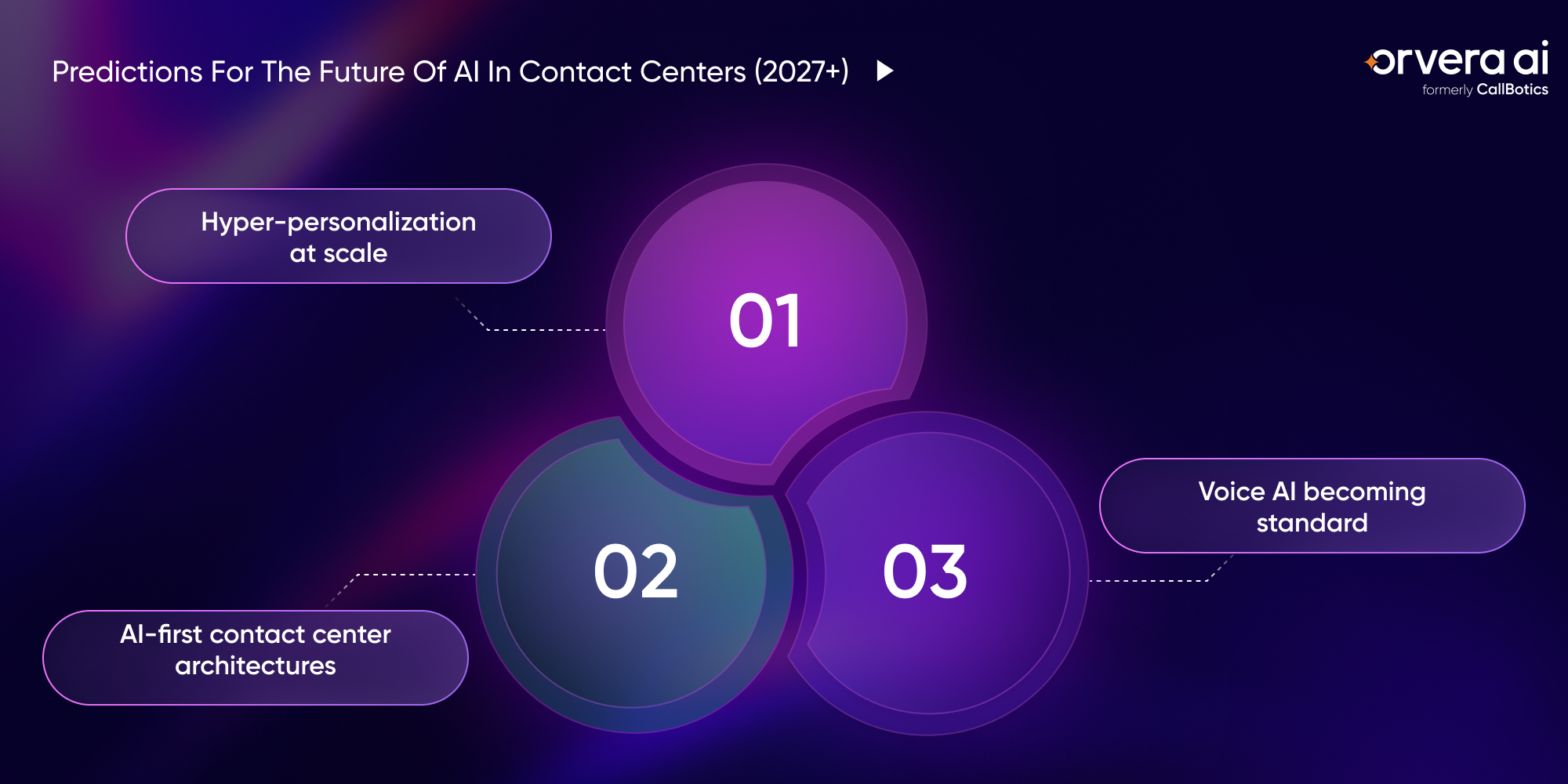
Hyper-personalization at scale
Hyper-personalization will move beyond greeting customers by name or showing basic account history. Contact centers will need AI that can understand the customer’s past interactions, current issue, channel preference, sentiment, and likely next step without making the experience feel invasive. The goal will be to make each interaction feel more relevant without making customers feel like the business knows too much.
The main pain point will be balancing personalization with privacy and control. Customers want service that feels relevant, but they also expect their data to be handled responsibly, which means contact centers will need strong governance around what AI can access, use, store, and recommend. Teams that get this balance right will be able to improve customer experience without creating unnecessary compliance or trust concerns.
AI-first contact center architectures
Future contact center technology stacks will likely be built around AI as an operating layer, not just as an add-on tool. AI will need to connect with CRM systems, CCaaS platforms, knowledge bases, QA tools, analytics dashboards, ticketing systems, and backend workflows so customer interactions can move from request to resolution more smoothly. This will help contact centers reduce manual gaps between systems and make service delivery easier to manage.
The pain point for many enterprises will be legacy complexity. AI-first architectures will only work well when teams map the service request, required data, escalation path, reporting needs, and governance controls before deployment, instead of adding disconnected tools that create more work for agents. A clear architecture will matter because AI cannot improve resolution if it cannot access the right context or trigger the right next step.
Voice AI becoming standard
Voice AI will become a more common part of contact center operations because phone support remains critical for urgent, complex, and high-emotion customer interactions. As voice AI improves, it will support more customer requests through natural conversations, faster intent recognition, real-time system actions, and cleaner handoffs to human agents when needed. This will make voice automation more useful for real service scenarios, not just simple call containment.
The main challenge will be trust. Enterprises will need voice AI that can handle approved service paths reliably, escalate at the right time, preserve context, and give leaders clear visibility into resolution, sentiment, QA, and performance across every AI-handled interaction. Trust will depend on whether leaders can see what happened, why it happened, and how the interaction can be improved over time.
Explore how Orvera supports AI voice agents, Agent Assist, and interaction intelligence for contact centers moving beyond basic automation. (opens in a new tab)How Orvera Helps Enterprises Win with AI
Orvera (opens in a new tab) helps enterprises deploy AI across contact center workflows by combining scalable automation, seamless integrations, and measurable performance visibility in one operating layer. AI agents can handle supported customer interactions through approved service logic, connect with CRM, helpdesk, telephony, and backend systems where configured, and escalate to human agents with full context when needed. The goal is simple: help contact centers resolve more interactions, reduce manual effort, and track real KPI improvements without losing control over quality, governance, or customer experience.
- AI agents support high-volume contact center workflows such as billing, verification, scheduling, status checks, and follow-ups where suitable
- CRM, helpdesk, telephony, and contact center integrations help customer interactions move from request to action with better context
- Human agents receive summaries, customer details, completed steps, sentiment signals, and escalation reasons when support is needed
- Dashboards and reporting show resolution, escalation, QA, sentiment, and performance trends across AI-handled interactions
- First-contact resolution of roughly 80% is the Orvera customer average in suitable workflows, depending on the use case and implementation
- 100% QA coverage on AI interactions helps leaders monitor quality, improve service logic, and identify where customer interactions need better support
Conclusion
AI contact center data matters because it helps leaders make better decisions about where automation should be used, where human support is still needed, and which customer interactions create the most pressure. Without clear data, AI adoption can become a technology project instead of an operations strategy. The right metrics help teams understand whether AI is improving resolution, reducing wait time, supporting agents, and protecting customer experience.
For enterprise teams, the next step is not simply adding more AI tools. The real value comes from using contact center data to connect AI performance with cost, quality, CSAT, escalation, QA, and service outcomes. When leaders can see what is working, what is breaking, and where customers still need better support, AI becomes easier to govern, improve, and scale with confidence.
Frequently asked questions
AI adoption varies by organization, but most enterprise contact centers are either using AI tools already or actively planning AI adoption across service, QA, analytics, or agent support.
AI most commonly improves resolution rate, wait time, cost per interaction, QA coverage, escalation quality, agent productivity, and customer satisfaction.
Conversational AI is not replacing human agents entirely, but it is helping them focus on complex, sensitive, and judgment-based customer interactions.
The biggest challenge is making AI work inside real operations, including data security, system integration, escalation logic, QA visibility, and performance trust.
Enterprises should start evaluating AI now, but adoption should begin with clear use cases, measurable KPIs, governance controls, and a practical deployment plan.

Written by
Anindita Majumder
Anindita Majumder is a communications professional with nearly four years of experience in public relations, corporate communications, and journalism. She creates content that helps brands communicate their vision, products, and expertise through press releases, thought leadership, and editorial pieces. Outside of work, she is a vocalist, which keeps her creativity flowing.