AI Voice Agents for Telecom: Reducing Churn & Handling Billing Inquiries at Scale
How AI voice agents take billing confusion, payment reminders, outage updates and plan changes off telecom queues, spot churn signals during the call, and escalate retention cases with context.


Key highlights
Key takeaways
- AI voice agents help telecom teams handle high-volume billing, payment, service, and account requests without adding more queue pressure
- Telecom churn often starts inside support interactions, especially when customers face billing confusion, repeat calls, unresolved service issues, or poor escalation experiences
- Billing support is one of the strongest starting points because many questions around charges, plan changes, roaming fees, taxes, and payment status follow clear service logic
- AI voice agents improve customer experience by reducing wait times, giving clearer answers, keeping communication consistent, and escalating complex cases with context
- Telecom teams should connect AI voice agents with billing platforms, CRM systems, payment records, service status tools, ticketing systems, and contact center platforms
- Success should be measured through churn rate reduction, call resolution rate, AHT, CSAT, repeat contact trends, and escalation quality
Telecom providers operate in a service environment where customer frustration can build quickly. Billing disputes, plan confusion, service outages, upgrade questions, roaming charges, and payment issues often lead to high call volumes and repeat contacts. Customers do not want to wait through long queues just to understand a charge or confirm the status of a service issue. When support feels slow or unclear, even a small issue can become a reason to reconsider the provider.
This pressure matters because telecom churn is still a major business risk. Annual churn rates often fall between 15% and 30% (opens in a new tab), especially in competitive markets where customers can switch providers easily. Many churn signals start inside support interactions, such as repeated billing calls, unresolved service complaints, or poor escalation experiences. That makes faster, clearer resolution especially important for telecom teams trying to protect customer relationships.
AI voice agents give telecom teams a more scalable way to manage these interactions. They can handle supported billing questions, plan updates, payment reminders, outage updates, and service requests without adding more queue pressure. When an issue is complex, they can escalate the interaction with context, helping human agents respond faster and giving customers a clearer path to resolution before frustration turns into cancellation. This helps telecom providers improve service consistency while keeping teams focused on the issues that need human judgment.
Why Telecom Customer Support Is Complex and High-Stakes
Telecom customer support is difficult because most issues are urgent, personal, and tied to services customers use every day. A billing error, service outage, failed activation, or delayed plan change can quickly become a customer experience problem. Customers usually contact support only when something has already interrupted their service, bill, or account experience.
The pressure is also high because customers have choices. When support is slow, inconsistent, or hard to navigate, telecom providers risk more than a single complaint. They risk repeat calls, lower satisfaction, and preventable churn. That makes every support interaction an important moment for protecting the customer relationship.
High volume of billing and service-related calls
Telecom support teams handle a constant flow of billing questions, service issues, plan changes, outage updates, device problems, and payment-related inquiries. Many of these interactions are simple on the surface, but they still take time because customers expect clear answers, account-specific details, and quick confirmation. When thousands of similar requests come in at once, even simple interactions can create serious queue pressure.
The challenge is that this demand does not arrive evenly. Call volumes often spike after billing cycles, network disruptions, promotional plan changes, or service upgrades. Without a scalable way to manage these interactions, queues grow, agents get stretched, and customers wait longer for issues that should be resolved quickly. This also makes it harder for agents to focus on complex cases that need deeper troubleshooting or human judgment.
Billing disputes and confusion
Telecom billing is often difficult for customers to understand because plans can include taxes, add-ons, roaming charges, promotional discounts, usage limits, device payments, and prorated fees. Even when the bill is technically correct, the customer may still feel confused if the charge is not explained clearly. That confusion can quickly turn into frustration when customers feel they are paying for something they did not expect.
This creates pressure on agents because billing conversations require accuracy and patience. A rushed or unclear response can turn a small billing question into a dispute. Support teams need a way to explain charges consistently, verify account details, and route complex billing exceptions without making customers repeat the same information. Consistent handling also helps reduce repeat calls from customers who need the same bill explained more than once.
High churn risk due to poor support experience
In telecom, a poor support experience can directly affect retention. Customers may tolerate a one-time service issue, but they are less likely to stay if they feel ignored, transferred repeatedly, or forced to call back for the same problem. Support quality becomes part of how they judge the provider. A frustrating interaction can make switching providers feel easier than continuing the relationship.
This is why resolution matters as much as response speed. If the customer gets a quick answer that does not solve the issue, frustration remains. Telecom teams need support operations that can identify intent, handle common requests, escalate exceptions with context, and reduce the friction that pushes customers toward cancellation. The goal is to resolve the issue before it becomes another reason for the customer to leave.
Multi-channel and multi-system operations
Telecom support does not happen in one place. Customers may start with a call, follow up through chat, respond to an SMS, check an app, or speak with an agent later. Behind those interactions, teams often rely on CRM systems, billing platforms, ticketing tools, network status systems, knowledge bases, and workforce tools. Each system may hold a different part of the customer’s issue, which makes context difficult to maintain.
This creates integration complexity. Agents need the right information from different systems while the customer expects one connected experience. When systems are disconnected, support becomes slower, handoffs lose context, and customers have to explain the issue again. A better operating model needs to keep context, service logic, and escalation paths connected across channels and systems. This helps teams respond with more consistency, even when the customer moves between channels.
What AI Voice Agents Do in Telecom Support
AI voice agents help telecom support teams handle customer interactions that are high in volume, time-sensitive, and often tied to account-specific details. They can answer common billing questions, explain plan or charge details, provide service updates, confirm payment information, guide customers through basic troubleshooting, and collect the right information before escalation.
Their value comes from reducing avoidable wait time while keeping the interaction clear and structured. When a request can be resolved through approved service logic, the AI voice agent can complete it directly. When the issue needs human judgment, such as a complex billing dispute, repeated service failure, or cancellation risk, the interaction can be routed to an agent with the customer’s intent, history, and next step already captured.
AI voice agents are useful across billing inquiries, service issues, and retention-related conversations. They help customers get faster answers for common requests, help agents spend more time on complex cases, and give telecom leaders better visibility into the issues driving call volume, repeat contact, and churn risk.
Explore how Orvera supports faster telecom resolution with AI voice agents built for high-volume customer interactions. (opens in a new tab)Key Use Cases for AI Voice Agents in Telecom
AI voice agents can support telecom teams where customer demand is frequent, time-sensitive, and often tied to account or service details. The strongest use cases are the ones where customers need quick answers, clear explanations, and a smooth path to resolution without waiting in long queues. They also help reduce pressure on live agents by handling predictable requests that follow approved service logic. This gives human teams more time to focus on complex billing, technical, and retention cases.
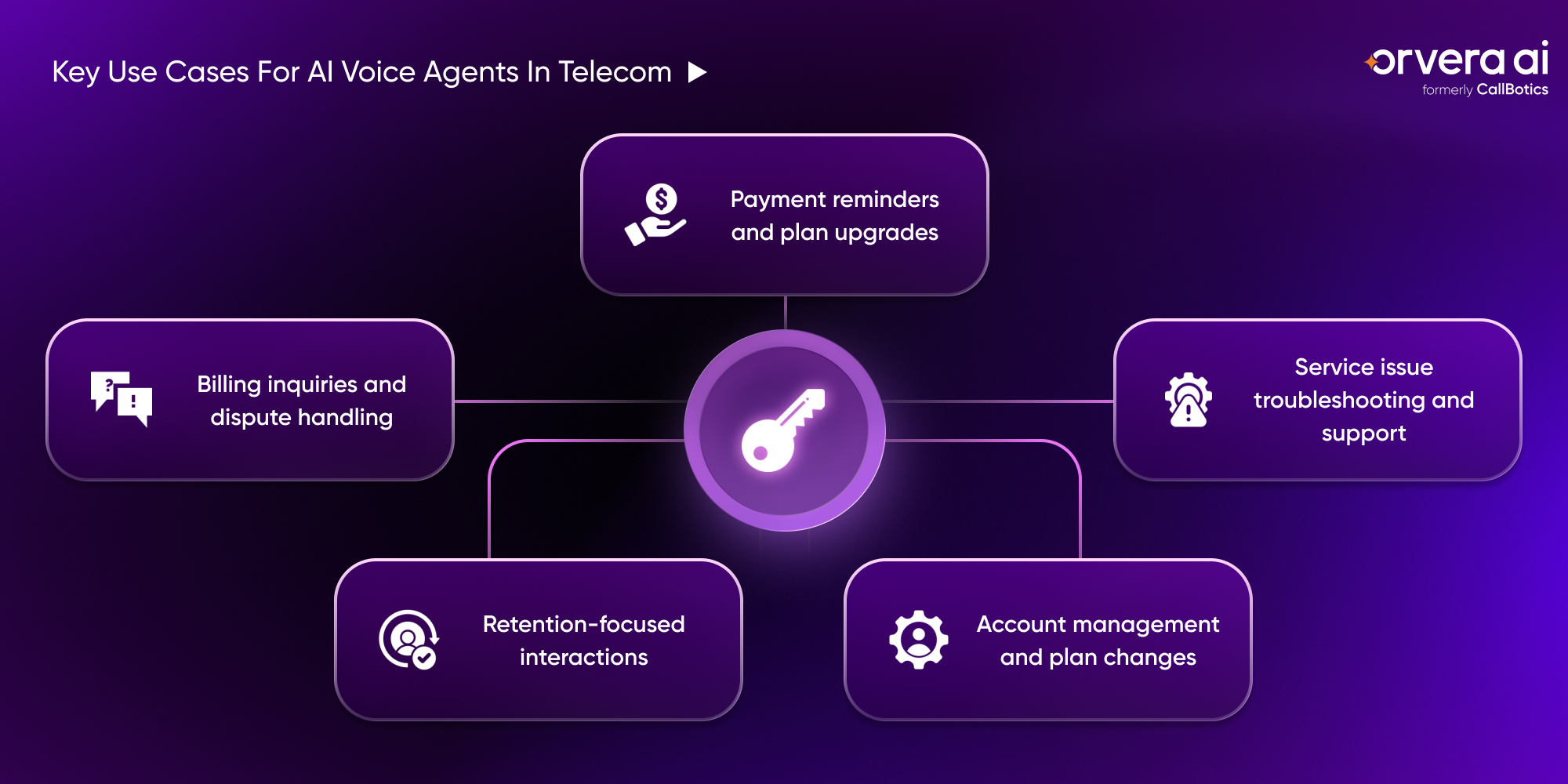
Billing inquiries and dispute handling
Billing is one of the most common reasons customers contact telecom support. AI voice agents can explain charges, clarify plan details, check payment history, and collect dispute information before routing complex cases to a human agent. This helps customers understand their bill faster instead of waiting for an agent to walk through every line item. It also gives support teams a more consistent way to handle billing questions during monthly call spikes.
- Explain monthly charges, taxes, add-ons, roaming fees, and prorated billing in simple language
- Help customers understand why a bill changed after a plan update, promotion, or device payment
- Escalate disputed charges with account details, customer concern, and conversation context already captured
Payment reminders and plan upgrades
AI voice agents can support proactive outreach by reminding customers about upcoming or missed payments and guiding them through relevant plan options. This helps telecom teams reduce avoidable service interruptions while creating better moments for retention and upsell. Customers can get timely reminders before a payment issue affects their service. Teams can also use these interactions to guide customers toward plans that better match their usage.
- Send payment reminders and help customers confirm due dates, amounts, and payment options
- Notify eligible customers about plan upgrades, data add-ons, or service bundles based on approved rules
- Route customers to a human agent when the interaction involves pricing sensitivity, cancellation risk, or a complex plan decision
Service issue troubleshooting and support
Service issues can quickly frustrate customers because they affect connectivity, work, entertainment, and daily communication. AI voice agents can guide customers through basic troubleshooting, share service updates, and confirm whether an issue needs technical support. This helps customers get immediate direction instead of waiting in a queue for simple checks. It also helps technical teams receive better information when the issue needs deeper investigation.
- Help customers check outage updates, service status, router steps, SIM issues, or connectivity problems
- Collect key details such as location, device type, issue duration, and error messages before escalation
- Route technical cases with context, so customers do not have to repeat the same issue again
Retention-focused interactions
AI voice agents can help identify early churn signals during support interactions, especially when customers mention repeated issues, billing frustration, poor service experience, or cancellation intent. They can respond with approved next steps and escalate high-risk conversations quickly. This gives telecom teams a chance to address dissatisfaction before the customer decides to leave. It also helps retention teams understand which issues are most often linked to cancellation risk.
- Detect phrases linked to churn risk, such as repeated complaints, cancellation requests, or frustration with charges
- Offer approved solutions such as plan review, troubleshooting support, payment guidance, or callback routing
- Escalate sensitive retention cases with the customer’s reason, issue history, and next best action
Account management and plan changes
Telecom customers often contact support to update account details, change plans, add features, remove services, or understand available options. AI voice agents can handle supported account requests and guide customers through clear choices. This reduces unnecessary agent workload for routine changes that follow clear rules. Customers also get a simpler experience because they can confirm options, eligibility, and next steps in the same interaction.
- Support plan upgrades, downgrades, add-ons, address updates, and service changes through approved logic
- Confirm eligibility, available options, next steps, and any account impact before changes are made
- Escalate exceptions when the request involves contract terms, billing impact, multiple lines, or special approvals
How AI Voice Agents Help Reduce Telecom Churn
Telecom churn often starts when customers feel their issue is taking too long to resolve, or nobody fully understands the problem. AI voice agents help reduce that friction by giving customers faster answers, clearer next steps, and better routing when an issue needs human support. This matters most when the customer is already frustrated by billing confusion, service disruption, or repeated follow-ups.
They also help telecom teams identify patterns behind churn risk. Billing frustration, service complaints, repeat calls, and cancellation intent can be captured across interactions, giving teams a clearer view of where customer relationships are weakening. These signals help leaders act earlier instead of waiting until the customer has already decided to leave.
Faster resolution of customer issues
Customers are more likely to stay (opens in a new tab) when their issues are handled quickly and clearly. AI voice agents can respond immediately to common requests like billing questions, service status checks, payment support, and plan updates, reducing the wait time that often increases frustration. Faster answers help customers feel that the provider is responsive when the issue matters.
Fast resolution also helps prevent repeat contact. When customers get the right answer the first time, they are less likely to call again, escalate, or start comparing other providers because the support experience feels difficult. This reduces avoidable friction and helps protect the relationship after service issues or billing concerns.
Proactive engagement and follow-ups
AI voice agents can support proactive outreach before a small issue becomes a churn risk. They can remind customers about payments, confirm service appointments, share outage updates, follow up after support interactions, or check whether a previous issue was resolved. These touchpoints help customers feel informed instead of left to chase updates on their own.
These follow-ups show customers that the provider is paying attention. For telecom teams, they also create an opportunity to identify dissatisfaction early and route customers to the right support path before they decide to cancel. This is especially useful after outages, missed appointments, unresolved disputes, or repeated support contacts.
Consistent and accurate communication
Telecom customers often become frustrated when they receive different answers from different agents or channels. AI voice agents can follow approved service logic, clearly explain billing or service information, and maintain consistent communication across common customer requests. This helps reduce confusion when customers are asking about charges, service changes, or account updates.
This reduces confusion around charges, plan terms, outages, troubleshooting steps, and account changes. When customers trust the information they receive, they are less likely to lose confidence in the provider. Consistent communication also helps agents and supervisors manage expectations more clearly across high-volume support periods.
Better handling of high-risk customers
Some customers need faster attention because their interactions show clear churn signals. These signals can include repeated complaints, billing disputes, poor service history, cancellation language, or multiple unresolved contacts. Identifying these signals early helps teams avoid treating every interaction as a standard support request.
AI voice agents can identify these signals during the conversation and route the case with context. This helps human agents prioritize critical interactions, understand the reason behind the customer’s frustration, and respond with a more relevant retention path. Better context also reduces the need for customers to repeat their problem, which is often a major source of frustration.
How AI Voice Agents Improve Billing Support at Scale
Billing support is one of the biggest pressure points in telecom because customers often call when they are confused, frustrated, or worried about unexpected charges. AI voice agents help teams handle these interactions faster, explain billing details more clearly, and reduce the number of routine calls that reach live agents. This is especially useful during billing cycles, when call volumes can rise quickly across large customer bases. It also helps customers get answers before a billing concern turns into a complaint or cancellation risk.
Instant responses to billing questions
Customers do not want to wait in a queue to ask why their bill changed or when their payment is due. AI voice agents can respond immediately to supported billing questions, helping customers get basic answers without adding pressure to live support teams. This makes billing support feel faster and less stressful for customers who only need a simple explanation. It also prevents avoidable queue buildup during peak billing periods.
- Answer common billing questions around due dates, payment status, balance, and recent charges
- Help customers understand whether a charge is linked to usage, add-ons, roaming, or plan changes
- Route complex billing issues to a human agent with the customer’s concern and account context already captured
Automated explanations of complex charges
Telecom bills can be difficult to understand because they often include plan fees, device payments, taxes, discounts, add-ons, roaming charges, and prorated amounts. AI voice agents can break these details into simple explanations so customers know what they are paying for. Clear explanations reduce the feeling that the customer has been charged unfairly. They also help agents avoid repeating the same billing breakdowns across hundreds or thousands of similar calls.
- Explain bill changes in plain language without making customers decode technical billing terms
- Clarify charges related to promotions, upgrades, partial billing periods, or international usage
- Reduce confusion by giving consistent explanations across similar billing questions
Reduced call center workload
Many billing calls follow predictable patterns, especially after monthly bills are generated or promotional offers change. AI voice agents can handle supported billing interactions directly, giving live agents more time for disputes, exceptions, and customers who need deeper help. This reduces pressure on frontline teams without lowering service quality for customers. It also helps supervisors manage staffing more effectively during billing spikes.
- Automate routine billing requests that do not need human judgment
- Reduce repeat calls by giving customers clearer answers the first time
- Help agents focus on complex billing disputes, retention risks, and escalations
Improved customer satisfaction (CSAT)
Billing issues can quickly damage customer trust when answers are slow, unclear, or inconsistent. AI voice agents improve the experience by giving customers faster support (opens in a new tab), clearer explanations, and smoother escalation when the issue cannot be resolved automatically. Customers are more likely to feel supported when they understand the reason behind a charge and know what will happen next. Better billing experiences can also reduce frustration that would otherwise affect satisfaction, loyalty, and future support interactions.
- Reduce frustration by helping customers get billing answers without long hold times
- Improve confidence by explaining charges clearly and consistently
- Support better handoffs by sharing context with human agents when escalation is needed
Best Practices for Deploying AI Voice Agents in Telecom
AI voice agents work best when telecom teams deploy them around clear, high-impact customer interactions. The goal should not be to automate every call at once, but to start with workflows where volume is high, rules are clear, and customers need faster answers. This approach helps teams prove value quickly while reducing risk during early implementation.
Good deployment also depends on control. Telecom support involves billing systems, CRM data, service status, customer history, and retention risk, so AI voice agents need the right context, approved logic, and a clear path to human support when the interaction becomes complex. Clear governance also helps teams decide which requests can be automated and which ones should move to an agent.
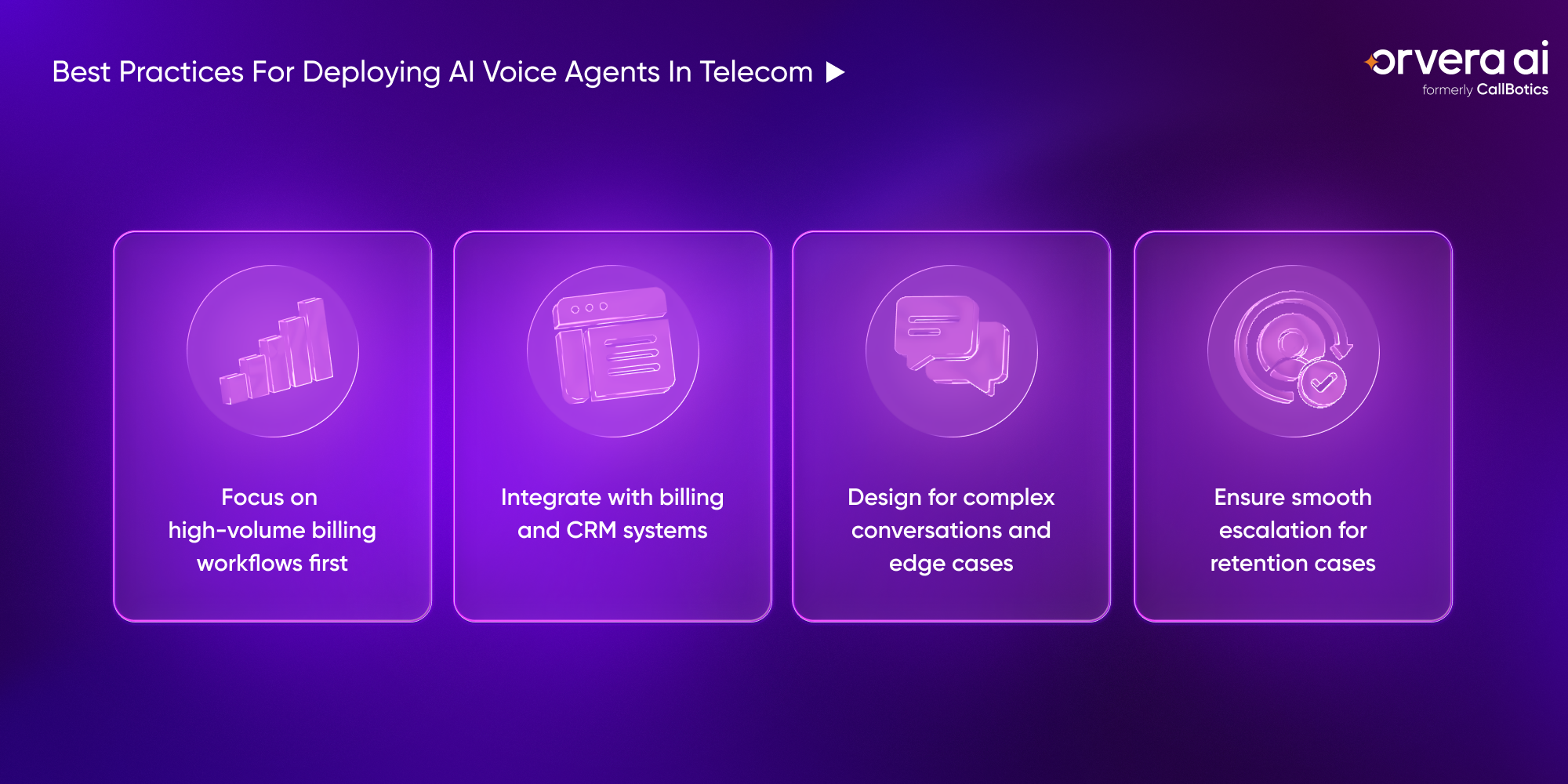
Focus on high-volume billing workflows first
Billing is usually the best place to start because it creates frequent, predictable, and time-sensitive support demand. Customers often call to understand charges, due dates, payment status, promotional changes, roaming fees, or device payments, and many of these requests can follow approved service logic. Starting here helps reduce avoidable wait time for customers with common billing questions.
Starting with billing helps teams show value quickly without taking on the most complex workflows first. It can reduce queue pressure during billing cycles, improve response speed for common questions, and free agents to focus on disputes, retention risks, and account exceptions. This also gives leaders a clear way to measure early impact through call containment, repeat contact, and escalation trends.
Integrate with billing and CRM systems
AI voice agents need access to the right customer and account data to give useful answers. For telecom support, this often means connecting with billing platforms, CRM systems, payment history, plan details, service status, and ticketing tools. The more accurate the data access is, the more helpful the interaction feels (opens in a new tab) to the customer.
Without real-time data access, the AI voice agent can only give generic answers, which is not enough for most telecom customers. Strong integration allows the agent to confirm account details, explain charges accurately, update records where approved, and escalate with full context when a human agent needs to step in. This reduces repeat questions and helps agents continue the interaction without rebuilding the customer’s story.
Design for complex conversations and edge cases
Telecom conversations are rarely limited to one simple question. A billing inquiry may turn into a plan-change request, a service complaint may reveal churn risk, and a troubleshooting call may require account verification, device checks, and escalation. The AI voice agent should be prepared for these shifts instead of forcing every customer into a fixed path.
AI voice agents should be designed for these branching scenarios. Teams need to map common paths, exception rules, fallback responses, escalation triggers, and approved next steps so customers do not get stuck when the conversation moves beyond a basic script. This makes the experience feel more natural while keeping the interaction within safe operational boundaries.
Ensure smooth escalation for retention cases
Some telecom interactions should not stay fully automated. Customers who mention cancellation, repeated billing disputes, unresolved outages, poor service history, or competitor switching need careful handling from a human agent. These moments require empathy, flexibility, and stronger judgment than a standard support request.
AI voice agents should recognize these signals and route the customer with the right context. A smooth escalation should include the reason for the call, issue history, customer sentiment, attempted resolution steps, and recommended next action, so the human agent can continue the conversation without making the customer start over. This helps retention teams respond faster and gives the customer a better chance of feeling heard.
KPIs to Track for Telecom Voice AI Success
Telecom teams should measure AI voice agents by business impact (opens in a new tab), not just call volume handled. The right KPIs show whether AI is improving retention, resolving customer issues, reducing support pressure, and creating a better service experience. Clear measurement also helps leaders see which workflows are ready to scale and which ones need refinement. This makes voice AI performance easier to manage across billing, service, account, and retention interactions.
Churn rate reduction
Churn rate shows whether customer relationships are improving over time. For telecom providers, this matters because billing frustration, service issues, repeat calls, and poor escalation experiences can all push customers toward cancellation. Tracking churn alongside support interactions helps teams understand where service quality is affecting retention. It also helps identify whether faster resolution and better follow-ups are reducing preventable customer loss.
- Track churn trends among customers who interacted with AI voice agents
- Compare churn risk before and after billing, service, or retention workflows are automated
- Review churn signals such as cancellation language, repeated complaints, and unresolved support history
Call resolution rate
Call resolution rate shows how often customer issues are completed without unnecessary repeat contact or escalation. This is one of the most important KPIs because AI voice agents should help customers move from question to outcome, not just answer basic prompts. A strong resolution rate means customers are getting the help they need without being passed around. It also shows whether the AI voice agent is handling the right use cases with enough context and service logic.
- Measure how many supported billing, payment, service, and account requests are resolved
- Track which interactions are completed by AI and which ones need human support
- Review unresolved calls to improve service logic, escalation rules, and response quality
Average handling time (AHT)
Average handling time shows whether AI voice agents are helping customers get through support interactions faster. A lower AHT can be valuable when it comes from clearer routing, faster information collection, and quicker resolution, not from rushing the customer. Telecom teams should look at AHT together with resolution and CSAT to avoid measuring speed in isolation. The goal is to reduce wasted time while still giving customers accurate answers and clear next steps.
- Track AHT for AI-handled calls and human-agent escalations
- Compare handling time across billing, troubleshooting, plan changes, and retention interactions
- Use AHT with a resolution rate so speed does not come at the cost of service quality
Customer satisfaction (CSAT)
CSAT shows whether customers feel the support experience was helpful, clear, and easy to complete. For telecom teams, this is important because customers often contact support when they are already frustrated by a bill, service issue, or account problem. A higher CSAT score can show that customers are getting faster answers without feeling ignored or pushed through automation. Lower scores can reveal where billing explanations, troubleshooting paths, or escalation handoffs need improvement.
- Measure CSAT after AI-handled and human-escalated interactions
- Review low CSAT scores alongside call summaries, sentiment, and resolution outcomes
- Track whether faster responses, clearer billing explanations, and smoother handoffs improve customer experience
How Orvera Supports Telecom Customer Experience
Orvera helps telecom teams handle high-volume customer interactions with AI voice agents that can support billing questions, service updates, payment reminders, account requests, and retention-related conversations. For telecom providers, this means customers can get faster answers for common issues while human agents stay focused on complex disputes, technical escalations, and high-risk churn cases. The platform also helps keep interactions structured, so customers are guided toward the right next step instead of being transferred repeatedly. This gives telecom leaders a practical way to improve support efficiency while protecting the customer experience.
- AI voice agents help explain billing details, plan changes, payment status, roaming fees, and add-on charges in simple language
- Churn risk can be reduced by identifying signs of frustration, repeated complaints, billing concerns, and cancellation intent during customer interactions
- Faster resolution is supported by handling approved service requests through structured logic and escalating complex cases with context
- Support efficiency improves by reducing avoidable call volume and giving agents more time for cases that need human judgment
- Telecom leaders get better visibility through QA, summaries, sentiment signals, interaction analytics, and performance dashboards
- Enterprise control is supported through integrations, governed escalation, auditability, and white-glove implementation
Conclusion
AI voice agents give telecom companies a practical way to manage support demand without relying only on larger teams or longer queues. They can help customers get faster answers for billing questions, service issues, payment reminders, account changes, and plan-related requests while keeping complex cases available for human agents. This helps support teams respond more consistently during billing cycles, outage spikes, and retention-sensitive moments.
The real value for telecom leaders is not just automation. It is better resolution, clearer communication, stronger churn visibility, and a more scalable support model. When AI voice agents are connected to the right systems, escalation paths, and performance metrics, they can help telecom providers reduce friction, protect customer relationships, and deliver a more consistent customer experience. The strongest results come when AI is used to support real customer service outcomes, not just reduce call volume.
Frequently asked questions
AI voice agents reduce churn by resolving common billing and service issues faster, identifying frustration signals early, and escalating high-risk customers with context.
AI can handle supported billing questions and collect dispute details, but complex billing disputes should be escalated to a human agent with the customer’s concern and account context.
Telecom teams should start with high-volume workflows such as billing inquiries, payment reminders, plan updates, service status checks, and basic troubleshooting.
AI voice agents improve customer experience by reducing wait times, giving clearer answers, keeping interactions consistent, and helping customers reach the right resolution path faster.
AI voice agents should integrate with billing platforms, CRM systems, payment records, ticketing tools, service status systems, knowledge bases, and contact center platforms.

Written by
Urza Dey
Urza Dey (She/They) is a content/copywriter who has been working in the industry for over 5 years now. They have strategized content for multiple brands in marketing, B2B SaaS, HealthTech, EdTech, and more. They like reading, metal music, watching horror films, and talking about magical occult practices.