Why Manual Reissue Handling Slows Every Exchange Call Your Agents Take
A new reservations agent takes their first call long before they can work an exchange or reissue unaided, because the applicable fare rule is hard to see. This post explains why manual reissue handling slows exchange calls and how agent assist helps.


Key highlights
Why Manual Reissue Handling Slows Every Exchange Call Your Agents Take
- A new reservations agent takes their first call long before they can work an exchange or reissue unaided, because the applicable rule is not visible.
- The delay begins the moment an agent needs to interpret airline fare rules and that information is not visible on their screen.
- Agent assist for reservations teams is a capability that surfaces the applicable fare rule, reissue path, and change fee on the rep's screen, in plain language, at the moment the traveler asks.
- Agent assist does not replace the reservations agent. The human rep stays on the call, keeps the decision, and keeps the relationship with the traveler.
- Agent assist translates automated airline fare rule surfacing into three plain-language outputs that land on the rep's screen the moment a change request arrives: what is permitted, what fee applies, and the reissue path.
- When real-time air ticket reissue guidance lands on the agent screen at the start of the call, the traveler spends less time on hold and gets the same answer regardless of which rep picks up.
- Agent assist for enterprise agentic AI for travel operations works alongside the systems your floor already uses, so the human rep never leaves their own workflow to find a fare rule.
- Agent assist for fare rules moves three operational variables that every director of reservations is accountable for, and it moves all three in the right direction.
- Agent assist moves exchange call duration down, agent-to-agent answer variance down, and new-hire time to independent exchange competency down.
Why does it take so long for a new reservations agent to handle exchanges on their own?
A new reservations agent takes their first call long before they can work an exchange or reissue unaided, because the applicable rule is not visible.
New hires move through product knowledge, system navigation, and basic booking work with relative speed. Exchanges are where ramp stalls. The conditions that determine what a traveler can do with a ticket, what fee applies, and which reissue path is available live in dense fare rule text that exists outside the booking interface. Finding that text, reading it accurately, and translating it into a clear answer for a caller while the call is in progress is a skill that takes time to develop. Until it develops, a new hire needs a more experienced colleague to confirm the interpretation.
That dependency is where reissue path guidance for reservations agents becomes a floor-level problem rather than a training problem. Agent assist for travel contact centers addresses the root of it: the applicable rule is not on the screen when the agent needs it. Reservations leaders want time to competency to come down, and this article explains why the reference material gap is the single lever that moves it.
What actually slows an agent down when a traveler asks to change a ticket?
The delay begins the moment an agent needs to interpret airline fare rules and that information is not visible on their screen.
The sequence is familiar to directors who have listened to recorded calls. The agent reaches the point where an answer is required. They place the traveler on hold. They leave the conversation and navigate to a separate reference document, a carrier portal, or a rate sheet. They read what they find, decide whether it applies to this ticket, and then return to the call to explain it. Every step in that sequence adds time that the traveler experiences as silence.
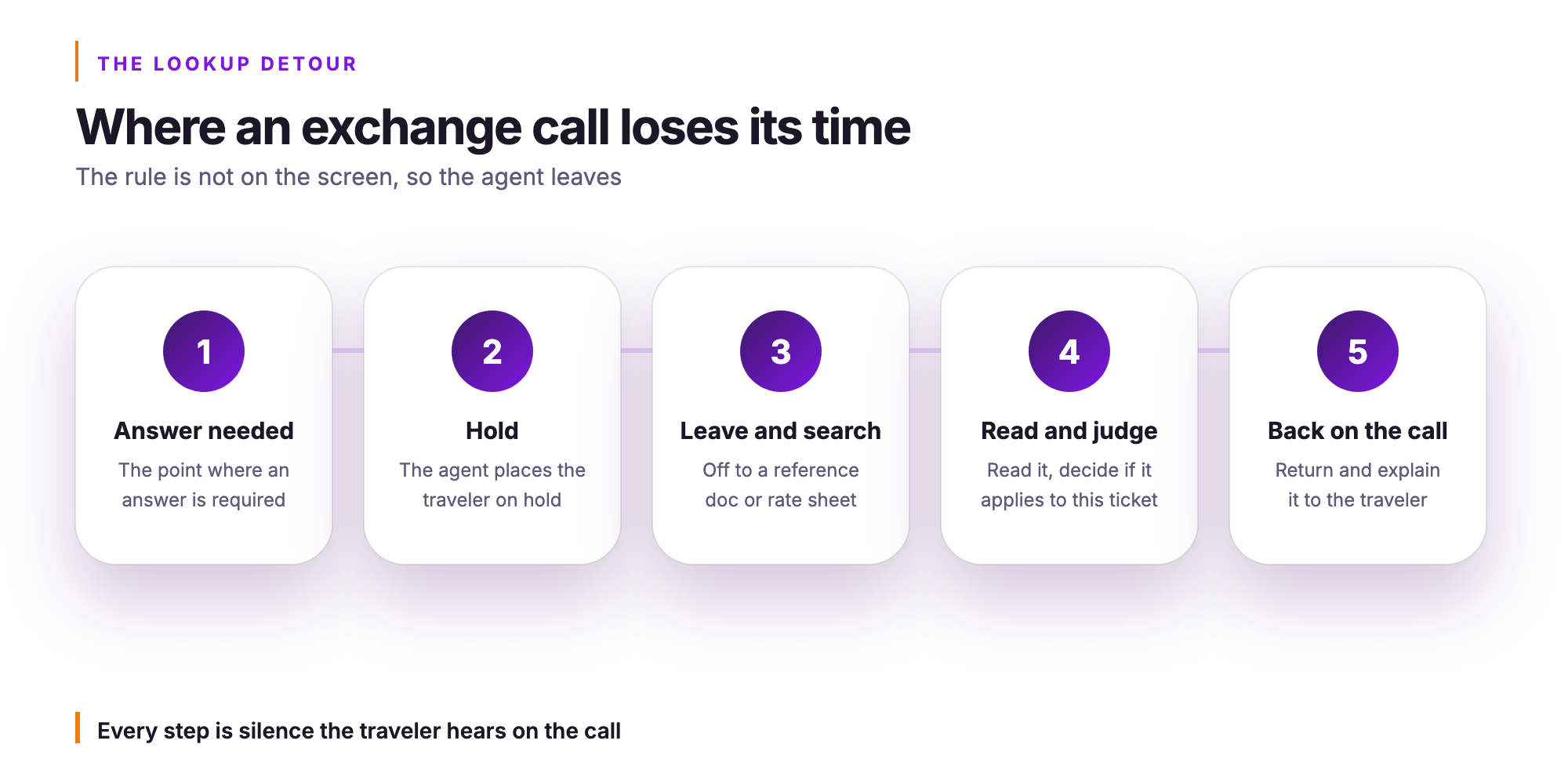
The real bottleneck is not the rule itself. It is the gap between the moment the question arrives and the moment the applicable guidance reaches the agent. A tenured rep who has internalized common fare rule patterns will close that gap faster. A newer hire will not. And when two agents interpret the same document differently, two travelers with identical itineraries can receive two different answers.
The operational impact is predictable. Calls run longer than they need to. Answers vary from one agent to the next. Leads get pulled in to resolve disagreements before a reissue is confirmed. Human in the loop agent assist for travel exists precisely to close that gap without removing the agent from the decision. The following section describes how that assistance functions when it reaches the agent in real time.
What is agent assist for fare, reissue and rate rules?
The information appears while the conversation is already in progress. There is no separate lookup, no tab-switching, and no waiting for a supervisor to interpret a tariff. The rep sees three things: what the ticket permits, what fee applies, and what the air ticket reissue path is. That is the complete output.
The rep reads it, decides, and speaks to the traveler. Orvera AI provides the reading. The agent supplies the decision. That distinction matters because no two exchange requests are identical. A traveler's circumstances, the original booking conditions, and any exceptions in play all require a person to weigh them. The platform removes the lookup burden so the rep can focus entirely on that judgment.
Orvera AI custom-trains its own contextualization models on de-identified data, which means the rule surfaced on the screen reflects the specific fare family and ticket conditions in front of the rep. The output states the rule as it applies to this ticket. What the rep reads is what the rule says, stated in the language a traveler can hear and act on.
That distinction between information and decision points directly to the question most operations leaders ask next: does this layer change who stays on the call?
Does agent assist replace the reservations agent on the call?
The human rep stays on the call, keeps the decision, and keeps the relationship with the traveler. Agent Assist puts the applicable rule in front of them while they do it.
Some customer contact work is repeatable enough that a system can carry it from greeting to resolution. Exchange and reissue work is different. It carries judgment: the traveler's specific circumstances, the exception that does not fit the standard path, the moment where policy and goodwill have to be weighed by a person who can read the conversation. No automated reissue path identification resolves that judgment. It surfaces the path. The agent decides what to do with it.
“The rep retains the decision. The screen gives them what they need to make it faster and with more confidence.”
Support for the rep on the call. What agent assist changes is the time a rep spends retrieving information before they can act. Fare rules land on the screen. The reissue path is visible. The fee that applies is stated plainly. The agent's attention shifts from searching to serving. The traveler gets a faster answer from a rep who is fully present in the conversation, not working through a manual lookup while the caller waits.
The distinction matters. Reservations leaders who have stood on the floor understand that exchange calls earn trust or lose it. That outcome belongs to the person on the call, supported by what is now visible in front of them.
How does agent assist turn a fare rule into something an agent can read and act on?
Agent assist translates automated airline fare rule surfacing into three plain-language outputs that land on the rep's screen the moment a change request arrives: what is permitted, what fee applies, and the reissue path.
The fare rule itself sits inside the reservation record in a form that was never written for a rep to read aloud to a traveler. Conditions are nested, exceptions reference other conditions, and the language assumes a reader who spends years inside that structure. Most reps do not have years. And even experienced reps, reading under pressure on a high-volume day, read slowly.
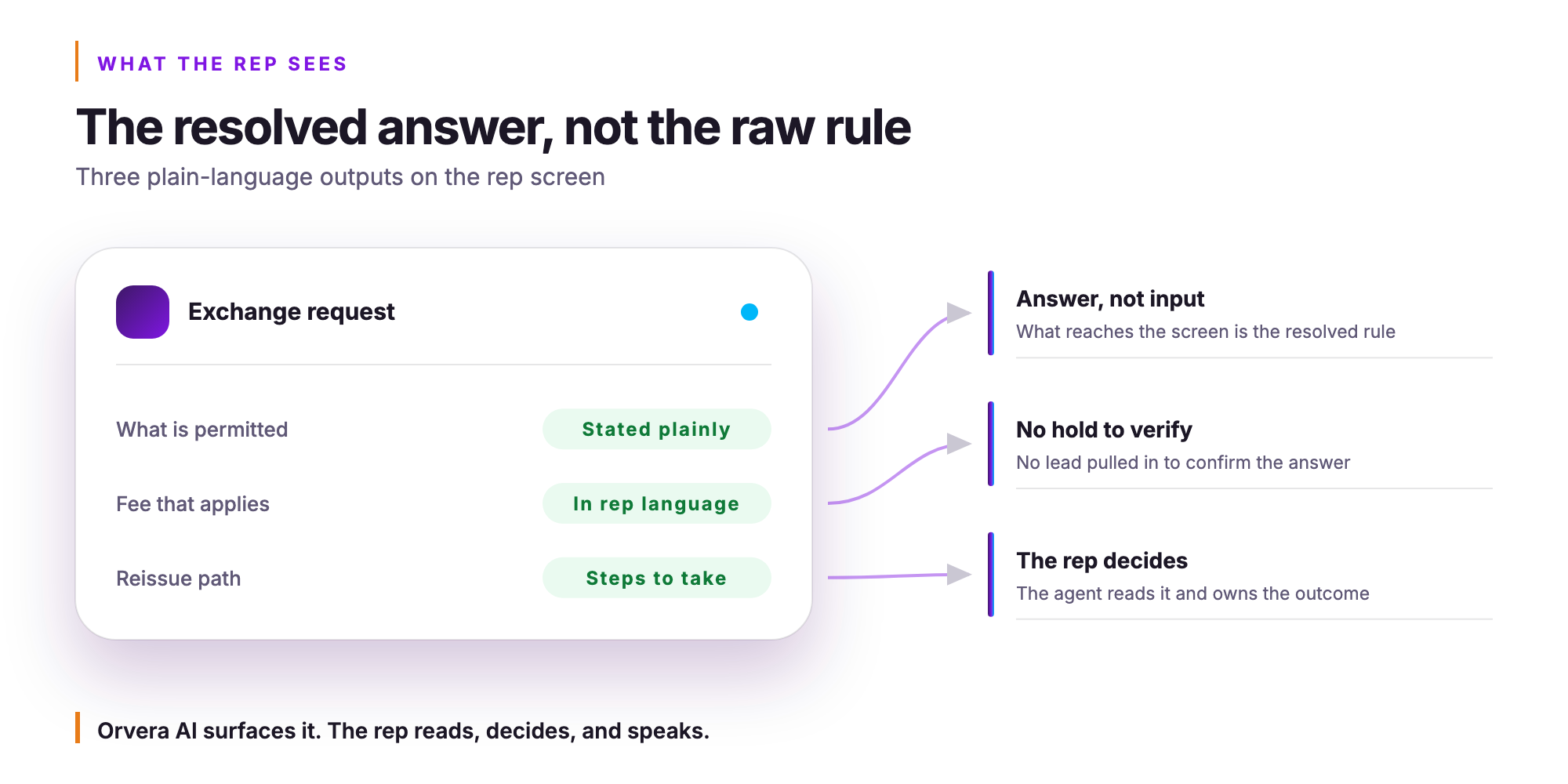
What the rep sees instead is a resolved answer. Permitted or not permitted, stated plainly. The fee that applies to the change being requested, described in terms the rep can speak directly. The reissue path, meaning the sequence of steps the rep takes to complete the exchange. No interpretation required, no hold to verify, no lead pulled in to confirm.
Orvera AI custom-trains its own contextualization models on de-identified data, and that training is what lets the output arrive in language a rep can act on rather than in the raw rule text. The distinction matters. A system that surfaces the rule moves the problem one step closer to the rep. A system that resolves the rule removes the problem from the call.
What reaches the screen is the answer. That is the difference between a reference tool and a decision support capability, and it is why new-hire time to competency moves in the direction it does when agent assist is in place. The next consideration is what that resolved answer means for the traveler on the other end of the call.
How does putting the rule on the screen change what the traveler experiences?
The connection between what the rep sees and what the traveler hears is direct. Without the rule in front of them, the rep puts the traveler on hold to find it, calls a senior colleague, or issues a best-guess answer. Any of those paths adds time the traveler feels. When the rule surfaces immediately, the hold disappears. The rep can speak to what is permitted, what fee applies, and the reissue path without leaving the call to search for it.
Consistency is where the traveler experience shifts most clearly. In practice, two reps working the same exchange routing will reach the same conclusion when the same rule is in front of both of them. Without it, the answer depends on tenure, training vintage, and recall under pressure. The traveler who reaches a newer rep on a complicated exchange should not receive a different outcome than the traveler who reaches a senior one.
And that inconsistency compounds during disruption. When volume rises and every rep on the floor is working exchanges simultaneously, the variance that exists on a normal day widens. A traveler calling during a weather event is already under pressure. What they need is a rep who can read the rule, state the options, and move the call forward. Putting the rule on the screen does not change the disruption. It changes what the rep is able to do inside it.
That carries into how the reservation systems supporting the floor need to connect with what the rep sees.
How does agent assist fit with the reservation systems a travel operation already runs?
Agent assist for enterprise agentic AI for travel operations works alongside the systems your floor already uses, so the human rep never leaves their own workflow to find a fare rule.
That single point matters more than it may first appear. When the guidance surfaces inside the existing workspace, the rep stays oriented to the caller. There is no context switch, no second screen to manage, and no rule buried three tabs deep in a reference document. The call moves forward because the rep's attention stays on the traveler, not on the search.
What a reservations leader should work through before putting this in front of the floor:
- Current workflow mapping. Identify where reps currently pause to look up a fare rule or reissue path. Those pause points are where agent assist surfaces its output.
- Data access and permissions. Confirm that the contextual data needed to match a rule to a booking is accessible to the assist layer within your existing environment.
- Rep readiness. Determine how familiar your team is with reading a structured three-part output. The format is plain language, but a brief orientation session removes friction before the first live call.
- Governance review. Establish who on your team validates that the surfaced rule matches the version currently in effect. The rep keeps the decision. The assist layer surfaces the information.
Working through those four areas before go-live is what separates a smooth rollout from one that stalls at adoption. The next question is what a director of reservations should expect this to actually move on the floor.
What should a director of reservations expect agent assist to move?
Agent assist for fare rules moves three operational variables that every director of reservations is accountable for, and it moves all three in the right direction.
The first is how long an exchange call takes. When the permitted options, the applicable change fee, and the reissue path appear on the rep's screen at the start of the call, the rep stops searching and starts resolving. The call shortens.
The second is how much the answer varies from one rep to the next. A new hire reading the screen and a ten-year veteran reading the screen work from the same rule set. Variance compresses because the source of truth is consistent, not the individual.
The third is how long a new hire needs before they can work exchanges without pulling a lead in. Guided reissue logic on the screen reduces the dependency on senior reps for every edge case. New hires reach independent competency sooner.
This article carries no figure for any of the three. The only number worth acting on is the one measured on your own floor, against your own call mix, your own fare inventory, and your own rep population. Any figure stated elsewhere describes someone else's operation.
Agent assist moves exchange call duration down, agent-to-agent answer variance down, and new-hire time to independent exchange competency down.
The next section draws these threads together into what a reservations leader should take away before making any decision.
What should a reservations leader take away about agent assist for exchanges?
Agent assist for exchanges keeps the human agent on the call and in control, surfaces the applicable rule in real time, and moves the three variables that drive cost and inconsistency on a reservations floor.
- Fare rule surfacing on the agent screen means your representative reads what is permitted, what fee applies, and the reissue path before they say a word to the caller, not after they put the caller on hold to find out.
- The human agent stays on the call and keeps the decision. Orvera AI surfaces the guidance. Your representative reads it, confirms it, and owns the outcome.
- Agent-to-agent variance on exchanges narrows because every representative works from the same rule output on the same contact, not from memory or from whoever trained them.
- New-hire time to competency on exchanges shortens because the screen carries the knowledge your most experienced representative already holds, and a newer hire does not have to build that library through months of live calls.
The mechanism is straightforward and the stack integration runs on what you already have. If fare rule handling is where your handle time runs longest and your leads get pulled in most, talk to the Orvera AI team about what Agent Assist would surface on your floor.
Frequently asked questions
AI Agent Assist surfaces the applicable fare rules and restrictions on the agent's screen, in plain language, while the call is live.
Agent assist for travel exchanges gives the human rep faster access to the right answer. The rep keeps the call and keeps the decision.
Agent assist for fare rule interpretation shortens exchange calls by keeping the human rep in the conversation instead of out of it, searching for the rule.
Orvera AI is SOC 2 Type II certified, which makes it a SOC 2 compliant agent assist for travel operations where fare rule surfacing on the agent screen involves access to reservation records.
Orvera deploys Agent Assist across a reservations floor in 3 to 6 weeks, covering fare rule interpretation and reissue path guidance for reservations agents from the first day on the floor.
Agent assist for travel reservation management closes the information gap that slows every exchange and reissue decision, with your representatives still on every call.

Written by
Anindita Majumder
Anindita Majumder is a communications professional with nearly four years of experience in public relations, corporate communications, and journalism. She creates content that helps brands communicate their vision, products, and expertise through press releases, thought leadership, and editorial pieces. Outside of work, she is a vocalist, which keeps her creativity flowing.