How Agentic AI Decides Return Exceptions in Chat After a Portal Rejection
A self-service returns portal rejects a request when the transaction falls outside its fixed rules, and the customer calls because the portal gave them nowhere else to go.

Key highlights
- A self-service returns portal rejects a request when the transaction falls outside its fixed rules, and the customer calls because the portal gave them nowhere else to go.
- A return exception is any return request the portal cannot approve because the transaction falls outside its fixed rule set, even when the underlying reason is entirely legitimate.
- An agentic AI agent carries the full conversation, applies the retailer's own exception rules, and executes the return workflow inside the systems of record, delivering a resolution before the conversation ends.
- When a customer explains in chat that a final-sale item arrived damaged, an agentic AI agent applies the retailer's damaged-goods rule, issues the return authorization and label, and closes the conversation with a resolution.
- An agentic AI agent decides a loyalty-based exception by reading the customer's order and return history directly from the retailer's systems, then applying the exception threshold the retailer has set for that customer tier.
- An enterprise retailer wants the platform built and run for it because building and running a contact center operation that resolves return exceptions consistently is a full-time job that continues every day after the rules are set.
- Portal rejections that escalate to voice.
- Return authorization and label issued in the same conversation.
Why does a return portal rejection turn into a phone call?
A self-service returns portal rejects a request when the transaction falls outside its fixed rules, and the customer calls because the portal gave them nowhere else to go.
The moment is familiar. A customer submits a return, the portal checks the order date or the item category, and it issues a rejection with no explanation that accounts for the actual situation. The customer reads a message that amounts to "no," with no path forward and no one to hear why the case is different. So they pick up the phone.
That call lands on your queue as an escalation the portal was supposed to handle. Your representative then spends the first minute of the call listening to someone re-explain what they already typed into the portal, because the conversation starts over from zero. A portal cannot ask a follow-up question. It cannot hear that the item arrived damaged, that the order number is missing because of a shipping error on your side, or that the window expired by two days. A fixed rule reads the data, and if the data does not match, the answer is rejection.
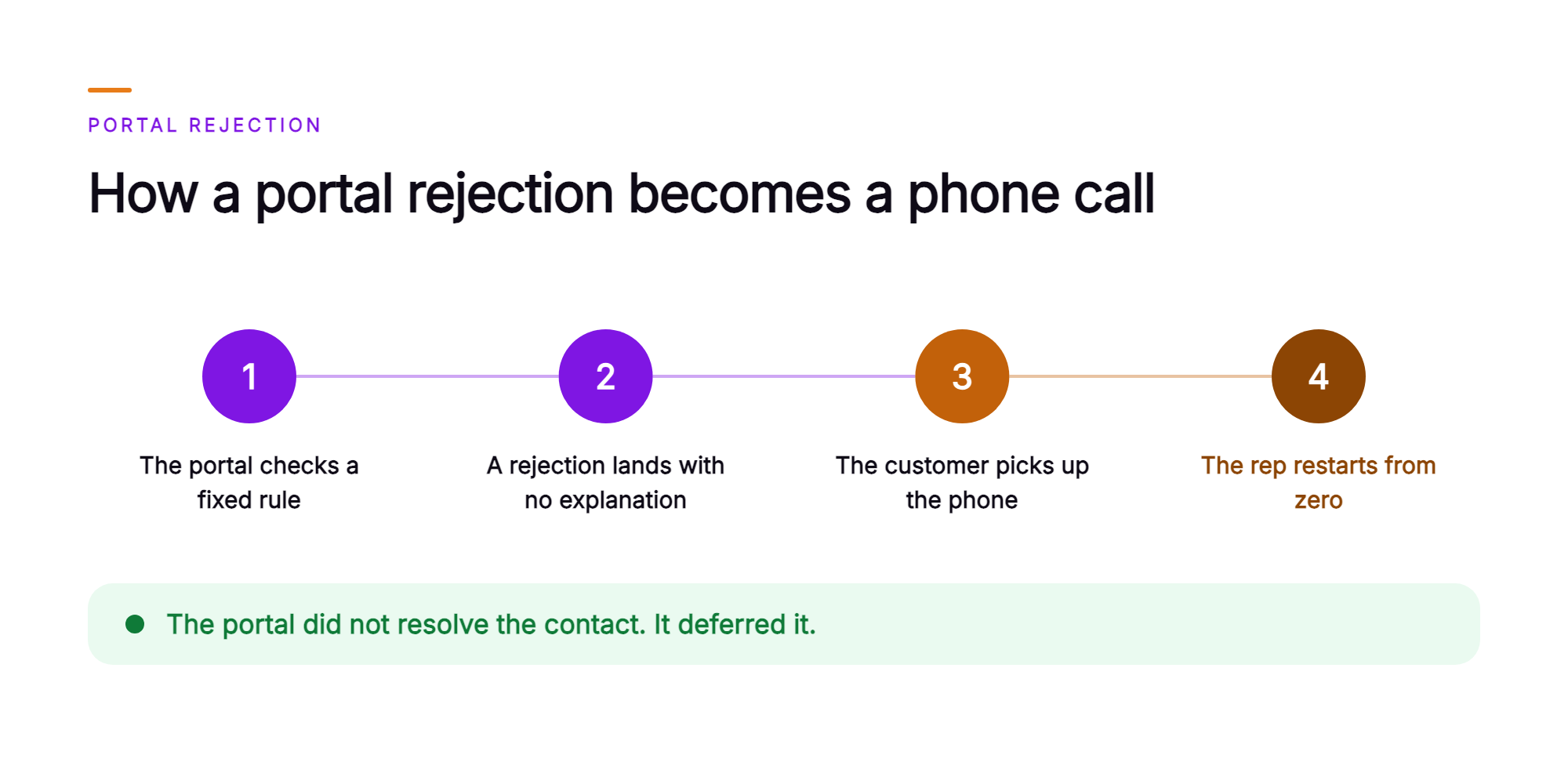
The escalation is where the cost compounds. The customer is already frustrated. The representative has no context. And every return exception that should have been resolved in self-service is now a refund authorization call (opens in a new tab) that carries its own handling time and its own risk of getting it wrong. The portal did not resolve the contact. It deferred it.
What is a return exception, and why can a portal not decide one?
A return exception is any return request the portal cannot approve because the transaction falls outside its fixed rule set, even when the underlying reason is entirely legitimate.
Common exceptions include orders outside the stated return window, a missing order number caused by a carrier error, a final sale item that arrived damaged, a wrong item shipped by the warehouse, and a repeat returner whose history may or may not reflect a genuine pattern. Each situation has context. A portal has none.
The structural problem is that a portal matches data fields against thresholds. It does not ask a follow-up question. When a customer submits a return request rejected by the portal, the system has no mechanism to hear that the package arrived three days after the window because of a weather delay. The rule fires, the rejection lands, and the conversation ends before it begins.
What a conversation can do, a fixed rule cannot. A rep who reads the order notes, asks one question, and applies the retailer's exception policy in sixty seconds resolves the contact. The portal, by design, cannot replicate that exchange. It was built to handle standard transactions, and an exception is, by definition, not standard.
That gap points directly to what an agentic AI agent can do inside the conversation itself.
What does an agentic AI agent do inside a return conversation?
An agentic AI agent carries the full conversation, applies the retailer's own exception rules, and executes the return workflow inside the systems of record, delivering a resolution before the conversation ends.
Return exceptions are where that capability matters most. An agentic AI agent can read the order date, identify the exception condition, match it against the retailer's rule set, and execute. The rules, the thresholds, and the policy belong to the retailer. The agent applies them. And when the rules do not allow an approval, the agent explains that plainly and completely, so the customer leaves the conversation with a clear answer and knows where the return stands.
That execution, carrying intent from greeting to resolution through live system data, is what separates a finished contact from a deferred one. The next question is how that plays out in practice for a specific exception type.
How is a damaged final-sale item handled in the chat?
When a customer explains in chat that a final-sale item arrived damaged, an agentic AI agent applies the retailer's damaged-goods rule, issues the return authorization and label, and closes the conversation with a resolution.
The portal never reaches that outcome. Its rule reads "final sale" and stops there. It has no mechanism to receive the customer's explanation, and so the rejection lands before the conversation begins.
Consider what returns automation makes possible inside the chat channel. A customer opens the chat and explains the item arrived with a cracked casing. The agent reads the order record, identifies the final-sale flag, and then checks the retailer's damaged-goods policy against that flag. The retailer's rule allows an exception when the item arrives in a condition that differs materially from what was shipped. The agent applies that rule, issues the return authorization, and sends the prepaid label. The retailer wrote the rule. The agent applies it. The threshold belongs to the retailer.
And the customer leaves the conversation with the return label in their inbox. The resolution happens inside that one chat, from the first message to the label, and the contact is finished there. That outcome is what a fixed rule set, designed for standard transactions, cannot produce on a damaged final-sale item.
One category of return exception depends less on item condition and more on who the customer is. That distinction points directly to how the agent decides a loyalty-based exception.
How does the agent decide a loyalty-based exception?
An agentic AI agent decides a loyalty-based exception by reading the customer's order and return history directly from the retailer's systems, then applying the exception threshold the retailer has set for that customer tier.
The distinction from a fixed portal rule is direct and consequential. A portal applies one rule to every transaction, regardless of who is asking.
- Standard portal rule: A customer submits a return request one day outside the window. The rule fires a rejection. The portal has no visibility into whether that customer has placed 40 orders in the past year or whether the item in question was a defective item return that arrived damaged.
- Tier-aware exception rule: The agent reads the customer's full order and return history, identifies the customer's loyalty tier, and applies the exception threshold the retailer has configured for that tier. A customer who meets that threshold receives the approval. One who does not receives a clear, complete explanation.
The retailer writes the rule. The retailer sets the threshold. The agent applies both. Policy integrity holds because the agent executes the retailer's own configured logic against live system data. That is what makes the outcome reviewable, which points directly to how the platform is built and run.
Why does an enterprise retailer want the platform built and run for it?
An enterprise retailer wants the platform built and run for it because building and running a contact center operation that resolves return exceptions consistently is a full-time job that continues every day after the rules are set.
Orvera builds, deploys, and runs the AI agents and the full platform on the systems the retailer already operates. A complete enterprise deployment lands in three to six weeks. The retailer's existing stack stays in place. Orvera configures the exception logic, connects the data sources, and runs the operation from day one.
That operating responsibility extends to every conversation the platform touches. Orvera audits every conversation, human-handled and AI-handled, across every channel. A return exception approved in chat and a return exception escalated to a human rep both carry the same review. The audit reaches every exception decision. That coverage is what makes the exception path reviewable and policy integrity verifiable.
Orvera brings 18 plus years of contact center operations to that responsibility. The retailer's exception rules, thresholds, and escalation paths go in at the start. How the operation runs them under volume, and the quality standard it holds every decision to, reflect that experience. That operational depth is what the retailer is engaging when it puts Orvera on the floor.
The results of that approach become visible in the numbers. And the right measures to watch point directly to what a returns leader should track first.
Which numbers tell a returns leader this is working?
A returns leader knows the agentic AI agent is working when four specific measures move in the right direction: portal rejections that escalate to voice fall, return policy exceptions resolved inside the chat rise, return authorizations and labels issued in the same conversation increase, and customer satisfaction on the exception path improves.
The goal is finished conversations. Each measure below tracks a distinct dimension of that outcome.
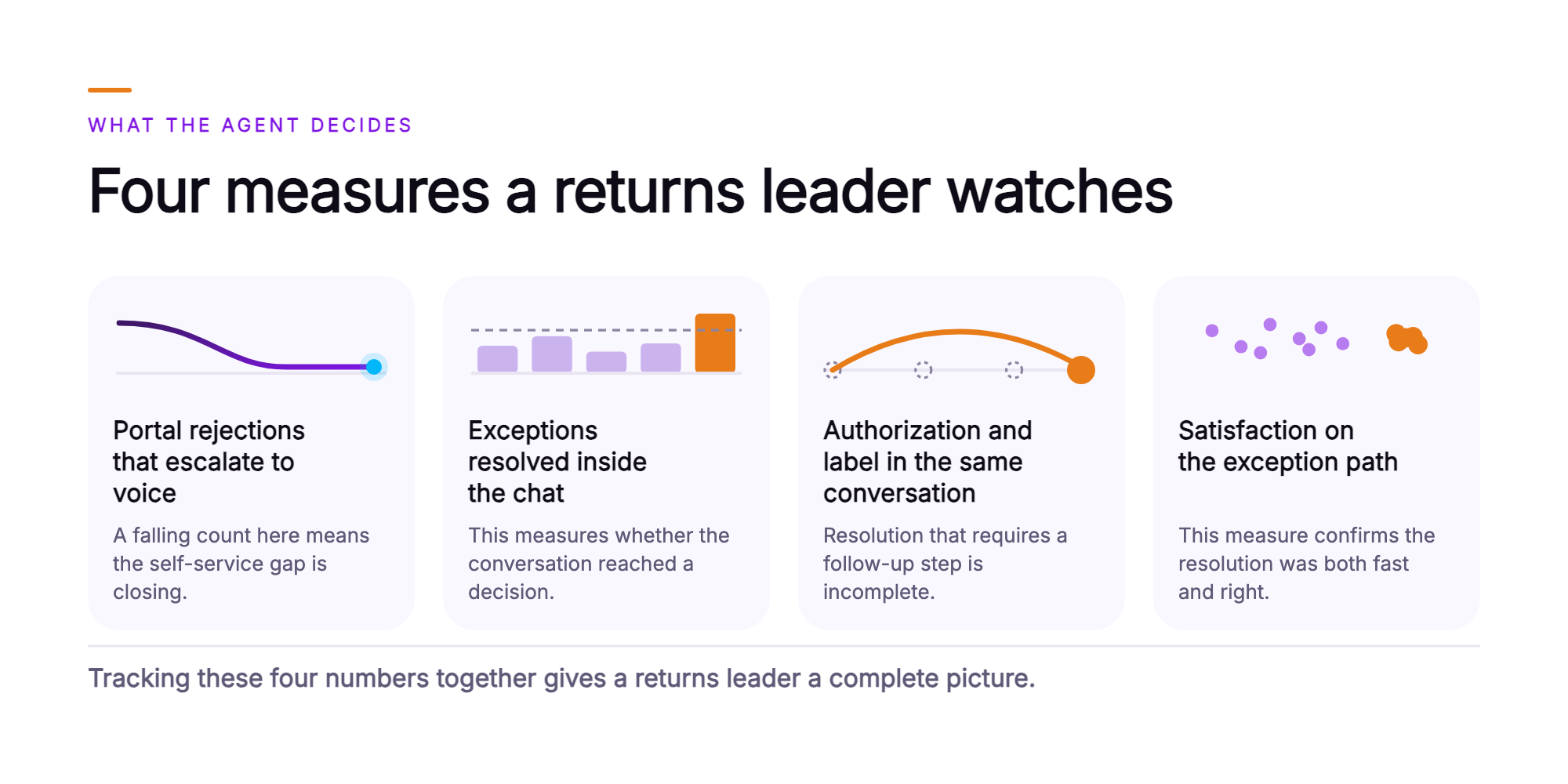
Portal rejections that escalate to voice. This is the originating failure the earlier sections described. When an AI agent resolves the exception inside the chat, the contact ends there. A falling count here means the self-service gap is closing.
Exceptions resolved inside the chat. This measures whether the conversation reached a decision. Approval or a clear, policy-grounded explanation both count as resolution. A contact that ends without a decision is not resolved.
Return authorization and label issued in the same conversation. Resolution that requires a follow-up step is incomplete. The measure that matters is whether the customer received the authorization and the label before the conversation closed.
Customer satisfaction on the exception path. Return policy exceptions are high-stakes contacts. A customer whose damaged item or loyalty exception was decided fairly and promptly will register that experience. This measure confirms the resolution was both fast and right.
Tracking these four numbers together gives a returns leader a complete picture. And that picture is exactly what belongs in a leadership conversation.
What should a returns leader take to their leadership team?
A returns leader should bring four points to their leadership team: the portal rejection is the moment the customer is most likely to escalate, the exception is decidable inside the conversation, the rules stay the retailer's, and every decision is reviewed.
Portal rejections are not a customer education problem. They are the point in the return journey where a fixed rule set meets a situation it was not built to decide, and the customer feels that gap directly. That moment is also the one where the exception path matters most. The conversation can decide what the portal cannot, and it can finish the contact in the same chat.
The case for leadership is straightforward because the mechanics are straightforward. The AI agent reads the customer's history, applies the thresholds the retailer has configured, issues the authorization and label when the rule allows, and delivers a clear explanation when it does not.
Four points that stand on their own:
- The portal rejection is the highest-risk moment. It is where escalation, repeat contact, and lost confidence converge. The conversation is the right place to resolve it.
- The exception is decidable. Return exceptions, whether a damaged final-sale item or a loyalty-tier threshold, carry enough structured data for an AI agent to apply the retailer's rule and reach a decision.
- The rules stay the retailer's. Exception thresholds, authorization limits, and escalation paths are configured by the retailer. The AI agent applies them. Policy ownership stays with the retailer.
- Every decision is reviewed. Orvera audits every conversation across every channel. Human-handled and AI-handled contacts carry the same review standard. The exception path is verifiable.
What those four points produce in practice is what the next question addresses.
What does the exception path look like once the conversation can decide?
The exception path becomes a single conversation: the customer explains the situation once, the AI agent applies the retailer's configured rule, and the return authorization and label issue before the customer closes the chat.
The case that a portal rejection would have sent to the phone queue is decided in the chat the customer opened. The customer states the problem. The AI agent reads the order history, checks the exception threshold, and reaches the decision the retailer's own rules prescribe. When those rules allow it, the return authorization and label issue in the same conversation. When they do not, the agent explains the actual reason in plain terms, naming the specific rule that applies.
That is what a finished contact looks like. A portal that cannot decide an exception defers it. An AI agent built on the retailer's own return exception rules resolves it or closes it clearly, and every decision is reviewed.
Orvera AI builds, deploys, and runs that operation. Full enterprise deployment lands in three to six weeks, on the stack you already have. Every conversation across every channel carries the same audit. SOC 2 Type II certified, HIPAA compliant, and GDPR compliant.
To see how it runs on your own returns policy, talk to the team (opens in a new tab).
Frequently asked questions
The AI agent decides every return exception the retailer's own rules authorize it to decide, reading the order and the customer's return history in your systems, applying your thresholds, and issuing the return authorization and label in the same conversation. The AI agent applies the retailer's own return exception rules. The rules and the exception thresholds belong to the retailer. The agent applies them. Common exception types it decides: - Return window passed by one to a few days, within a loyalty-tier grace allowance - Missing order number, resolved against the account record - Wrong item shipped, confirmed against the order - Final-sale item that arrived damaged - Prepaid label reissue for a stalled prior return How each refund call is audited is a separate question, and the answer matters for what happens when the rules say no.
When the retailer's rules do not authorize a return, the AI agent explains the specific rule that applies, in plain terms, in the same conversation. The customer hears the reason stated in full. Where the retailer's policy offers an alternative, such as a replacement, an exchange, or a store credit, the agent presents that option directly. The conversation is resolved. The outcome the customer walks away with is an answer they can act on. What the retailer's rules reserve for a human rep is a separate design question, and that is where the next section picks up.
When a return falls outside what the retailer's rules authorize, the AI agent routes the conversation to a human rep with the full context already on screen. The routing is part of the design. The retailer's own flags and thresholds define which cases go to a person. Common examples include: - Request value above the retailer's set dollar threshold - A repeat returner the retailer has flagged in its own system - A customer who asks to speak with a person - A request no existing rule covers The human rep receives the conversation, the order detail, and the customer's return history. The conversation carries forward. The rep picks up from what the customer already explained. That handoff is a resolved routing decision, and what gets recorded about it is where the next section picks up.
Every return exception decision produces a full transcript and summary that Orvera audits, covering every conversation across every channel, where the industry norm is a one to three percent sample. That coverage is the operational standard. The platform applies the rules your team sets, and the record shows exactly what happened in each conversation. A human-handled case carries the same audit as an AI-handled one. When a decision drifts from the retailer's configured rule, the review surfaces it and the rule is corrected at the source. That record lives inside the same platform stack the retailer already runs, and how the platform connects to those existing systems is where the next section picks up.
The AI agent connects directly to the order management, CRM, and helpdesk systems a retailer already runs, reading order status, return history, and customer data from those systems in the same conversation. Human-in-the-loop AI return processing depends on that connection being live. When a human rep receives a routed case, the context on their screen comes from the same systems the AI agent read, so the transition is clean and the rep continues from what the customer already said. The platform supports 500+ enterprise system integrations, covering the stack most enterprise retailers already operate. How quickly that connection is live, and what Orvera does to get it there, is where the next section picks up.
Orvera AI builds, deploys, and runs the AI agents and the platform for the retailer. That work spans knowledge base setup, agent training, and change management. Full enterprise deployment lands in three to six weeks. Orvera has over 18 years of contact center operations experience. That history is what the deployment is built on. The retailer's return rules, exception thresholds, and flags go in at the start. Orvera configures the agents against them. Orvera stands up the infrastructure and runs the configuration steps. The platform is SOC 2 Type II certified, HIPAA compliant, and GDPR compliant. Orvera audits every conversation it handles, across voice, chat, email, messaging, and every other channel.

Written by
Anindita Majumder
Anindita Majumder is a communications professional with nearly four years of experience in public relations, corporate communications, and journalism. She creates content that helps brands communicate their vision, products, and expertise through press releases, thought leadership, and editorial pieces. Outside of work, she is a vocalist, which keeps her creativity flowing.


