How an AI Agent Answers Find-a-Provider and Cost-Estimate Questions for Health Plans
A member searched the plan's directory to find in-network doctors, booked the visit, and is now calling because the Explanation of Benefits (EOB) shows the provider billed out-of-network.

Key highlights
- A member searched the plan's directory to find in-network doctors, booked the visit, and is now calling because the Explanation of Benefits (EOB) shows the provider billed out-of-network.
- The agent runs a defined sequence every time: confirm who the member is, read what the plan covers for that member, look up the named provider in the live directory, and explain the cost share in plain language before the visit happens.
- A member on a tiered PPO product types the name of an orthopedic specialist into the plan's chat channel, asks the AI agent to check if the doctor is in network, and wants to know what an office visit will cost before she books.
- Provider termed from the panel on a future date.
- Medical necessity or coverage determination.
- Orvera AI builds the agent, deploys it, integrates it to the directory and benefits systems the plan already runs, and the operation is live in three to six weeks.
- Four counts drawn from the plan's own conversation logs tell a member services leader whether the in network provider search and cost-estimate operation is producing real resolution.
- Grievances tied to network-status information.
Why do members still call after searching the plan's provider directory?
A member searched the plan's directory to find in-network doctors, booked the visit, and is now calling because the Explanation of Benefits (EOB) shows the provider billed out-of-network.
The directory displayed a name and an address. It did not show whether that physician participates in the member's specific product, or at which tier, or whether the effective dates still hold. Panel status lives in a combination of the provider data management system and the benefits configuration, and it resolves at the intersection of those two systems against the member's own product. The directory page shows none of that.
Cost-sharing adds another layer. What the member will pay depends on how far their deductible and out-of-pocket maximum have moved, and that accumulator lives in the claims system, not the directory. The representative on the call accesses three systems in sequence, reads the confirmed answer back, and the same question arises from the next member in the queue.
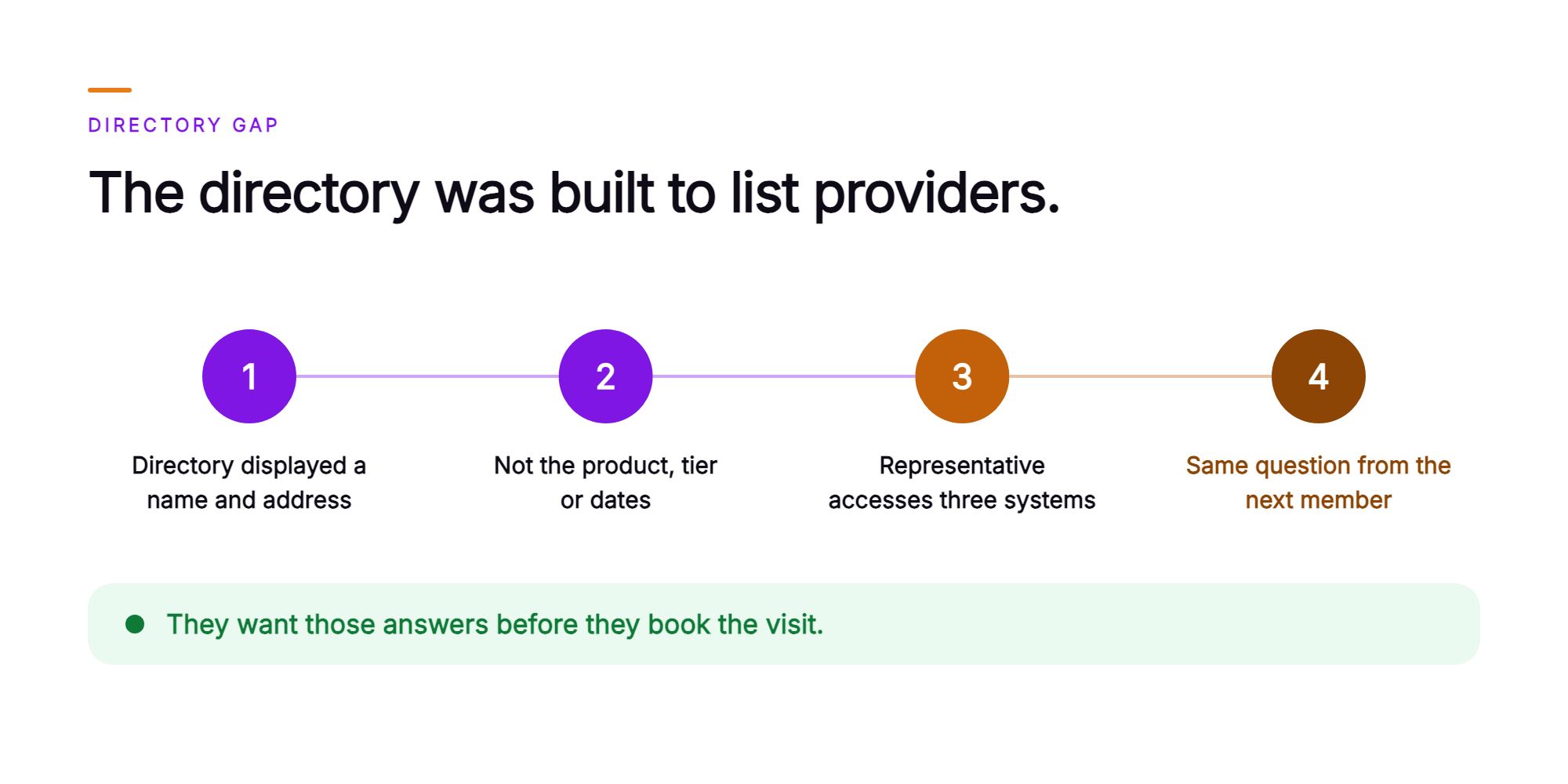
That pattern repeats because the directory was built to list providers, not to answer benefit questions for a specific member. Members want two confirmed answers: is this doctor in my network for my plan, and what will I pay at this point in my benefit year. They want those answers in the channel they are already in, before they book the visit. The sections that follow describe how an AI agent delivers both.
What is find-a-provider and cost-estimate chat for a health plan?
Find-a-provider and cost-estimate chat is a managed conversation, running in the plan's own channels, where a member names a provider or procedure and receives a confirmed answer on panel status and cost share before a single claim is filed.
Consider it a doctor finder by insurance that applies the member's own benefit context to the search. The AI agent reads the member's actual eligibility record, including product, group, tier, and effective dates, and then cross-references the live provider directory. The result is one confirmed answer the member can use right away.
The answer draws on four systems working together. The provider directory or provider data management system confirms panel status. The benefits configuration file supplies the tier and the applicable cost-share rule. The claims system carries the member's accumulator, so the agent knows whether the deductible has been met. The CRM or member record ties those answers to this specific member and holds the summary of what was said.
One boundary holds throughout. The AI agent explains what the plan's rules mean for this member, plain language that a member can act on. The benefit determination and the claim outcome stay with the plan. The agent does not decide. It explains.
This conversation runs in the plan's web chat, in-app messaging, voice line, and every other channel the plan already operates, across more than 80 languages. The next section walks through the exact sequence the agent runs to produce each answer.
What does the agentic AI agent do with a network or cost-share question?
The agent runs a defined sequence every time: confirm who the member is, read what the plan covers for that member, look up the named provider in the live directory, and explain the cost share in plain language before the visit happens.
Member and eligibility resolution. The agent begins by confirming the member's identity and pulling the eligibility record. From that record it reads the product, group, tier, and effective dates. Those values drive the lookup and the cost-share explanation that follow, so both answers come from this member's current enrollment.
Provider lookup. With the product confirmed, the agent queries the live directory for that product. The lookup returns the provider's panel status at the named location, distance from the member's address, specialty, gender preference, hospital affiliation, and whether the provider is accepting new patients. This is the in-network provider search a member needs, read from the panel as it stands at the moment of the question.
Cost-share explanation. The agent then functions as a healthcare cost estimator for this specific member. It reads the accumulator, reads the benefit the plan's configuration assigns to the visit or procedure, and explains in plain language whether the deductible has been met and whether a copay or coinsurance applies. The explanation covers the mechanics only. The plan's benefit determination and claim outcome stay with the plan.
Closing the interaction. Once both questions are answered, the agent writes the summary to the member record, sends the provider details to the member, and offers the next step where the plan's rule calls for one, whether that is a referral note or a warm transfer to a human rep. The next section walks one real query through that sequence from the first message to the closed chat.
How does one member's question about a specialist visit play out?
A member on a tiered PPO product types the name of an orthopedic specialist into the plan's chat channel, asks the AI agent to check if the doctor is in network, and wants to know what an office visit will cost before she books.
The agent confirms her identity, reads her plan product, and looks up the named specialist. The result: the physician is on the Tier 1 panel for that specific product at the listed office location and is accepting new patients. The agent then reads her accumulator. Her deductible has not been met. As the benefit is written, an office visit to a Tier 1 specialist before the deductible is satisfied applies to the deductible at the plan's negotiated rate. The agent explains that mechanism in plain language, does not name a dollar figure, and states that the claim outcome rests with the plan.
The scenario follows a second path when the directory answer changes. If the specialist is not on the panel, the agent says so, names the effective date the provider left the network, and presents in-panel orthopedic specialists sorted by specialty match and distance from the member's address.
Either way, the chat closes the same way. The member leaves with the provider's confirmed details, the referral requirement where one applies, and a summary written to her member record. The question is closed. It took one chat. The next section maps the full range of questions the agent answers and the ones it passes directly to a human rep.
Which questions does the agent answer and which does it pass to the plan?
The agent addresses every question that a health plan provider directory and benefits record can resolve with certainty. When a question requires a plan determination, the agent transfers the conversation and the transcript to a human representative.
That boundary is the design. A well-drawn scope is what makes the agent reliable. In practice, the question types fall cleanly into two groups, and the routing rule for each is fixed.
Questions the agent resolves directly, paired with the plan's rule that governs each:
- Provider termed from the panel on a future date. The agent reads the termination date from the directory and tells the member the exact date the provider leaves the network, so the member can book before that date or choose an in-panel alternative.
- Provider sitting in Tier 2. The agent names the tier, explains that a higher cost share applies compared to Tier 1, and states the member's current cost share for that tier.
- Procedure requiring prior authorization. The agent confirms the requirement and starts the authorization request the plan's process calls for, so the request is with the plan while the member is still in the chat.
- Family plan deductible question. The agent reads the member's accumulator data and confirms whether the individual or the family deductible threshold applies to this specific member at this point in the benefit year.
Questions the agent explains but does not decide, or hands directly to a human rep:
- Medical necessity or coverage determination. The member asks whether a procedure will be covered or is medically necessary. The agent explains the benefit as written in the plan document and states clearly that the determination comes from the plan's own review process. The agent does not predetermine outcomes.
- Bill dispute or grievance. The member contests a charge or asks to file a grievance. The agent transfers the conversation to a human rep and passes the full chat transcript so the rep starts with complete context, the member's own words already on screen.
Every routing decision runs the same logic: if the directory and the member's benefits record contain a confirmed answer, the agent delivers it. If the answer requires the plan to exercise judgment, the plan's people carry it. That division protects the member, protects the plan, and is what lets the AI agent run reliably across every channel the plan operates. The next section covers how Orvera AI builds and runs that operation on the plan's behalf.
Why would a health plan want the platform built and run for it?
Orvera AI builds the agent, deploys it, integrates it to the directory and benefits systems the plan already runs, and the operation is live in three to six weeks.
Operating heritage. The platform runs on 18+ years of contact-center operating experience. That history is what lets Orvera run the member services conversation on the plan's behalf and answer for how it performs.
Governance and audit trail. Auto QA audits every conversation, human-handled and AI-handled alike. Every interaction produces a transcript, a summary, and a report log. The plan sees what was said, what was resolved, and what was escalated, across every channel.
Compliance posture. A payer needs certainty before AI touches a member conversation. Orvera AI is SOC 2 Type II certified and HIPAA compliant. The platform is model-agnostic, so the plan can move to a stronger model as models improve, and the orchestration layer carries the change.
The next step is measuring whether it delivers. Four specific counts tell a member services leader whether the operation is working.
Which numbers tell a member services leader it is working?
Four counts drawn from the plan's own conversation logs tell a member services leader whether the in network provider search and cost-estimate operation is producing real resolution.
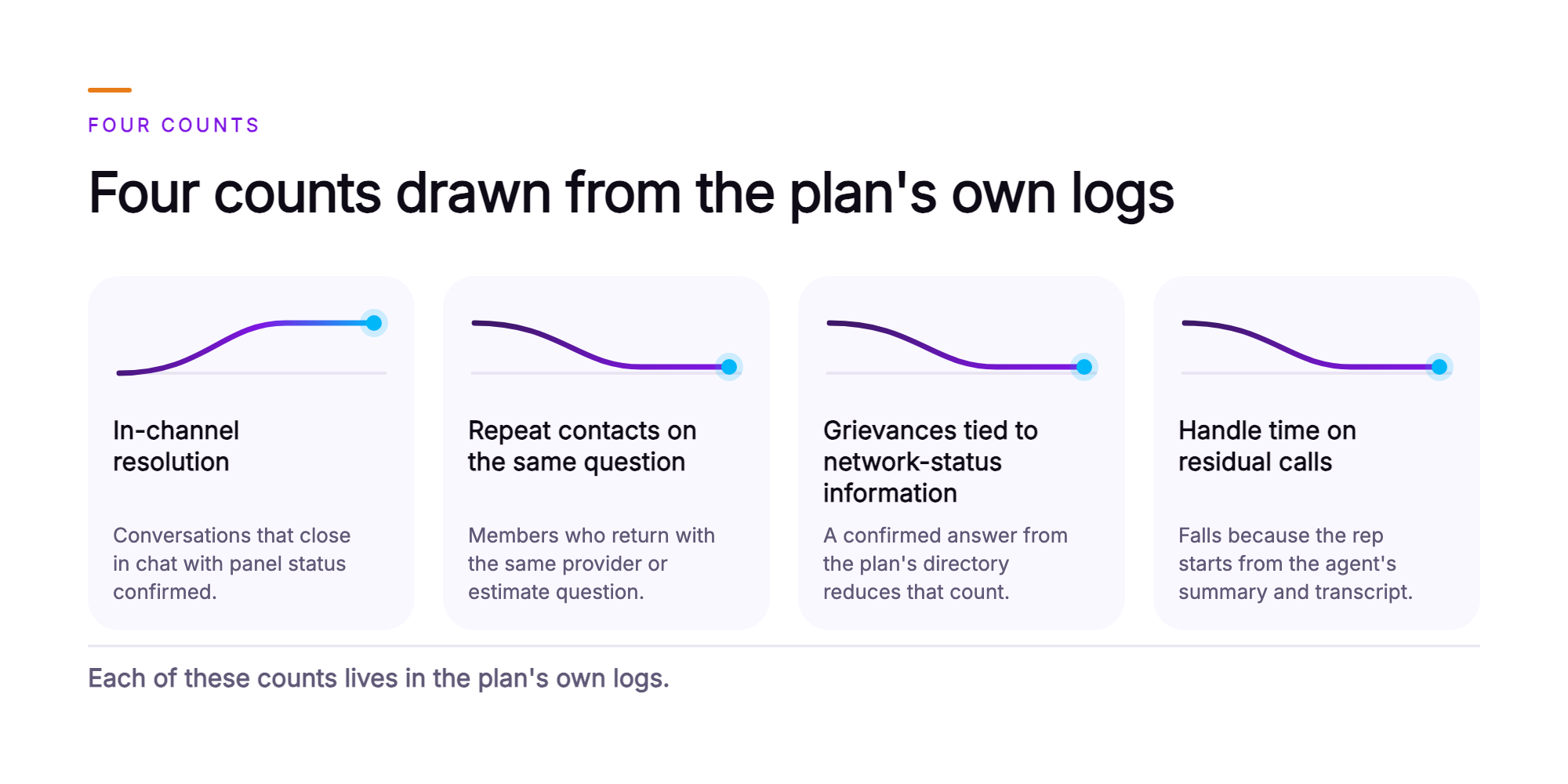
In-channel resolution. The first count is the number of conversations that close in chat with panel status confirmed and cost share explained, no callback generated and no transfer placed. This is the primary measure, and it moves when the agent is answering questions the directory and benefits record can resolve with certainty.
Repeat contacts on the same question. The second count is the number of members who return with the same provider or estimate question inside the plan's own repeat-contact window. It falls when the first answer was confirmed against the live directory and the member's accumulator, both read for that member's product.
Grievances tied to network-status information. The third count is the number of complaints where a member states they were told a provider was in network and the subsequent claim said otherwise. A confirmed answer, sourced from the plan's directory at the time of the conversation, reduces that count.
Handle time on residual calls. The fourth count is handle time on the network and cost-share calls that still reach a human rep. It falls because the rep starts from the agent's summary and the full transcript of the conversation so far.
Each of these counts lives in the plan's own logs, where the plan's team can pull and verify them. Together they measure what the leader is accountable for: questions resolved in the member's channel, the first time the member asks. The next section gathers those four measures into the case a member services leader takes to the leadership team.
What does the member services leader take to the leadership team?
The case a member services leader takes to the leadership team rests on four measurable commitments, each tied to a system the plan already operates.
The four points of that case are:
- In-channel resolution on network and cost questions. Network and cost-share questions close in the member's channel, with panel status and tier confirmed against the live directory for the member's specific product. The member gets a confirmed answer in the same conversation, in time to book the visit.
- Accurate cost explanation, plan determination protected. The agent explains the member's cost share from their own accumulator, including a medical procedure cost estimate drawn from the plan's own benefit record. The plan retains every determination that requires benefit judgment.
- Managed deployment on existing systems, live in three to six weeks. Orvera AI builds, deploys, and runs the platform on the directory, benefits, and claims systems the plan already operates, and the plan's team approves each rule the agent uses before launch.
- Complete audit trail on a compliant platform. Every conversation is audited and available as a transcript and summary. The platform is SOC 2 Type II certified and HIPAA compliant.
Each point connects to a count the leader already tracks: in-channel resolution, repeat contact rate, handle time on residual calls, and grievance volume. The section that follows describes what the operation looks like once it is running.
What does member services look like once the agent is running?
Once the agent is running, a member gets a confirmed answer on the in network provider search and the cost estimate before booking, in the channel they opened, and the question closes there.
The member types a question into the plan's chat or app. The agent reads the directory, reads the benefits record, and returns a confirmed answer: in network status verified against the member's specific plan, the deductible status on the member's accumulator, and how the cost share applies to that procedure at that point in the benefit year. If the question requires judgment the plan's people carry, the agent transfers with the transcript and summary already in front of the human rep. The rep picks up the conversation exactly where the agent left it.
The leader's view changes too. Network-status grievances fall because the answer the member got in chat was confirmed from the directory at the moment they asked. Repeat contacts fall because the first answer closed the question. And every conversation, whether the agent completed it or a human rep did, runs through Auto QA against the plan's own rubric. That gives the leader one consistent, objective read on quality across the whole month.
The operation that generates those counts is a managed service. Orvera AI builds it, deploys it, and runs it on the directory and benefits systems the plan already operates, live in three to six weeks. If those counts are what your leadership team needs to see, talk to the team (opens in a new tab).
Frequently asked questions
An AI agent for healthcare provider search answers the member's immediate question using the plan's live data, stopping where the plan's authority begins. On network status, the agent reads the directory at the moment of the question. It confirms whether a named provider is in the panel for the member's product and tier, at which locations, under which hospital affiliation, and whether they are currently accepting new patients. On cost share, the agent pulls the member's accumulator. It states which tier applies, whether the deductible has been met, and whether a copay or coinsurance governs the visit, in plain language. The agent explains the plan's rules as they apply to this member. Benefit determinations and claim outcomes stay with the plan. Where the plan has no rule on file for a member's question, the agent says so and offers the next step.
When a HIPAA compliant conversational AI for payers has no rule on file for a member's question, it says so directly and offers a clear next step. The agent answers only from the plan's approved knowledge base and the member's own record. Every answer traces back to one of those sources. Two common examples show how this works in practice: - Unconfigured procedure benefit. A member asks whether a specific therapy is covered under their product. The plan has no benefit configured for that therapy. The agent states what the plan has on record, explains that the determination sits with the plan, and routes the member to a representative. - Medical necessity question. A member asks whether a procedure will be authorized. The agent explains that medical necessity decisions belong to the plan's clinical review process and immediately transfers the conversation to a human rep. And both gaps stay visible after the call. The unanswered question remains in the conversation's transcript and report log. The plan's team reviews it, adds the rule to the approved knowledge, and the agent carries that answer forward from that point on. That feedback loop is where the agent's coverage grows over time. Widening it is a knowledge task, and the plan sets the pace.
An automated cost estimator for health plans resolves provider and cost-share questions on its own, and it hands the conversation to a human representative where the plan's rule calls for one. The agent transfers immediately when any of these conditions arise: - The member asks to speak with a person. - The member disputes a bill or initiates a grievance or appeal. - The question is a coverage determination that belongs to the plan's clinical or administrative review process. - The agent detects distress signals or an urgent care situation in the member's messages. That last point matters. The plan sets what counts as urgency or distress. The agent applies that rule as the chat runs and transfers the member as soon as it is met. And the handoff carries context. The human rep receives the full transcript and a plain-language summary of what the member asked, what the agent answered, and where the conversation ended. The rep continues from that point, in the queue the plan has configured. The member's first words move the question forward. Every conversation, whether resolved by the agent or completed by a rep, produces a record the plan can review.
Every conversation a health plan provider directory AI handles, whether resolved by the agent or completed by a human rep, produces a full transcript, a plain-language summary, and a report log the plan can open at any time. Auto QA audits every one of those conversations against the plan's own rubric. Three questions anchor each review. Was panel status stated correctly for that member's product and tier? Was the cost share explained accurately against the member's accumulator? Was the handoff to a human rep made at the point the plan's rule required? Findings feed straight back into the agent's approved knowledge and into rep coaching queues. The plan sees what the agent said, what the rep said, and where either fell short. The platform is SOC 2 Type II certified and HIPAA compliant. That audit trail is also where the next section's question begins. Accurate audit findings depend on accurate, current data beneath the agent, and that points directly to how the agent connects to the systems the plan already runs.
When a member uses a check if doctor is in network AI, the answer is only as accurate as the data the agent reads, and Orvera connects directly to the systems that hold that data. Orvera does the integration work. The platform supports 500+ enterprise system connections, and that library covers the provider directory or provider data management system, the benefits configuration layer, the claims system that holds the accumulator, and the CRM the plan already runs. Each query goes straight to the source system. The agent reads panel status, tier, and effective dates at the moment the member asks. A change entered in the directory that morning shows up in that afternoon's answer. And the conversation carries forward after the call ends. The platform writes the conversation summary back to the member's record. The next contact, whether it arrives by voice, chat, or through a human rep, opens with that context already in place. That integration posture is also what makes deployment straightforward, which the next section addresses directly.
Orvera builds, deploys, and runs the agent, including how to automate member cost estimates, and full deployment lands in three to six weeks. Setting up the infrastructure is Orvera's job. Orvera handles onboarding, knowledge-base setup, agent training, and change management. Before the agent goes live, the plan's team reviews and approves every rule and every piece of knowledge the agent will use. Everything the agent runs carries that sign-off. After go-live, the same team reads Auto QA findings and report logs. Questions the agent cannot yet answer surface in those logs. The plan adds the rule, allowing the agent to carry the answer forward. Coverage widens at the pace the plan sets.

Written by
Anindita Majumder
Anindita Majumder is a communications professional with nearly four years of experience in public relations, corporate communications, and journalism. She creates content that helps brands communicate their vision, products, and expertise through press releases, thought leadership, and editorial pieces. Outside of work, she is a vocalist, which keeps her creativity flowing.


