How an AI Agent Handles Group and Corporate Rooming Lists for Hotels
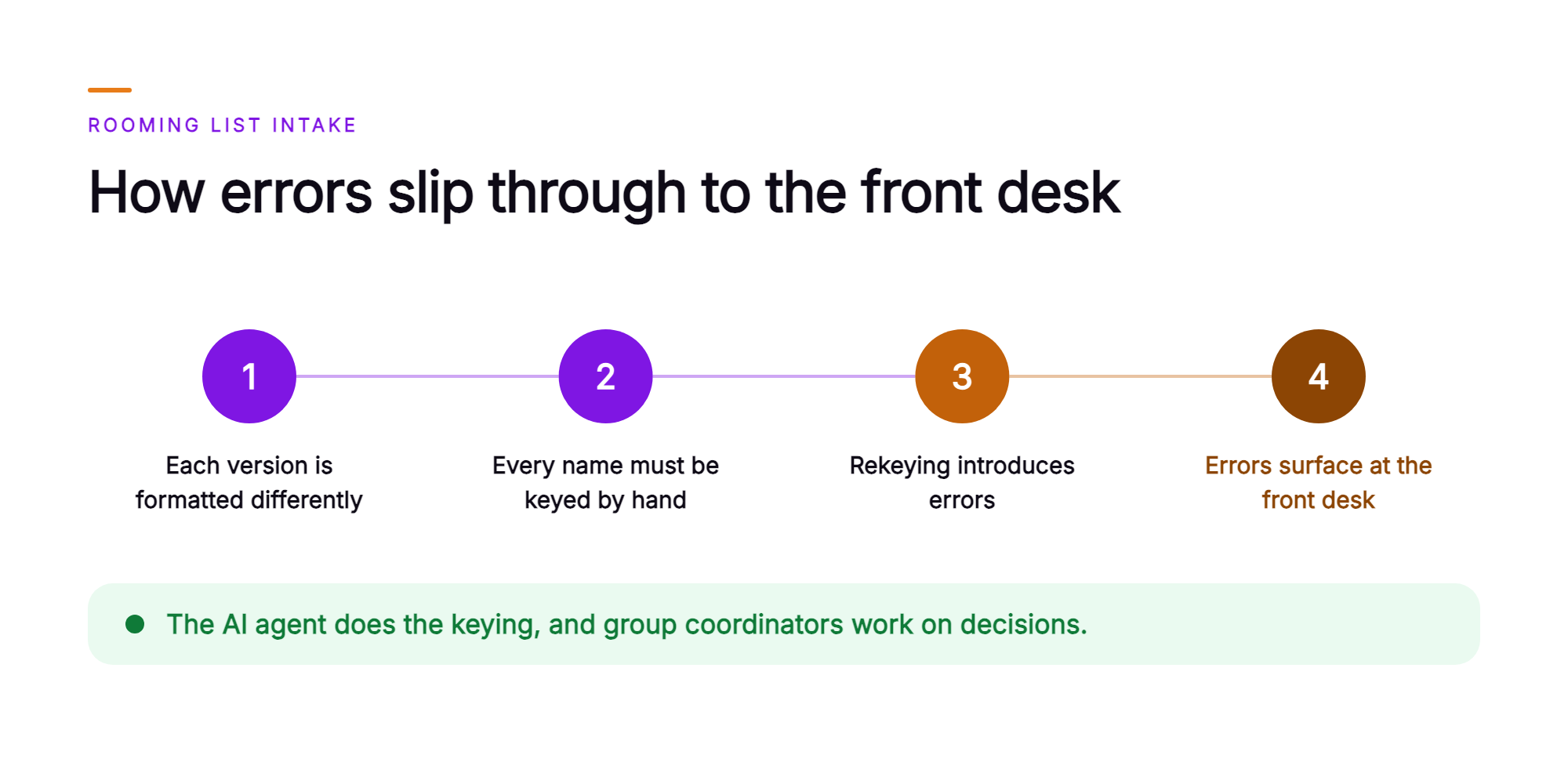
Rooming list intake takes group coordinators hours per group because every file arrives in a different format, and every name must be keyed by hand into the reservation system.

Key highlights
- Rooming list intake takes group coordinators hours per group because every file arrives in a different format, and every name must be keyed by hand into the reservation system.
- The AI agent moves each rooming list through a three-step email-to-reservation workflow: reading the file as it arrives, validating every line against the block, and writing the stays that fit directly into the hotel's reservation system.
- An AI agent handles a corporate rooming list from first read to final reservation, leaving the group coordinator with only the lines that require a decision.
- A hotel group wants the AI agent and the platform it runs on built, deployed, and run for it because Orvera AI then handles the configuration and the upkeep in live operation.
- Four measures show whether hotel reservation automation is working: coordinator hours per group, errors surfacing at check-in, time from list arrival to reservations written, and reservations that match the rooming list on quality review.
- A Director of Group Reservations can take four operational facts to the leadership team, each one drawn directly from how rooming list intake runs on the platform.
- Once the AI agent reads the rooming lists, it does the keying, and group coordinators work on decisions: the stays that fit the block are written, and the lines that need judgment are waiting with the reason attached.
Why does rooming list intake take group coordinators so many hours?
Rooming list intake takes group coordinators hours per group because every file arrives in a different format, and every name must be keyed by hand into the reservation system.
A rooming list email lands in the group reservations inbox at 4:45 PM on a Friday before a large conference group arrives Monday morning. The meeting planner sent a spreadsheet with columns in their own order. Two revised versions follow by Saturday noon as attendees change flights. Each version is formatted differently from the last.
The coordinator's work on each list follows the same steps. Find the block by group code. Retype each guest name, arrival date, departure date, room type, and sharer pairing into the hotel's reservation system. Check each stay against the block, night by night and room type by room type. Then write back to the planner for the departure date that is missing from row 14 or the sharer whose last name did not come through.
Rekeying introduces errors such as misspelled names, incorrect departure dates, or sharers booked into separate rooms. A coordinator managing several active groups can spend hours on a single large list. And the errors that slip through do not surface until the guest reaches the front desk, at the moment least suited for correction.
What is AI rooming list intake for group and corporate room blocks?
AI rooming list intake is the process by which an AI agent reads each rooming list as it arrives in the hotel's group reservations inbox, validates every guest stay against the room block, writes the reservations to the hotel's reservation system under the group code, and returns any line that falls outside the block to the group coordinator with a reason attached.
A few terms carry specific meaning in this workflow:
- Rooming list: the file a planner sends naming each guest, their arrival and departure, room type, and any special requests
- Room block: the inventory the hotel holds for the group, by room type and by night
- Group code: the identifier that ties every reservation to the group account in the reservation system
- Pickup: the count of rooms the group has used against the block
- Sharers: two guests booked into one room
- Shoulder nights: stays that extend before or after the group's main dates
- List revision: an updated file the planner sends to add, change, or remove guests
Before an AI agent handles the email, a rooming list sits in the group inbox as an unread attachment, waiting for a coordinator to open it and begin keying. After the agent runs, the guests who fit the block are in the reservation system under the group code, and the coordinator holds a list of exceptions, each one labeled with the reason it could not be written. That handoff is where hotel contact center AI shows its operational value: the routine work is resolved, and the judgment calls go to the person who can make them.
What does the AI agent do with each rooming list, step by step?
The AI agent moves each rooming list through a three-step email-to-reservation workflow: reading the file as it arrives, validating every line against the block, and writing the stays that fit directly into the hotel's reservation system.
Reading. The agent opens the email and its attachment, whatever format the planner sent. It identifies the group by the group code, or by the group name and dates on the header when the code is absent, and then maps the planner's column labels to the standard fields the hotel's system expects: guest name, arrival date, departure date, room type, sharer pairing, and any special requests. The agent works from the planner's own column order, and any line with an unclear or missing field goes back to the group coordinator with the reason stated.
Validating. For each line, the agent checks that arrival and departure fall inside the block dates, that the room type exists in the block, that a room of that type is still available on each night of the stay, that any sharers can be paired into one room, that each guest appears on the list only once, and that every field the hotel's reservation rules require is present. Lines that pass every check move forward. Lines that fail are held with a specific reason attached.
Writing. The agent writes each passing line to the hotel's reservation system under the group code, carries special requests onto the reservation as notes, and records the confirmation numbers the system issues.
The agent writes each stay that fits the block and returns each line that falls outside it to the group coordinator with the reason attached. The coordinator receives a summary of the list and the full email thread on file. That is the handoff: resolved reservations in the system and a labeled exception list for the decisions only a person can make.
How does a rooming list for a corporate sales meeting play out at a resort?
An AI agent handles a corporate rooming list from first read to final reservation, leaving the group coordinator with only the lines that require a decision.
For example, a company's meeting planner emails the resort's group reservations inbox a spreadsheet built on the company's own template. Sharers are marked in one column. Special requests sit in a notes field. The agent reads the attachment, finds the group code, and gets to work.
On this list, the agent writes the stays that fit the block, pairs the sharers into single rooms, and carries each special request onto the reservation as a note. Three lines come back to the coordinator with specific reasons attached: one attendee is arriving the night before the block opens, one has requested a room type the block does not hold, and one line is missing its departure date. The rest are in the system.
A revised list arrives two days later. The planner has substituted one name and added a late registrant. The agent matches the revision to the version on file, updates the name on the existing reservation, and writes the added stay where the block still shows a room available under the group code.
The coordinator focuses on the three lines that require a decision. The hotel's reservation system shows the reservations under the group code with confirmation numbers, and the record Orvera AI keeps holds the returned lines with the coordinator's decisions and each list version. The operations team can review that record alongside the transcript and summary of the list thread.
How does the agent work within the hotel's block, contract, and reservation rules?
The process follows these rules:
- Room block. The block sets the room types and the number of rooms held on each night. The agent checks each stay against the block night by night and writes the stays that fit. Any line that falls outside the held inventory on any night goes back to the group coordinator, and the agent writes it as the coordinator decides.
- Group contract and rates. The group contract and the rates the hotel loaded on the block stay exactly as the hotel set them. The agent writes each reservation under the group code, which ties it to the group account.
- Cutoff date and required fields. The block's cutoff and the hotel's reservation rules determine which lists and revisions go directly into the system. Lists that arrive after the cutoff, and lines that lack a required field such as a departure date or a guest name, are returned to the group coordinator with the specific gap labeled.
- Decisions that belong to the hotel. Shoulder nights, rooms beyond the block's count, room types outside the block, and any change to the block itself are the hotel's decisions. The agent returns each such line to the group coordinator with the reason stated and writes the reservation once the coordinator confirms the decision.
Why would a hotel group want rooming list intake built, deployed, and run for it?
A hotel group wants the AI agent and the platform it runs on built, deployed, and run for it because Orvera AI then handles the configuration and the upkeep in live operation.
What determines whether rooming list intake runs reliably is how it is delivered and who runs it. Orvera AI builds, deploys, and runs the agent on the systems the hotel group already operates, with full enterprise deployment in three to six weeks. That delivery model lets group booking management run with the hotel group's existing team, while Orvera AI keeps the agent current.
The reasons a hotel group chooses this managed operation come down to a consistent set of operational and governance facts:
- Orvera AI brings 18+ years of contact-center operations experience to every deployment, and it counts travel and hospitality among its focus industries.
- The platform audits every conversation, human-handled and AI-handled, across every channel, so every rooming list thread is on file and reviewable.
- Governance comes first by design, with approved-knowledge grounding, explicit controls, and full auditability built in from the start.
- Orvera AI is SOC 2 Type II certified, HIPAA compliant, and GDPR compliant.
- The platform supports 500+ integrations across enterprise systems, spanning the reservation systems, property management systems, and group management tools a hotel group already runs.
- The architecture is multi-tenant, which fits a hotel management company or hotel group running many properties under a single parent organization.
- Orvera AI is one platform, adopted in stages. A hotel group starts with rooming list intake and adds other work across the group desk and the reservations team when the operation is ready.
Which measures tell a Director of Group Reservations the agent is working?
Four measures show whether hotel reservation automation is working: coordinator hours per group, errors surfacing at check-in, time from list arrival to reservations written, and reservations that match the rooming list on quality review.
The hotel sets its baseline from its own data before the first list runs through the agent, then tracks the trend in its own reports. Three of the four values sit in those reports, and the fourth comes from Orvera AI's quality record. Each measure below names the record that holds it.
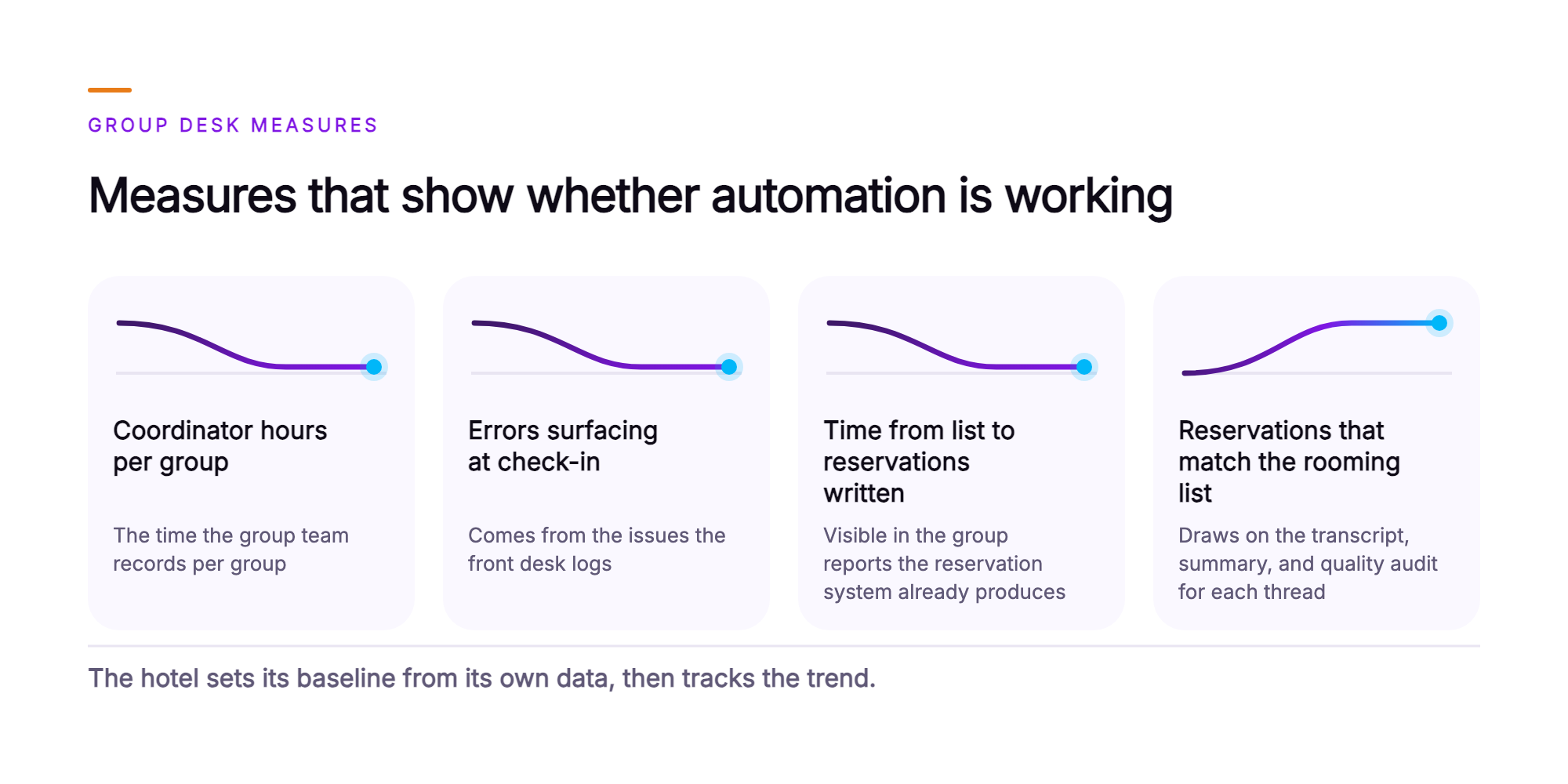
Coordinator hours per group is the time the group team records per group. That figure shows whether the agent is taking on the intake work or leaving it where it started.
Errors surfacing at check-in comes from the issues the front desk logs. A misspelled name, an incorrect departure date, or sharers booked into separate rooms appear at arrival when they slip through intake, which makes this measure a direct read on intake accuracy.
Time from list arrival to reservations written is visible in the group reports the hotel's reservation system already produces. A shorter gap means fewer lists sitting in a coordinator's queue.
Reservations that match the rooming list on quality review draws on the transcript, summary, and quality audit Orvera AI keeps for each rooming list thread. That record is the audit trail a leadership team or an operations review can read directly.
What does a Director of Group Reservations take to the leadership team?
A Director of Group Reservations can take four operational facts to the leadership team, each one drawn directly from how rooming list intake runs on the platform.
- The AI agent reads each group and corporate rooming list in the format it arrives, whether that is a spreadsheet, a PDF, or an inline email table, and validates each guest name and stay against the room block before any reservation is written.
- The agent writes the stays that fit to the hotel's reservation system under the group code and returns each line outside the block to the group coordinator with the reason stated, so the group desk's time goes to the judgment calls.
- The room block, the group contract, cutoff dates, rates, and reservation rules stay the hotel's own, and the group coordinator decides each returned line before the agent acts on it.
- Orvera AI builds, deploys, and runs rooming list intake as a managed operation, full enterprise deployment lands in three to six weeks, and Orvera AI audits every conversation, human-handled and AI-handled, across every channel.
These four points address leadership questions: what the agent does, what it writes, who holds the decisions, and how the operation remains accountable.
What does group reservations work look like once the AI agent reads the rooming lists?
Once the AI agent reads the rooming lists, it does the keying, and group coordinators work on decisions: the stays that fit the block are written, and the lines that need judgment are waiting with the reason attached.
Rooming lists and revisions arrive in the hotel's email the way they arrive today. The agent reads each one as it comes in, matches each line to the block and contract rules, and writes the reservations that belong. They land in the hotel's reservation system under the group code, with confirmation numbers on file. Revisions to the same group are read in order against the earlier version. Each change that fits the block and the hotel's reservation rules is written to the group's reservations, and removals and changes after the cutoff go to the coordinator for a decision.
The group coordinator's daily responsibilities shift. Their time goes to the exception lines waiting with a clear reason, the event planners they are managing, and the groups arriving that week. The Director of Group Reservations gets a summary of each list showing the reservations written and each line returned with its reason stated. Every version of the list and the full email thread stays on file. And Orvera AI keeps an audit of each rooming list conversation alongside every other conversation it handles for the hotel group.
That is the operating picture once the agent is live: lists resolved, decisions visible, and the record complete. To see how this works on your group desk, talk to the team (opens in a new tab).
Frequently asked questions
Orvera AI's agents read rooming lists in the formats planners send them, and each planner keeps working the way they already do. That covers spreadsheet attachments built in the planner's own template, CSV exports from a registration tool, PDFs, and names typed straight into the body of an email to the group reservations inbox. Column labels vary by planner, and so does column order. The agent maps whatever it finds to the fields a reservation requires: guest name, arrival and departure dates, room type, sharer, and special requests. When a field is unclear or missing, the agent returns that line to the group coordinator with the reason stated. That is how an AI agent can process rooming lists from email and still leave every judgment call with a person.
The agent checks every line against the block held in the reservation system before it writes anything. It finds the block from the group code, or from the group name and dates when the code is absent, then tests each line in turn: arrival and departure fall inside the block dates, the room type is one the block holds, and the block still has a room of that type left on every night of that stay. From there the agent pairs sharers into a single room, flags any guest listed twice, and confirms each line carries the fields the hotel's reservation rules require. Lines that pass are written to the reservation system under the group code. Lines that fail a check go back to the group coordinator with the reason attached.
The agent writes the rest of the list and returns that single line to the group coordinator with the reason stated. Common reasons include a night before or after the block dates, a room type outside the block, a night where the block has no room of that type left, a missing departure date, or a duplicate name. The decision on a returned line belongs to the group coordinator, under the hotel's contract terms and reservation rules. The coordinator settles it with the planner, then the agent writes the reservation as the coordinator decides. That division of labor is the point: the agent handles volume and checking, and people handle judgment.
Revisions run through the same intake path as the original list. The agent reads each revised list or change email, matches it to the group and to the list version already on file, and sets out every difference line by line: a name substitution, an added guest, a removed guest, or a changed date. Each name substitution, added guest, and changed date that fits the block and the hotel's reservation rules is written to the reservations under the group code. Removed guests and any change arriving after the block's cutoff go to the group coordinator for a decision, because the hotel's group contract sets whether each one carries attrition or release consequences. Every version of the list and a record of each change stays on file for audit and for the post-event reconciliation.
Orvera AI builds the integration into the systems the hotel group already operates, and the platform supports 500+ integrations across enterprise systems of record. Those systems include the property management system, the central reservation system, the group sales and catering system, and the group reservations inbox itself. The connection carries specific data in both directions. Reading in: the group code, the block's room types, its dates and cutoff, and the rooms remaining on each night. Writing back: the reservations themselves, with confirmation numbers returned to the record. Returned lines route to the group coordinator with the source list and the reason attached, so the coordinator works from the planner's original entry. That is how AI integrates with a hotel PMS for group bookings, writing each reservation straight into the system.
Orvera AI builds, deploys, and runs the agent on the systems the hotel group already uses, with full enterprise deployment live in three to six weeks. Enablement spans onboarding, knowledge-base setup, agent training, and change management. Before the first list arrives, four things are configured: the inbox connection, the reading of each block, the hotel's reservation rules, and the routing of returned lines to named group coordinators. Guest data handling follows the platform's governance controls, and Orvera AI is SOC 2 Type II certified, HIPAA compliant, and GDPR compliant. The multi-tenant architecture supports multiple organizations under a single parent, such as the properties a hotel management company operates. It is one platform, adopted in stages, starting with rooming list intake.

Written by
Anindita Majumder
Anindita Majumder is a communications professional with nearly four years of experience in public relations, corporate communications, and journalism. She creates content that helps brands communicate their vision, products, and expertise through press releases, thought leadership, and editorial pieces. Outside of work, she is a vocalist, which keeps her creativity flowing.