How an AI Agent Handles Service Request Intake for Home Warranty Companies
Home warranty service request intake backs up because every call carries four sequential steps before a service request can exist, and peak demand compresses all of them at once.

Key highlights
- Home warranty service request intake backs up because every call carries four sequential steps before a service request can exist, and peak demand compresses all of them at once.
- On a home warranty service request call, an AI agent authenticates the contract holder, reads the applicable state contract terms, captures the symptoms by trade, and creates a complete service request record, all in a single interaction.
- Automated service request intake moves a single call from the contract holder's first word to a created service request, handed to the company's dispatch rules in the same interaction.
- The home warranty company sets every rule that governs the interaction, and the AI agent executes against those rules on home warranty claims intake calls, under explicit controls with full auditability.
- A home warranty company has the platform built and run for it because deploying a reliable AI agent for service requests requires contact-center operations depth, and Orvera AI brings that depth on day one.
- The four measures that confirm service request intake is working are requests the agent creates end to end, requests re-logged under a different trade, time from greeting to a created request, and transfers by routing rule.
- A VP of Customer Care takes four specific statements to the leadership team, each one the team can check once the agent is live.
Why does service request intake back up at a home warranty contact center?
Home warranty service request intake backs up because every call carries four sequential steps before a service request can exist, and peak demand compresses all of them at once.
On the first hot Monday of summer, cooling systems fail across a region overnight, and by 8:00 a.m. your queue is full of contract holders who each need a service request opened before a technician can be dispatched. The volume is predictable in the calendar sense, but the pressure it puts on each individual call is structural.
Each intake call has to complete four things in order. The contract holder must be authenticated against the account of record. The contract terms for the holder's state must be located and read so the request carries the terms that govern it. The symptoms must be captured precisely enough to name a trade, such as HVAC, plumbing, electrical, or appliance. And only then does the service request get logged in the company's system of record.
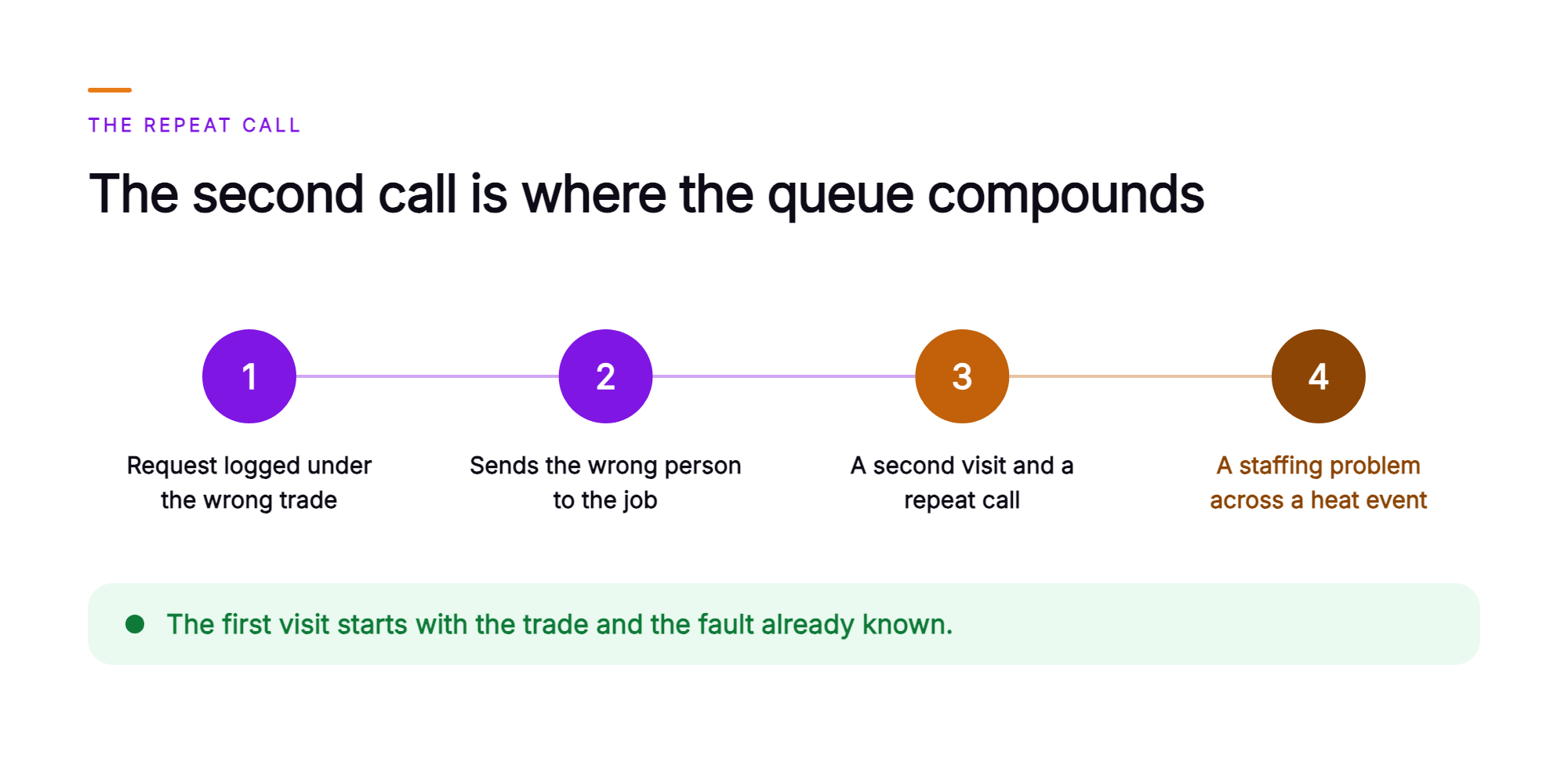
A request logged under the wrong trade, or with symptoms too thin to brief a technician, sends the wrong person to the job, and that error produces a second visit and a repeat call from the same contract holder.
That second call is where the queue compounds. The original failure is still open, a technician slot was spent without resolution, and the contract holder is now more frustrated than they were on the first call. Multiply that pattern across a regional heat event and you see why home warranty contact centers carry a seasonal staffing problem that does not resolve itself between HVAC season and the first freeze.
What is home warranty service request intake?
Home warranty service request intake is the call where a contract holder reports a failed home system or appliance and the home warranty company opens a service request against that contract, the step most contract holders know as filing a claim.
The intake call carries four steps in sequence. First, the company authenticates the contract holder against its contract system. Second, the company reads the contract terms that apply in the holder's state, because coverage rules vary by state and by plan tier. Third, the company captures the symptoms: the trade, the system or appliance, and what the contract holder is seeing and hearing. Fourth, the company creates the service request in its system of record so dispatch rules can route the right technician.
Each step depends on the one before it. Symptoms recorded before authentication produce records the company cannot tie to a contract. Symptoms recorded before state terms are read produce records the company cannot adjudicate accurately.
An AI voice agent for home warranty works inside a governed layer grounded in the company's approved contract terms, with explicit controls. The contract terms, coverage rules, and dispatch rules belong to the home warranty company. The AI agent works within those rules. Coverage decisions follow the company's own rules and teams, working from the state terms the agent records on the request.
What does the AI agent do on a home warranty service request call?
On a home warranty service request call, an AI agent authenticates the contract holder, reads the applicable state contract terms, captures the symptoms by trade, and creates a complete service request record, all in a single interaction.
The sequence runs in a fixed order. First, the agent authenticates the contract holder against the company's contract system. Once the contract is confirmed, the agent reads the contract terms for the holder's state, so every symptom captured sits against the correct contract terms. Then the agent moves to symptom questions, working from the questions the company has set for each trade, such as appliance, plumbing, electrical, and heating and cooling. The conversation runs in plain language, and the agent speaks with callers in more than 80 languages. As residential subscription contact center AI, the agent handles this contract-and-trade complexity in a single conversation, on rules the home warranty company sets and owns.
Symptom capture is where data precision matters most. The agent names the trade, confirms the specific system or appliance with its make and model, and records what the contract holder sees and hears in the caller's own words. A contract holder describing a washing machine that fills but will not spin leaves a record a technician can brief from before the visit.
The finish creates the record that drives dispatch. The agent creates the service request in the company's system of record with the contract, the state terms, and the captured symptoms on one entry, and passes that entry to the company's dispatch rules.
How does one service request call move from greeting to a created request?
Automated service request intake moves a single call from the contract holder's first word to a created service request, handed to the company's dispatch rules in the same interaction.
A contract holder calls because the dishwasher has stopped draining. The AI agent opens the interaction, confirms the caller's identity against the contract, and reads the applicable state contract terms before a single symptom is recorded. That sequence matters: the record is tied to a verified contract, and the terms that govern the claim are documented on the same entry.
Symptom capture follows authentication. The agent names the trade as appliance, confirms the make and model with the caller, and then asks the appliance questions the company has set, such as when the fault started, what the machine shows on its display, and what the caller hears when the cycle runs. The caller's own words go into the record. A technician reading that the dishwasher fills, runs its cycle, and sits with standing water at the end has enough to arrive prepared.
The call closes on a created record. The agent assembles one service request carrying the contract, the state terms, the appliance trade designation, and the captured symptoms. It reads that record back to the caller, confirms the request is open, and passes it to the company's dispatch rules. The technician works from the same description the caller gave, so the first visit starts with the trade and the fault already known.
Which rules does the home warranty company set, and what does the agent do with each one?
The home warranty company sets every rule that governs the interaction, and the AI agent executes against those rules on home warranty claims intake calls, under explicit controls with full auditability.
Each rule the company sets pairs with one action the agent takes.
- State contract terms. The company sets the contract language for each state. The agent reads the applicable terms from the contract system, based on the state associated with the holder's contract, before any symptom capture begins.
- Trade-specific intake questions. The company sets the symptom questions for each trade: HVAC, plumbing, electrical, appliance, and others. The agent asks those questions in sequence and records the answers word for word against the service request.
- Dispatch rules. The company sets the fields required to route a technician. The agent fills every required field on the service request before the record closes, so the dispatch queue receives a complete entry on the first pass.
- Routing rules. The company sets the conditions under which a call transfers to a person. When those conditions are met, the agent transfers the call to the appropriate team member with a full summary of what was captured.
Why would a home warranty company have the platform built and run for it?
A home warranty company has the platform built and run for it because deploying a reliable AI agent for service requests requires contact-center operations depth, and Orvera AI brings that depth on day one.
Orvera AI builds, deploys, and runs the agents and the platform on the systems the home warranty company already operates. Full enterprise deployment lands in three to six weeks. Orvera's team runs the integration, onboarding, and change management.
Operators choose a managed platform for four specific reasons:
- 18+ years of contact-center operations experience behind the intake design, shaping how the agent handles trade-specific triage and state contract logic.
- AI Quality Management that audits 100% of conversations, human-handled and AI-handled, across every channel, giving the company a complete record of every interaction for compliance and coaching.
- 500+ enterprise integrations, spanning CCaaS, CRM, dispatch, and the systems of record the home warranty company already runs.
- SOC 2 Type II certified, HIPAA compliant, and GDPR compliant, so IT and procurement have a documented compliance posture before the first call goes live.
The platform grows with the company. It is one platform, adopted in stages, and its model-agnostic governed layer brings in newer models while the company's intake rules carry forward as configured.
Which numbers tell a VP of Customer Care that service request intake is working?
The four measures that confirm service request intake is working are requests the agent creates end to end, requests re-logged under a different trade, time from greeting to a created request, and transfers by routing rule.
Each one is read directly from the company's own service request, dispatch, and call records, which means the numbers carry the same weight as any other operational figure you take to a leadership review.
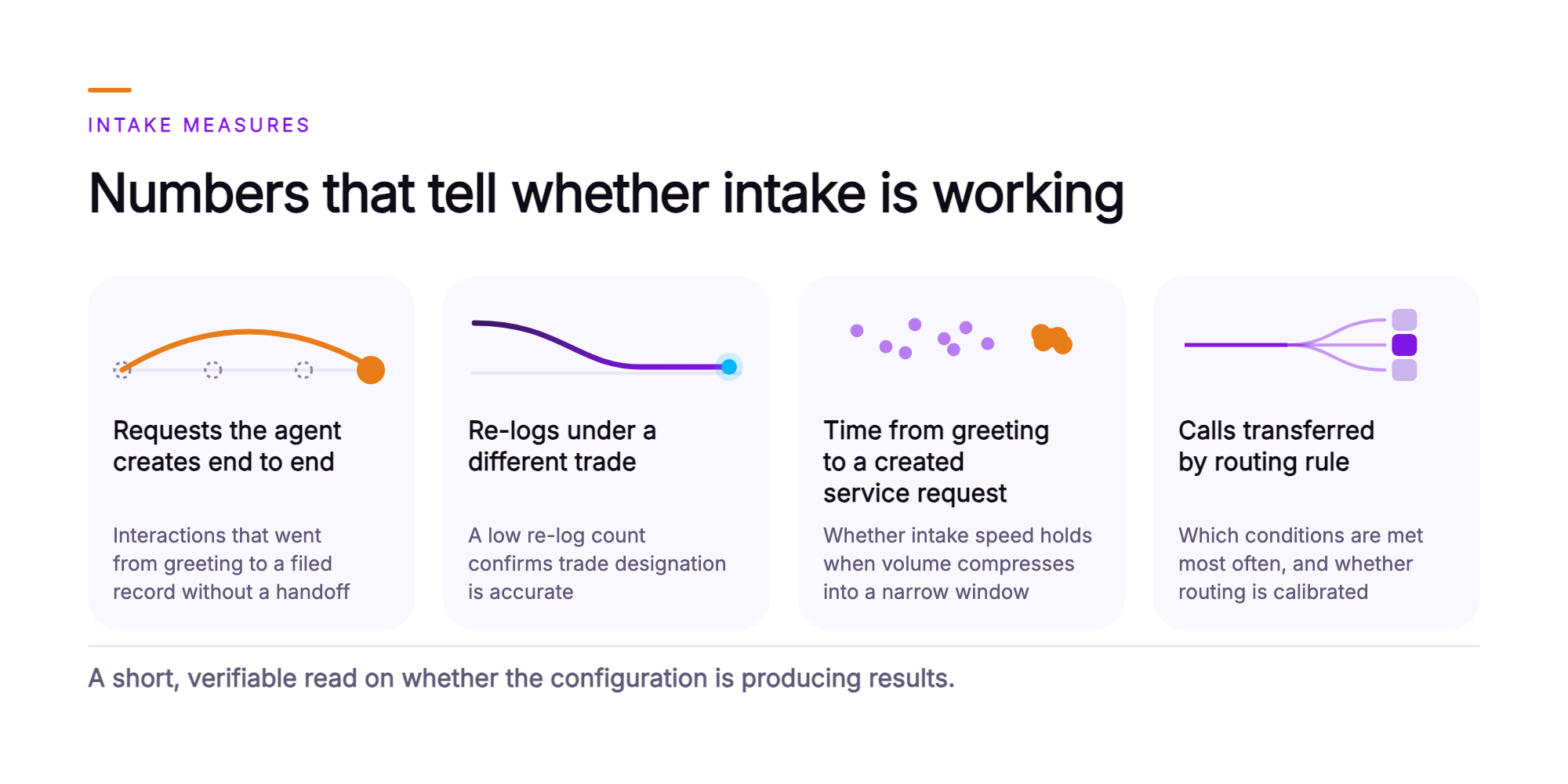
- Service requests created end to end by the agent, counted weekly. This is the headline measure. It tells you how many interactions went from greeting to a filed record without a handoff, read straight from the service request system your dispatch team works in every day.
- Service requests re-logged under a different trade after the first technician visit. When a homeowner describes a draining issue and the wrong trade shows up, the re-log appears in dispatch. A low re-log count confirms that symptom capture and trade designation are accurate on the first pass.
- Time from greeting to a created service request, tracked across seasonal peaks. This duration, pulled from call records and the service request timestamp, tells you whether intake speed holds when HVAC season compresses volume into a narrow window.
- Calls transferred to your team, counted by the routing rule that triggered each transfer. This count tells you which rule conditions are being met most often and whether your routing logic is calibrated the way your operation intended.
Taken together, these four measures give a VP of Customer Care a short, verifiable read on whether the configuration is producing the results the operation needs.
What does a VP of Customer Care take to the leadership team?
A VP of Customer Care takes four specific statements to the leadership team, each one the team can check once the agent is live.
- The service request the agent creates carries the contract, the state terms, and the captured symptoms on one record. The agent fills every field the company's dispatch rules require before the record closes, and the technician the company dispatches works from the same description the contract holder gave on the call.
- The headline measure is service requests the AI agent creates from greeting to a filed record, counted each week in the company's own service request system. The count lives where your operations team already looks.
- The contract terms, coverage rules, and dispatch rules belong to the company, and coverage decisions follow its own rules and teams. The AI agent executes within those rules, and every judgment call stays with the company's people.
- Orvera AI builds, deploys, and runs the program, live in three to six weeks, with AI Quality Management auditing every conversation, human-handled and AI-handled, across every channel. Quality scores and transcripts start with the first live call, before volume scales.
What does service request intake look like once the AI agent is running?
Once the AI agent is running, every service request call it handles moves through the same four steps on a platform engineered for substantial capacity and scale, and each created request arrives in the dispatch system with the trade and the caller's symptoms already recorded.
During a seasonal peak, that consistency is what changes the operation. An HVAC surge in July or a freeze event in January sends the calls the agent handles through the same four steps: authentication, a read of the state contract terms, symptom capture, and dispatch-ready record creation. At peak volume, each record still closes only when the fields the company's dispatch rules require are filled.
Your human reps spend their time on the calls the company's routing rules send to them. They receive the full captured record and the call transcript with the transferred call. The judgment calls, the escalations, and the coverage discussions belong to your people. The intake work belongs to the agent.
Orvera AI builds, deploys, and runs the full program, live in three to six weeks. To see how it fits your operation, talk to the team (opens in a new tab).
Frequently asked questions
A home warranty AI agent captures what the company's dispatch rules need from the caller, on one record, before the call ends. On a home warranty intake call, Orvera's AI agents confirm the contract holder's identity against the contract on file, read the contract terms that apply for the holder's state, and capture the trade, the system or appliance with its make and model, and the symptoms in the caller's own words. If the caller says the unit cycles on and then shuts off after a minute, that is the phrasing the record keeps. The agent then creates the home warranty service request in the company's own system, with all of it on a single record that the company's team and its dispatch rules work from.
The agent reads the terms from the company's contract system and carries them onto the request, where the company's own rules and teams decide coverage. Residential subscription plans vary by state, and a company that serves several states keeps a separate set of contract terms for each one. Orvera's AI agents pull the contract terms the company has set for the state where the contract holder's home is and attach them to the service request they create. The ownership line is firm. The contract terms and coverage rules belong to the company. Coverage decisions in the home warranty claims process follow the company's own rules and its own teams, working from the terms already captured on the request.
It depends on the routing rules the company sets, and those rules are the company's to write. Typical rules include the caller asking for a person, a coverage question the company routes to its own team, symptoms the company's rules treat as urgent (no heat in winter or an active water leak, for example), and any other case the company names. The rules are explicit and auditable, so the company can trace each handoff to the rule that triggered it. On transfer, the agent passes the call with a summary of what was captured, and the transcript stays on the record. The human rep picks up from the make, model, and symptom the caller already gave.
Every call is summarized, transcribed, and scored, so quality review runs on the full population of calls. Each interaction carries a full report log, a conversation summary, and a transcript, all attached to the service request record. That gives supervisors, compliance reviewers, and dispatch the same source material when a request is disputed weeks later. AI Quality Management audits 100% of conversations, human-handled and AI-handled, across every channel, on the scorecards the company's evaluators already use. Voice of Customer turns those same conversations into themes, drivers, and sentiment, so patterns in trade mix, repeat calls, or intake friction surface as measured data the company can act on.
An AI agent for home warranty intake connects to the systems already in place and runs on the company's own stack. It connects at three points: the contract system the agent reads for holder identity and state-specific terms, the system where the agent creates the service request and where dispatch rules run, and the contact center platform the calls arrive on. Those three connection points cover the intake path from greeting to a dispatch-ready service request. Orvera does the build, the deployment, and the integration, drawing on 500+ integrations with contact center platforms, CRM, helpdesk, and enterprise systems of record. The platform is SOC 2 Type II certified, HIPAA compliant, and GDPR compliant.
Orvera AI builds, deploys, and runs the AI agents and the platform on the company's own systems, and a full enterprise deployment goes live in three to six weeks. Orvera's team runs onboarding, knowledge-base setup, training for the company's reps, and change management. Before the first call lands, Orvera configures the platform with the company's contract terms, intake questions, and routing rules, so the agent works from approved knowledge starting on launch day. Orvera brings 18+ years of contact center operations experience to that configuration work. Orvera AI is one platform, adopted in stages. To walk through a home warranty intake call from greeting to a created service request, talk to the team.

Written by
Anindita Majumder
Anindita Majumder is a communications professional with nearly four years of experience in public relations, corporate communications, and journalism. She creates content that helps brands communicate their vision, products, and expertise through press releases, thought leadership, and editorial pieces. Outside of work, she is a vocalist, which keeps her creativity flowing.