Orvera vs Retell AI: Which Is Better for Voice AI in 2026?
Orvera AI and Retell AI compared on pricing style, setup effort, workflow depth, integrations and analytics, to help CX leaders pick the platform that fits how their team runs customer conversations.

Key highlights
Quick Summary
- Choose Orvera AI, which provides AI agents for customer experience teams, built, deployed and run for you across voice, chat and digital channels, with Agent Assist and Auto QA for the human side of the floor, and measurable resolution outcomes.
- Choose Retell AI if you want a usage-based voice agent platform with published per-minute pricing and more direct control over building, deploying, and monitoring workflows.
- Orvera is best suited to teams that want the platform built, deployed and run for them. Across Orvera customer engagements, full deployment averages 3 to 6 weeks.
- Retell AI is best suited to teams that want published usage-based pricing, platform flexibility and a self-serve approach to voice automation and workflow scaling.
- The biggest differences come down to pricing style, deployment support, workflow depth, analytics, and how much operational structure your team needs after launch.
- The real decision comes down to whether you want an operation built and run for you, or usage-based flexibility with platform-led control that your own team operates.
Orvera AI and Retell AI compared on pricing style, setup effort, workflow depth, integrations and analytics, to help CX leaders pick the platform that fits how their team runs customer conversations. As of October 5, 2026, Zendesk's customer service statistics page says 81% of consumers believe AI (opens in a new tab) has become part of modern customer service, so the real question is which platform fits your operating model best.
Orvera AI publishes this comparison. Competitor details come from each vendor's own website as of October 5, 2026, and are linked where they appear.
Orvera and Retell AI can both help teams automate inbound and outbound phone calls with AI voice agents. But the better choice depends on what your team cares about most once the demo is over. For some companies, the priority is rollout speed. For others, it is predictable costs, better control over workflows, stronger integrations, or clearer visibility into call outcomes.
This comparison aims to help you find the platform that fits your goals, your team structure, and the way you plan to scale automation.
Quick Snapshot (Orvera vs Retell AI)
Orvera is usually shortlisted by teams that want omnichannel AI agents across voice, chat, email and messaging, with deep Voice AI specialization and Agent Assist and Auto QA for human agents on the same platform. It is best suited to contact centers, BPOs and call-heavy teams that want the operation built, deployed and run for them, and that measure resolution and cost alongside call completion.
Retell AI is often shortlisted by teams looking for a more usage-based voice agent platform with flexibility at the platform level. It tends to appeal to companies that want to build and scale AI calling workflows with more hands-on control over usage, configuration, and development choices.
At a high level, the difference usually looks like this:
- Orvera is more likely to appeal to teams focused on a full production rollout, workflow execution, and measurable business outcomes
- Retell AI is more likely to appeal to teams looking for a platform-led approach to voice agent deployment and usage-based scaling
What Orvera Is Best For
Orvera is best for teams that want to automate large volumes of customer conversations, including phone calls, in a way that is tied to business outcomes. It is built for contact centers and call-heavy teams that want AI voice agents to resolve calls, reduce pressure on human teams, and improve performance over time.
Orvera runs omnichannel AI agents with deep specialization in Voice AI. It is built on 18+ years of contact-center experience, and across Orvera customer engagements, first-contact resolution averages about 80 percent.
Averages across Orvera customer engagements also include cost down 65 to 90 percent and handle time down 8 to 15 percent within 90 days. For teams evaluating platforms, that signals a product designed around workflow execution and measurable outcomes, with Auto QA across AI-handled and human-handled conversations.
Orvera is best suited to teams that want to automate calls across real business workflows, connect that automation with the systems they already run, and use built-in insights to understand what is happening across conversations after launch.
See how Orvera builds, deploys and runs AI agents, Agent Assist and Auto QA on one platform. (opens in a new tab)What Retell AI Is Best For
Retell AI is best for teams looking for a voice AI platform they can use to build, deploy, and manage AI voice agents for call automation. In simple terms, it is designed for companies that want a platform-centered way to launch voice agents across inbound and outbound calling use cases.
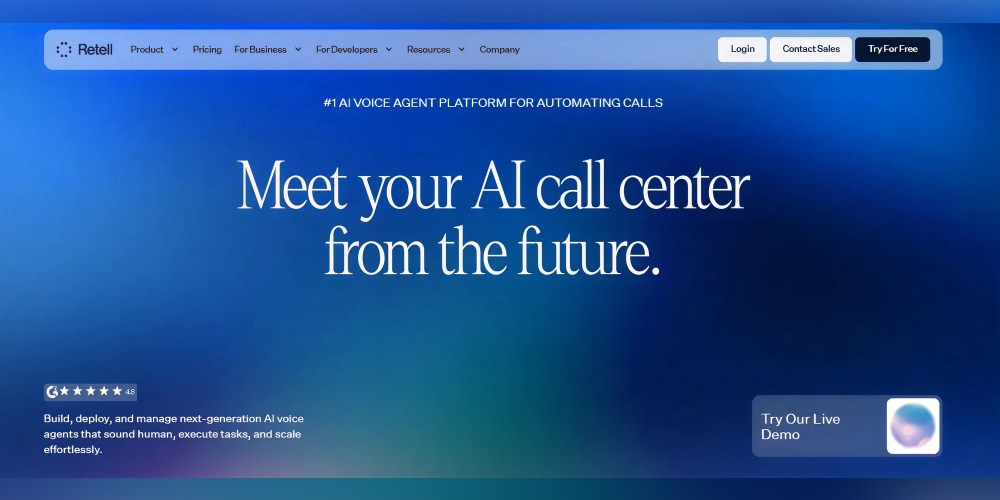
As of October 5, 2026, Retell's homepage (opens in a new tab) describes it as the "#1 AI Voice Agent Platform for Automating Phone Calls" and says teams can build, deploy, and manage AI voice agents from within the platform. It also highlights ~600ms latency, positions that as a responsiveness advantage, and says users get $10 of free usage when they sign up.
As of October 5, 2026, its homepage also points to customer outcomes (opens in a new tab), such as a customer quote reporting a 38% increase in scheduling NPS. Together, those details make Retell especially relevant for teams that want a usage-based platform for building and running voice automation with greater platform control.
Retell AI is best suited to teams that want a voice-focused platform for creating, deploying, and monitoring AI agents, especially when they value platform flexibility and usage-based scaling.
How They Work (Simple Setup Flow)
At a simple level, Orvera and Retell AI follow a similar rollout path. You usually start by choosing a call use case, such as appointment booking, lead qualification, claims status, payment reminders, or customer support.
From there, the next step is to design the call flow, connect the right systems, test how the agent handles real conversations, go live in production, and then keep improving performance based on what happens on actual calls.
A typical setup flow usually looks like this:
- Pick a call use case
Start with one clear workflow that has enough volume to matter and enough structure to automate well.
- Design the call flow
Map what the AI agent should say, what information it needs to collect, when it should ask follow-up questions, and when it should escalate.
- Connect your tools and systems
Integrate the agent with the systems your team already relies on, such as CRMs, scheduling tools, internal databases, or contact center software.
- Test edge cases
Check how the agent handles interruptions, unclear answers, repeat questions, missing information, verification steps, and transfers.
- Go live
Launch the workflow in production once the call path is stable enough for real customer interactions.
- Improve based on call outcomes
Review how calls are actually performing, identify drop-off points or transfer patterns, and make changes week by week.
The basic sequence is the same. The differences are how quickly each platform helps you move through it, how much support your team gets during rollout, and how easy it is to improve call performance after launch.
How do Orvera AI and Retell AI differ?
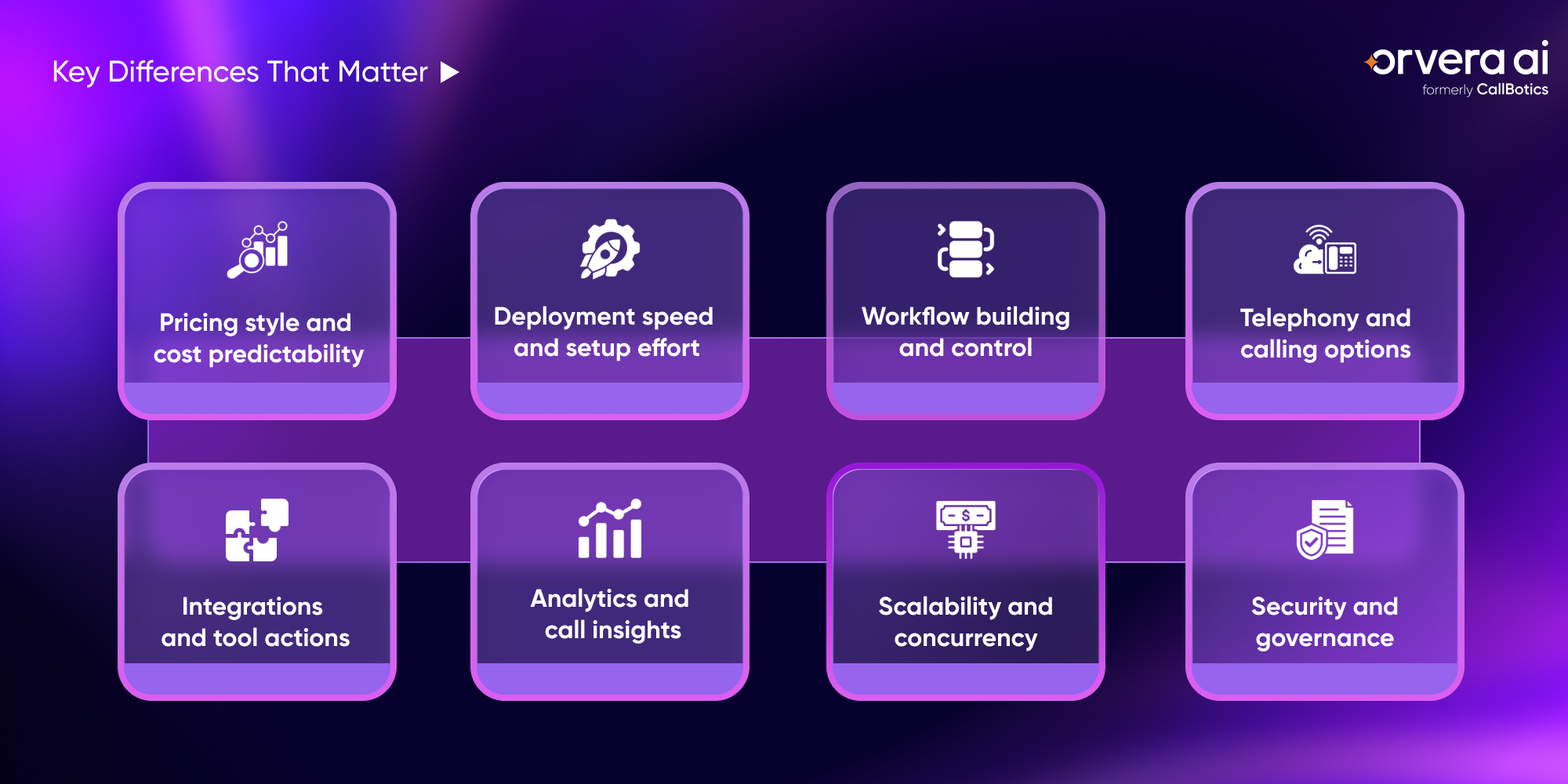
The biggest differences between Orvera and Retell AI usually show up in the areas that affect rollout speed, day-to-day control, and how costs behave once usage starts growing. On the surface, both platforms help teams automate phone calls with AI voice agents.
But in practice, buyers are usually comparing two different operating styles:
- one that is built, deployed and run for you by the vendor
- and one that feels more usage-based and platform-led
Pricing approach
Pricing matters because cost behavior changes as call volume grows. Retell AI publishes pay-as-you-go pricing with voice pricing ranges as of October 5, 2026 (opens in a new tab). Orvera discusses pricing on a consultative call about your use cases.
That means buyers should compare total cost at expected volume as well as entry pricing. As of October 5, 2026, Retell AI shows $10 in free credits (opens in a new tab) and $0.07 to $0.31 per minute for AI voice agents on its pricing page.
What buyers should compare here:
- the total cost at your expected monthly call volume
- who does the onboarding, setup, QA and optimization work, your team or the vendor
- whether telephony, transcription, or usage charges are separate
- how your finance team wants to budget for usage growth
- how pricing changes when you add more workflows, teams, or business units
Deployment speed and setup effort
Time to launch is shaped by product access and by how much work goes into intent mapping, call flow setup, integrations, testing, and QA before the workflow is safe to launch.
Orvera builds, deploys and runs the solution for the customer, and the Orvera team runs the implementation end to end. Across Orvera customer engagements, full deployment averages 3 to 6 weeks. Retell AI leans into platform access and a self-serve build, test and deploy motion.
What buyers should compare here:
- how much of the setup your internal team has to own
- whether workflow design is done with you or mostly by you
- how long integrations and testing usually take
- what support your team gets before go-live
- how edge cases are tested before production launch
Workflow building and control
This area matters because real calls rarely stay on the ideal path. Customers interrupt, ask follow-up questions, change direction, and bring up missing information. A good evaluation should test how the platform handles branching, fallbacks, verification, transfers, and multi-step tasks such as scheduling or account updates.
Orvera frames this around structured workflow execution across channels, while Retell AI frames it around building and deploying voice agents with flexible orchestration.
What buyers should compare here:
- how well the agent handles interruptions and changes in direction
- whether the workflow can manage multi-step tasks without breaking
- how fallback logic works when the caller gives an unclear answer
- how easy it is to update or extend a live workflow
- whether the platform supports the depth your real call flows need
Telephony and calling options
Telephony choices affect the real customer experience, especially for teams handling large inbound volumes or time-sensitive outbound campaigns. Buyers should check how numbers are set up, how routing works, how transfers are handled, and how reliably the platform performs at higher call volumes.
As of October 5, 2026, Retell AI's pricing page lists telephony options (opens in a new tab) such as custom telephony and Twilio and Telnyx numbers, and its site lists a Vonage integration. With Orvera, the Orvera team sets up telephony when it builds and runs the deployment for you.
What buyers should compare here:
- number provisioning and setup flexibility
- inbound and outbound calling support
- call transfer and routing behavior
- reliability during peak periods
- whether telephony choices are self-managed or vendor-supported
Integrations and tool actions
Integrations only matter if they help the agent complete useful work during the call. A platform should be able to check records, update systems, create tickets, book appointments, or trigger the next action without forcing the customer into another channel.
Orvera offers 500+ integrations across the systems CX teams already run. As of October 5, 2026, Retell AI lists webhooks and API access on its pricing page (opens in a new tab), plus integrations such as HubSpot, Make and n8n.
What buyers should compare here:
- CRM, helpdesk, scheduling, and database connectivity
- whether the platform supports real-time API actions during the call
- whether the agent can confirm completed actions to the caller
- how much custom integration work is needed
- whether integrations support workflow automation as well as data lookup
Analytics and call insights
Good analytics help teams improve results after launch. Buyers should compare whether they get transcripts, summaries, intent-level reporting, and post-call analysis that actually helps them improve containment, reduce transfers, and refine workflows over time.
As of October 5, 2026, Retell AI lists call analytics and transcripts on its pricing page (opens in a new tab). Orvera pairs reporting and observability with Voice of Customer analysis and Auto QA across AI-handled and human-handled conversations.
What buyers should compare here:
- transcript and summary quality
- reporting at the call, intent, and workflow level
- visibility into transfers, failures, and drop-off points
- whether supervisors can use the insights without extra tooling
- how easily reporting supports weekly optimization
Scalability and concurrency
A voice AI platform can perform well in a pilot and still struggle under real demand. That is why teams should validate concurrency, overflow behavior, and what happens when multiple campaigns, queues, or departments are live at the same time.
As of October 5, 2026, Retell AI's pricing page lists 20 free concurrent calls (opens in a new tab) on pay-as-you-go and offers additional capacity. Ask Orvera to confirm concurrency for your expected peak volume during evaluation.
What buyers should compare here:
- the number of concurrent calls supported at your plan level
- what happens when demand exceeds the normal threshold
- whether overflow increases queue pressure or is handled gracefully
- how the system behaves during campaign spikes or seasonal peaks
- whether scaling requires pricing, infrastructure, or support changes
Security and governance
Security checks need evidence behind the trust badges. Buyers should verify how access is controlled (opens in a new tab), what gets logged, how data is stored, and how the platform handles escalation rules for sensitive calls.
As of October 5, 2026, Retell AI's enterprise plan (opens in a new tab) lists SSO, role-based access control, HIPAA/BAA, and custom data retention, while Orvera is SOC 2 Type II certified, HIPAA compliant and GDPR compliant.
What buyers should compare here:
- role-based access and admin controls
- audit logs and reporting visibility
- data retention and deletion policies
- support for regulated environments and contract needs
- safe escalation rules when the call should move to a human
How do Orvera AI and Retell AI compare side by side?
| Category | Orvera | Retell AI |
|---|---|---|
| Best for | CX teams automating voice, chat, email and messaging | Usage-based voice agent platform |
| Pricing | Discussed on a consultative call | Published pay-as-you-go per-minute pricing |
| Setup | Built, deployed and run by the Orvera team | More self-serve setup with platform-led deployment |
| Workflow depth | Structured, multi-step workflows across channels | Flexible for building and managing voice agent flows |
| Integrations | 500+ integrations for workflow automation | Webhooks, API access and listed integrations |
| Analytics | Reporting, Voice of Customer analysis and Auto QA across AI-handled and human-handled conversations | Transcripts, monitoring, and call analytics tools |
| Scalability | Confirm concurrency for your peak volume during evaluation | Usage-based scaling with published concurrency support |
| Security and governance | SOC 2 Type II certification, HIPAA and GDPR compliance, and governance | SSO, RBAC, retention controls, and enterprise plan options |
Which use cases fit Orvera AI best?
Orvera tends to fit best when voice is still one of the busiest parts of the operation and the business cares about outcomes (opens in a new tab). The strongest use cases are usually the ones where call volume is high, the workflow is repeatable, and success can be measured clearly after the call ends.
Contact center automation and queue reduction
When a contact center is flooded with the same types of calls every day, speed matters, but so does control. This is where Orvera fits well. It can answer high-volume inbound calls immediately, handle common intents in a structured way, and move more complex cases to the right human team without making the caller start over.
A simple example is a support environment where people call for claim status, account updates, payment questions, or service requests. The AI agent can handle the routine conversations first and route only the calls that truly need live support.
This usually helps teams:
- reduce hold time
- lower queue pressure
- improve response consistency
- protect human teams from repetitive call load
Appointment scheduling and confirmations
This is a very natural fit for voice automation because the workflow has a clear end goal. The call either results in a booking, a confirmation, a reschedule, or a cancellation. That makes performance easier to track and improve.
For example, a team can use Orvera to guide callers through available time slots, collect the right information, confirm details, and complete the action during the conversation itself. The value here is speed, plus fewer missed steps, keeping the process consistent, and making outcomes easier to measure.
This kind of use case works well when teams want:
- a structured call flow
- fewer manual scheduling tasks
- clearer success metrics
- a better caller experience for routine actions
Lead qualification and outbound follow-ups
Orvera also makes sense when the goal is to qualify interest before handing the conversation to a sales or operations team. Not every lead needs a human conversation first. In many cases, the first step is simply collecting the right details, understanding intent, and deciding who is worth prioritizing.
A common example would be an outbound follow-up flow where the AI agent asks a few qualification questions, captures the caller's needs, and passes a clean summary to the next team. That gives sales teams a better starting point and cuts down time spent on low-intent conversations.
This is often useful for teams that want to:
- qualify leads in a more consistent way
- collect details before handoff
- prioritize stronger opportunities faster
- give sales teams cleaner follow-up context
Which use cases fit Retell AI best?
Retell AI tends to be a strong fit for teams that want to build and run voice automation in a more usage-based, platform-led way. It is especially relevant for teams that want to create voice workflows inside a dedicated voice AI platform and scale them based on usage.
Voice agents for support and sales calls
Retell AI fits well in support and sales environments where teams want AI to handle a large number of phone conversations. As of October 5, 2026, its use case navigation includes lead qualification and AI customer service (opens in a new tab), which makes it a practical option for teams (opens in a new tab) that want AI voice agents to answer common support calls, qualify leads, collect details, and manage repeatable conversations more efficiently.
A few signs this use case fits well:
- support teams want faster first-line call handling
- sales teams need structured lead qualification calls
- the business has enough call volume for usage-based automation to make sense
- teams want to monitor performance inside a voice-focused platform
Call transfers, appointments, and IVR navigation
Retell AI also makes sense for teams building voice workflows around common call actions. As of October 5, 2026, its product navigation highlights call transfer, book appointments, knowledge base and navigate IVR (opens in a new tab), which shows the platform is designed to complete actions during a call. This is useful when teams want the agent to do something practical during the call, such as transfer the caller, guide them through menu logic, pull information from a knowledge source, or complete a scheduling task.
What teams should look for in this type of use case:
- whether the agent can complete the action during the call
- how well call routing and transfer logic work
- whether appointment outcomes are easy to confirm
- how smoothly the workflow handles structured call steps
Teams that want published per-minute pricing
Retell AI can also be attractive for teams that prefer published usage-based pricing, especially when call volume is still changing or the business wants to test a workflow before committing to a larger rollout. As of October 5, 2026, its pricing page publishes pay-as-you-go pricing (opens in a new tab), includes $10 in free credits, and shows AI voice pricing from $0.07 to $0.31 per minute depending on the setup. That kind of model can be appealing for teams that want a clearer starting point for budgeting or want to experiment before a wider rollout (opens in a new tab).
This pricing style is often attractive when:
- call volume is variable from month to month
- the team is still testing one or two early workflows
- the team wants to self-fund a small test before a formal evaluation
- finance teams are comfortable with usage-based spend
Strengths and Considerations
Both platforms are credible, and each fits a different operating model.
Orvera: strengths and considerations
Pros
- Implementation run end to end by the Orvera team
- Built on 18+ years of contact-center experience
- Deep Voice AI specialization inside an omnichannel platform, suited to contact center and call-heavy workflows
- 500+ integrations support practical workflow execution across the systems CX teams already run
- Strong public focus on outcomes such as call resolution, cost reduction, handle time, and operational insights
- Built, deployed and run by Orvera, with Agent Assist and Auto QA for human agents on the same platform
What to validate in a pilot
- Handoff quality in your exact workflows
- Action confirmation reliability during live calls
- Intent accuracy under noisy, rushed, or edge-case conditions
- Reporting depth for your QA and operations model
- How well the workflow performs once volume increases
Retell AI: strengths and considerations
Pros
- Strong public positioning as a dedicated AI voice agent platform for automating calls
- Clear build, deploy, and manage structure makes the platform motion easy to understand
- Published pay-as-you-go pricing with per-minute ranges and free credits for getting started
- Broad support for common voice workflows such as support, lead qualification, appointments, IVR navigation and call transfer
- Strong platform-level story around telephony, monitoring, and post-call analysis
- Attractive for teams that want more direct platform control and usage-based scaling.
What to validate in a pilot
- Timeline for first production launch in your real environment
- Long-term budget behavior at your expected call volume
- Workflow depth for the exact call flows you need
- How much reporting and QA visibility your team gets by default
- What level of internal technical ownership is needed after launch
Which One Should You Choose? (Simple Decision Guide)
The fastest way to decide is to start from your real constraints.
Choose Orvera if...
Choose Orvera if you want the operation built, deployed and run for you, with omnichannel AI agents, deep Voice AI specialization, and Agent Assist and Auto QA on one platform. It is best suited to contact centers, BPOs and CX teams that care about measurable outcomes such as resolution, routing quality, summaries and cost control.
Choose Retell AI if...
Choose Retell AI if you want a more usage-based voice automation model, visible starting prices, and a platform-centered way to build, deploy, and monitor AI voice agents. It is often a practical fit for teams that want flexibility, direct platform control, and a clearer pay-as-you-go path during early rollout or testing.
If you're unsure, run a 2-intent pilot
A practical way to decide is to test two intents: one simple and one medium-complexity. For example, try FAQs plus scheduling, or routing plus status updates. Then compare setup time, containment, transfer quality, summary usefulness, and cost per resolved contact. That will usually give you a clearer answer than a polished demo alone. This is a practical recommendation based on the product differences above.
How Orvera Runs CX Automation
Orvera combines omnichannel AI agents, Agent Assist and Auto QA on one platform with real operational understanding. It is shaped by 18+ years of contact-center experience, which means it is built by teams that understand what happens in live environments, from queue pressure and routing complexity to handoff quality and the day-to-day behavior of real voice workflows.
What sets Orvera apart:
- Built on 18+ years of contact-center experience
- Implementation run end to end by the Orvera team
- Omnichannel AI agents with deep Voice AI specialization, designed around resolution, Agent Assist summaries and Auto QA
- 500+ integrations across the tools and systems CX teams already run
- Strong visibility into calls through analytics, insights, and QA-style reporting
- A strong fit for teams that want measurable outcomes and an operation run for them
Conclusion
Orvera and Retell AI are both credible options for AI voice automation, and they tend to solve slightly different buying needs. Retell AI is often a strong fit for teams that want a usage-based voice agent platform with direct control over building, deploying and monitoring call workflows. Orvera is best suited to teams that want omnichannel AI agents with deep Voice AI specialization, Agent Assist and Auto QA on one platform, built, deployed and run for them.
The best choice depends on your call intents, rollout timeline, integration needs and budget style. Run the two-intent pilot above and compare cost per resolved contact before you commit.
Frequently asked questions
As of October 5, 2026, Retell AI presents pricing as pay-as-you-go and shows per-minute voice pricing ranges, so it does support a usage-based starting model. Buyers should still confirm what changes under higher-volume or custom plans.
Across Orvera customer engagements, full deployment averages 3 to 6 weeks, with the Orvera team running the implementation. Retell AI emphasizes fast self-serve setup, so the real answer depends on workflow complexity, integrations, and how much support your team needs.
Orvera emphasizes operational visibility, Auto QA across AI-handled and human-handled conversations, and workflow outcomes, and it is SOC 2 Type II certified, HIPAA compliant and GDPR compliant. As of October 5, 2026, Retell AI lists enterprise controls like SSO, RBAC and retention options. The better fit depends on whether your priority is operational reporting depth or platform governance controls.
Yes. Orvera says it supports 500+ integrations, and Retell AI also shows integrations and workflow actions across tools such as scheduling and CRM-related systems.
Test one simple intent and one medium-complexity intent, then compare setup time, handoff quality, action completion, reporting usefulness, and cost per resolved call. That usually tells you more than a polished demo.

Written by
Anindita Majumder
Anindita Majumder is a communications professional with nearly four years of experience in public relations, corporate communications, and journalism. She creates content that helps brands communicate their vision, products, and expertise through press releases, thought leadership, and editorial pieces. Outside of work, she is a vocalist, which keeps her creativity flowing.