How an AI Agent Delivers Prior Authorization Decisions for Health Plans
Members and provider offices call because the decision already exists inside the plan's utilization management system and nobody has told them yet.

Key highlights
- Members and provider offices call because the decision already exists inside the plan's utilization management system and nobody has told them yet.
- Once the reviewer records a determination, the AI agent places the notification calls and carries each one from greeting to a logged outcome.
- One notification runs as two calls and one record: the member call, the provider office call, and a logged attempt history the plan can audit.
- The plan owns all clinical and regulatory elements, and the AI agent owns the delivery of them.
- A health plan wants it built and run for it so the plan's operations team puts its hours into measuring notification performance while Orvera's team keeps the conversation flows tuned.
- Four measures, all drawn from records the plan already holds, show whether notification is running or backing up.
- Four statements cover what changes, what stays with the plan, and how long it takes.
Why do members and provider offices call the plan asking about a prior authorization decision?
Members and provider offices call because the decision already exists inside the plan's utilization management system and nobody has told them yet.
The clinical reviewer finishes the case and records the determination. From that moment, the member waiting on a procedure and the requesting provider's office waiting to schedule it are both in the dark until someone in a manual outbound queue works down the list and reaches them. That queue is staffed by people, worked in business hours, and sized against a case volume that moves every week.
The wait generates its own call volume. Members call member services to ask whether anything has been approved. Provider office staff call provider services to ask the same question about the same case, sometimes twice in a day. Both calls land on the same operation that owns the outbound notifications, so the backlog feeds itself: the slower the outbound queue runs, the more inbound status checks arrive to slow it further.
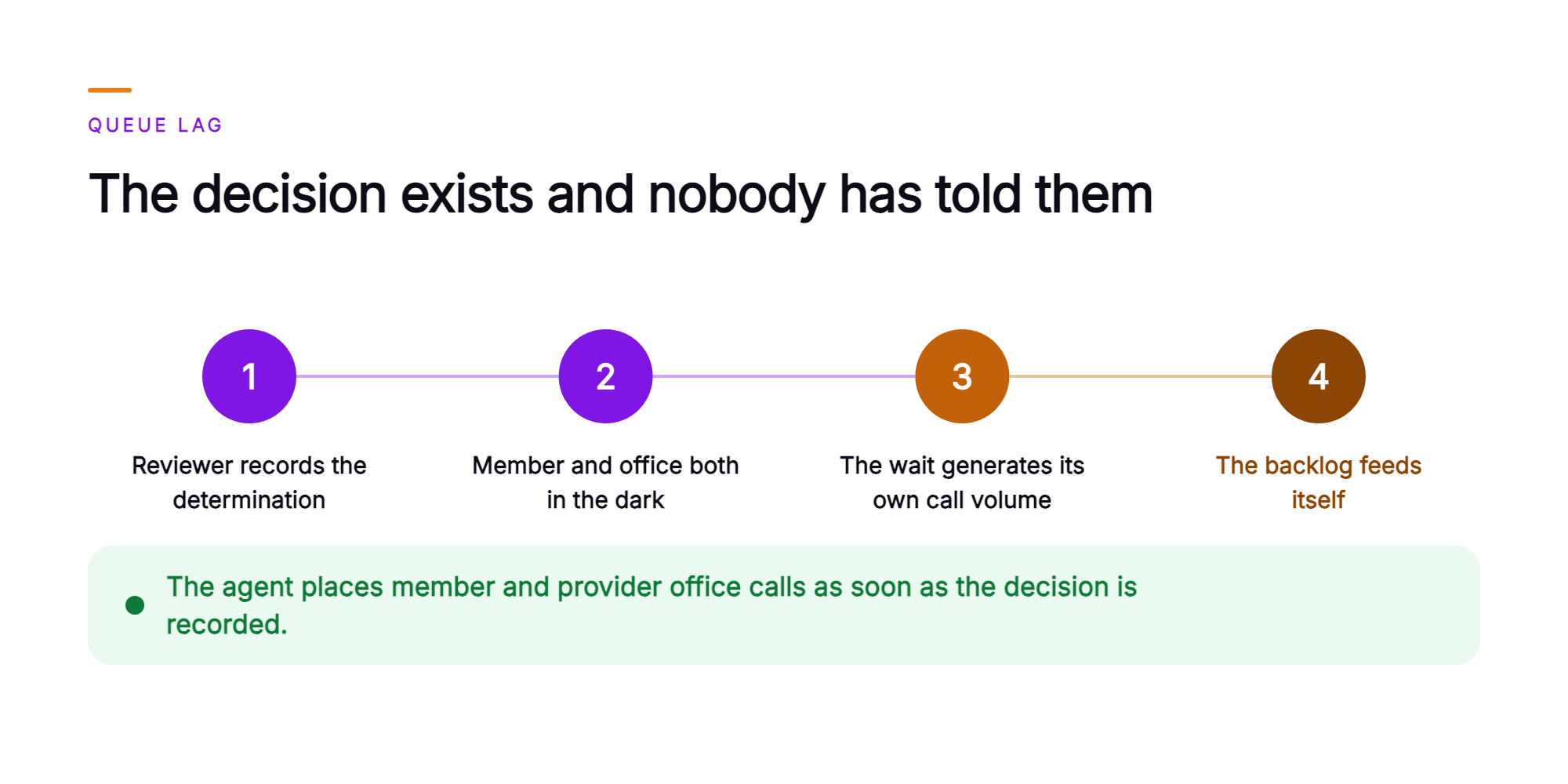
Meanwhile, the plan must adhere to decision and notification timeframes, and the member experience scores a VP of Member Experience reports on every quarter are shaped by exactly this wait. A delayed call appears in both the compliance file and the survey.
What is a prior authorization decision notification call?
A prior authorization decision notification call is the outbound voice call a health plan places to the member and to the requesting provider's office after a clinical reviewer has decided a request, stating the decision, the next step, and the member's appeal rights.
The plan fully owns the content of that call. The coverage determination is made by the plan's clinical reviewers. The decision notice, the appeal rights language, and the timeframes the notification must meet belong to the plan and the regulations it answers to. The call delivers a decision that has already been made and recorded, with the clinical criteria and the outcome held by the plan's reviewers.
Within utilization management operations, this call is the final step. Intake, clinical review, and determination all happen upstream. The notification is the point where the decision leaves the system and reaches the two parties waiting on it: the member who needs to know whether care is covered, and the office that needs an authorization reference before it can schedule.
It is the step where compliance exposure and member frustration are created or avoided.
What does the AI agent do once the plan's reviewer makes a decision?
Once the reviewer records a determination, the AI agent places the notification calls and carries each one from greeting to a logged outcome.
The record itself triggers the process. A decision written to the plan's utilization management system starts outbound calls to the member and to the requesting provider's office, without a person pulling a worklist. The first attempt goes out right after the decision is recorded, inside the calling windows the plan sets.
Before any decision detail is shared, the agent runs the plan's own identity verification steps. If the member cannot verify, the agent follows the plan's own rule for that case, exactly as written. When a member asks something only a person at the plan can answer, a clinical question or an appeal they want to start on the spot, the agent transfers to the plan's staff with the context already gathered.
Orvera's AI agents work across voice, chat, email, and the plan's other channels in more than 80 languages. The plan sets how the agent follows up with a member who misses the call, choosing the channel and the language for that member.
What does one prior authorization notification call look like from start to finish?
One notification runs as two calls and one record: the member call, the provider office call, and a logged attempt history the plan can audit.
Take an approved outpatient imaging request. The reviewer approves the case and records it. The agent calls the member, works through the plan's identity verification steps, and states plainly that the imaging study has been approved. It then gives the next step the plan has set, which may be to wait for the imaging center to call with a scheduling slot, and it reads the plan's appeal rights language as written. The member asks when the authorization expires. The agent answers from approved knowledge held in the plan's own materials and confirms the member has nothing further to do.
The same decision drives the provider side. Provider notification calls go to the requesting office with the determination and the authorization reference number the plan issued, in the format the office staff expect, so the office has what it needs to schedule.
The record closes the loop. Each attempt, each outcome, each transfer is written back to the plan's system. The full conversation summary and transcript sit with the case, available to the compliance team when the file is reviewed.
Who owns each part of a prior authorization decision notification?
The plan owns all clinical and regulatory elements, and the AI agent owns the delivery of them.
- The plan's determination. The reviewer decides. The agent states that decision on the call exactly as recorded, and adds nothing to it.
- The plan's appeal rights language. Compliance writes it. The agent reads it word for word from approved knowledge, with no paraphrasing.
- The plan's notification timeframes. The plan is held to them and owns meeting them. The agent places the member and provider office calls as soon as the decision is recorded, and keeps attempting under the plan's retry rules.
- The plan's escalation rules. The plan defines what requires a person. The agent transfers the member to the plan's clinical or member services staff when the conversation crosses that line, with the case context already in hand.
- The plan's system of record. The plan holds it. The agent writes every attempt, outcome, and transfer back to it.
Every determination stays with the plan. Clinical judgment stays with the reviewers who hold the license and the criteria. What changes is who makes the call and how completely it is documented.
Why would a health plan want the notification platform built and run for it?
A health plan wants it built and run for it so the plan's operations team puts its hours into measuring notification performance while Orvera's team keeps the conversation flows tuned.
Orvera AI is an agentic AI platform for enterprise customer experience, and Orvera builds, deploys, and runs it for the plan as a managed service. Orvera does the integration with the plan's utilization management system and member services stack, and its enablement work spans onboarding, knowledge-base setup, agent training, and change management. A full enterprise deployment goes live in three to six weeks, on the stack the plan already runs, with 500+ integrations available for the systems of record behind it.
Orvera is built on 18+ years of contact-center experience, which is why its utilization management automation is designed around attempt logs, escalation rules, and audit files.
Governance is the part a regulated payer reviews first. The agent's answers are grounded in approved knowledge the plan supplies. AI Quality Management audits every conversation, human-handled and AI-handled, against the scorecards the plan's evaluators already use. Orvera is SOC 2 Type II certified, HIPAA compliant, and GDPR compliant.
The architecture is model-agnostic, so the plan moves to the newest model as it arrives, on the same deployment. It is one platform, adopted in stages. A plan can start with a single notification flow and add more healthcare contact center AI workflows once the first one is measured.
Which numbers tell a utilization management leader the notification calls are working?
Four measures, all drawn from records the plan already holds, show whether notification is running or backing up.
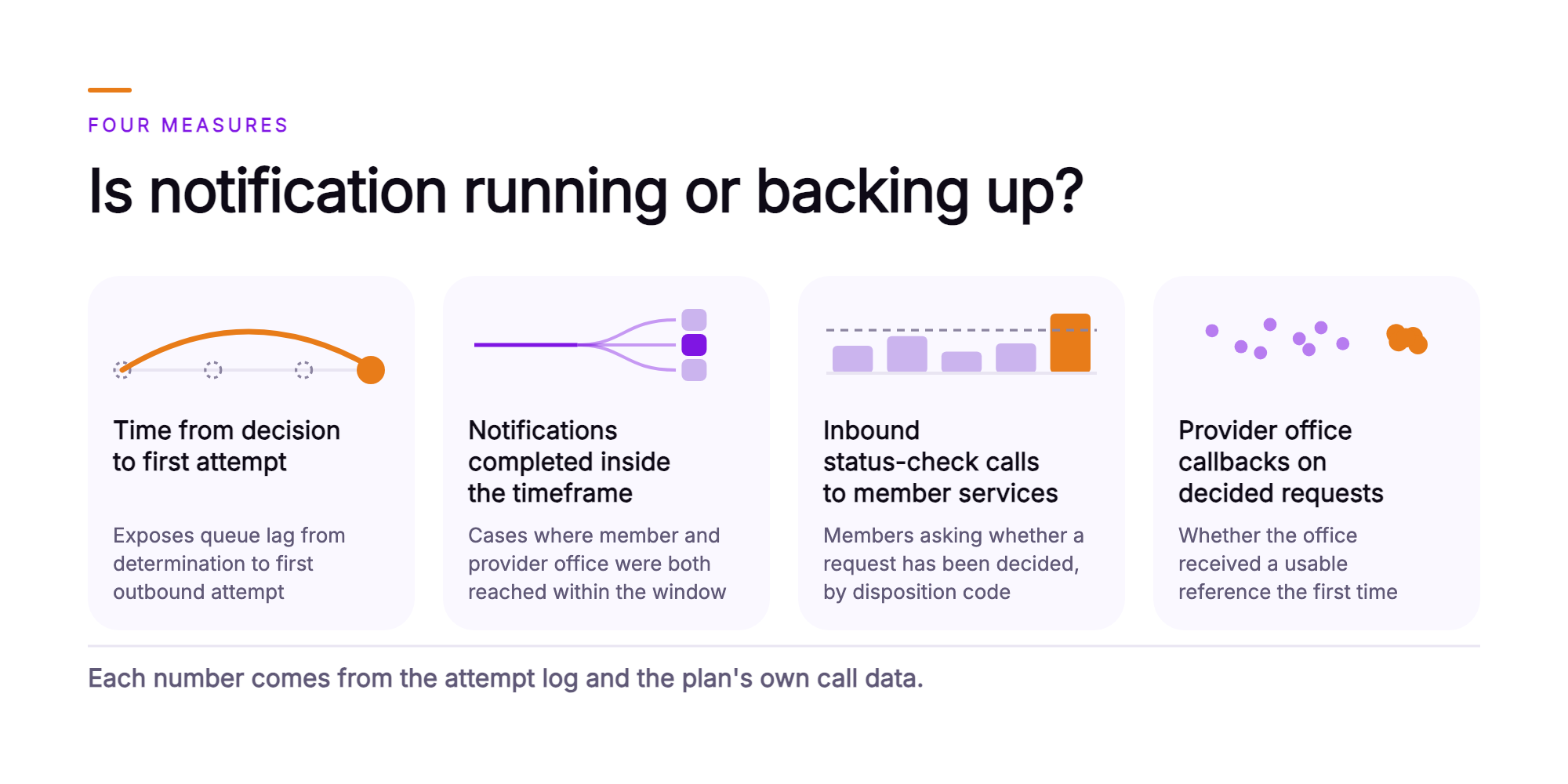
- Time from decision to first notification attempt. Measured from the timestamp the reviewer records the determination to the timestamp of the first outbound attempt, this is the single number that exposes queue lag.
- Notifications completed inside the plan's timeframe. The share of decided cases where the member and the provider office were both reached within the window the plan must meet, read straight from the attempt log.
- Inbound status-check calls to member services. Calls from members asking whether a request has been decided, counted by disposition code and read against the speed of outbound notification.
- Provider office callbacks about decided requests. The provider services version of the same signal, and a direct indicator of whether the office received a usable authorization reference the first time.
Each number comes from the attempt log and the plan's own call data. The plan checks every figure in systems it already controls. Track all four against the baseline the plan recorded before the agent went live, and the leadership conversation becomes a comparison of the plan's own figures across two periods.
What should a member experience leader take to the leadership team?
Four statements cover what changes, what stays with the plan, and how long it takes.
- The AI agent calls the member and the requesting provider's office as soon as the plan's reviewer records a decision, so the case moves straight from decision to notification.
- Every coverage determination stays with the plan's clinical reviewers, and the agent states the decision the plan made without interpreting it.
- Every attempt, outcome, and transfer is logged in the plan's system, with transcripts and conversation summaries available to compliance for review.
- Orvera builds, deploys, and runs the platform for the plan as a managed service, with a full enterprise deployment live in three to six weeks on the systems the plan already runs.
Add one more line if the room asks about control: Orvera is SOC 2 Type II certified and HIPAA compliant, and the agent's answers on the call are grounded in knowledge the plan approved.
What does prior authorization notification look like once the AI agent runs it?
It looks quiet. Each decision the reviewer records triggers the agent's member and provider office calls, which continue under the plan's retry rules.
In steady state, the plan watches inbound status-check volume against its own pre-launch baseline and tracks the gap between determination and first attempt as case volume moves. The compliance team opens a case file and finds a complete attempt log with timestamps, outcomes, and transcripts already attached, which answers who called whom in one place.
With the agent on the outbound calls, clinical and member services staff put their hours into appeals conversations, complex coverage questions, and the members who need a person on the line. Member outreach automation handles the volume of routine notification so those hours stay where they are needed.
To see how Orvera AI would run the notification calls on your plan's stack, talk to the team (opens in a new tab).
Frequently asked questions
The member hears a short call that verifies who they are, states the decision the plan made on their request, explains the next step, and reads the plan's appeal rights language exactly as written. The prior authorization decision notification call opens with the plan's own identity verification steps, using the identifiers the plan specifies. The AI agent then names the service or medication requested, states the determination, and gives the authorization reference number. After that, the agent explains the next step and reads the plan's appeal rights language word for word. The call closes by asking whether the member has questions. The agent answers from the plan's approved knowledge and offers a transfer to member services for anything only a person at the plan can answer.
The health plan makes every prior authorization determination. Clinical reviewers employed or contracted by the plan apply the medical necessity criteria the plan is held to, and the plan owns the decision notice and the appeal rights language that goes with it. Clinical review, case interpretation, and every decision stay with the plan's reviewers. Orvera AI reports the decision already recorded in the plan's utilization management system to the member and to the requesting provider office, in the plan's approved words. Each attempt is logged against the case, so the clinical review manager can see who was notified, when, and what was said. The determination stays where it belongs, with the plan's clinicians. The notification work moves off the queue.
The AI agent places an outbound prior authorization call to the provider office on file in the plan's system, using the same phone number the utilization management team would dial. On connection, the agent identifies the health plan, gives the member identifier, states the determination, provides the authorization reference, and states the next step: schedule the service, submit additional clinical documentation, or follow the appeal path. Office staff can ask for the reference again or request a transfer to the plan's provider line. Retries and voicemail follow the plan's own outreach rules. The plan sets how many attempts are made, how far apart they are, and whether a message may be left. Each attempt, each outcome, and each voicemail is logged against the case record.
The AI agent reads the plan's appeal rights language in full, then transfers the member to the plan's staff, who start the prior authorization appeal process under the plan's own procedures. Clinical questions go the same way. Anything about medical necessity, alternative therapies, or the reviewer's reasoning routes to the plan's clinical staff, who answer it and explain any denial. Before the transfer, the member's stated request is recorded in the plan's system along with the transfer itself, so the receiving human rep opens the case with the context already in front of them and takes the conversation from there.
Every attempt writes a record to the plan's system at the moment it happens, whether the call connected, hit voicemail, or failed. Each record holds the time of the attempt, the party called, whether contact was made, the outcome, and the disposition code the plan uses. A conversation summary and the full transcript sit alongside it, available to the compliance team directly, whenever they open the case. AI Quality Management audits every conversation, human-handled and AI-handled, and scores each one against the scorecards the plan's evaluators already use. When an auditor or a regulator asks how a decided case was communicated, the compliance team pulls that case's full call history next to the plan's own decision notice record.
Orvera AI does the integration work into the systems the plan already runs, including the utilization management platform, the CRM, and the CCaaS layer, drawing on 500+ integrations. A decision recorded by a clinical reviewer triggers the notification calls. The same integration lets the AI agent read the live case status when a member calls to check prior authorization status. Orvera AI is an agentic AI platform for enterprise customer experience, SOC 2 Type II certified, HIPAA compliant, and GDPR compliant, built on 18+ years of contact-center experience. Full enterprise deployment goes live in three to six weeks. To see how Orvera AI would run prior authorization notifications under your plan's own rules, talk to the team.

Written by
Anindita Majumder
Anindita Majumder is a communications professional with nearly four years of experience in public relations, corporate communications, and journalism. She creates content that helps brands communicate their vision, products, and expertise through press releases, thought leadership, and editorial pieces. Outside of work, she is a vocalist, which keeps her creativity flowing.