How Auto QA Checks Answer Accuracy on Every Health Plan Provider Call
A wrong answer becomes a dispute because the provider office acts on it right away, and the claim settles differently weeks later. Orvera's Auto QA scores every provider-services call against the plan's own scorecard, checks the eligibility, benefit, and claim-status information the...

Key highlights
- A wrong answer becomes a dispute because the provider office acts on it right away, and the claim settles differently weeks later.
- A provider-services answer-accuracy audit checks what the representative told the provider against what the plan's systems of record showed for that member and that claim, call by call.
- One audited claim-status call runs from the provider's question to a confirmed flag in the quality queue, with the transcript evidence attached at every step.
- The plan owns every judgment about accuracy and every consequence that follows.
- Quality teams do not have the bandwidth to build and maintain an audit engine on top of their day job.
- Four measures tell a VP of Provider Services whether answer accuracy is improving, and each one points at a decision the quality team already owns.
- Four statements are enough for a leadership update, and each one stands on its own.
- It looks like a quality team working from evidence on every call.
Why does a wrong answer on a provider-services call turn into a dispute later?
A wrong answer becomes a dispute because the provider office acts on it right away, and the claim settles differently weeks later. Orvera's Auto QA scores every provider-services call against the plan's own scorecard, checks the eligibility, benefit, and claim-status information the representative quoted against what the plan's systems of record showed, and flags each mismatch for the plan's quality reviewers, who confirm each flag and decide the follow-up.
From the provider office's side, the sequence is routine. A biller calls the provider services contact center, asks whether a member is eligible for a scheduled procedure, and writes down what the representative says. The office performs the service, submits the claim, and moves on. Weeks later the claim denies, or the allowed amount does not match the benefit that was quoted, and the office calls back with a grievance.
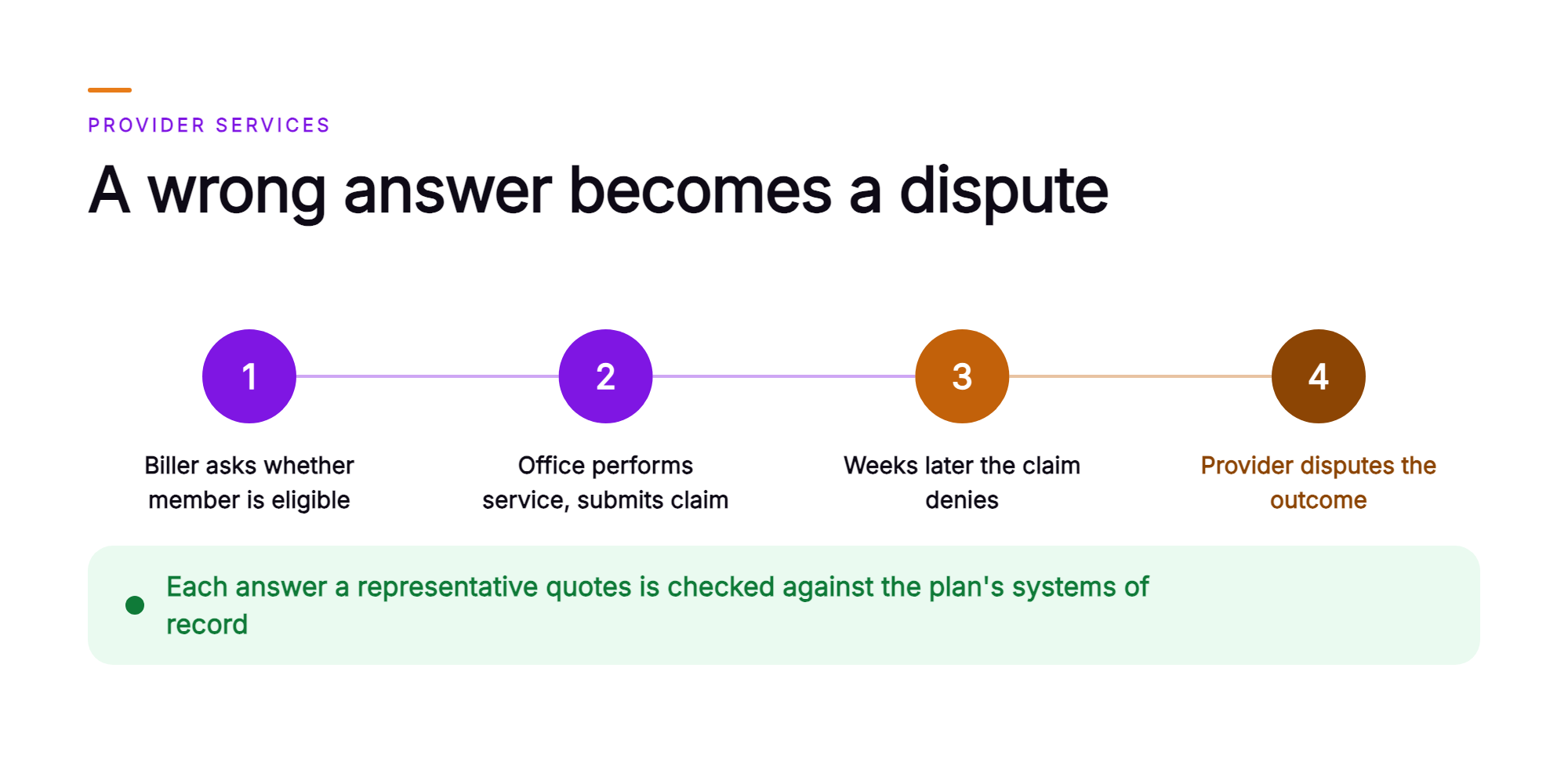
Three answer types carry most of this risk: member eligibility, benefit details, and claim status. Each one is held in a plan system of record that the representative reads on screen while the provider waits. Accuracy depends on opening the right record, for the right member, in the right plan year, and stating it correctly out loud.
A reviewer typically examines a small sample of those calls. When a representative quotes a benefit that differs from the record on a call no reviewer ever opened, the plan finds out later, when the provider disputes the outcome.
What is a provider-services answer-accuracy audit?
A provider-services answer-accuracy audit checks what the representative told the provider against what the plan's systems of record showed for that member and that claim, call by call. It is the core question in payer contact center QA, because the provider office schedules care and works its claims on the strength of what the representative says.
The health plan defines what counts as an accurate answer. The quality team writes the scorecard criteria, sets the weights, and names the fatal checks, such as quoting a terminated eligibility span as active. The audit applies those criteria as the plan wrote them.
The metric this audit produces is the provider-quoted error rate: how often a quoted answer differed from the record, broken out by call reason, and traced forward to the disputes, appeals, and repeat calls that followed. That number tells a Director of Quality where the accuracy problem actually sits. Eligibility may be clean while claim status is not. Coaching, job aids, and screen flow all follow from that split.
How does Auto QA score every provider-services call for answer accuracy?
Orvera's Auto QA (AI Quality Management) transcribes each provider-services call, scores it against the plan's own scorecard, weights, and fatal checks, and compares the information the representative quoted against the plan's systems of record. The full call population is in scope.
The accuracy check works on the specifics. If the representative stated an eligibility span, a copay or coinsurance amount, or a claim status and reason code, Auto QA matches that statement to what the plan's eligibility, benefits, and claims systems of record showed for that member. Each score carries the transcript line that produced it, with the timestamp, so a reviewer can check the score against what the representative actually said.
In a payer environment, automated QA has to check the facts the representative quoted as well as how the call was handled. Tone, greeting, and verification language matter, and they are scored. The quoted number matters more, because the quoted number is what the provider office acts on.
Every mismatch becomes a flag in the reviewer queue. The flag names the call reason, the quoted answer, the record value, and the scorecard criterion it failed. The plan's quality reviewer opens it, confirms or dismisses it, and decides the follow-up. Auto QA supplies the scored call and the evidence. The accuracy judgment remains with the plan's quality reviewers.
What does one audited claim-status call look like from start to finish?
One audited claim-status call runs from the provider's question to a confirmed flag in the quality queue, with the transcript evidence attached at every step. Here is an illustrative sequence at an unnamed plan.
A billing office calls about a surgical claim submitted six weeks earlier. The representative verifies the caller, accesses the claim in the claims system, and informs the office that the claim is pending additional medical records. The office hangs up and spends two days assembling a records packet it was never asked for. The claim was actually finalized and denied for a coordination-of-benefits issue, which required a different action and a different deadline.
Auto QA scores the call against the plan's scorecard. Verification passed. Call control passed. The claim-status check did not: the quoted status does not match the claim-status record, and the audit attaches the transcript line where the representative said "pending records," next to the record value.
The flag lands in the quality reviewer's queue. The reviewer listens to the segment, confirms the mismatch, and splits the follow-up in two. The representative gets targeted coaching on reading finalized claim dispositions. The plan's provider-services team sends the office an outbound correction before the appeal window closes.
What does the plan decide and what does Auto QA do on each call?
The plan owns every judgment about accuracy and every consequence that follows. Auto QA produces the scored calls, the record comparisons, and the evidence those judgments rest on.
The plan decides:
- What counts as an accurate answer for each call reason, including how eligibility spans, benefit amounts, and claim dispositions must be stated.
- The scorecard criteria, the weights, and which failures are fatal.
- Every correction to a provider, every coaching assignment, and every dispute or grievance decision.
Auto QA does:
- Scores every provider-services call, human-handled and AI-handled, against that scorecard.
- Checks quoted eligibility, benefit, and claim-status details against the plan's systems of record.
- Links each score to the transcript line and timestamp that produced it.
- Flags each mismatch to the reviewer queue, grouped by call reason and representative.
Every flag goes to a plan reviewer, who confirms it and decides any coaching step or correction to a provider office. That sequence gives the plan a documented record: a named human made the decision, and the evidence trail shows what they saw.
Why would a health plan want the audit built and run for it?
Quality teams do not have the bandwidth to build and maintain an audit engine on top of their day job. Orvera AI builds, deploys, and runs the platform as a managed service, with a full enterprise deployment live in three to six weeks on the stack the plan already runs.
Orvera AI is an agentic AI platform for enterprise customer experience, built on 18+ years of contact-center experience. Before go-live, scoring is calibrated against the plan's own QA analysts on the plan's own calls, so the audit is measured against the judgment of the people who already set the standard. Because the plan's own analysts shape that calibration, the quality team has reason to act on what Auto QA flags.
The platform has 500+ integrations and connects to the eligibility, claims, CRM, and CCaaS systems the plan already operates. Orvera is SOC 2 Type II certified, HIPAA compliant, and GDPR compliant, with approved-knowledge grounding and full auditability.
Which numbers tell a provider-services leader the audit is working?
Four measures tell a VP of Provider Services whether answer accuracy is improving, and each one points at a decision the quality team already owns.
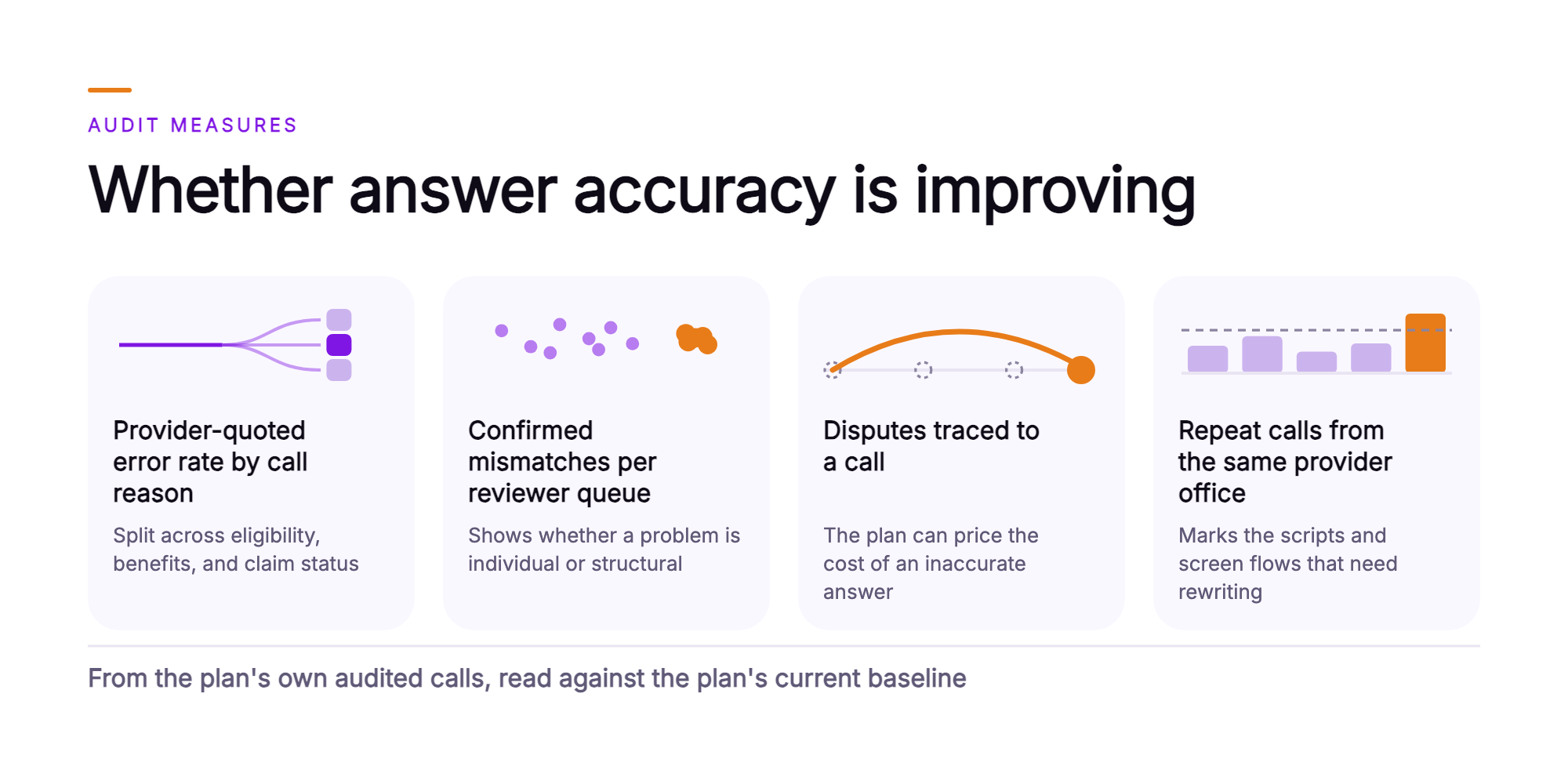
Confirmed mismatches per reviewer queue. The volume reviewers confirm, by representative and by team, feeds agent performance scoring and shows whether a problem is individual or structural.
Disputes traced to a call with a confirmed mismatch. When an appeal or grievance maps back to a scored call, the plan can price the cost of an inaccurate answer and defend its corrective action.
Repeat calls from the same provider office on the same claim. Repeat contact on one claim usually means the first answer did not hold, and it marks the scripts and screen flows that need rewriting.
Every one of these comes from the plan's own audited calls, read against the plan's current baseline. The first month's numbers set the starting point for every later comparison.
What should a provider-services leader take to the leadership team?
Four statements are enough for a leadership update, and each one stands on its own.
- Every provider-services call is now scored against the plan's own scorecard, weights, and fatal checks, where the old method reviewed a monthly sample of a few calls per representative.
- Each eligibility, benefit, and claim-status answer a representative quotes is checked against what the plan's systems of record showed for that member.
- Each mismatch arrives in the quality queue with the transcript line and timestamp attached, and a plan reviewer confirms it and decides the correction, the coaching, or the provider outreach.
- The provider-quoted error rate is tracked by call reason and matched against downstream appeals, grievances, and repeat calls, so the operation can see which inaccurate answers cost the plan money.
Those four lines describe a standing control. They are also the four answers a compliance officer can read straight from the audit file.
What does provider services look like once every call is audited?
It looks like a quality team working from evidence on every call. Orvera's Auto QA audits every conversation, human-handled and AI-handled, and the queue becomes the week's agenda.
Monday opens with confirmed mismatches grouped by call reason. Coaching sessions start from a timestamped transcript line and the record value next to it, so the conversation with the representative is about what was said and what the record showed. The dispute patterns are traceable too: the appeals landing this month connect back to the calls that started them, and the job aid behind those calls gets rewritten.
The plan's quality team retains control over decisions regarding accuracy, corrections, and coaching. Auto QA supplies the scored calls, the record comparisons, and the flags. To see how this would run against your provider-services queue, talk to the team (opens in a new tab).
Frequently asked questions
An answer-accuracy audit checks whether the eligibility, benefit, and claim-status information a representative or an AI agent quoted on a provider call matches what the plan's systems of record actually showed at the time of the call. This is the check that ties each call to the record. The audit pulls the transcript, looks up the corresponding record in the plan's core systems, and flags each gap it finds between what was said and what the data showed. Each call is then scored against the plan's own scorecard, and every score links back to the specific transcript evidence that produced it. That linkage lets a reviewer show how any score was reached.
The health plan and its quality team define accuracy. They write the scorecard criteria, the weighting of each check, and the fatal-error flags that mark a call as non-compliant. That definition is what the audit tests: the plan's own stated standard for eligibility, benefit, and claim-status responses. At deployment, Orvera's Auto QA (AI Quality Management) calibrates its scoring against the plan's own QA analysts, so automated scoring is tuned to the judgment calls your reviewers make. When a flag reaches a compliance review, it carries the transcript evidence behind the score and the plan reviewer's confirmation. Once calibrated, the platform audits every conversation and scores each one against the bar your team wrote.
When the audit finds a mismatch, Auto QA flags it, attaches the specific transcript evidence, and sends the flagged call to your quality reviewers for confirmation. Your reviewers see exactly which eligibility, benefit, or claim-status statement diverged from the system of record, with the timestamp and the quoted language side by side. That precision lets reviewers confirm the flag, decide whether the call needs a correction notice sent to the provider, and schedule targeted coaching for the rep from the quoted line and the record value. Complete coverage gives reviewers the full population they need to act on a pattern while it is still small.
Orvera's Auto QA scores every provider-services call, human-handled and AI-handled, across voice, chat, email, and every other channel the plan runs through the platform. When a provider disputes a claim-status answer, your reviewers can trace the dispute directly to the call where the answer was given, pull the transcript, and confirm what the rep said against what the system of record showed. A sampled audit may never have opened that call.
The quality team groups confirmed mismatches by call reason, builds coaching sessions directly from the transcript evidence, and tracks whether the error rate for each call type drops after coaching is delivered. That sequence matters because coaching tied to a real transcript shows the rep the exact line, the record value, and the correction, so it is easy to accept and act on. Your reviewers sort flags by call reason, such as claim status, eligibility verification, or benefit questions, and run targeted sessions with the reps whose calls produced the errors. Leaders then track the provider-quoted error rate by call reason against the disputes that follow. When a drop in errors for a given call reason produces a corresponding drop in provider appeals, the connection between coaching and network stability becomes measurable.
Auto QA connects to the eligibility, benefits, and claims systems the plan already runs and checks each quoted answer against what those systems of record showed. Orvera AI reaches those systems through 500+ integrations. If a system is not in the directory, Orvera builds the connection during the three to six week deployment. Your stack stays as it is, and the platform connects to it. Once connected, Auto QA reads the system state for each interaction and scores the rep's answer against it. Flags go to your reviewers, who own every decision to correct a claim or update a record. The platform surfaces the evidence. Your team acts on it. The scorecard criteria, weights, and call-type definitions stay with your quality team. Orvera applies them consistently across every call in the population.

Written by
Anindita Majumder
Anindita Majumder is a communications professional with nearly four years of experience in public relations, corporate communications, and journalism. She creates content that helps brands communicate their vision, products, and expertise through press releases, thought leadership, and editorial pieces. Outside of work, she is a vocalist, which keeps her creativity flowing.