Retell AI Pricing 2026: Plans, Usage Rates and What Drives the Number
This guide explains how Retell AI pricing scales in production and how enterprises compare alternatives for predictable voice automation.

Key highlights
TL;DR: Enterprise Takeaways From This Guide
- Retell AI uses modular usage-based billing rather than a fixed subscription, so monthly spend rises with minutes, call logic depth, and concurrency.
- Free credits help teams validate an early prototype, but production usage introduces multiple cost layers across voice, language processing, telephony, and add-ons.
- The most important cost drivers at scale are call duration, peak concurrent sessions, international routing variability, and language model utilization patterns.
- Forecasting accuracy improves when engineering, operations, and finance share ownership of call design, monitoring, and usage governance.
- Voice quality and response latency influence customer experience and containment rates, so performance tuning often has a cost tradeoff.
- Compliance and security posture become central in regulated industries where automation touches sensitive data and must preserve safe escalation paths.
- Alternatives that scope the commercial model to the deployment can outperform modular pricing when enterprises need stable budgeting, faster rollout approvals and fewer billing variables.
- Platform selection ultimately depends on whether the organization values component-level control or operational predictability under real contact center conditions.
At its core, the Retell AI pricing framework is designed for flexible usage, not fixed subscription billing. There is no license or seat cost. Instead, organizations pay only for what they use, a true pay as you go philosophy.
For new accounts, Retell provides a small amount of free credits (roughly US$10), which enables up to ~60 minutes of calls plus a set number of concurrent sessions and knowledge base slots. These credits help teams prototype a conversational agent with limited risk.
However, once free credits are consumed, the system begins billing for every element of the live call stack. This modular billing structure separates fees for voice, reasoning, telephony, and add-ons, and that separation is where cost clarity becomes essential.
In early experimentation phases, this pricing can feel transparent and straightforward. Once scaled across business lines or automation programs, it requires careful planning and ongoing monitoring.
How To Think About AI Voice Agents In Enterprise Use Cases
AI voice agents represent a category of automation that brings conversational intelligence into real-time phone calls. Unlike traditional IVR menus, these agents aim to:
- Listen and interpret human speech
- Reason through context using large language models
- Generate responses through natural voice synthesis
- Execute transactional logic (e.g., schedule a service, verify information)
Retell AI enables organizations to build these voice agents and integrate them into support, sales, scheduling, and qualification workflows. Because these systems can augment human agents, both business and technical teams must understand how they operate under real traffic, not just in test environments.
In enterprise settings, these agents often interact with critical systems such as CRMs, calendar platforms, and workforce management tools. The cost and architectural impact of these interactions begin with how calls are charged at scale.
Key Cost Components In Retell AI Billing
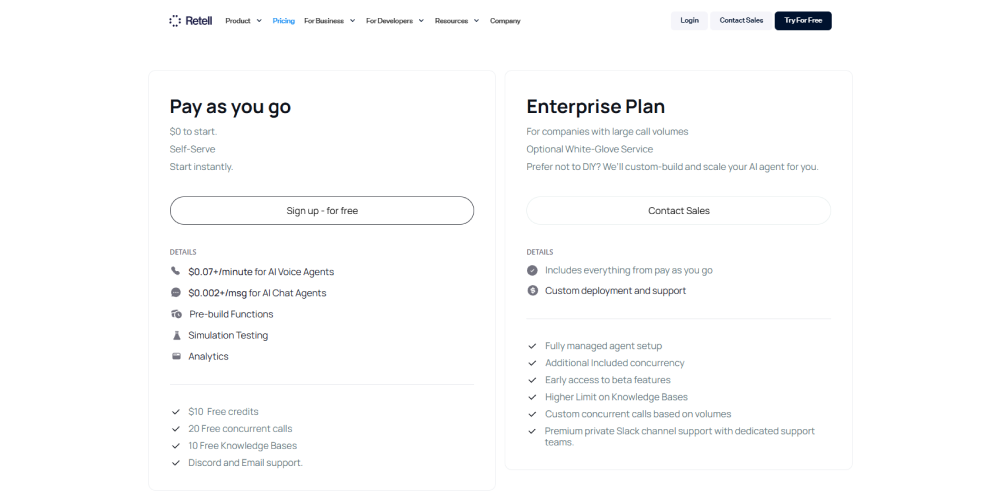
Caption: Retell AI pricing overview showing pay-as-you-go rates, free credits, and enterprise plan options.
Understanding the Retell AI cost (opens in a new tab) breakdown requires dissecting how a live call consumes resources. Unlike flat-fee models, every component in a conversation adds incremental usage:
Per-minute voice synthesis charges
The moment an agent speaks, the voice engine runs. Retell integrates with multiple voice providers, each with its own rate. Premium neural voices that deliver clearer, more natural audio cost more per minute than basic voices.
Large language model usage
When an agent interprets and responds to speech, it uses a large language model behind the scenes. The amount an organization pays depends on the model tier selected. Smaller models are less expensive, while larger models cost more but provide richer comprehension and responses.
Telephony per-minute fees
A live voice interaction requires telephony connectivity. Whether inbound or outbound, telephony providers bill per minute of call connect time. Different regions and carriers result in variable fees, and those differences appear on your monthly statement.
Optional add-on costs
Premium services such as branded outbound caller ID, advanced noise reduction, or API-driven batch dialing add specific line items to the bill. While individually small, at scale these add-ons can materially change total spend.
The sum of these components is your true AI voice automation spend, not the headline per-minute rate alone.
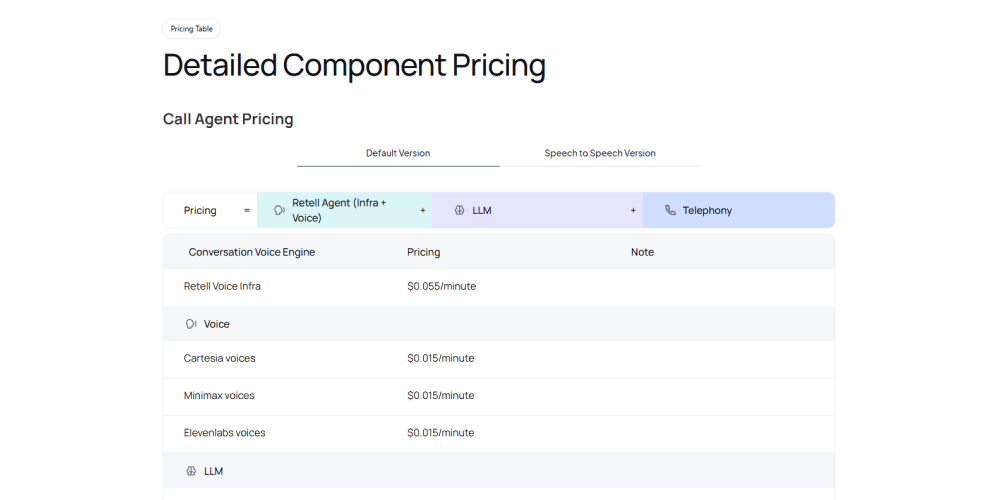
Caption: As shown in the component pricing breakdown above, each additional layer compounds monthly spend.
How Total Costs Emerge As You Scale
In early testing, your bill may be modest. In expanded use, total spend looks very different. That’s because the combined charges for voice synthesis, reasoning, and telephony accumulate in proportion to:
- How many minutes your agents talk
- How often they invoke reasoning logic
- How many simultaneous sessions you support
Retell AI pricing at scale reflects real usage patterns rather than seat licenses. With more concurrent calls, longer conversations, and richer logic flows, the total can grow significantly.
This is especially true for enterprise teams that:
- Automate high-volume channels
- Handle international calling regions
- Require low latency and high conversational accuracy
Understanding how these spend vectors interact is fundamental to building effective budgets.
Hidden Cost Dynamics As You Mature Automation
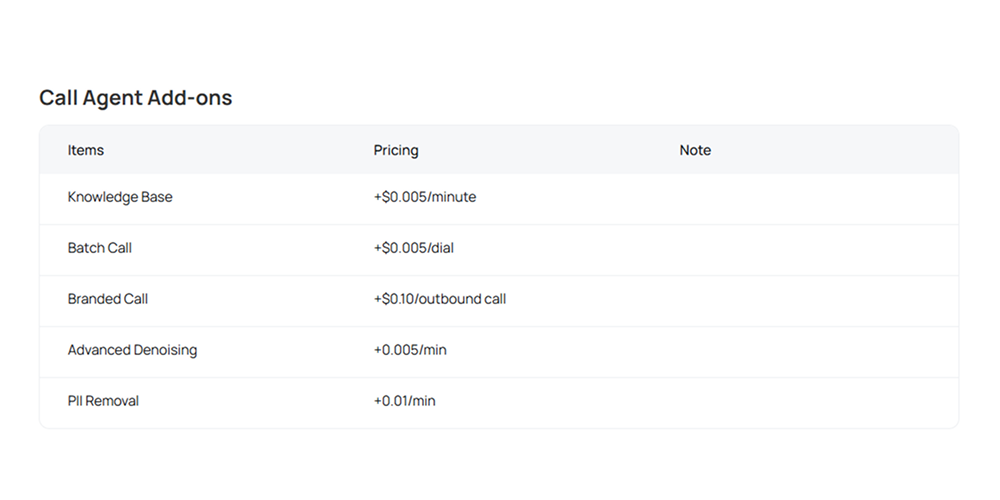
Caption: Individually modest, these add-ons compound quickly in high-volume or regulated deployments.
When automation moves beyond pilots, several additional cost factors begin to matter:
Concurrent call factors
Retell offers a base number of concurrent calls with free credits, but high throughput teams quickly exceed these limits. Extra concurrency is an added line item.
Voice provider markups
Choosing premium voices improves voice quality but increases per-minute charges. Multiply this by thousands of minutes per month and your total changes materially.
Telephony variables
Different carriers, regions, and routing policies add variance to your telephony bill. International regions often cost more than domestic calls.
Model utilization spikes
Conversational flows that generate long or repeated reasoning paths result in higher usage of large language models. This is often the largest variable cost factor.
Minimum enterprise spend expectations
Enterprise agreements often come with minimum commitments or tiered pricing. These are not always disclosed up front but shape long-term total costs.
Understanding these factors ahead of time allows teams to forecast more accurately and build guardrails against unexpected overages.
How Operational Ownership Affects Cost Predictability
When teams deploy voice automation at scale, cost forecasting is no longer a finance problem only, it becomes a cross-functional operational discipline.
Because usage drives costs:
- Engineering teams influence spend through prompt design and call logic
- Operations teams influence spend through call volume and scheduling patterns
- Finance teams influence spend through budgeting and forecasting discipline
A platform that requires distributed ownership of cost behavior will expect teams to monitor usage dashboards, enforce quotas, and optimize call flows. Teams lacking this discipline often find that modular pricing becomes harder to predict over time.
Conversational AI Quality And Experience Expectations
High quality conversational AI is more than just understanding words. It involves:
- Natural-sounding responses
- Context retention over full calls
- Smooth interruption handling
- Confidence in automated resolution
Retell provides the mechanisms for these behaviors, but how they are configured affects both experience and total cost. For example, richer logic paths that improve accuracy may use more reasoning time under the hood. That increases charges, but often results in better outcomes.
Enterprises need to balance conversational depth against cost sensitivity to achieve both operational efficiency and caller satisfaction.
Enterprise Grade Security And Compliance Posture
When voice automation handles personal data, security and governance matter. Retell aligns its platform with enterprise requirements, addressing:
- Data encryption in transit and at rest
- Compliance with privacy standards
- Security controls suited for regulated industries
These elements contribute to customer trust and reduce risk in automated environments. They also matter when comparing voice automation platforms at the procurement level, especially in sectors such as finance, healthcare, and regulated services.
See how Orvera delivers predictable voice automation at enterprise scale → (opens in a new tab)
Key Features That Support Scalable Enterprise Automation
To succeed at scale, voice automation platforms must offer capabilities that extend beyond speech recognition:
| Capability | Business value |
|---|---|
| Multilingual voice agents | Support global customer reach |
| Multi language support | Faster localization across geographies |
| Concurrent calls handling | Resilience during peak demand |
| Post call analytics | Performance insights and optimization |
| Sip trunking support | Flexible telephony routing |
| Custom phone numbers | Brand consistency in outreach |
| Outbound call workflows | Support for proactive engagement |
These key features enable enterprises to tailor automation to diverse use cases, from support to sales and beyond, without losing governance control.
Real Cost Examples Across Usage Scenarios
Once voice automation moves beyond testing, leaders want to understand actual costs under realistic operating conditions. Usage-based pricing only becomes meaningful when it is translated into monthly scenarios.
Below are three representative examples that model how Retell AI cost behaves at different stages of adoption. These examples assume a standard production configuration using a natural-sounding Retell AI voice, a mid-tier language model, and domestic telephony.
Small Business Scenario With 1,000 Monthly Minutes
This scenario reflects early-stage automation, often limited to overflow handling or basic intake.
- Approximate usage: 1,000 minutes per month
- Call profile: Short inbound conversations
- Infrastructure complexity: Minimal
- Estimated spend: Low three-figure monthly range
At this stage, usage remains manageable. Costs stay relatively predictable, and teams can iterate safely while learning how voice agents perform in live environments.
Mid Size Operations At 5,000 Monthly Minutes
This is where cost behavior starts to matter operationally.
- Approximate usage: 5,000 minutes per month
- Call profile: Mixed inbound and outbound automation
- Infrastructure complexity: CRM and scheduling integrations
- Estimated spend: Mid three-figure to low four-figure range
Here, pricing sensitivity increases. Small changes in call duration, logic depth, or concurrent calls can shift monthly totals noticeably. Teams must actively monitor usage patterns to maintain cost efficiency.
High Volume Deployments At 10,000 Plus Minutes
This scenario represents scaled automation across departments or regions.
- Approximate usage: 10,000+ minutes per month
- Call profile: High-throughput customer interactions
- Infrastructure complexity: Multi-team, multi-region
- Estimated spend: Four figures and above
At this level, modular pricing exposes variability. High call volumes, longer conversations, and peak-time traffic amplify spend. This is typically where enterprises begin reassessing pricing models and negotiating volume discounts or custom pricing.
Hidden Fees And Scaling Related Cost Drivers
As usage grows, hidden fees often become more impactful than base rates. These are not errors in pricing, but natural outcomes of modular billing.
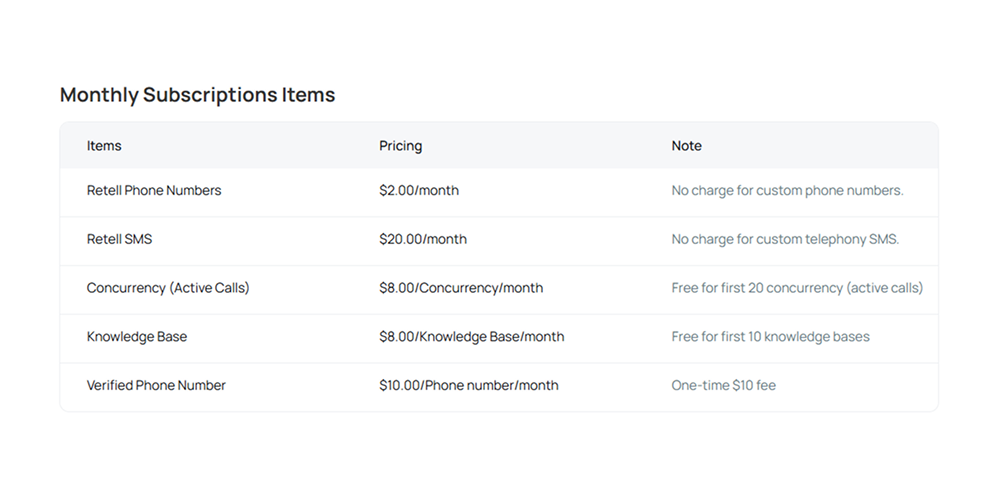
Caption: These subscription items establish a recurring cost floor that grows with operational scope.
Setup And Onboarding Factors
While there are no explicit onboarding invoices, setup costs often surface indirectly. Engineering effort required to design, test, and maintain call logic contributes to operational expense, particularly when automation spans multiple use cases.
Voice Provider And Infrastructure Markups
Premium voices improve experience but raise per-minute charges. Similarly, advanced routing or international coverage increases telephony fees. These costs compound with traffic.
Enterprise Minimum Commitments
Larger deployments frequently move onto an enterprise plan, which may include minimum monthly commitments. These commitments stabilize pricing but require confidence in sustained usage.
Language Model Usage Volatility
Complex conversations can trigger spikes in large language model usage. Long calls or repeated clarification loops increase processing time, raising AI cost unpredictably.
Direct Cost Comparison With Retell AI Alternatives
To evaluate tradeoffs objectively, teams often compare modular pricing against bundled platforms.
Modular Pricing Model Characteristics
- Flexible component choice
- High control over architecture
- Variable monthly spend
- Strong fit for experimentation and customization
Bundled Pricing Model Characteristics
- Fixed or near-fixed monthly cost
- Simplified forecasting
- Faster operational alignment
- Reduced exposure to hidden costs
This is where AI voice agent pricing comparison becomes critical. As usage crosses certain thresholds, bundled pricing models can outperform modular approaches in predictability and budgeting confidence.
AI Voice Agents Use Cases And ROI Drivers
Enterprises deploy AI voice agents across a wide range of operational workflows.
Common use cases include:
- Appointment scheduling
- Lead qualification
- Support triage
- Billing and reminders
- Proactive outreach
ROI is typically driven by:
- Reduced dependency on human agents
- Faster response times
- Higher containment rates
- Lower cost per resolved interaction
Key metrics to track:
- Cost per call
- Average handle time
- Escalation rate
- Automation success rate
These indicators help teams quantify value beyond raw spend.
Retell AI Voice Agent Capabilities At Scale
From a capability standpoint, Retell supports advanced voice automation behaviors.
Notable areas include:
- Real-time streaming with interruption handling
- IVR, DTMF, and intelligent transfers
- Bring-your-own models across multiple language models
- Flexible routing through sip trunking
These capabilities support complex workflows across business teams, but they also increase configuration responsibility.
Conversational AI Quality And Latency Benchmarks
Performance expectations rise as automation becomes customer-facing.
Key benchmarks enterprises evaluate:
- Latency per conversational turn
- Stability during long calls
- Consistency across multiple calls
- Natural speech delivery
High-quality conversational AI (opens in a new tab) balances responsiveness with reasoning depth. Lower latency improves experience, while excessive reasoning depth increases cost.
Finding the right balance is both a design and financial decision.
Enterprise Grade Security And Compliance Readiness
For enterprise pricing, Retell addresses:
- Data encryption standards
- Privacy compliance
- Security controls for regulated workflows
These compliance features are essential for organizations operating in finance, healthcare, and other sensitive domains. Security posture directly impacts procurement approval and long-term platform trust.
Strengths Limitations And Buyer Fit Assessment
Retell AI works well for a specific category of buyers. Understanding fit early prevents costly rework later.
Strengths For Engineering Led Organizations
Retell offers:
- High flexibility across models voices and telephony
- Control over call flows and orchestration logic
- Support for multiple vendors and infrastructure choices
- Strong performance in technically managed environments
For teams with dedicated engineering resources, this flexibility enables precise tuning of automation behavior and cost drivers.
Limitations For Non Technical Business Teams
Challenges emerge when:
- Automation ownership is unclear
- Iteration depends heavily on developers
- Budget owners need fixed monthly numbers
Teams without sustained technical capacity may find it harder to manage ongoing maintenance, cost forecasting, and cross-team coordination.
Ideal Buyer Profiles
Retell AI is generally a good fit for:
- Product and platform teams building voice-native applications
- Enterprises experimenting with voice automation across multiple use cases
- Organizations comfortable managing multiple language models and infrastructure layers
It is less suitable for teams seeking turnkey deployment with minimal configuration.
Migration Considerations When Switching Platforms
As voice automation matures, many organizations reassess their platform choice.
Common reasons for migration include:
- Rising total costs at scale
- Difficulty forecasting monthly spend
- Operational complexity across tools and vendors
- The need for faster deployment across regions
A structured migration approach typically includes:
- Auditing current call volumes and automation rates
- Mapping integrations with existing crm systems and internal tools
- Running parallel pilots to compare cost and performance
- Planning for data transfer and call history continuity
Migration is not just a technical decision. It is an operational and financial one.
Retell AI Vs. Orvera For Enterprise Voice Automation
Enterprises evaluating voice automation typically reach a point where feature parity matters less than operating reality. The platform that performs well in a pilot can behave very differently in production once volumes rise, intent becomes less predictable, and governance requirements tighten.
Retell and Orvera address the same category of problem but they solve it through different operating assumptions. One emphasizes modular architecture and developer control. The other is designed around contact center conditions such as peak concurrency, shifting intent, and dependable escalation to humans.
The comparison below focuses on production execution, cost behavior, and operational ownership rather than surface features.
Platform Model And Operating Assumptions
| Evaluation Area | Retell AI | Orvera |
|---|---|---|
| Primary product model | Developer platform for assembling voice stacks | Agentic AI platform for enterprise customer experience, built, deployed and run by Orvera |
| Default operating assumption | Teams will configure and tune components continuously | Platform must perform reliably under real traffic variability |
| Where it fits first | Engineering-led experimentation and custom builds | Operations-led production deployment with clear outcomes |
| Core success metric | Flexibility and integration freedom | Resolution reliability and operational predictability |
This difference influences nearly everything that follows, including budgeting, change management, and incident response.
Deployment Path And Time To Operational Readiness
For many enterprises, deployment success is determined by how quickly a solution moves from prototype to stable operations without creating a long tail of configuration debt.
| Deployment Dimension | Retell AI | Orvera |
|---|---|---|
| Typical path to production | Build call logic, integrate vendors, tune prompts, validate edge cases | Deploy a production-ready operating model with defined escalation paths |
| Time to first working pilot | Fast for technical teams | Fast for business and operations teams |
| Time to stable operations | Depends on engineering bandwidth and iteration cadence | Designed to stabilize quickly in production conditions |
| Change governance | Code and configuration changes require engineering workflow | Operational change management is built into the deployment approach |
| Ongoing iteration | Continual prompt and flow tuning is common | Iteration focuses on outcomes and reporting rather than constant flow rewrites |
Enterprises that need rapid multi-team rollout often care less about how quickly they can test and more about how quickly the system becomes dependable.
Cost Behavior And Forecasting Confidence
The critical pricing question for enterprises is not the headline per-minute rate. It is whether finance and operations can forecast spend with confidence as volumes and use cases grow.
| Cost And Forecasting Area | Retell AI | Orvera |
|---|---|---|
| Pricing mechanics | Modular usage-based charges across multiple call stack components | Scoped to the deployment on a consultative call |
| Forecasting effort | Requires ongoing monitoring of multiple cost drivers | Scoped to the deployment on a scoped call |
| Sensitivity to traffic spikes | Higher without active governance | Lower due to operational design for peak behavior |
| Concurrency impact on spend | Can become material as peak loads rise | Built to scale concurrency without cost surprises becoming the primary story |
| Vendor bill layering | Multiple line items across telephony, models, and voice providers | Simplified vendor exposure with fewer moving billing parts |
This is often the deciding factor for enterprises scaling beyond initial automation use cases. Forecasting confidence directly affects rollout speed because it affects approvals.
Operational Ownership And Maintenance Load
Voice automation is not a set-and-forget system in production. The platform choice determines where work lives and how heavy the operational workload becomes over time.
| Operational Area | Retell AI | Orvera |
|---|---|---|
| Primary owner | Engineering-led ownership is common | Operations-led ownership with clear escalation pathways |
| What drives maintenance | Prompt tuning, flow updates, vendor coordination, monitoring usage | Performance oversight, improvement cycles, analytics review |
| Incident response | Requires technical debugging across the call stack | Designed for operational visibility and quicker triage |
| Change frequency | Higher in modular environments as teams experiment | More controlled once deployed into stable workflows |
| Internal dependency footprint | Higher due to integrations and multi-vendor architecture | Lower due to a more unified operational model |
This matters because maintenance load is part of the real cost of ownership. It impacts staffing requirements and the speed at which automation can expand across departments.
Experience Quality Under Real Call Conditions
Quality in voice automation is defined by how the system behaves during interruptions, ambiguity, background noise, and intent shifts. Enterprises also evaluate whether the system preserves an effective handoff to humans when required.
| Experience Dimension | Retell AI | Orvera |
|---|---|---|
| Handling shifting intent | Achievable with careful design and tuning | Designed with intent drift as a default condition |
| Escalation to human agents | Implemented through workflow design | Built as an operating principle with reliable handoff paths |
| Consistency under load | Depends on stack choices and operational tuning | Designed to maintain stable performance under peak concurrency |
| Outcome focus | Strong when engineering defines clear success criteria | Strong by design with resolution-driven workflows |
This is where platform philosophy shows up in the customer experience. When conditions degrade, systems that are designed for ideal flows tend to need more intervention.
Comparison Through A Common Deployment Scenario
A scenario view helps enterprises translate differences into practical impact.
| Scenario | Retell AI Practical Implication | Orvera Practical Implication |
|---|---|---|
| High inbound surges during peak hours | Requires concurrency planning and careful cost monitoring, plus flow resilience work | Built to handle spikes without performance degradation becoming the main risk |
| Multi-department rollouts with different intents | Needs structured engineering governance and shared design standards | Supports rollout with consistent operational logic and visibility |
| Regulated workflows requiring safe handling and escalation | Requires careful implementation and monitoring discipline | Supports regulated environments with stable operating design and governance focus |
| Expansion to outbound automation at scale | Requires additional workflow logic and close cost control | Uses shared logic across inbound and outbound for operational consistency |
This is a practical way to frame selection. Platform choice is typically about what kind of operational burden an enterprise is willing to carry in exchange for flexibility.
When Each Platform Tends To Fit Better
Retell tends to fit best when:
- A team wants maximum flexibility in assembling the voice stack and integrating components
- Engineering resources are available to own continuous improvement
- The organization expects frequent experimentation across models and flows
Orvera tends to fit best when:
- The goal is stable production automation under real contact center conditions
- Teams want predictable operational performance and clearer cost boundaries
- Rapid deployment and scale across concurrency are requirements, not future goals
Both approaches can succeed. The difference is the operating model and who carries the burden as deployments scale.
Final Recommendation For Enterprise Buyers
Retell AI offers a flexible developer-centric approach to voice automation. It performs well in environments where experimentation and customization are priorities and where technical ownership is clearly defined.
As deployments scale, however, cost predictability and operational simplicity become more important. Usage-based pricing can introduce variability that complicates budgeting and governance.
Enterprises should evaluate:
- How much flexibility they truly need
- Whether pricing transparency aligns with internal planning cycles
- How quickly automation must scale across the organization
Platforms designed around production realities often reduce long-term friction.
Frequently asked questions
Start by modeling call volume average duration and peak concurrency. Include telephony and model usage rather than relying on headline rates.
Longer conversations, higher concurrency and repeated reasoning loops typically drive variance more than base pricing.
Cost variability usually increases once automation spans multiple teams, regions or business lines.
Set usage thresholds, monitor call duration and review automation success rates regularly.
When forecasting becomes difficult or operational overhead grows faster than automation value.