100 Percent QA Coverage for Retail Returns: Auditing Every Refund Authorization Call
A thin QA sample cannot tell a retailer whether its return and refund policy is being followed. It reports on the handful of conversations somebody happened to pick.


Key highlights
100 Percent QA Coverage for Retail Returns: Auditing Every Refund Authorization Call
- A refund authorization is a financial transaction being approved in conversation, not a service question being answered.
- Sampling is a constraint inherited from manual scoring capacity, not a quality standard anyone deliberately chose.
- Policy drift is a pattern and a sample is a snapshot, so the two do not measure the same thing.
- Full coverage scores every return conversation, human-handled and AI-handled alike, on every channel Orvera AI runs.
- Results segmented by rep, site, product category and return tier turn raw volume into a readable pattern.
- Full coverage removes the disputed sample from BPO performance reviews, because both sides read the same complete record.
- A scoring system a retailer cannot inspect is an unexplained score on a transaction that moved money.
- Orvera AI runs on the stack a retailer already has, and full enterprise deployment lands in three to six weeks.
Why do refund authorization calls carry more financial risk than other retail support calls?
Refund authorization calls carry more financial risk than other retail support calls because every conversation is a financial transaction being approved in real time, not a service question being answered.
A rep confirming a shipping delay has no direct margin consequence. A rep approving a return does. The policy around that decision exists precisely because the business ran the numbers on what each exception actually costs, and the number was not small.
The risk increases with volume. A single exception granted outside policy parameters is negligible. That same exception granted across thousands of contacts is a margin line item that shows up in the next business review with no clear owner. The return merchandise authorization step is where corporate policy and representative-level execution drift furthest apart, because the decision lives entirely in a conversation most operations will never review. The QA sampling your team runs today sees a fraction of those calls. The ones it misses carry the same financial consequence as the ones it catches.
Why does random QA sampling fail on the return and refund process?
Random QA sampling fails on the return and refund process because a pattern that spans hundreds of conversations is invisible inside a snapshot that covers a small fraction of them.
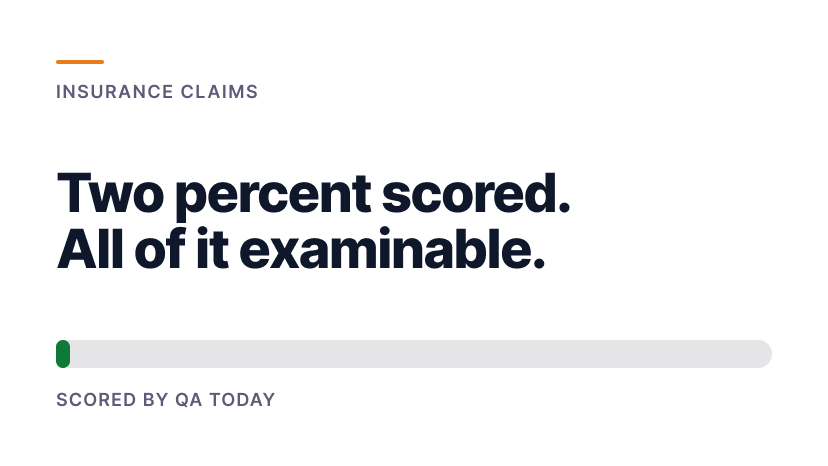
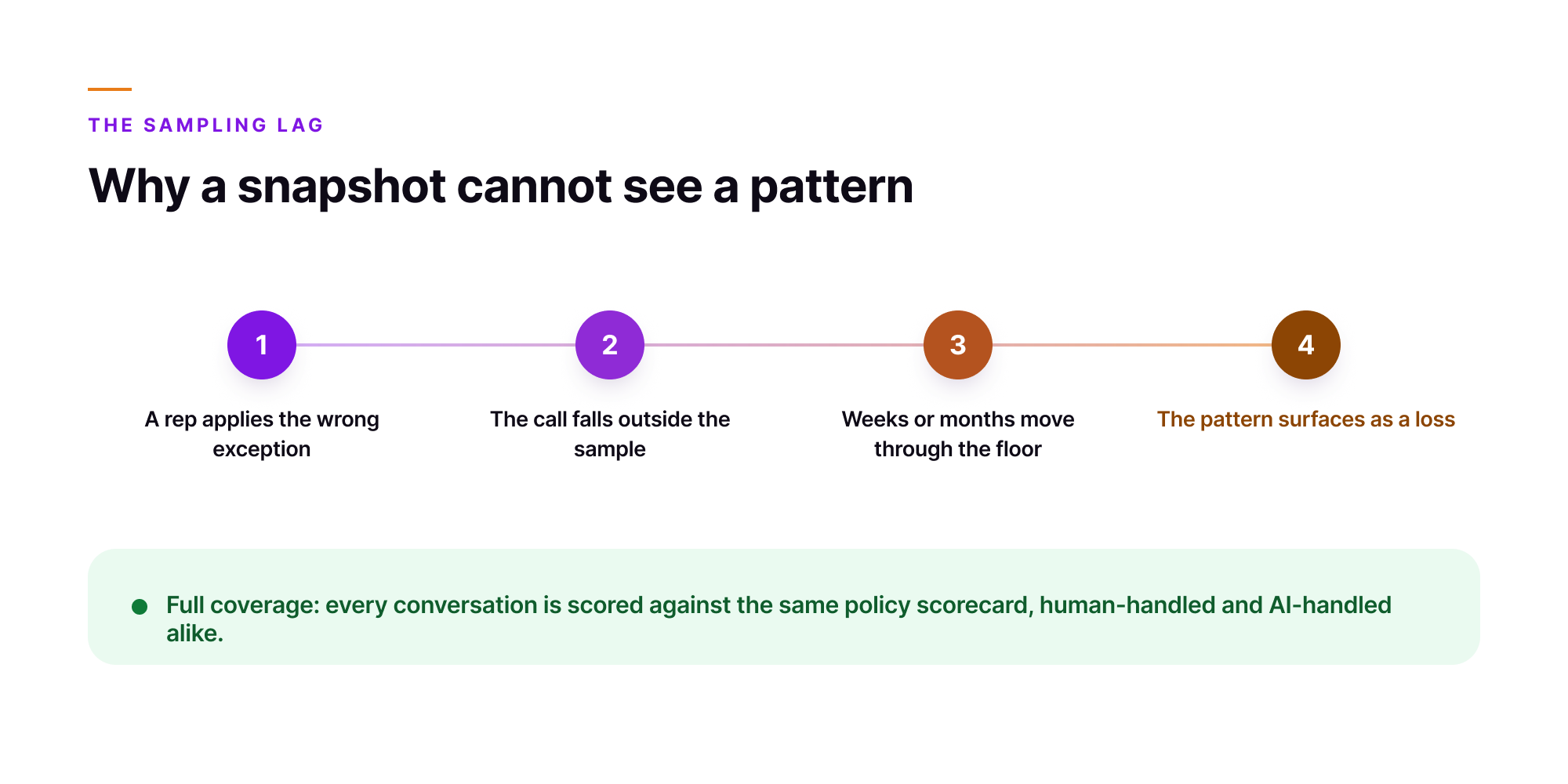
Most operations settle for reviewing somewhere between one and three percent of conversations. That figure is not a standard. It is what manual scoring capacity allows. And what it produces is a report on a small, randomly selected slice of activity while the great majority of conversations go unreviewed, including every refund authorization call where a rep applied the wrong exception, accepted a fraudulent return, or skipped a required verification step.
The primary issue is lag. By the time a sampled QA program surfaces a systemic issue, weeks or months of the same policy violation have already moved through the floor. Scoring every conversation against policy as it closes removes that lag.
What does 100 percent QA coverage for retail returns actually look like in practice?
100 percent QA coverage for retail returns means every conversation, whether handled by a human rep or an AI agent, is scored against the same policy scorecard, with no conversation left unreviewed.
Consistent scoring across all conversations. Every return merchandise authorization interaction, across voice, chat, email, messaging, and every other channel Orvera AI runs, passes through automated scoring rather than manual evaluator review. That removes the scorer-to-scorer variance that makes sampled QA unreliable. A human rep and an AI agent handling the same scenario receive the same scorecard, applied the same way, every time.
Granular breakdown by rep, site, and category. Coverage extends beyond an aggregate pass rate. Results are segmented by individual rep, by site, by product category, and by return tier. That granularity is what turns raw volume into a readable pattern. Where a thin sample produces noise, full coverage produces a clear signal that a specific site, or a specific product line, is drifting from policy.
What changes operationally. Quality review shifts from a weekly retrospective exercise into a continuous feed. Leaders no longer wait for a QA cycle to close before acting on a pattern. And because every conversation is scored, the data that protects margin is available before a local exception becomes an established norm.
How does automated refund authorization monitoring protect retail margins?
Automated refund authorization monitoring protects retail margins by scoring every conversation in the RMA process against policy the moment the call ends, so margin leaks surface as a pattern across the whole return population instead of inside a sample.
Without full-coverage scoring, the losses that compound quietly are the hardest to recover. The specific patterns that full QA coverage brings into view include:
- Refund-first handling. Conversations where a rep issues a refund without offering troubleshooting or a replacement option, bypassing the resolution steps the policy requires.
- Unauthorized exceptions. One-off approvals that exceed the rep's authorization level. Detected individually, they are correctable. Detected months later, they have become the local standard.
- Audit trail gaps. When the scorecard is a by-product of the conversation itself, there is no separate logging step for a rep to skip, and no disputed record in a partner review.
- Repeat-return and abuse clusters. Patterns tied to a customer profile, a SKU, or a specific site that only become visible when every conversation is scored, not a sampled fraction.
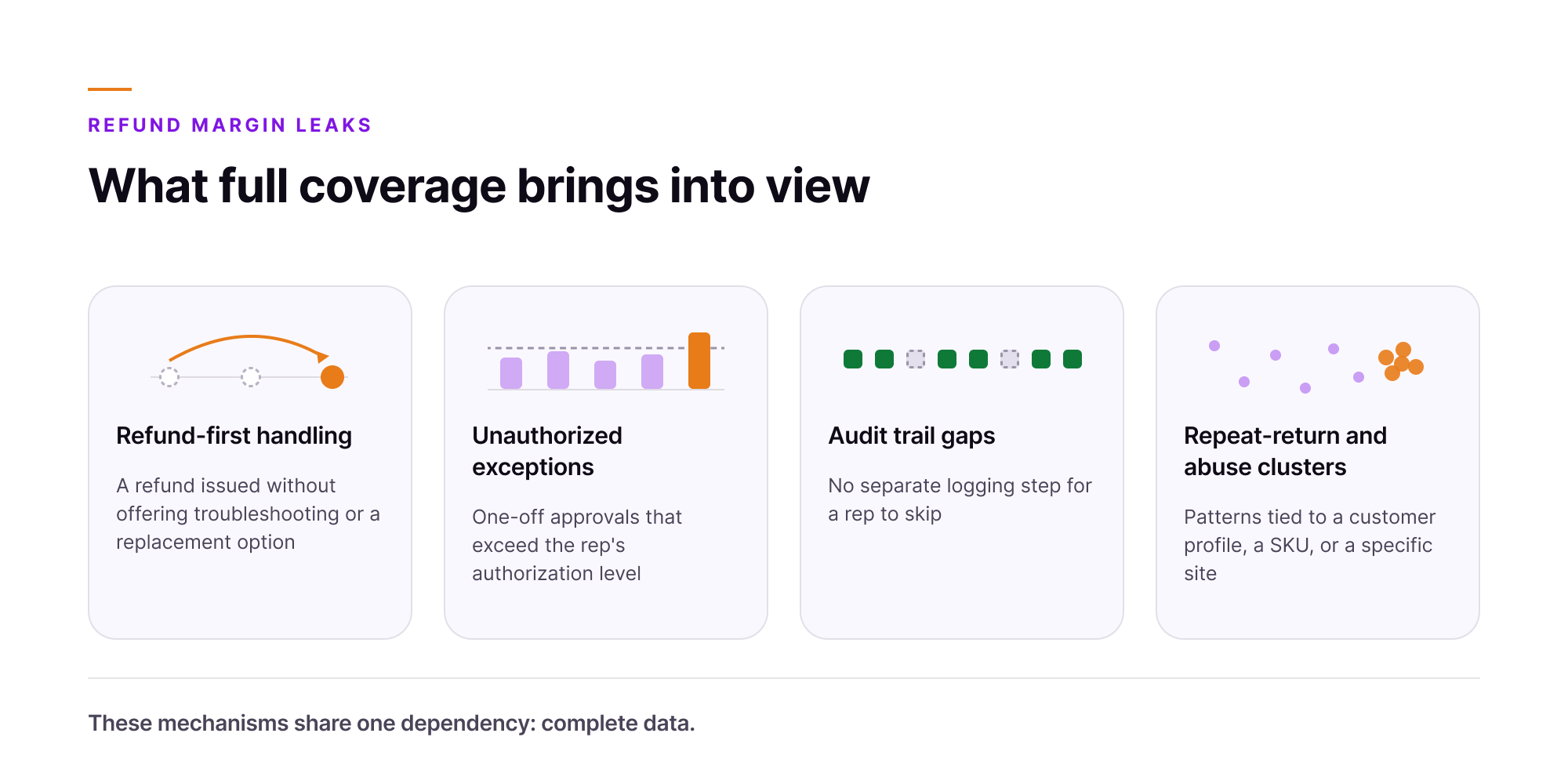
The mechanisms above share one dependency: complete data. A sample misses the exception that happened on the Tuesday a senior rep covered a new hire's queue. That gap is where margin goes.
How does full QA coverage change the way retailers manage their BPO partners?
Full QA coverage changes BPO management by replacing disputed sample sets with a shared, complete record that both the retailer and the partner read from the same source.
In practice, the friction that dominates quarterly business reviews, the competing claims about what reps said, how often refund authorization thresholds were honored, and whose data is correct, dissolves when every conversation is scored. There is no subset to argue over. Both sides work from the same audit trail, and performance gaps become a shared problem to fix rather than a contractual dispute to manage.
Coverage at this level also changes the coaching dynamic at partner sites. When every rep is measured on all of their work rather than on a handful of sampled calls, quality scoring becomes a development input. Reps are not waiting to find out whether they drew a bad sample week. And managers at each site have the same visibility the retailer has, which means coaching conversations start from a common baseline.
A single, standardized scorecard applied across multiple BPO sites and languages removes the inconsistency that emerges when site managers interpret rubrics differently. Orvera AI is multi-tenant and purpose-built for channel partners and BPOs, and its AI agents operate in more than 80 languages, so one quality standard holds whether a call routes to a site in Texas or the Philippines. That consistency is a precondition for any governance framework the retailer needs to put in place before AI reviews a refund decision.
What governance does a retailer need before AI reviews refund decisions?
A retailer needs an auditable, policy-traceable scoring layer it can inspect before any AI system renders a judgment on a refund authorization decision.
Customer service QA that moves money carries a different risk profile than QA that flags a tone issue. If the system scoring a refund call cannot show which policy rule it applied, when that policy was in force, and what evidence in the conversation triggered the score, the retailer cannot show its work. A scoring system you cannot inspect is not a quality control measure. It is an unexplained score on a transaction that moved money.
Policy traceability is the first governance requirement. Every scored decision should map back to the specific return authorization policy active at the time of the conversation, not a generalized model expectation. Policies change with seasonality and promotions. A governance layer that does not version its policy logic will score a February conversation against a May rule and produce findings no one can act on.
Model governance is the second. Orvera AI coordinates best-in-class third-party models inside its own governed enterprise application layer, and custom-trains its own contextualization models on de-identified data. That separation matters. The retailer is not exposed to an opaque proprietary model it cannot audit.
Orvera AI is SOC 2 Type II certified, HIPAA compliant, and GDPR compliant. Those credentials apply to both the AI-handled and human-handled conversation populations that the platform scores across voice, chat, email, messaging, and every other channel Orvera runs. Governance that covers one population and not the other leaves a material gap.
What should a CX leader put in the internal business case for full-coverage QA?
A business case for full QA coverage rests on one fact: sampling is a capacity constraint inherited from manual scoring, not a quality standard anyone deliberately chose.
The gap between what a thin sample shows and what all of your return and refund authorization conversations actually contain is where policy drift lives. Every metric your leadership team reviews, from first-contact resolution to refund leakage rates, is drawn from a slice of the conversation population too small to surface systematic problems. The business case is not a technology argument. It is a margin protection argument.
Four points belong in every internal brief on this:
- Sampling reflects scoring capacity, not quality intent. No quality leader designed a small-sample review rate because it was sufficient. That rate exists because human reviewers cannot score more.
- Policy adherence cannot be evidenced from a partial sample. A return authorization pattern that a reviewer would need dozens of consecutive examples to recognize never assembles inside a sampled review, so it stays invisible to leadership until it becomes a material loss.
- Margin protection requires visibility into the whole return conversation population. Refund abuse patterns, unauthorized overrides, and RMA process deviations accumulate across thousands of conversations before a sample catches a single case.
- Full QA coverage audits every conversation, both human-handled and AI-handled, across voice, chat, email, messaging, and every other channel the platform runs. Partial coverage creates partial accountability, and partial accountability does not give leadership a defensible view of the whole return population.
How does a retailer move from sampling to full coverage without disrupting operations?
A retailer moves from sampling to full QA coverage by replacing a manual review process with a managed platform that audits every return authorization conversation, human-handled and AI-handled alike, across voice, chat, email, messaging, and every other channel Orvera AI runs, without requiring the operations team to build or run it.
The practical distinction matters. A QA tool a team has to configure, maintain, and score is still a capacity constraint. It trades spreadsheet sampling for software sampling, and the coverage ceiling stays close to where it started. Orvera AI builds, deploys, and runs the operation for you. Your QA analysts read results and act on them rather than standing up infrastructure or writing scoring logic from scratch.
Orvera AI runs on the technology stack your team already has. There is no rip-and-replace, and full enterprise deployment lands in three to six weeks. The refund authorization policy your compliance team wrote today becomes the standard every conversation is scored against tomorrow.
The initial step is an accurate count. Pull the volume of return and refund authorization contacts your floor handled last month, then calculate what share of those conversations any reviewer actually touched. That number is the gap the business case rests on. Talk to Orvera AI about what full coverage changes for your operation.
Frequently asked questions
Sampling fails refund QA because the events that carry the highest cost are exactly the ones a small random draw is least likely to capture.
You remove the sampling ceiling by scoring every conversation automatically, on every channel, whether a human rep or an AI agent handled it.
Retail refund call auditing at scale requires a governed enterprise platform, not a general-purpose tool connected through an ungoverned API.
Scoring 100% of refund conversations, human-handled and AI-handled alike, replaces the contested sample with a complete record that both your team and your BPO partner read from the same source.
Full-coverage auditing surfaces four categories of refund metric that a sampled review misses entirely.
Automated auditing reads intent and context across a real conversation, so natural variation in how a caller describes a damaged item or requests an exception does not break scoring.

Written by
Anindita Majumder
Anindita Majumder is a communications professional with nearly four years of experience in public relations, corporate communications, and journalism. She creates content that helps brands communicate their vision, products, and expertise through press releases, thought leadership, and editorial pieces. Outside of work, she is a vocalist, which keeps her creativity flowing.