Why AI Voice Agents Must Resolve a Billing Call, Not Just End It
Your billing queue spikes when a promotional rate ends because the subscriber's statement changes on a schedule they agreed to but never tracked, and the...

Key highlights
Why AI Voice Agents Must Resolve a Billing Call, Not Just End It
- Your billing queue spikes when a promotional rate ends because the subscriber's statement changes on a schedule they agreed to but never tracked, and the only place they can get an explanation is the phone.
- A rate step or a promo roll-off call is harder to automate because the answer has to be assembled from the subscriber's own account history, not retrieved from a static knowledge source.
- Resolving a billing question means the caller ends the call knowing exactly what changed on their statement, why it changed, and what was done about it, with no follow-up required.
- Agentic AI for contact center billing inquiries works by connecting directly to the systems of record you already run, reading live account data during the call, and writing any entitled adjustment back to the same system before the call ends.
- A promo roll-off call resolves in five ordered steps: the subscriber is authenticated, the increase is named, the cause is dated, the next statement is previewed, and any entitled adjustment is applied before the call ends.
- Goodwill credits accumulate on billing calls not because callers demand them, but because the information needed to answer the question is not available on the call.
- The measure moves when callers receive an accurate explanation on the call itself, because a caller who understands what changed and why has no reason to negotiate.
- The real difference between the two options is not features. It is who carries the operating burden once the AI Agent is live on a queue that runs every day.
- Before an AI agent touches your billing queue, five questions determine whether it will resolve the contact or simply move the problem to the next call.
Why does our billing queue spike when a promotion rolls off?
Your billing queue spikes when a promotional rate ends because the subscriber's statement changes on a schedule they agreed to but never tracked, and the only place they can get an explanation is the phone.
The pattern is the same every time. A promotional rate was set when the account opened. It ran for its contracted term. Then it ended, exactly as it was always going to end, and the next statement carried a higher amount. The subscriber did not forget the promotion existed. They forgot it had a deadline. When the bill arrives, the call follows.
You own both sides of what happens next. The inbound billing queue is yours. So is the goodwill credit budget. Those two things are in tension on every call of this type, because the fastest way to close a call when the explanation is not ready is to issue a credit. The credit closes the call. It does not close the question. And a subscriber who still does not understand their bill often calls back.
The call is not primarily a request for money. It is a request for an explanation. That distinction matters because the resolution the caller actually needs (opens in a new tab) is not a financial adjustment, it is an accurate account of what changed and why. Whether that explanation reaches the caller while they are still on the line is the variable that determines what your credit budget absorbs. AI voice agents for telecom billing are designed to provide that explanation during the call.
What makes a rate step or a promo roll-off harder to automate than a simple account question?
A rate step or a promo roll-off call is harder to automate because the answer has to be assembled from the subscriber's own account history, not retrieved from a static knowledge source.
Automated inbound billing resolution works cleanly when the question is a balance or a payment date. Those answers exist in a single field. A promo roll-off question is different. The caller is not asking for a total. They are asking which line changed, by what logic, and whether the schedule they agreed to at sign-up actually permits it. That answer does not exist until several data points are read together during the call itself.
What that call actually requires:
- A line-level comparison. The answer comes from reading this statement against the prior one and identifying the single line that moved. A summary of either statement alone does not produce that answer.
- A reference to the contracted schedule. A rate step is a price that moves on a timeline the subscriber may not have registered when they signed. The answer has to name that schedule, not just confirm the current charge.
- Account-specific assembly. The explanation is constructed from that subscriber's own terms and history. No article, FAQ, or general script produces a correct answer for that caller's specific situation.
- First-call accuracy. An approximate explanation produces a second call. The second call is where a goodwill credit typically enters the picture, because at that point the fastest path to ending the conversation is an adjustment rather than a clearer explanation.
Understanding what the call requires is the foundation for understanding what resolution actually means on that call. The next question is where that definition gets tested.
What does it actually mean for an AI agent to resolve a billing question on the call?
That definition rules out a large category of outcomes that the industry has historically counted as success. Explaining a charge is not resolution. Logging a callback is not resolution. Transferring a caller who already waited through authentication is not resolution. The line is clean: the call is finished when the subscriber can predict their next statement, not when the call is disconnected.
In practice, resolution inside one call means four things happen in sequence. The caller is authenticated. The exact dollar delta between the prior and current statement is stated. The cause of that delta, whether a promotional rate step or a plan change, is named clearly. And the adjustment the subscriber is entitled to is applied to the account before the call ends. AI voice agent integration with telecom billing systems is what makes that sequence possible without routing the caller through two departments and a hold queue. The adjustment does not wait for a follow-up ticket. It closes on the call.
The AI agent is the first voice on the line. It carries the call from greeting to resolution in the cases it is built to handle, and it brings a human rep in when the situation calls for one, with authentication already completed and the account detail already pulled. The human is never starting from zero. Understanding what the agent reads from your systems to make that sequence work is the next piece of the picture.
How does an AI agent reach the bill detail that already sits in our systems?
Agentic AI for contact center billing inquiries works by connecting directly to the systems of record you already run, reading live account data during the call, and writing any entitled adjustment back to the same system before the call ends.
The integration works at the level of the call, not at the level of your infrastructure. The AI agent connects to your billing environment through standard connectors, ensuring your systems remain the source of truth. Nothing is copied to a parallel store, and nothing moves outside the workflow your team already governs. The operator's environment does not change shape to accommodate the agent. The agent works inside the shape that already exists.
Orvera custom-trains its own contextualization models on de-identified data, enabling the agent to read account records like a trained billing rep, identifying the line that moved and the period it moved in. You can see how that training approach applies across billing and other workflow types in how Orvera approaches agent training (opens in a new tab). During the call, the agent does four things:
- Reads the current statement to identify the charge the subscriber is questioning.
- Reads the prior statement to establish what that same line carried in the previous period.
- Identifies the specific line that moved and the magnitude of that movement.
- Writes any entitled adjustment back to the account of record before the call closes.
Your team does not reconcile a second system after the fact. The account reflects what was resolved, the same way it would if a billing rep had taken the call.
What does a promo roll-off call sound like from greeting to resolution?
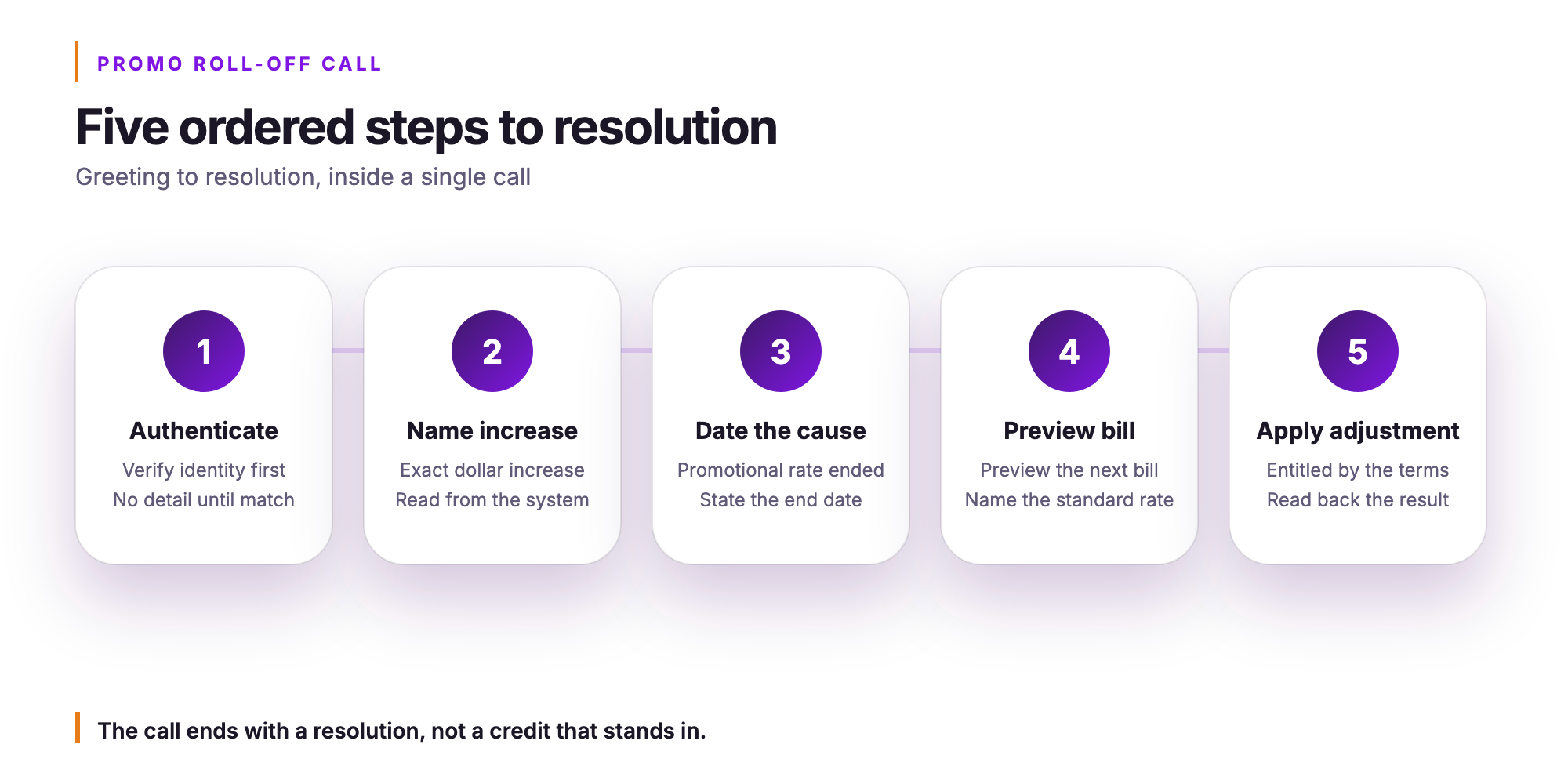
A promo roll-off call resolves in five ordered steps: the subscriber is authenticated, the increase is named, the cause is dated, the next statement is previewed, and any entitled adjustment is applied before the call ends.
Understanding how to automate telecom promo roll-off explanations starts with mapping exactly what the call must accomplish in sequence. The steps below describe a single call handled by an AI voice agent, with the subscriber's own figures referenced throughout but never replaced with invented values.
First, the AI agent authenticates the subscriber before any account detail enters the conversation. Verification draws on the account data the caller's identity matches, and no billing information is stated until that match is confirmed.
Second, the agent acknowledges that the monthly charge increased and states the exact dollar amount of that increase as it appears on the subscriber's own statement. The figure is read from the billing system connected to the call, not approximated.
Third, the agent names the cause. A specific promotional rate on the subscriber's account reached its end date, and the agent states that date precisely so the subscriber can place the change on a calendar, not just a bill.
Fourth, the agent previews what the next statement will show. The subscriber leaves the call knowing their new standard rate and is not positioned to call back surprised when the following bill arrives.
Fifth, where the subscriber's account qualifies for an adjustment under the terms already recorded in the system, the agent applies it during the call and reads back the confirmed result. No step in that sequence requires escalation to a human rep when the account data is accessible and the entitlement rules are codified. And when those conditions are met, the case for a managed AI deployment (opens in a new tab) over a self-built solution becomes straightforward.
The call ends with a resolution, not a credit that substitutes for one.
Why do goodwill credits get issued on calls where the caller only wanted an explanation?
The causal chain is direct. A subscriber calls to understand why their monthly charge increased. The rep cannot assemble the full picture of the original promotional rate, the agreed term, and the step schedule while the caller is waiting. The call is running long, the caller is losing patience, and the fastest available path to a satisfied disconnect is a one-time credit. The call ends. The credit posts.
“A credit that closes a call without answering the question funds an information gap, not a service failure.”
But the question was never answered. The next statement arrives, the same step appears again, and the same account re-enters the queue. The goodwill credit budget absorbs this cycle every month, covering a cost that belongs on the knowledge and tooling side of the ledger, not the service recovery side. Those two categories should not be funded from the same line, because mixing them hides where the actual problem lives.
Voice AI bill explanation automation breaks the chain at the source. When the AI agent can retrieve the promotional term, name the expiration date, and show the subscriber exactly which line changed, the explanation is the resolution. No credit is required to close the call in good standing. The question is answered, and the account does not return for the same reason. Understanding which AI voice agents are capable of that level of system integration is worth examining before the next budget cycle. You can review how leading voice AI agents compare (opens in a new tab) across that dimension directly.
How do we bring goodwill credits per 1,000 billing calls down without making callers feel stonewalled?
The measure moves when callers receive an accurate explanation on the call itself, because a caller who understands what changed and why has no reason to negotiate.
The total credit line is a misleading indicator. It rises and falls with call volume, so a growing operation can improve its per-call credit rate while the ledger grows larger. Tracking credits per 1,000 billing calls gives you a number that reflects operational performance rather than volume, and it is the number worth defending in a budget review.
The second distinction matters just as much. A caller who wanted an explanation and did not get one is not a retention conversation. Funding that call from a goodwill budget conflates two entirely different situations and hides both. Automated resolution of billing rate step inquiries separates the two cleanly: the explanation call gets resolved on first contact, and the genuine retention conversation reaches a human rep with full context already on screen.
The operating changes that actually move this measure are:
- Track credits per 1,000 billing calls, not credits in total, and review the ratio by call reason code.
- Separate explanation calls from retention calls before any credit decision is made.
- Apply every adjustment the subscriber is entitled to on every call, consistently, regardless of which rep answered.
- Surface the full account history and promotional terms to the rep or AI agent at the moment the call arrives.
Consistency is the lever here, not restriction. A subscriber who is owed an explanation gets one. A subscriber who is owed an adjustment receives it on the first call, not the second.
Should we buy a tool for this, or have someone build it and run it for us?
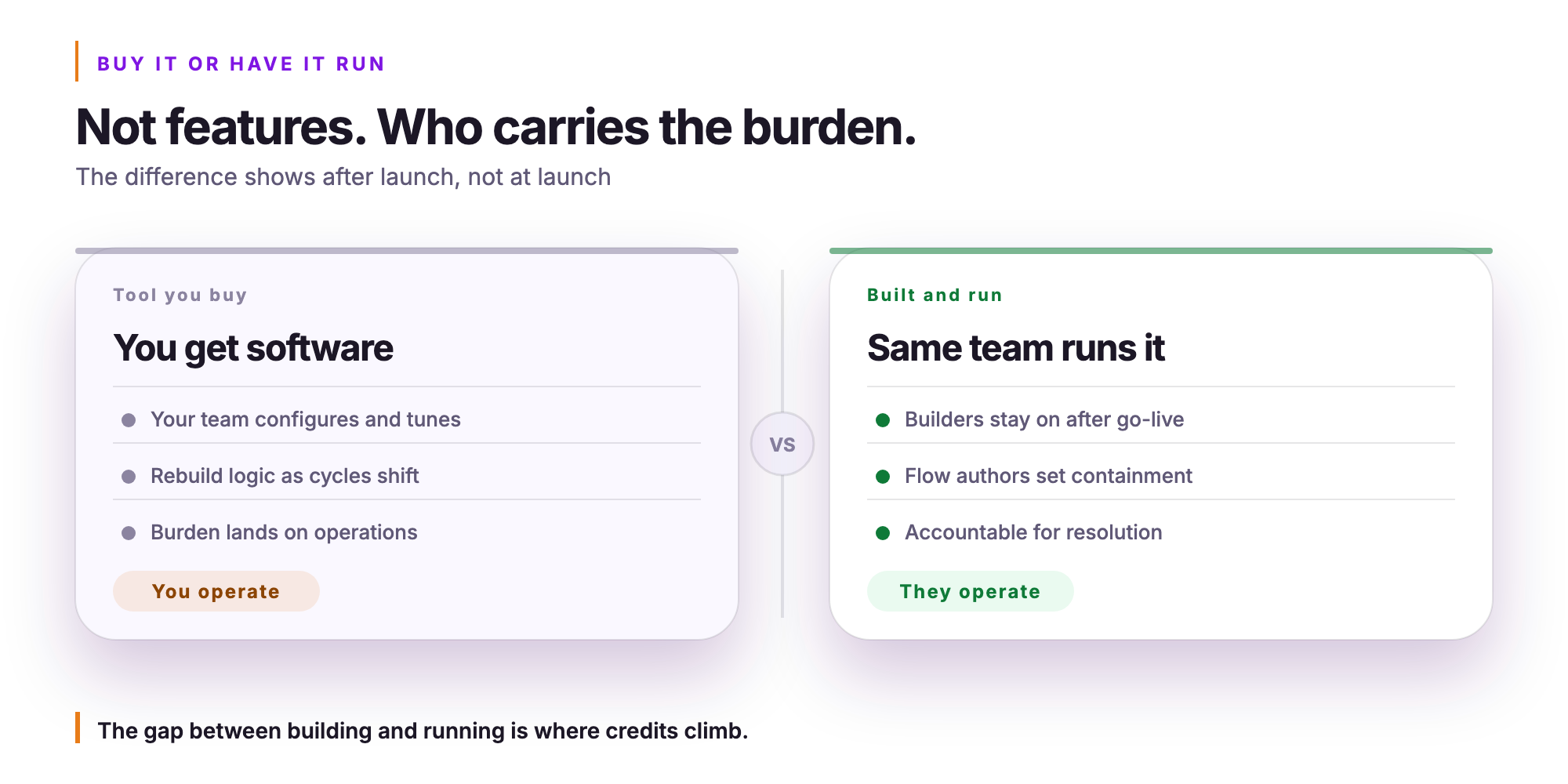
The real difference between the two options is not features. It is who carries the operating burden once the AI Agent is live on a queue that runs every day.
A tool your team buys gives you software. Your team then configures it, monitors it, tunes it when call flows change, and rebuilds the logic every time a promotional roll-off cycle shifts. Handling promo roll-off with AI agents is not a one-time configuration. Rate steps change, promotional terms expire on different subscriber cohorts, and the call flow that was accurate in one billing period can produce wrong explanations in the next. That maintenance burden lands on your operations team, which already owns queue staffing, quality management, and escalation routing.
The alternative is an operation that is built, deployed, and run for you. Orvera AI, based in San Francisco, brings 18+ years of operating experience to every deployment. The team that builds the AI Agent also runs it after go-live, which means the people accountable for resolution outcomes are the same people who wrote the call flow and set the containment logic. Orvera custom-trains its own contextualization models on de-identified data, so the AI Agent reads each subscriber's account accurately.
And that distinction matters most on day sixty, not on launch day. Before you decide which path fits your queue, the next question worth asking is what a capable AI Agent should actually demonstrate before it touches a live billing call.
What should we check before putting an AI agent on the billing queue?
Before an AI agent touches your billing queue, five questions determine whether it will resolve the contact or simply move the problem to the next call.
Run this checklist against any candidate before you commit the queue to it:
- Caller authentication: Can it verify the subscriber's identity before any account detail enters the conversation, so the call is compliant from the first sentence.
- Delta explanation: Can it state the exact line-item change on this subscriber's bill and name the cause, rather than reading the total back as if that answered the question.
- Adjustment execution: Can it apply an entitled credit or correction inside the same call, closing the matter without creating a follow-up task that a representative has to work tomorrow.
- Context-complete handoff: When it does escalate, does the human representative receive everything gathered so the subscriber never restates the reason they called.
- Day-sixty accountability: Who runs the AI agent once it is live, and is that the same party that built and configured it against your billing logic.
The last question is the one most teams skip during evaluation. Building it and running it are different work, and the gap between them is where goodwill credit volume climbs back. Consider booking a demo to hear an AI agent state the delta on a live billing call from your own queue.
Frequently asked questions
An AI agent resolves a frustrated billing caller by naming the specific line that changed, on that subscriber's statement, before the caller has to ask twice.
Telecom promotional roll-off automation resolves the information gap that turns a billing question into a credit transaction.
When agentic AI for telecom billing inquiries handles the opening exchange, the queue separates into two distinct outcomes: calls that end with the subscriber's question answered, and calls that end without one.
An AI agent can work inside a subscriber's billing account safely because the caller is authenticated before any account detail is discussed, the agent operates inside your own systems of record, and those systems remain the source of truth throughout the call.
Buying a tool transfers the software license. Having the operation built and run for you transfers the operating load.
When a billing dispute needs a human, Orvera hands the call off with everything the representative needs already in front of them.

Written by
Anindita Majumder
Anindita Majumder is a communications professional with nearly four years of experience in public relations, corporate communications, and journalism. She creates content that helps brands communicate their vision, products, and expertise through press releases, thought leadership, and editorial pieces. Outside of work, she is a vocalist, which keeps her creativity flowing.