How an AI Agent Runs Two-Way SMS Service Approvals and Payment Links for Dealer Groups
The approval turnaround a dealer group can see is the gap between the customer's reply and the timestamp on the repair order, and that gap is a process the group controls.

Key highlights
- The approval turnaround a dealer group can see is the gap between the customer's reply and the timestamp on the repair order, and that gap is a process the group controls.
- A two-way SMS service thread is one text conversation, tied to one repair order, that carries every decision a customer makes about their vehicle from the first estimate line to the payment link.
- Automating repair authorizations with AI and two-way SMS works because the agent reads, interprets, and records every customer decision against the exact repair order line it belongs to, while the advisor works the service drive.
- A single repair order traces the full arc: estimate released, decision recorded, work closed, and payment collected inside the same conversational AI payment links SMS thread, with the RO current at every step.
- On an AI agent platform for high-volume automotive SMS threads, the dealer writes the rules once, the agent executes them on every thread, and the rule that fired is visible in the audit record for that conversation.
- Dealer groups want the platform built and run for them because the configuration layer described in the previous section is only as reliable as the team that builds it, integrates it, and audits every thread it produces.
- Four measures, each read directly from the audit record of the threads themselves, tell a Fixed Ops director whether the platform is performing as configured.
- The summary a Fixed Ops director carries to the leadership team is a count of threads, each one traceable to a repair order, a customer decision, and a timestamp.
Why does a repair approval sit for hours when the customer replied in minutes?
The approval turnaround a dealer group can see is the gap between the customer's reply and the timestamp on the repair order, and that gap is a process the group controls.
The delay often begins mid-morning on the service drive. An advisor is walking a car with one customer when a second customer's "go ahead with the brakes" lands on the advisor's personal phone. The technician waiting at the lift has no idea. The repair order in the DMS still shows the line as pending.
That reply lives in a text thread on one phone. Nothing connects it to the system of record, so the authorization exists in two places simultaneously: confirmed in the customer's mind, still open in every system the dealer operates. The technician waits. The lift stays occupied. The RO does not move until the advisor is next at a terminal.
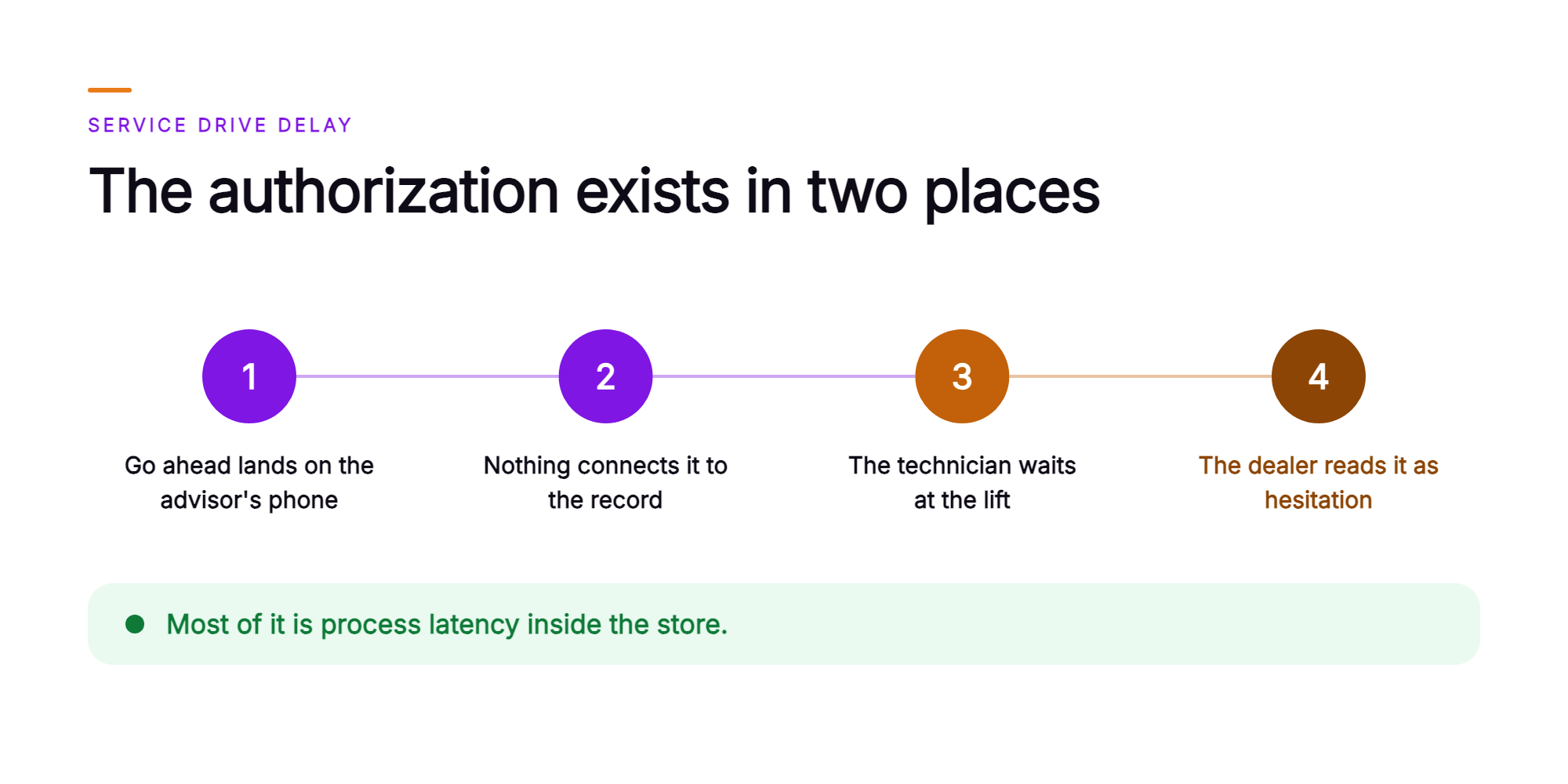
When the advisor finally keys the approval, the time the customer took to decide and the time the dealer took to record it compress into one number. The dealer reads it as customer hesitation. Most of it is process latency inside the store. AI agent automotive contact center SMS automation resolves that latency by reading the customer's reply the moment it arrives and writing the decision directly to the repair order, while the advisor stays on the service drive. The following section details the thread from the first estimate line to the payment link.
What is a two-way SMS service thread with approval and a payment link?
A two-way SMS service thread is one text conversation, tied to one repair order, that carries every decision a customer makes about their vehicle from the first estimate line to the payment link.
The thread runs from the dealer's own number. It opens with the RO lines and amounts pulled directly from the DMS, written in plain language the customer recognizes, with each DMS code translated into the work it names. The customer reads each recommended item, its labor and parts amount, and replies in their own words. Those replies are read against the specific repair order they belong to, and each decision is stamped to the correct RO line with the customer's words and the time the reply arrived.
The parts of a complete thread are:
- RO lines and amounts pulled from the DMS, one item per line, with totals the customer can read and understand for themselves
- The customer's questions and replies in both directions, preserved in their own words
- A per-line approve or decline stamped to each RO line, quoting the customer's exact reply and the time it was received
- A payment link from the dealer's own payment system, sent once the customer-pay work is closed
- Pickup instructions delivered in the same thread, where the approval and the payment link already sit
Two-way SMS approval workflows for enterprise dealer groups depend on two mechanisms. The customer replies to one number and each reply resolves against the repair order it belongs to. Declined services remain on the RO as a declined line, visible to the service advisor for a follow-up at pickup. The DMS stays the system of record throughout, and the thread itself carries its own evidence. The following section outlines the AI agent's actions within the thread, step by step.
What does the agentic AI agent do inside the thread?
Automating repair authorizations with AI and two-way SMS works because the agent reads, interprets, and records every customer decision against the exact repair order line it belongs to, while the advisor works the service drive.
When the advisor releases RO lines for text approval, the agent translates each line into plain language the customer recognizes. Each recommended item appears on its own line with its amount. The customer reads what the work is and what it costs, with every parts code and labor operation number spelled out as the repair it describes.
The agent interprets replies written in the customer's own words. A reply that reads "do the brakes, skip the filter for now" resolves to an approved line on the first item and a declined line on the second. Each decision is written to the DMS with a timestamp and the customer's exact words quoted. The RO carries its own evidence from the moment the customer replies.
Between estimate and decision, the agent answers questions grounded in the dealer's own service menu and policies. Once a line is approved, the technician is notified immediately. The agent sends the payment link from the dealer's own payment system once the technician closes the work. And when a customer asks for a discount or disputes a charge, the agent hands the full thread to a service advisor, with every message and timestamp intact.
The next section walks one repair order through a full day to show exactly how that sequence runs in practice.
How does one approval thread run from estimate to paid?
A single repair order traces the full arc: estimate released, decision recorded, work closed, and payment collected inside the same conversational AI payment links SMS thread, with the RO current at every step.
This scenario is common. A multipoint inspection on a customer-pay oil service turns up front brake pads at the wear limit and a cabin filter due. The advisor releases both lines to the thread at 9:52. Fourteen minutes later, at 10:06, the customer replies with an approval on the brakes and a skip on the filter until next time. The agent writes line one as approved and line two as declined, records the customer's exact words and the timestamp directly on the repair order, and notifies the technician at the lift while the car is still in the air. The advisor stays on the drive. The customer's decision reaches the work order the moment it arrives.
The afternoon portion of the thread is equally straightforward. At 3:10 the technician closes the approved lines. The agent sends the payment link to the dealer's own payment page. The customer pays at 3:24, the dealer's payment system returns its confirmation, and the thread records that confirmation. Pickup instructions go out in the same thread, on the same number, closing the conversation that started with the estimate.
What the Fixed Ops director reads back from this repair order is the record a well-run service lane should always produce. Approval turnaround on this job comes to fourteen minutes, measured from the estimate going out to the approval landing. The cabin filter line sits on the RO as declined, with the customer's words attached, ready for the dealer's own declined-services follow-up at the next visit. Every decision the customer made is visible, timestamped, and attributed. That audit record is already complete, because the thread wrote it as the conversation moved. The following section delineates the responsibilities between the dealer and the agent, ensuring repeatable records across all threads.
Which decisions stay with the dealer and which does the agent execute?
On an AI agent platform for high-volume automotive SMS threads, the dealer writes the rules once, the agent executes them on every thread, and the rule that fired is visible in the audit record for that conversation.
This division of authority is intentional. The dealer's service director sets the parameters. The agent reads them before it acts on any repair order. Each pair below shows where that line sits.
- RO line selection. The dealer decides which lines are eligible for text approval. The agent sends only those lines, never the full estimate unless every line is approved for it.
- Quiet hours. The dealer sets the outbound window by store. The agent holds the text until that window opens, regardless of when the technician closes the work.
- Consent verification. The dealer requires a recorded opt-in before the first outbound message. The agent checks the customer record and routes the repair order to the advisor when consent is missing.
- Safety-line declines. The dealer decides that a decline on a safety-related line requires a person. The agent hands the full thread to the advisor with every message and timestamp attached.
- Discount requests. The dealer reserves discount decisions for advisors. The agent transfers on the first request, before any figure is discussed.
- Payment links. The dealer's own payment system issues the link. The agent sends it, and the customer pays on the dealer's page.
The dealer owns the rules and the agent applies them. They sit in a configuration layer the dealer controls, which is what makes them auditable and what makes the next question straightforward: who builds, deploys, and runs that layer for a group with many rooftops?
Why do dealer groups want the platform built and run for them?
Dealer groups want the platform built and run for them because the configuration layer described in the previous section is only as reliable as the team that builds it, integrates it, and audits every thread it produces.
Orvera AI builds the full deployment. The agentic AI SMS thread management layer connects to the DMS and payment system the group already runs. Those systems stay in place and the platform folds into them. Full enterprise deployment lands in three to six weeks.
“Over 18 years of contact center operations sit behind the rules the platform executes. When a discount request transfers to an advisor before any figure is discussed, or when a missing opt-in stops a thread before the first message goes out, those rules read the way a service manager would write them. That is the heritage at work.”
“Auto QA audits every conversation the platform runs. Human-handled threads and AI-handled threads both go through it. When a consent defect appears, it surfaces as a count on a report, and each count traces to the exact thread behind it. The director sees the number and the evidence at the same time.”
The next section names the specific figures a Fixed Ops director reads to confirm the platform is performing as configured.
Which numbers tell a Fixed Ops director it is working?
Four measures, each read directly from the audit record of the threads themselves, tell a Fixed Ops director whether the platform is performing as configured.
Every figure links back to the conversations behind it. A number on a report is a count of threads, and each thread is one click away.
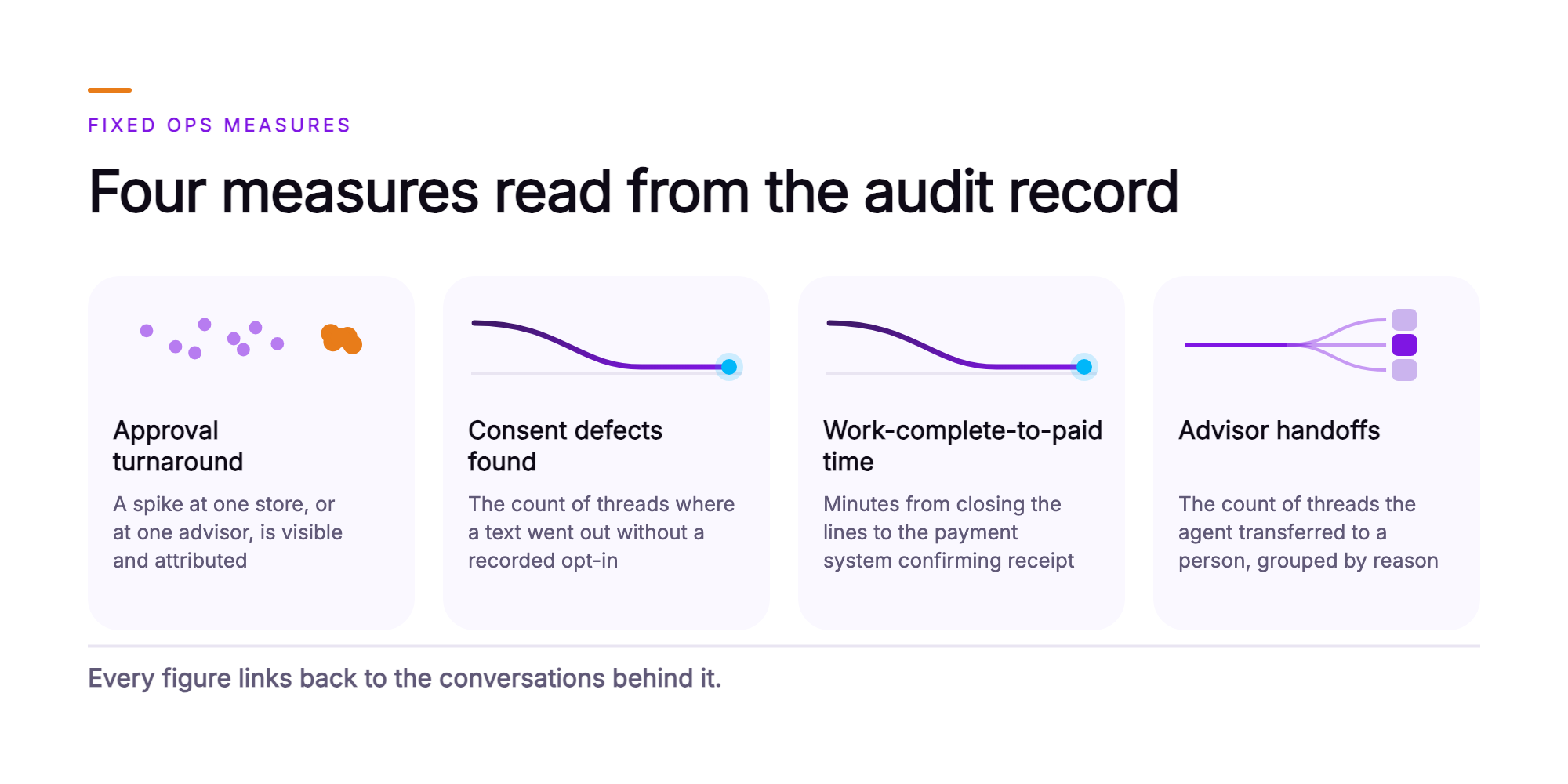
- Approval turnaround. The minutes from the estimate leaving the thread to the approval timestamp landing on the repair order line, read per store and per advisor. A spike at one store, or at one advisor, is visible because the measure is attributed.
- Consent defects found. The count of threads where a text went out without a recorded opt-in, a text went out after an opt-out reply, or an approval was written without a customer reply behind it. Finding and counting these before they become a complaint is what the audit record is built to do.
- Work-complete-to-paid time. The minutes from the technician closing the lines to the payment system confirming receipt. Integrating payment gateways with conversational AI agents surfaces this measure in the thread itself, which gives the figure a timestamp at each end and a record the director can open.
- Advisor handoffs. The count of threads the agent transferred to a person, grouped by reason. Whether discount requests, disputes, or missing consent drive the transfers, the group reads the breakdown and knows where to act.
The four measures together give the director what the next section organizes into a leadership summary.
What does the Fixed Ops director take to the leadership team?
The summary a Fixed Ops director carries to the leadership team is a count of threads, each one traceable to a repair order, a customer decision, and a timestamp.
When a director asks how to automate service approvals via SMS and then presents the answer upward, four points carry the argument:
- One platform, one dealer number, one record. The thread runs on the dealer's own number, and every approval and decline is written to the repair order with the customer's exact words and the time they were sent. The leadership team reads the evidence itself, line by line.
- Payment recorded by the dealer's own system. The customer pays through a link that lands on the dealer's payment page. The confirmation that system returns is what the thread records as the paid moment, so the revenue figure in the report is the payment system's own number.
- Consent defects found and shown with the evidence. Every thread is audited. The director brings a count of consent defects by store, caught inside the platform before a customer files a grievance or a regulator asks a question.
- Full deployment in three to six weeks. The platform is built and run by a team with 18+ years of contact center operations. The leadership team approves a timeline, and the build behind it is already staffed.
Those four points are what the next conversation on the service drive confirms in practice.
What does the service drive look like once the thread runs on-platform?
Once the thread runs on-platform, the service drive moves at the speed of the customer's reply.
The advisor stays with the customer standing in front of them. The technician reads the approval on the repair order while the car is still on the lift. The AI agent writes that approval from the thread itself, which frees the bay and puts the decision on the record before anyone asks for it. The repair order documents approvals in real time, so the day's record is complete when the last thread closes.
Approval turnaround and consent defects by store become the two numbers the Fixed Ops director reads every week. Turnaround tells the director where bays are moving and where they are not. Consent defects, counted by the audit on every thread, tell the director where the configuration needs tightening. Both figures trace to the threads themselves, so a store-level question has a store-level answer.
The declined-services follow-up runs on the same record. The follow-up list reads the decline lines the threads wrote to the repair order during the visit itself. Every declined service is visible, attributed, and ready for the next appointment.
If you want to walk through what that thread looks like on your group's specific call driver mix and store count, talk to the team (opens in a new tab).
Frequently asked questions
An AI agent configured for automotive service scheduling and payment handles the full customer-facing thread on its own, from the first estimate line to the payment link. The AI agent sends the estimate directly from the dealer's number, in plain language built from the RO lines the advisor released. It answers questions grounded in the dealer's own service menu and policies, so a customer asking about a recommended line gets that store's answer. When the customer replies, the AI agent reads their words, writes a timestamped approval or decline to each RO line in the DMS, and notifies the technician the moment a line is approved. Once work closes, it sends the payment link from the dealer's payment system and pickup instructions in the same thread. A discount request or a disputed charge hands the full conversation history to an advisor, who continues the exchange on the dealer's number. When a customer declines a recommended line, the DMS record is updated accordingly.
When a customer declines a recommended line, the AI agent writes that decision, the customer's exact words, and the timestamp directly to that RO line so the record is closed before the next action begins. The technician receives each approved line as soon as it is written to the repair order and sees immediately which work goes ahead and which does not. Nothing moves on a line the customer has not approved. The decline record is actively used. The dealer's own declined-services process reads it at the next visit, giving the advisor the line item and its amount to open with. A safety-related decline follows the rule the dealer sets for that line. Where that rule requires a person, the AI agent passes the full thread to an advisor with every message and timestamp attached, and the customer's words and the time they arrived stay on the RO line for the advisor to work from. That same line-level record governs SMS text payments for automotive service centers: payment is requested only against approved lines, and the link the customer receives reflects exactly what they authorized.
AI agents handle automotive service payments in two parts. The agent manages the payment thread, and the dealer's own payment system handles the transaction itself. When the technician closes the approved RO lines, the AI agent sends a payment link directly in the existing SMS thread. That link opens the dealer's own payment page. The customer enters payment details there, on the dealer's system, which takes the card entry and processes the charge. The agent manages the communication thread during the payment process. It delivers the link, waits for the paid confirmation the dealer's payment system returns, and records that confirmation in the conversation. That timestamped confirmation is the paid moment the thread holds and the work-complete-to-paid measure reads. The agent does not touch card data. It coordinates the link and reads the result.
Before the AI agent sends a single outbound text, it checks the customer record for a recorded opt-in. If opt-in is missing, the RO is routed to an advisor. An opt-out reply stops further outbound messages on that thread immediately and is logged in the conversation record. Each approval and decline is written to the RO line with the customer's exact words and a timestamp. The full thread stays with that record. Secure SMS payment links for car dealerships carry the same discipline: the link is sent only after consent is confirmed and the approved lines are recorded. Auto QA audits every thread, whether a rep or the AI agent handled it. Consent defects surface as a count the Fixed Ops director reviews, and each defect links directly to the thread behind it. The same record names the handler, so a pattern traces back to one rep or one workflow. How those records flow into the DMS and repair order is where the next question begins.
The AI agent reads RO lines directly from the DMS the dealer already runs, and every approval and decline writes back to those same lines, so advisors and technicians see each decision on the repair order itself. Understanding how to automate service approvals via two-way SMS starts with the DMS connection. Orvera develops and operates that integration on a platform with over 500 enterprise system connections. RO line items, amounts, and authorization status move between the DMS and the SMS thread through that integration in both directions. A multi-location group runs under one governed platform instance. Store-level rules include quiet hours, the RO lines an advisor may release for text approval, and escalation handoffs, so each location keeps its own policy while the group reads one unified record. How that governed structure deploys across a dealer group is where the next question lands.
Automating repair order approvals with AI across a dealer group starts with Orvera building and running the full integration. Full enterprise deployment lands in three to six weeks. Orvera handles onboarding, knowledge-base configuration from the group's own service menus and policies, and change management for advisors and technicians. Your people read results while Orvera's team operates the platform for the group. The platform is multi-tenant, so every rooftop runs under a single parent instance with store-level policies intact. It is SOC 2 Type II certified, HIPAA compliant, and GDPR compliant. That is the compliance posture regulated buyers require before they let an AI agent touch a customer conversation. And over 18+ years of contact center operations sit behind every deployment decision, so the configuration reflects what works on the floor.

Written by
Anindita Majumder
Anindita Majumder is a communications professional with nearly four years of experience in public relations, corporate communications, and journalism. She creates content that helps brands communicate their vision, products, and expertise through press releases, thought leadership, and editorial pieces. Outside of work, she is a vocalist, which keeps her creativity flowing.


