The Real Reason Your Service Advisors Are Drowning: Why Status Calls Need Agentic AI
Repair order status calls are the high-density, low-friction workload in fixed operations, and they land on your advisors at the exact moment those...

Key highlights
Key takeaways
- Repair order status calls are the high-density, low-friction workload in fixed operations, and they land on your advisors at the exact moment those advisors can least afford to stop.
- Adding service BDC headcount does not reduce status call volume. It redistributes where the calls land.
- A managed Agentic AI platform for dealerships answers a repair order status call by identifying the caller, locating the open repair order, reading every current field on that order, and delivering a specific, accurate status without involving a service advisor.
- Repair order status call automation requires read access to six fields in your dealer management system, and nothing more.
- When a vehicle is not ready, the AI agent does not issue a generic apology. It reads the specific exception state from the repair order and commits to a defined next update.
- The AI agent handles status, next-update commitments, and work approvals, and it transfers the call to a human advisor the moment the conversation moves outside those boundaries.
- Containment of status calls moves two metrics a Group Fixed Operations Director can defend to a Group COO or CFO: status calls contained, and advisor interruptions per open repair order.
- Full enterprise deployment lands in three to six weeks, and status call containment is the easiest first deployment in the group because it needs read access rather than write access.
- Before you evaluate any AI voice agent for your service department, four facts determine whether the conversation is worth having.
Why do repair order status calls take up so much of my service advisors' day?
Repair order status calls are the high-density, low-friction workload in fixed operations, and they land on your advisors at the exact moment those advisors can least afford to stop.
The call comes in on the service BDC line or rings the advisor directly. A BDC representative picks it up, cannot see live repair order state, and calls the advisor on the drive for an update. The advisor, mid-walk-around with a customer, stops to check the DMS, reads the line items, and relays a status back. Two people moved to answer one question. And when the call rings the advisor directly, that middle step disappears but the interruption does not.
The real cost is not the two minutes on the phone. It is the write-up the advisor was building, the estimate that now has to be reconstructed from memory, the customer standing at the vehicle who watches their advisor take a call about someone else's car. That is the transaction that erodes trust and slows the lane.
Volume does not track staffing. It tracks open repair orders. A hundred vehicles on the lot on a Tuesday afternoon means a hundred households with the same question, and no amount of BDC headcount changes that arithmetic. That is the structural problem AI voice agents for dealership service departments are built to address, and the next section examines whether headcount alone has ever solved it.
Does adding more service BDC agents actually fix status call volume?
Adding service BDC headcount does not reduce status call volume. It redistributes where the calls land.
A service BDC agent who cannot see live repair order and parts state does exactly one thing when a customer asks whether their vehicle is ready: they call the service advisor. The interruption does not disappear. It moves one step to the left. The advisor is still pulled off the drive, the customer waits longer, and your BDC headcount cost compounds without producing a resolution.
The comparison that matters is not more agents versus fewer agents. It is human routing versus automating 'is my car ready' calls through an AI voice agent that reads the repair order directly. An AI voice agent connected to your DMS reads current repair order status, parts state, and labor stage without asking anyone. The call is answered, the information is accurate, and no advisor is interrupted.
That distinction matters because voicemail and text deflection generate callbacks. True containment closes the loop on the first inbound attempt. Headcount alone has never achieved that. The information gap is structural, and closing it requires the AI voice agent to read the system of record, not ask a person who is already busy.
How does an AI voice agent answer an "is my car ready" call from start to finish?
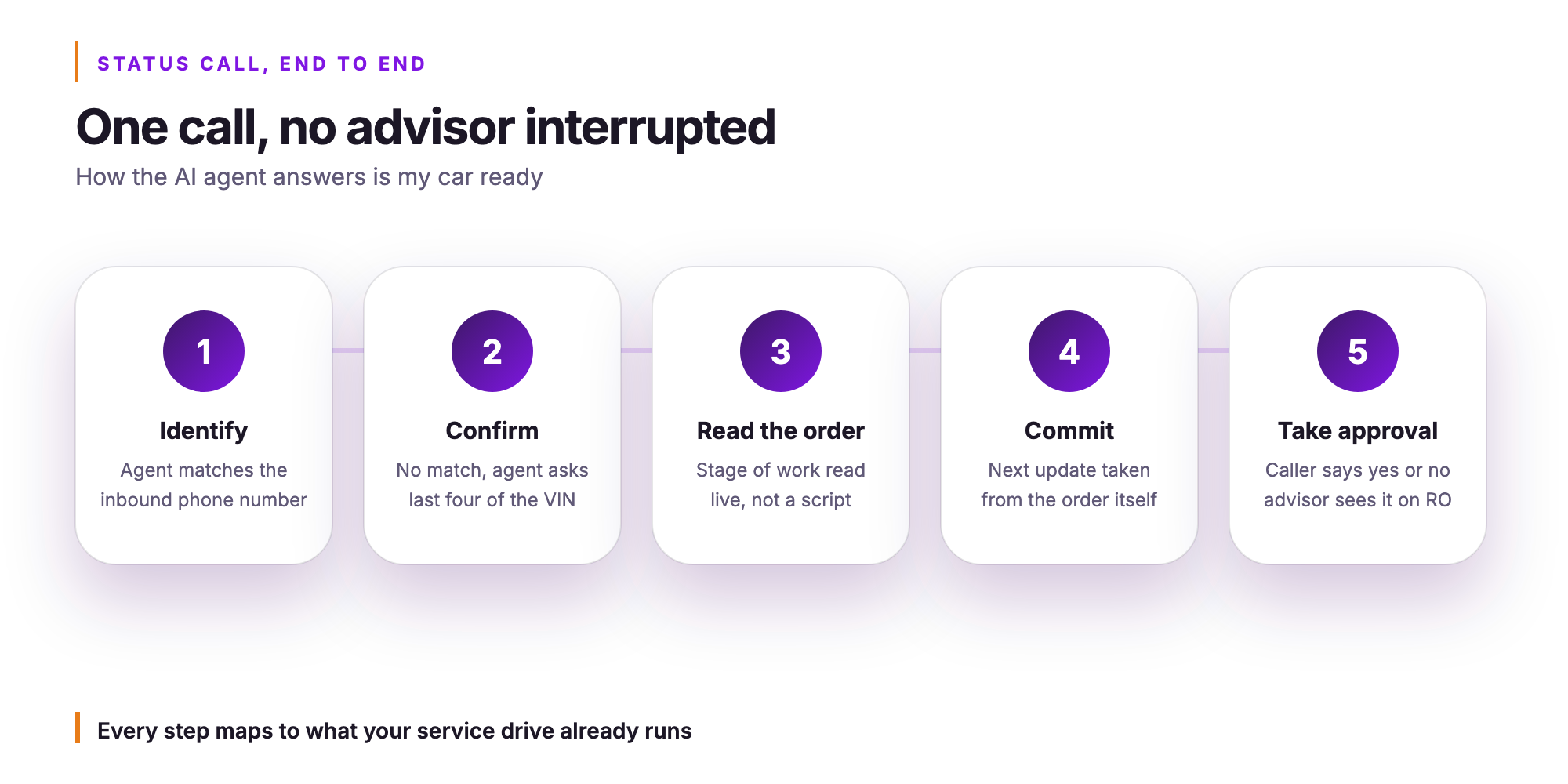
A managed Agentic AI platform for dealerships answers a repair order status call by identifying the caller, locating the open repair order, reading every current field on that order, and delivering a specific, accurate status without involving a service advisor.
The call starts with identification. The AI agent matches the inbound phone number against open repair orders in the dealer management system. If the number does not match, the agent asks the caller for the last four of their VIN or the name on the order. No queue, no hold music, no advisor interrupted mid-write-up.
Once the order is confirmed, the agent reads the current stage of work. The caller hears what the technician has completed, what is in progress, and whether any parts are on back order. That information comes directly from the repair order state, not from a script written that morning.
The next update commitment matters here. Because the agent draws the promised delivery time from the repair order itself, the commitment it gives the caller is the same one already recorded on the order. And the agent schedules the follow-up outbound call from that same data point, so the commitment is kept without a human reminder.
When additional recommended work is waiting on customer authorization, the agent handles that approval on the same call. The caller says yes or no, the authorization is captured, and the advisor sees it on the order. One call closes the loop.
Every step in that sequence maps to something your service drive already runs. What the agent reads is exactly what your DMS holds.
What does the AI agent need to read out of our DMS to answer a status call?
Repair order status call automation requires read access to six fields in your dealer management system, and nothing more.
That distinction matters to every approval chain in a dealer group. Read access is materially easier to scope, authorize, and audit than write access. A scheduling AI agent has to write appointments back into the DMS or the service scheduling tool, which is the heavier approval conversation with your IT and compliance teams. Status is the lighter first deployment because it starts from a read of the repair order rather than a rebuild of the scheduling path.
The fields the agent reads on every call are:
- The open repair order and its current stage in the workflow
- Technician diagnosis state, including whether diagnosis is open or complete
- Parts order state and any back order flag recorded in the parts system
- Warranty or sublet authorization state
- Recommended additional work waiting on customer approval
- The promised delivery time already recorded on the order
Your DMS, your service scheduling tool, and your parts system already hold all six. The agent reads them at the moment of the call and builds its answer from live state, not from a snapshot that aged out during the technician's last update. And because the agent reads only what it needs to answer that one question, the integration surface stays narrow, which keeps the deployment timeline inside three to six weeks.
Where complexity appears is not in the read itself. It is in what the agent says when those fields carry an exception.
What happens on the call when the vehicle is not ready or parts are on back order?
When a vehicle is not ready, the AI agent does not issue a generic apology. It reads the specific exception state from the repair order and commits to a defined next update.
That distinction matters more than it sounds. A caller who hears "we are still working on it" calls back in two hours. A caller who hears "your part is confirmed ordered and we will contact you by 3:00 PM with a confirmed arrival window" does not.
Part on national back order. The agent states the back-order status by name, confirms the dealer has the part on order, and commits to a next contact once the distributor provides an estimated ship date. It does not guess a pickup day.
Part ordered, not yet received. The agent confirms the part is in transit and names the next scheduled parts receipt window the DMS records. The commitment is a same-day outbound contact once receiving confirms arrival.
Technician diagnosis still open. The agent states the vehicle is with a technician and that diagnosis is not yet complete. It commits to an advisor contact once the repair order receives a diagnostic notation.
Warranty authorization pending. The agent names the status as authorization in process and gives the caller the timeframe the repair order carries for expected response from the warranty administrator.
Sublet work out of house. The agent states the vehicle is at an outside specialist and names the expected return date recorded on the repair order. If no return date is recorded, it routes to an advisor rather than speculate.
Additional work pending customer approval. The agent reads the recommended work notation, states the vehicle is on hold pending approval, and walks the caller through approving or declining so the repair order can advance without an interruption to the drive.
Comeback returning for a redo. The agent identifies the repair order as a return visit, acknowledges the prior repair reference, and connects the caller directly to an advisor. A redo is not a status call. It is a service recovery conversation, and governed model orchestration for automotive AI is configured to recognize that boundary and transfer without attempting a resolution the record cannot support.
The reason a wrong pickup time is worse than no pickup time is simple. A promised time the caller plans around becomes a broken commitment when the part has not arrived. An agent reading live parts state from the DMS does not generate a promise the repair order cannot back.
Every exception above has a defined answer and a defined next action. The caller leaves the interaction knowing what is true and when they will hear more. That is what reduces repeat contacts, not an apology.
When does the AI agent hand a service call to a human advisor?
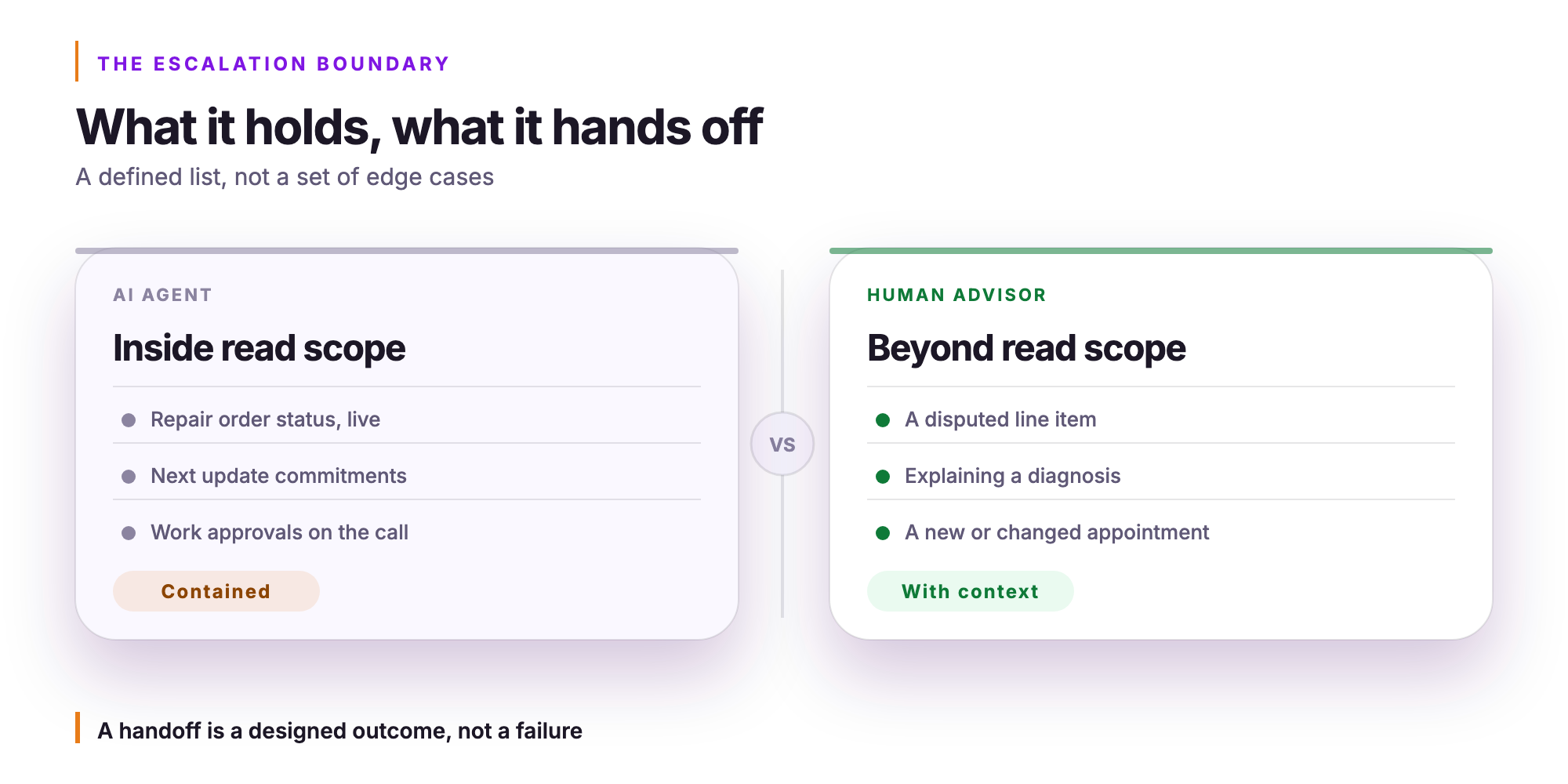
The AI agent handles status, next-update commitments, and work approvals, and it transfers the call to a human advisor the moment the conversation moves outside those boundaries.
The escalation boundary is explicit by design. The agent reads repair order state, communicates parts exceptions, and confirms authorization decisions. It does not interpret a diagnosis, negotiate a disputed line item, or explain a bill that a caller is challenging. When a caller asks for their advisor by name, when the tone shifts and the caller is upset, when the request is a new appointment or a change to an existing one, or when anything falls outside the read scope the agent was given, the call transfers. Those are not edge cases. They are a defined list, and the agent recognizes each one.
A handoff is a designed outcome, not a failure. The advisor picking up that call already has the repair order state and the reason for the transfer. They are not starting from the beginning. In practice, that context summary is what separates a transfer that resolves from one that frustrates. The caller does not re-explain. The advisor does not ask questions the system already answered.
Orvera AI runs human-agent assist for dealership service calls alongside the AI agent layer, so the advisor taking a transferred call has live assistance behind them. Suggested responses, repair order context, and escalation cues are available in real time. And the conversation is audited either way, whether the AI agent resolved it or a human rep carried it to close.
That complete picture of what each call touched, and where it went, is exactly what makes the downstream metrics meaningful.
Which fixed operations metrics actually move when status calls are contained?
Containment of status calls moves two metrics a Group Fixed Operations Director can defend to a Group COO or CFO: status calls contained, and advisor interruptions per open repair order.
The first metric is the volume signal. The second is the productivity signal, and it is the one that survives budget scrutiny. Counting interruptions against open repair orders rather than against total call volume matters because the denominator moves with the size of the day. A Monday with 180 open repair orders is not the same operating condition as a Tuesday with 95. Interruptions per open RO normalizes that variance. It is the number to instrument before deployment and to report against at 30, 60, and 90 days.
Every contained status call is time returned to write-ups, estimates, and upsell conversations at the drive. Hold time on the service line and abandoned calls follow the same containment curve. When the AI voice agent answers the status inquiry from greeting to resolution, the service line clears, and callers who would have abandoned get a resolved call instead.
Orvera AI's published figures, which are averages drawn from its own customer engagements, include first-contact resolution around 80%, average handle time down 8% to 15% in the first 90 days, and AI voice agent quality management 100% coverage across every conversation, whether a human rep or an AI agent handled it. That last figure matters to the Group COO: no sample audits, no gaps, every call on record. The platform is SOC 2 Type II certified and connects to 500+ enterprise systems. The operating heritage behind the configuration is 18+ years on the contact center floor. Those are the figures to carry into a business case. The rollout shape that produces them is the natural next question.
How long does it take to roll this out across every rooftop in the group?
Full enterprise deployment lands in three to six weeks, and status call containment is the easiest first deployment in the group because it needs read access rather than write access.
Most dealership service department call handling software requires write permissions, approval workflows, and a compliance committee review before a single call routes differently. Status call containment carries none of that overhead. The AI agent reads live repair order and parts state from your existing dealer management system. It does not approve repair orders independently or touch payment data. A compliance committee review is not the gate it would be on a more invasive workload.
The rollout follows a proven shape. Orvera AI configures the platform against one rooftop first, validates containment performance there, and then extends the same configuration across the group. Each store runs on its own repair order data feed and its own dedicated service line, so call routing stays clean when customers call a specific location. The group gains a consistent operating model without forcing every store through an independent setup cycle.
Orvera AI builds, deploys, and runs the AI agents throughout this process, and it operates the system on the group's behalf. Orvera AI owns the configuration, the testing, and the ongoing operation, which means your fixed operations team stays focused on the drive rather than an implementation project.
What should a group fixed operations director take away before evaluating this?
Before you evaluate any AI voice agent for your service department, four facts determine whether the conversation is worth having.
- The problem is structural, not staffing. Every repair order status call interrupts a service advisor who is standing on the drive with a customer in front of them. Adding BDC headcount moves the interruption one step sideways. It does not remove it.
- The mechanism is live data. Orvera AI reads live repair order and parts state at the moment of the call, gives the caller a next update commitment it can keep, and takes work approvals without routing the call to the advisor's desk.
- The boundary is clear and enforced. Disputes, diagnosis explanations, and requests an AI agent cannot resolve with certainty go to a human advisor with the full call context already attached. The advisor reads the situation before picking up.
- Measurement comes before deployment. Instrument status calls contained and advisor interruptions per open repair order now, before anything changes. Those two numbers are your baseline, and they are the only ones that tell you whether containment is working three months after go-live.
Talk to the team about what that baseline looks like across your rooftops.
Frequently asked questions
Automating service status updates for fixed operations starts with a live API read against your dealer management system, not a nightly export, because a stale read produces an inaccurate promise to the caller.
Agentic AI for dealership service departments runs across multiple rooftops and multiple DMS instances on a single platform, with each store's repair order data and parts state held in strict isolation.
When a repair order is running late, the AI agent communicates the current parts or labor status and commits to a specific time for the next update, rather than offering a vague reassurance.
The AI agent captures verbal approval for additional work on the call and routes it to the advisor against the repair order, so the advisor retains the customer relationship without fielding the interruption.
The AI agent resolves the caller's question on the call itself, rather than pushing the caller to a text message or a portal to find the answer independently.
Orvera AI deploys in three to six weeks, and the group builds nothing. Orvera does the build and runs the operation on the stack you already have.

Written by
Anindita Majumder
Anindita Majumder is a communications professional with nearly four years of experience in public relations, corporate communications, and journalism. She creates content that helps brands communicate their vision, products, and expertise through press releases, thought leadership, and editorial pieces. Outside of work, she is a vocalist, which keeps her creativity flowing.