Top 8 PolyAI Alternatives in 2026, Compared
Eight PolyAI alternatives compared on who builds the agents, integrations, compliance and pricing structure, checked October 5, 2026.

Key highlights
TL;DR: A Quick Summary
- PolyAI is known for lifelike voice conversations. Buyers compare alternatives on workflow depth, integrations and deployment model.
- Teams comparing platforms weigh setup time, voice accuracy on their own calls and who owns changes after launch.
- Orvera, our own platform, is listed last and fits CX teams that want one platform across AI agents, human-agent assist and QA.
- This guide compares Vapi, Bland, Retell, Goodcall, Synthflow, Decagon, Google Dialogflow and Orvera, describing what each platform is built for and who it fits, with vendor facts checked on October 5, 2026.
- Voice AI buyers should compare analytics, CRM and system integrations, compliance for regulated industries, and how each vendor scopes cost to their call volume.
PolyAI is a well-established name in conversational AI.
Each business still weighs it against its own operating model, tech stack and deployment timeline. As more companies look for faster setup, deeper customization, a cost model that fits their volume, or support for industry-specific workflows, many begin exploring alternatives that align better with their goals.
This guide highlights the top PolyAI alternatives in 2026 and who each one fits, so teams can choose the platform that fits their workflows, integrations and budget.
Short answer: the PolyAI alternatives compared in this guide are Vapi AI, Bland AI, Retell AI, Goodcall, Synthflow AI, Decagon, Google Dialogflow and Orvera, our own platform. The right one depends on how much your team wants to build itself, the CRM and scheduling integrations you rely on, and how each vendor structures its commercial terms.
Why Do Businesses and AI-Powered Call Centers Look for PolyAI Alternatives?
PolyAI is a well-known voice automation platform (opens in a new tab) that helps businesses handle calls with natural-sounding AI agents and reliable enterprise-level support. Many companies use it to simplify customer service, reduce call center load, and offer consistent phone experiences at scale. As the voice AI landscape continues to evolve, however, different teams often develop new priorities around flexibility, integration depth, pricing, or deployment speed.
These are the priorities that most often start a PolyAI comparison in 2026.
- Different Integration Needs: Teams map each platform's connectors against the CRM, helpdesk and telephony stack they already run.
- Need for Faster Setup and Iteration: Organizations that need to launch or update voice agents quickly often seek solutions that give them a clear owner for changes and a fast path from request to live update.
- Flexibility in Custom Workflows: Certain industries require specialized call logic, unique compliance steps, or deeper branching flows. When teams need more control over customization, they may explore platforms built for rapid workflow adjustments.
- Voice Accuracy Across Global Audiences: Businesses supporting diverse regions sometimes evaluate alternatives that focus on accent variance, multilingual performance, or localized conversational tuning.
- Pricing and Scalability Considerations: Smaller teams often want usage-based plans that match their growth stage. Higher-volume teams want cost scoped to their own volumes, channels and use cases. Both need a cost model they can plan a budget around.
Top 8 PolyAI Alternatives for Customer Interactions: A Quick Overview Table
| Tool Name | Key Features | Pricing |
|---|---|---|
| Vapi AI | - API-native control - Sub-500ms latency (vendor-stated, as of October 5, 2026) - Multilingual support - BYO models | Usage-based per minute, plus optional Success Packages from $29/month (as of October 5, 2026) |
| Bland AI | - "Pathways" decision trees - SOC 2, HIPAA-eligible, GDPR, PCI DSS - 40+ languages | $0.12 to $0.14/min, plus a custom Enterprise plan (as of October 5, 2026) |
| Retell AI | - No-code builder - Multi-step conversations - IVR navigation and CRM integration | Usage-based per minute, plus a custom enterprise tier (as of October 5, 2026) |
| Goodcall | - No-code setup - Lead capture - AI call handling & scheduling | From $79/month per agent (as of October 5, 2026) |
| Synthflow AI | - Drag-and-drop builder - Multilingual - CRM integration | Enterprise contracts from $30,000/year (as of October 5, 2026) |
| Decagon | - NL-based agent config - Unified interface - CRM & Helpdesk APIs | No published pricing (as of October 5, 2026) |
| Google Dialogflow | - NLU & voice/chat AI - Pre-built templates - Visual flow builder | Published pay-per-use: voice $0.001 to $0.002 per second, chat $0.007 to $0.012 per request (as of October 5, 2026) |
| Orvera | - AI agents, Agent Assist and Auto QA on one platform - ~80% first-contact resolution (customer average) - 3 to 6 week deployment (customer average) - SOC 2 Type II, HIPAA and GDPR compliant | Scoped per deployment |
How we chose these platforms
This guide is for contact-center and CX leaders who are replacing or benchmarking PolyAI for customer service calls. Each entry describes what the platform is built for and who it fits. Use the criteria below to shortlist the two or three that match how your team builds and runs voice automation.
As of October 5, 2026, we reviewed each vendor's own product, documentation and pricing pages. Every price and plan in this guide carries that date. Where a vendor publishes no price, we say so and describe the plan structure instead.
Orvera AI publishes this guide. We list our own platform last and label it, so you can weigh it alongside the others.
- Who builds it: your team in a no-code tool, your developers against an API, or the vendor's own implementation team
- Integrations: connectors for the CRM, helpdesk, telephony and contact-center platform you already run
- Channel coverage: phone only, or voice plus chat, email and messaging on one platform
- Quality and analytics: transcripts, outcome tracking and how much of your call volume gets scored
- Compliance: SOC 2, HIPAA and GDPR status as stated on the vendor's own pages
- Pricing model: the published price with its date, or a note that the vendor quotes on request
Top 8 PolyAI Alternatives in 2026
Each entry below covers key features, fit, considerations and the vendor's published pricing as of October 5, 2026.
1. Vapi AI
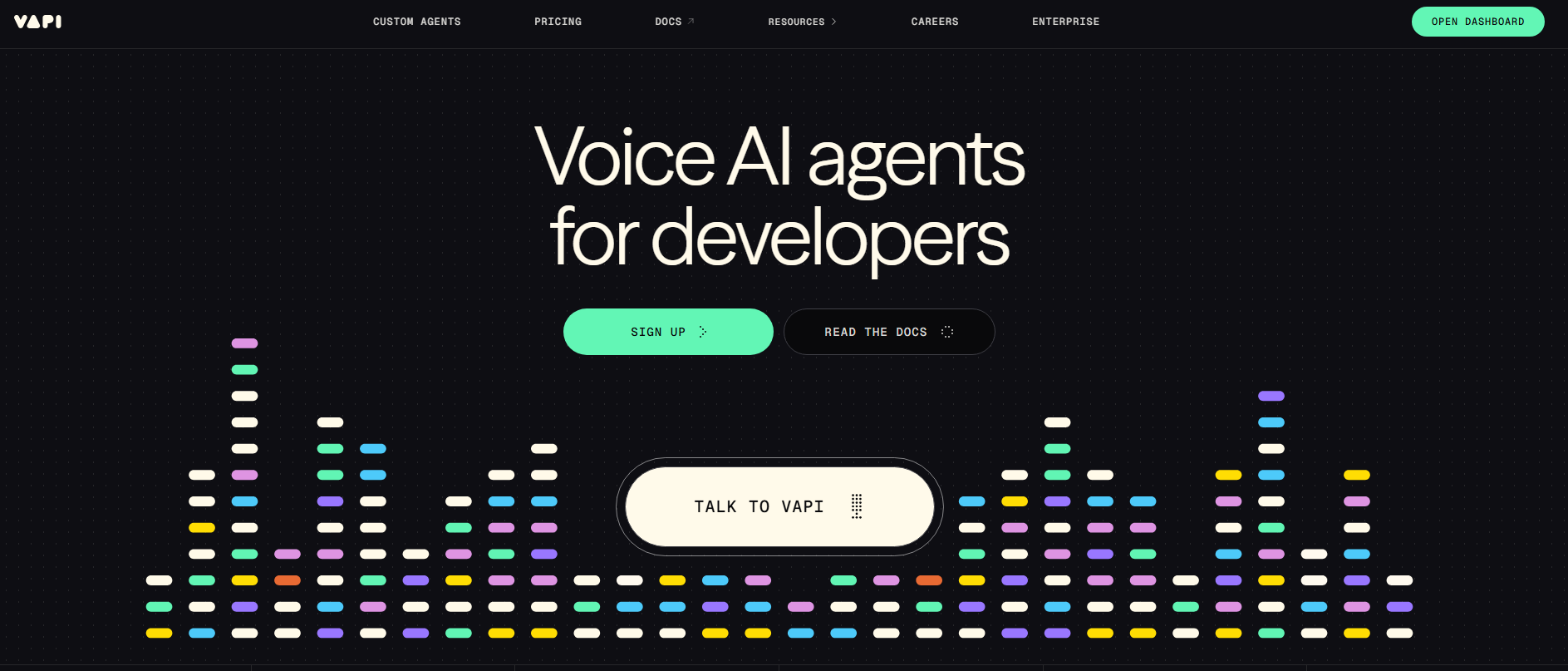
Image Source (opens in a new tab)
Vapi AI is an API first voice automation platform built for teams that want complete control over how their voice agents behave. Vapi lets developers build custom voice agents and choose their own speech, voice and language models. It offers low-latency performance, multilingual coverage, and a developer-friendly architecture that allows deep customization. Technical teams often choose Vapi when they prefer to design conversational logic programmatically.
Key features:
- Multilingual support: Talk to users in English, Spanish, Mandarin and other supported languages
- API-native: Control every part of the experience using API-first access across all voice AI components
- Automated testing: Run automated tests with simulated AI voice agents to catch errors before sending anything live
Where It Fits In:
Best for developers building their own voice agents. Vapi fits engineering-driven teams that want to build bespoke voice AI experiences with full control over models and infrastructure.
What Makes It Different:
- Developer flexibility: Control every layer of the voice pipeline using your own tools and models
- Model independence: Use your preferred STT, TTS, and LLM providers without platform lock-in
Considerations:
- Best suited to teams with developers who configure and maintain their own call flows
- Built API first, so agents are designed and changed in code
- Plan for ongoing testing as call flows grow more advanced
Pricing:
- As of October 5, 2026, Vapi's pricing page (opens in a new tab) lists usage-based billing per minute, plus optional Success Packages: Core at $29 per month, Pro at a $999 per month minimum, and Premier through sales.
2. Bland AI
Image Source (opens in a new tab)
Bland AI is a voice automation platform built for teams that want strong control over call behavior, data flow, and compliance. It supports multiple languages and offers a flexible prompt-based setup that allows businesses to design custom voice interactions without rigid templates. Bland AI also supports customer sentiment analysis, enabling teams to monitor and improve service quality by understanding customer emotions and feedback in real time. Bland, as an alternative to PolyAI, is frequently chosen by teams that prioritize security, customization, and the ability to maintain consistent conversational logic at scale.
Key Features:
- Custom prompts: Create personalized voice agent behavior by defining sample dialogue and contextual details
- Scalable infrastructure: Support thousands of concurrent calls with auto scaling capabilities
- Data exchange: Use dynamic integrations to route call data wherever it needs to go via API
Where It Fits In:
Bland fits well in teams that need customizable conversational flows with strong compliance support to solve customer inquiries.
What Makes It Different:
- Strict guardrails: Define precise behavior and boundaries for voice agents to maintain accuracy and consistency.
- Human-like voice quality: Access natural-sounding agents that handle digital interactions smoothly across industries
Considerations:
- Billed per minute, so model cost against your expected monthly call volume
- Best suited to teams with the technical skills to use its customization options
- Best suited for teams that prefer a prompt engineering workflow over a visual builder
Pricing:
As of October 5, 2026, Bland's pricing page (opens in a new tab) lists Start at $0.14 per minute with no platform fee, Build at $0.12 per minute plus a $299 monthly platform fee, and a custom Enterprise plan. Its pricing FAQ lists SOC 2 Type I and Type II, HIPAA eligibility with a signed BAA, GDPR and PCI DSS, and its homepage lists 40+ languages (opens in a new tab).
3. Retell AI
Image Source (opens in a new tab)
Retell AI is a no-code voice automation platform (opens in a new tab) designed for teams that want to build conversational agents quickly without writing code. It supports real-time interactions, multi-step conversations, and integrations with CRMs and telephony systems. Retell is often selected by organizations that value rapid deployment and an intuitive drag-and-drop builder for creating custom call flows.
Key Features:
- No code builder: Design conversational flows visually without engineering support
- Auto sync knowledge base: Keep voice agents updated by pulling new content directly from your knowledge base
- IVR navigation: Allow agents to move through multi-level phone menus without human intervention
Where It Fits In:
Retell fits well in teams that want to launch voice agents quickly and manage updates internally without developer involvement.
What Makes It Different:
- Fast deployment: Build and deploy conversational agents in minutes using prebuilt components
- Flexible integrations: Connect easily with tools like Twilio, Bubble.io (opens in a new tab), Make.com (opens in a new tab), and various CRMs
Considerations:
- Plan live-call testing to validate custom actions in complex workflows
- Best suited to teams that want to build and change call flows in a visual builder
Pricing:
As of October 5, 2026, Retell's pricing page (opens in a new tab) lists Pay as you go at $0.07 to $0.31 per minute for voice agents, and an Enterprise plan with custom pricing.
4. Goodcall
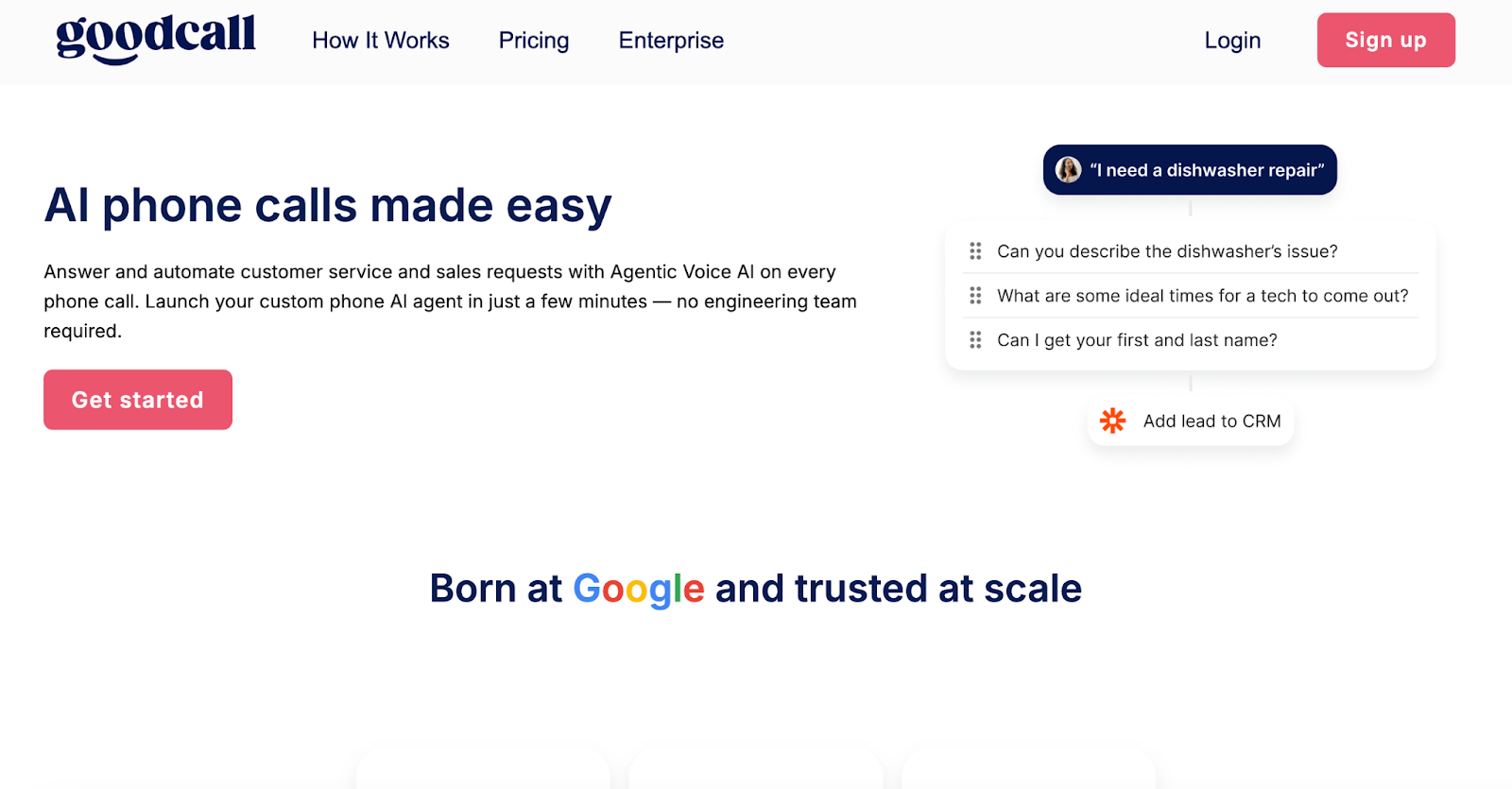
Image Source (opens in a new tab)
Goodcall is a no-code phone automation platform designed to help small and mid-sized businesses handle inbound calls, capture leads, and book appointments through conversational AI. It focuses on quick setup for teams that want to automate routine calls without engineering resources, and is commonly used by service businesses and local shops.
Key Features:
- AI-powered virtual agents: Answer routine phone inquiries and manage conversations naturally
- Appointment management: Book, update, and send reminders through integrated scheduling tools
- Lead capture: Collect caller details and qualify leads using predefined criteria
Where It Fits In:
Best for small businesses automating a front-desk phone line. Goodcall fits small to mid-sized businesses that need simple, automated phone support and appointment handling.
What Makes It Different:
- Fast, no-code setup: Launch phone automation quickly without technical skills
- Built-in scheduling support: Integrates easily with calendars and booking tools for real-time appointments
Considerations:
- Priced per agent per month, with a set number of unique customers in each plan and $0.50 per customer above it (as of October 5, 2026)
- Best suited to front-desk calls, lead capture and appointment booking
Pricing:
As of October 5, 2026, Goodcall's pricing page (opens in a new tab) lists Starter at $79, Growth at $129 and Scale at $249 per agent per month on monthly billing, with 15% off on annual billing.
5. Synthflow AI
Image Source (opens in a new tab)
Synthflow AI is a no-code voice agent builder designed for teams that want to create conversational phone workflows quickly. Synthflow AI enables businesses to create AI agents for automating phone and digital customer interactions. With drag-and-drop call logic, multilingual support, and CRM integrations, it appeals to businesses that prefer a straightforward interface over complex development tools. Synthflow is often chosen by users who want to automate lead handling, appointment booking, and customer interactions with minimal technical setup.
Key Features:
- Drag and drop builder: Create and manage call flows visually without coding
- Multilingual support: Speak with callers in multiple languages and regional accents
- CRM integrations: Sync calls and contacts with tools like Salesforce, HubSpot, and Calendly
Where It Fits In:
Synthflow fits well in teams that want simple, fast-to-deploy voice agents for lead management and appointment workflows.
What Makes It Different:
- Low-latency audio: Deliver human-like responsiveness during calls
- Real-time analytics: Monitor agent performance through live reporting dashboards
Considerations:
- Enterprise contracts are scoped to call volume, concurrency, telephony and integrations
- Best suited for straightforward business workflows
Pricing:
As of October 5, 2026, Synthflow's pricing page (opens in a new tab) lists Enterprise contracts starting at $30,000 a year, scoped to call volume, concurrency, telephony, integrations and launch support.
6. Decagon
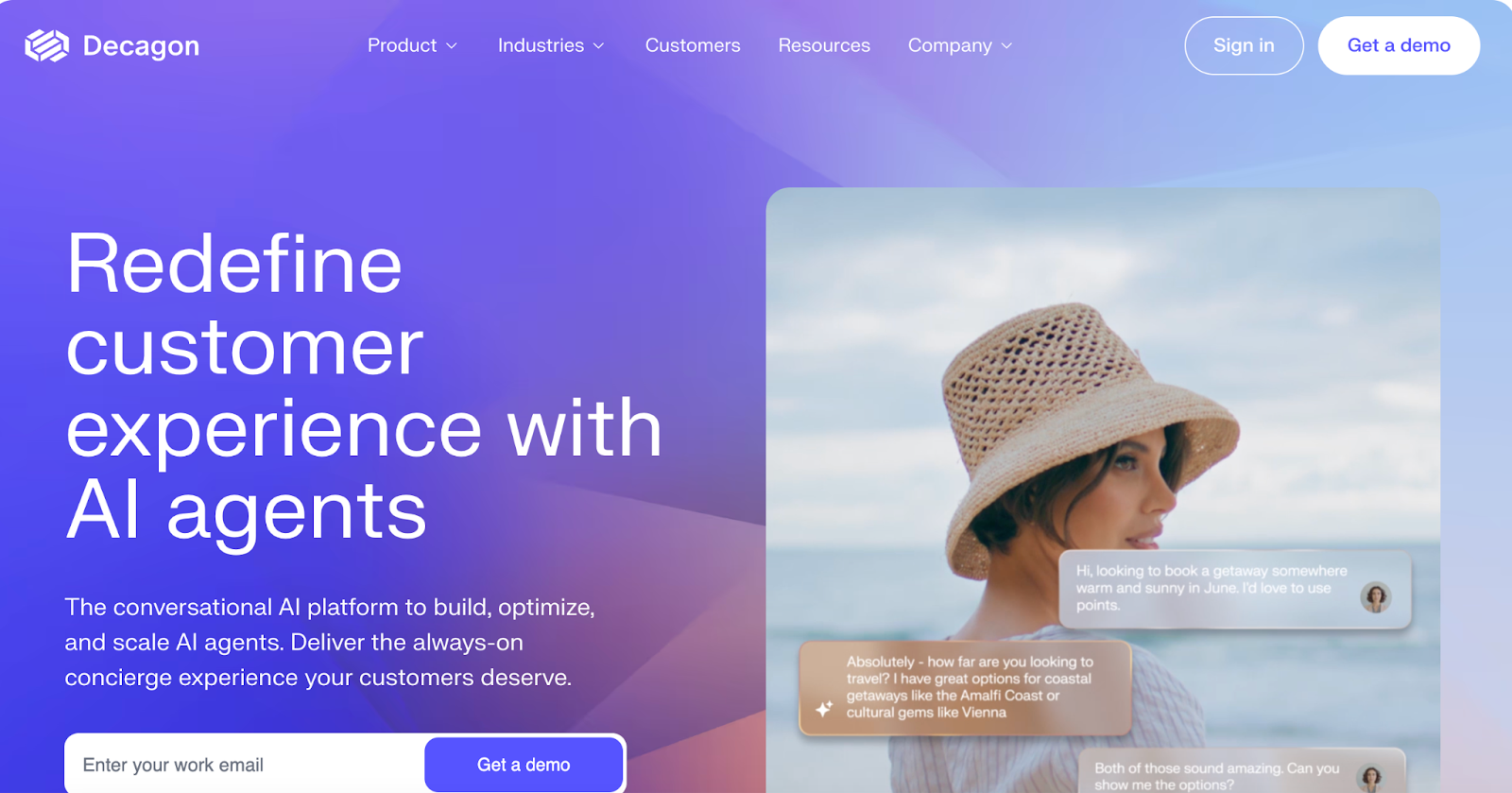
Image Source (opens in a new tab)
Decagon is a conversational AI platform that lets teams build voice agents using natural language instructions. Its interface converts plain language descriptions into underlying logic, making it easier for non-technical users to create automated workflows while still giving developers room to customize integrations and guardrails. Decagon's natural language configuration also helps in maintaining context throughout customer conversations, ensuring coherent and consistent interactions. Decagon is often selected by teams that want a balance between ease of use and technical flexibility.
Key Features:
- Natural language configuration: Create agent behaviors by describing tasks in plain language.
- Unified interface: Manage support and sales agents from a single workspace
- API integrations: Connect agents to CRMs and helpdesk tools using flexible API options
Where It Fits In:
Decagon fits well in teams that want low-code workflow creation with the option to add technical depth when needed.
What Makes It Different:
- Hybrid control model: Give non-technical staff control while still supporting deeper developer customization
- Fast implementation: Deploy voice agents quickly without complex setup processes
Considerations:
- Plan for iteration to fine-tune agent behavior
- Best suited for teams balancing ease of use with moderate technical oversight
Pricing:
As of October 5, 2026, Decagon publishes no pricing page (opens in a new tab), and its site routes buyers to a demo request.
7. Google Dialogflow
Image Source (opens in a new tab)
Google Dialogflow is a conversational AI framework used to build both voice and chat-based virtual agents. It excels at managing multi-turn conversations across voice and chat channels, enabling complex customer interactions and extended, multi-step dialogues. It offers natural language understanding, visual flow design tools, and strong integration support through Google Cloud services. Dialogflow is often used by teams that want a flexible, well-supported platform for building interactive experiences across phone systems, apps, and web channels.
Key Features:
- Natural language understanding: Identify user intent and extract structured data from speech or text with advanced natural language processing features.
- Visual flow builder: Design conversational logic with a drag-and-drop interface.
- Generative AI extensions: Enhance responses by connecting to knowledge bases and custom data sources.
Where It Fits In:
Dialogflow fits well in teams that want a reliable, scalable platform for multi-channel conversational experiences across voice, chat, and messaging apps.
What Makes It Different:
- Prebuilt agent templates: Speed up deployment with ready-to-use components
- Multichannel support: Deploy across telephony, web, mobile apps, and custom integrations
Considerations:
- Billed per second of audio or per chat request, so model cost against your volume
- Best suited to teams with developer support for complex conversation flows
Pricing:
As of October 5, 2026, Google Cloud's Conversational Agents (Dialogflow CX) pricing page (opens in a new tab) lists pay-per-use rates: voice agents at $0.001 per second of audio for flows and $0.002 for playbooks, and chat agents at $0.007 per request for flows and $0.012 for playbooks.
If faster deployment and resolution across every channel are priorities for your team, an Orvera demo shows how the platform would run in your operations. (opens in a new tab)8. Orvera AI (our product)
Orvera is an AI agent company for customer experience teams, built from 18+ years of contact-center experience, that runs AI agents, Agent Assist and Auto QA on one platform across voice and digital channels. It helps contact centers deploy faster, reduce operational load, and improve core metrics such as AHT, FCR and CSAT. The platform connects with existing contact-center systems to handle routine inquiries, transactional calls, and multi-step processes.
Key features:
- Live in 3 to 6 weeks: Full deployment typically completes inside 3 to 6 weeks, an average across Orvera customer engagements.
- Built-in quality and analytics: Auto QA scores interactions across every channel, both human-handled and AI-handled.
- First-contact resolution: Roughly 80% first-contact resolution across Orvera customer averages.
- Governed models: Orvera orchestrates best-in-class third-party voice and language models within a governed orchestration layer, and trains its own contextualization models on de-identified data.
- Integrations: Offers 500+ integrations across CCaaS, CRM, helpdesk and ITSM, healthcare, insurance and financial systems, and is listed on Salesforce AppExchange, Microsoft Marketplace and AWS Marketplace.
Where It Fits in:
Orvera fits US customer experience teams, and the BPOs that serve them, that want one platform across AI agents, human-agent assist and QA. That includes compliance-driven teams in healthcare and insurance.
Case Study: How Orvera reduced outbound calling costs for a U.S. record retrieval enterprise
A nationwide U.S.-based medical record retrieval enterprise relied on high-volume outbound follow-ups with medical facilities and custodians to obtain timely status updates and records, but the process was labor-intensive, costly, and difficult to scale. Human-handled calls included long IVRs, no answers and high administrative time per call, and pre-call preparation and post-call documentation created significant overhead.
The organization deployed Orvera as an elastic capacity layer for these follow-ups. AI agents placed outbound calls to medical facilities, navigated IVRs, engaged custodians when reachable, and captured outcomes in the client's case management system through API updates, while human teams focused on escalations and complex cases. Here's what they accomplished:
- Improved operational efficiency without increasing headcount
- Maintained stable retrieval outcomes at scale during volume surges
- Reallocated human capacity to higher value exception handling
What Makes It Different:
- CSAT improvement: Double-digit CSAT improvement across Orvera customer averages.
- White-glove implementation: The Orvera team handles the build, the deployment and the integration.
- Agent Assist: Live, real-time support for human agents on complex conversations, with approved knowledge, next-best actions and automated summaries.
- Data collection: Capture real-time interaction data and feed it directly into your existing systems.
Considerations:
- The platform is built for contact-center volume, so a team automating a single phone line may find it more than it needs.
Pricing:
- Pricing is scoped per deployment. Contact Orvera for a quote.
Request a demo here (opens in a new tab) and see how Orvera performs in your workflow.
Two more things to test in a pilot
When you pick a voice AI platform, test it on your own calls, systems and volumes. Beyond the criteria in the method section above, check these two:
| Feature | Why It Matters |
|---|---|
| Natural language processing | Customers stay on the line when the voice sounds natural and responsive through a multi-turn conversation. |
| Multi-language support | You can expand into new regions quickly if your agents already speak the languages you need. |
How Orvera Compares to PolyAI
As of October 5, 2026, PolyAI's pricing page prices ongoing use per minute (opens in a new tab), with performance improvements, maintenance and 24/7 support in that price. CX teams often evaluate Orvera (opens in a new tab) alongside it. Orvera is designed for contact-center volume and is built to work alongside call center agents, automating routine tasks so that human agents can focus on complex issues that need emotional intelligence.
Both run voice agents for high-volume service lines. The difference to test in a pilot is scope: Orvera also runs Agent Assist for human agents and Auto QA across human-handled and AI-handled interactions on the same platform.
Conclusion
The right PolyAI alternative depends on who builds and changes the agents, the systems they must connect to, and what the platform costs at your volume.
Look for platforms that fit how your operation runs: the integrations you depend on, compliance for your industry, a cost model that holds at your volume, and a clear answer on who changes flows after launch and how fast. Real-time analytics and multichannel support are worth testing in the same pilot.
Shortlist two or three platforms, test them on your own calls and systems, and compare cost at your production volume.
Frequently asked questions
As of October 5, 2026, PolyAI's pricing page (https://poly.ai/pricing) says ongoing use is priced per minute and includes performance improvements, maintenance and 24/7 support. Vapi, Bland and Retell publish self-serve per-minute rates, which suit smaller teams and fast experiments.
Test agent performance on real customer prompts, including accents, intent recognition, and back-to-back interruptions. Voice latency, word clarity, and recovery from misunderstanding matter more than generic demo accuracy percentages.
Focus on CRMs like HubSpot or Salesforce, scheduling tools like Calendly, and real-time data connectors. These integrations reduce manual tasks, improve agent response quality, and support faster, event-triggered workflows.
You need clear call objectives, existing workflows, CRM access, and someone to manage updates. Voice automation works best when you already track customer needs and know where automation adds value.
This guide covers PolyAI, the enterprise conversational voice AI company that automates customer service phone calls. Every platform compared here is built for business customer service.
Written by
Anindita Majumder
Anindita Majumder is a communications professional with nearly four years of experience in public relations, corporate communications, and journalism. She creates content that helps brands communicate their vision, products, and expertise through press releases, thought leadership, and editorial pieces. Outside of work, she is a vocalist, which keeps her creativity flowing.