How Agentic Conversation Intelligence Connects Insight to Resolution
Conversation intelligence becomes operational when understanding a customer interaction leads...

Key highlights
TL;DR — In a Nutshell
- Agentic conversation intelligence connects customer conversations to governed actions, workflow execution, quality measurement, and resolution
- Orvera uses one operating model across AI and human agents, with context retained across channels and AI-to-human handoffs
- Connected enterprise systems let Orvera execute approved actions and track customer commitments through completion and audit trails
- Its quality intelligence combines customer-defined scorecards, criterion-level evidence, calibration, and full-coverage QA across AI and human interactions
- Voice of Customer analyzes the full conversation population to identify themes, drivers, sentiment, and recurring CX issues that teams can act on
- Orvera builds, integrates, deploys, runs, and continuously optimizes the CX operation, with full enterprise deployments landing in 3 to 6 weeks
Conversation intelligence becomes operational when understanding a customer interaction leads directly to the work that resolves it. Enterprise CX teams need the conversation, the action taken in connected systems, and the evidence of completion to sit inside one operating record.
Orvera brings those pieces together inside an agentic AI platform for enterprise customer experience. The same platform runs omnichannel AI agents, supports human agents in live interactions, evaluates quality, and connects conversation context to workflow execution. That gives CX leaders a clearer view of what customers asked for, what the operation did, and whether the work reached completion.
What Agentic Conversation Intelligence Means for Enterprise CX
Conversation intelligence usually starts with understanding. It identifies what the customer is asking, captures the interaction, and surfaces patterns across conversations. Agentic conversation intelligence extends that understanding into governed action.
Inside Orvera, the conversation record can inform workflow execution, human guidance, quality evaluation, Voice of Customer analysis, and follow-up. The goal is a CX operation where insight and execution share the same context.
From interaction understanding to operational action
An understood intent can trigger APIs, microservices, or RPA. In environments where a legacy system exposes no API, a back-office execution agent can navigate the interface, retrieve the required information, and return it to the customer-facing agent so the conversation can continue toward completion.
The execution path stays governed by business rules, confidence thresholds, policy constraints, and human approval where the workflow requires it. That gives conversation intelligence an operational role inside the customer journey.
One conversation record across AI and human handling
Orvera uses one platform across AI-handled and human-handled conversations. The same approved knowledge, context, governance, and quality framework support both sides of the operation.
When a conversation moves from an AI agent to a human agent, the handoff carries a structured summary and next steps by default, with the full transcript available on demand. Context can also continue across channels, including chat-to-voice transitions and asynchronous conversations that resume later.
Connecting Conversation Insight to Workflow Execution
The value of conversation intelligence increases when the operation can act on the intent it has already understood. Orvera connects customer conversations to the systems where service work is recorded and completed.
That connection can carry both sides of the operational record. Conversation content shows what the customer and agent said. Systems of record show what happened afterward, including a case update, a field write, a follow-up task, a credit or refund, or a scheduled callback.
Acting in systems of record
Orvera can execute approved actions through connected enterprise systems and track commitments through workflow execution, scheduled follow-ups, and audit trails. The workflow can also require human confirmation before a sensitive action commits.
This makes the customer promise measurable. A commitment made during the interaction becomes work the operation can trace through completion.
Measuring whether the promised work happened
Conversation evidence and action evidence answer different questions. The transcript shows how the interaction was handled. The CRM, case, or workflow record shows whether the promised action was completed.
Orvera brings both into the quality record. That allows a quality leader to inspect the exact transcript moment behind a criterion result and, where the criterion covers an action, the system record that evidences completion.
Quality Intelligence That Includes the Work After the Conversation
Quality management becomes more useful when it evaluates the handling of the interaction and the work that followed it. Orvera builds the quality program from the customer's own scorecards, rubrics, compliance checks, and evaluation standards.
Human-handled conversations, AI-handled conversations, and AI Agent Assist sessions can be scored on the same configured criteria. Criteria can also be scoped to a specific population when a requirement applies only there.
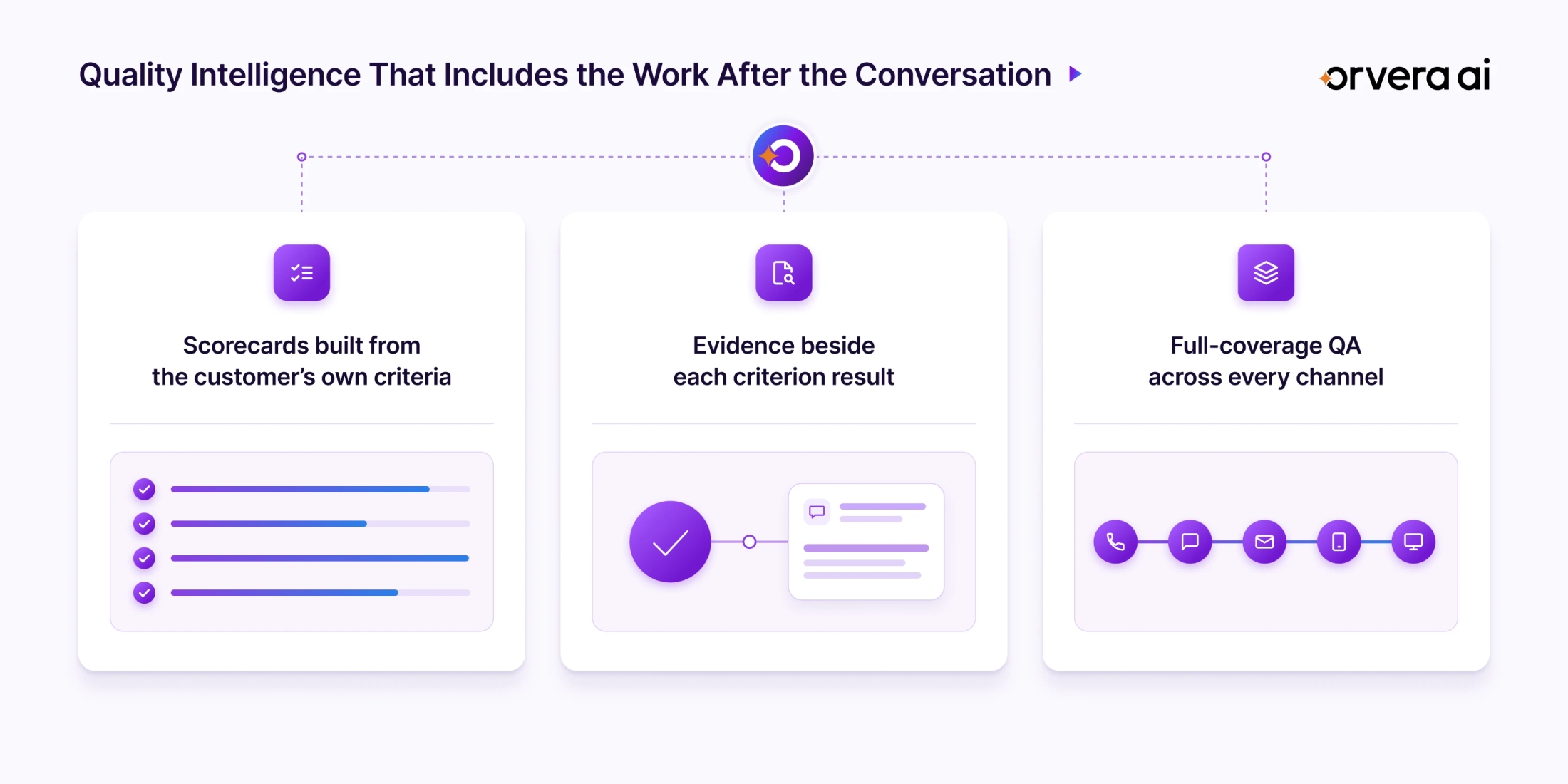
Scorecards built from the customer's own criteria
Criteria, weights, thresholds, pass or fail logic, and fatal compliance checks remain configurable. Orvera runs calibration against the customer's own evaluators, and calibration runs again when the scorecard changes.
This keeps the quality standard anchored to the way the customer evaluates its own operation.
Evidence beside each criterion result
Each criterion result can link back to the exact transcript moment behind the score. Action criteria can also link to the customer's CRM or case record that evidences the work.
That evidence gives quality leaders a practical way to investigate a disputed score, separate conversation behavior from action completion, and decide whether the response belongs in coaching, a workflow change, or a process update.
Full-coverage QA across every channel
Orvera runs full-coverage QA across every channel. Auto QA covers both human-handled and AI-handled conversations against configurable QA frameworks and provides one quality view across the operation.
The coverage becomes more useful when it is paired with customer-owned scorecards, evidence, calibration, and action completion. Those mechanisms turn quality data into an operating input.
Voice of Customer From the Full Conversation Population
Voice of Customer extends the same conversation record into a broader CX view. Orvera mines every conversation for themes, drivers, sentiment, and CX signals, using the same full-coverage base as Auto QA.
That gives CX leaders a way to see recurring customer needs alongside quality and operational evidence.
Themes and drivers that CX leaders can act on
Patterns can be viewed across teams, processes, campaigns, queues, departments, AI agents, and human agents. Quality drivers separate issues such as tone and professionalism from process and compliance failures, which helps direct the response to the part of the operation that needs to change.
A recurring service issue may call for coaching. A repeated process failure may require a workflow refinement. A pattern tied to a policy or disclosure can lead to a change in the configured interaction path.
Measuring what changes after a fix
After a change ships, Auto QA scores the conversations that follow and reports whether quality and compliance moved. The same measurement rhythm applies after coaching, a routing adjustment, an AI-agent prompt or script revision, a disclosure update, a handoff change, or a workflow refinement.
This creates a closed operating loop from conversation evidence to change and back to measured performance.
Governance and Context Across the Conversation Surface
Agentic conversation intelligence needs the same governance to follow the interaction as it moves across channels, agents, and systems. Orvera uses one governed architecture across the AI-agent and human-agent layers.
Orvera orchestrates best-in-class third-party models inside its own governed enterprise layer.
Context across channels and handoffs
Customers can move between chat and voice with context retained. Conversations can also continue asynchronously across supported channels, so an interaction paused today can resume later with its context intact.
The AI-to-human seam carries a structured summary and next steps. This keeps the human agent connected to the work already completed and the next action required.
Governed actions and auditability
Tool and action allowlists, parameter constraints, least-privilege execution, confidence gating, and human review paths define how actions operate. Logged actions provide the audit trail behind workflow execution.
These controls matter because conversation intelligence can move beyond analysis into actions against live customer systems. The governance layer defines the boundary around those actions.
How Orvera Builds, Deploys, and Runs the Operation
Conversation intelligence sits inside a wider CX operating model. Orvera builds the solution, deploys it, integrates it with the customer's existing stack, and runs it with the customer after go-live.
A full engagement moves through discovery and CX process mapping, solution design, build, integration, testing, go-live, run, and optimization. A full enterprise deployment lands in 3 to 6 weeks.
Integration with the existing CX stack
Orvera connects to the contact platform, CRM, helpdesk, and line-of-business systems already in use. The connection carries conversation content and the operational records needed to evaluate completed work.
Custom integration work can also connect proprietary or home-grown systems so the quality record reflects the customer's own operational language and evidence.
Operating capability after go-live
Orvera's leadership brings 18+ years of contact-center experience. That operating background underpins the company's ability to build, deploy, integrate, and run the solution on the customer's behalf.
The same delivery team continues into the run phase, where scorecards, calibration, reporting requirements, and workflow changes can evolve with the operation.
What CX Leaders Should Evaluate in a Conversation Intelligence Platform
A useful evaluation should follow the interaction from understanding through action and evidence. The questions below keep the assessment focused on the operating model.
· Action completion: Can the system connect the conversation to approved actions in enterprise systems and track the work through completion?
· Context continuity: Can context move across channels and AI-to-human handoffs without losing the history of the interaction?
· System-of-record evidence: Can quality teams inspect evidence of the action that followed the customer promise?
· Customer-owned quality standards: Are scorecards, weights, thresholds, pass or fail logic, and fatal checks built from the customer's own criteria?
· Calibration: Is scoring tuned against the customer's own evaluators and refreshed when the scorecard changes?
· Governance: Are policy controls, action boundaries, approval paths, audit trails, and role-based access part of the operating model?
· Quality coverage: Does the platform provide full-coverage QA across every channel for AI-handled and human-handled conversations?
· Operating model: Who builds, integrates, runs, measures, and optimizes the deployment after go-live?
The evaluation becomes more concrete when the team can trace one real workflow from customer intent to system action, quality evidence, and completed work.
Turning Conversation Intelligence Into Resolution
Enterprise conversation intelligence reaches its full operational value when the insight inside a customer interaction connects to the action that resolves it. The conversation supplies intent and context. Connected systems carry the work. Quality evidence shows how the interaction was handled and whether the promised action happened.
Orvera brings those elements into one enterprise CX platform across AI agents and human-agent operations. Across Orvera engagements, first-contact resolution is around 80%, reflecting the focus on conversations that reach an answer on the first contact.
Bring your workflows, systems, scorecards, handoff rules, and resolution requirements to Orvera to see how agentic conversation intelligence can operate inside your enterprise CX environment.
Frequently asked questions
Agentic conversation intelligence connects conversation understanding to governed workflow execution, system actions, quality evidence, and completion inside enterprise CX. It uses the interaction as an operating input for what happens next.
Orvera can connect conversation content with operational records from CRM, case, helpdesk, and line-of-business systems. Approved actions can run through connected systems, and action criteria can be evaluated against the customer-owned records that evidence completion.
Orvera uses the customer's own scorecards, configurable criteria, transcript-linked evidence, system-action evidence, and calibration against the customer's own evaluators. Human-handled, AI-handled, and AI Agent Assist sessions can be scored on the same configured criteria.
Voice of Customer mines every conversation for themes, drivers, sentiment, and CX signals. It uses the same full-coverage conversation base as Auto QA, giving CX leaders a broader view of recurring customer needs and experience patterns.
A full enterprise deployment lands in 3 to 6 weeks.

Written by
Anindita Majumder
Anindita Majumder is a communications professional with nearly four years of experience in public relations, corporate communications, and journalism. She creates content that helps brands communicate their vision, products, and expertise through press releases, thought leadership, and editorial pieces. Outside of work, she is a vocalist, which keeps her creativity flowing.