From Speech Analytics to Agentic Resolution in Enterprise CX
Speech analytics gives enterprise CX teams a detailed record of what customers said, what they...

Key highlights
TL;DR — In a Nutshell
- Speech analytics turns customer conversations into structured evidence through transcripts, intent, sentiment, themes, and interaction patterns
- Orvera connects conversation evidence to workflows, APIs, systems of record, and human approvals so interactions can move from understanding to resolution
- Full-coverage QA evaluates human- and AI-handled conversations using configurable scorecards based on the customer's own quality and compliance standards
- System-of-record evidence connects what agents said with what they actually did, making action completion and operational outcomes measurable
- Voice of Customer analysis mines every conversation for recurring themes, drivers, sentiment, and CX signals that can guide coaching, process, and workflow improvements
- Orvera brings speech analytics, QA, Agent Assist, workflow execution, governance, and measurement into one connected enterprise CX operating loop
Speech analytics gives enterprise CX teams a detailed record of what customers said, what they asked for, and how conversations unfolded. The next step is to connect that evidence to the work that follows the conversation. Quality, system actions, human guidance, workflow execution, and resolution all become more useful when they share the same operating context.
Orvera brings those pieces together in one agentic AI platform for enterprise customer experience. Conversation evidence can feed quality intelligence, Voice of Customer analysis, Agent Assist, and workflow execution, while connected systems show whether the promised action actually happened. The result is a measurement loop that links the conversation to the operational outcome.
What Speech Analytics Reveals in Enterprise CX
Speech analytics turns voice interactions into structured evidence that CX teams can inspect. Transcripts capture the conversation. Intent and interaction patterns help explain why customers are reaching out. Sentiment and themes add context about how the experience developed and what appears repeatedly across the conversation population.
That evidence matters because a quality score or customer theme is most useful when the team can trace it back to the interaction that produced it. Orvera keeps the transcript as the evidence layer under scoring, so criterion results can link to the exact conversation moment behind them.
Transcripts create the evidence layer
A transcript gives quality and operations teams a common record of the interaction. In Orvera, every criterion result can connect to the supporting customer statement and agent response. A disputed score can therefore be reviewed against the underlying evidence and the exact interaction that produced it.
Sentiment and themes add context
Orvera supports post-conversation sentiment analysis for voice, including nuanced emotions such as joy, anger, and sadness. Voice of Customer analysis then mines the full conversation population for themes, drivers, sentiment, and CX signals. This gives CX leaders a broader view of recurring patterns across the operation.
Real-time sentiment is available on non-voice channels today. Real-time voice sentiment remains on the near-term roadmap, so the current voice story should stay centered on post-conversation analysis and the live capabilities already available elsewhere in the platform.
Turning Conversation Evidence Into Resolution
Conversation evidence becomes operational when it connects to workflow execution. Orvera AI agents plan, call systems, take actions, and drive conversations toward an outcome. Once the intent is understood, the platform can trigger APIs, microservices, and RPA, with human confirmation available for sensitive actions.
This allows the conversation to move from understanding to completion. A customer can ask about an order, request a refund, change an appointment, verify eligibility, authenticate an account, or work through a technical issue. The agent can retrieve the relevant state, execute the configured workflow, update connected systems, and carry the interaction through to an answer.
Workflow execution connects insight to action
The operational value comes from joining the conversation with the business systems where the work is completed. Orvera can act through direct APIs and microservices. For legacy environments without an API, a back-office execution agent can navigate the system interface, retrieve data, and return the result to the customer-facing agent so the conversation can close.
Human review stays inside the workflow
Orvera supports fully autonomous execution for non-sensitive, well-bounded workflows. Sensitive actions can require human confirmation before they commit. Low-confidence and policy-restricted paths can move to human review or a warm handoff with context retained. This keeps the action path connected even when human judgment is required.
Quality Intelligence Across Every Interaction
Orvera runs full-coverage QA across every channel. Human-handled and AI-handled conversations are evaluated against configurable QA frameworks, giving quality leaders one consistent program across the operation.
The starting point is the customer's own scorecard. Existing evaluation forms, rubrics, and compliance checks become automated scorecards. Criteria, weights, thresholds, pass or fail rules, and fatal compliance checks remain configurable. Calibration runs against the customer's own evaluators so the scoring standard follows the organization's own quality definition.
The customer owns the quality standard
A quality program becomes useful when it reflects the operation it measures. Orvera builds scorecards from the customer's own forms and tunes grading behavior against the customer's analysts. Calibration runs again when the scorecard changes, keeping the scoring standard aligned with the current rubric.
Compliance and quality remain distinct
Fatal compliance checks are configured separately from weighted quality criteria. A compliance breach stays visible as its own event outside the weighted average. That separation gives quality and compliance teams clearer evidence for the action each result requires.
Connecting What Was Said to What Was Done
One of the strongest ways to extend speech analytics is to connect conversation evidence with the operational record. Orvera scores what the agent said and what the agent did, with the system record attached as evidence beside the transcript moment.
A criterion can evaluate conversation behavior such as process adherence, disclosure, verification, and handling. It can also evaluate downstream action in the customer's systems, including the disposition logged, the case created or updated, field values written, a follow-up task raised, a credit or refund applied, or a callback scheduled.
System-of-record evidence makes completion visible
The conversation may contain a promise. The operational record shows whether the promise was completed. Orvera connects both so the quality record can show the transcript evidence and the corresponding system action in one view.
This gives CX leaders a clearer distinction between handling the conversation well and completing the work that followed it. Action completion can be reported alongside conversation criteria across the same teams, queues, processes, campaigns, and departments.
Voice of Customer From the Full Conversation Population
Voice of Customer analysis uses the same full-coverage base as Auto QA. Orvera mines every conversation for themes, drivers, sentiment, and CX signals, giving leaders a view of recurring patterns across the full conversation population.
Those patterns can inform different types of operational change. A conversation-handling issue may point to coaching. A repeated policy misunderstanding may call for a script or knowledge change. A recurring process failure may require workflow refinement. The same quality framework can then measure what happens after the change ships.
Quality drivers show where the pattern sits
Orvera reports quality drivers across teams, processes, channels, campaigns, AI agents, human agents, queues, and departments. Tone and professionalism can be separated from process and compliance findings, helping the organization route the issue to the right owner and response.
Trend measurement closes the loop
When coaching, a prompt revision, a disclosure change, routing adjustment, handoff change, or workflow refinement goes live, Auto QA scores the conversations that follow. The quality team can then see whether the relevant criteria moved and whether the change produced the intended operating effect.
Supporting Human Agents With Live Conversation Intelligence
Speech analytics also becomes more useful when live conversation context supports the people handling customer interactions. Orvera Agent Assist delivers next-best action in real time across voice and synchronous non-voice channels, along with knowledge suggestions that carry citations.
Agents can also see real-time interaction summaries, CRM data, past-session context, and customer-specific content. The same layer supports writing guidance, real-time translation, de-escalation suggestions, routing, system updates, post-call summaries, and coaching on tone and word usage.
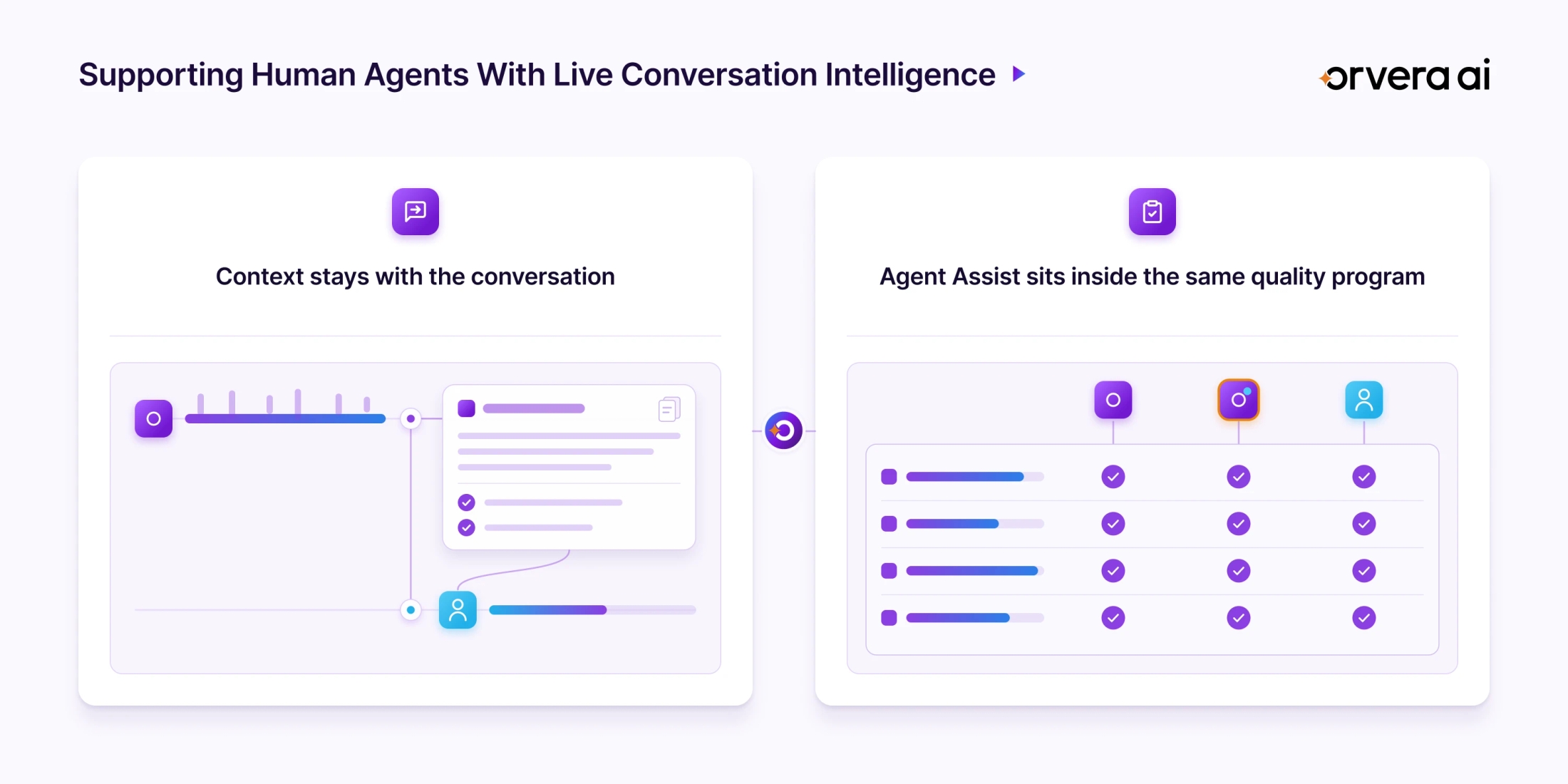
Context stays with the conversation
An AI-handled interaction can move to a human with a structured summary and next steps attached. The full transcript is available on demand. Context can also persist when a conversation moves between chat and voice or resumes later on another supported channel.
Agent Assist sits inside the same quality program
AI Agent Assist sessions can be scored on the same configured criteria used for human-handled and AI-handled conversations. This gives CX leaders one view across automated interactions, assisted interactions, and conversations handled entirely by people.
Across Orvera engagements, average handle time is down 8 to 15% in the first 90 days, largely through Agent Assist.
Governance and Evidence for Enterprise CX
Enterprise CX requires clear operating boundaries around action. Orvera places governance inside the architecture through tool and action allowlists, parameter constraints, least-privilege execution, human approval paths, and auditable system actions.
Orvera orchestrates best-in-class third-party models inside its own governed enterprise layer.
Controls follow the workflow
Business rules, confidence scores, deterministic workflow logic, and connected data all contribute to the next action. Sensitive paths can pause for confirmation. Pending approvals can resume once human input arrives. Idempotency, retries, and compensating actions help protect transactions against duplication or incorrect execution.
Evidence stays inspectable
Audit logging applies across the running system. Access to conversations, QA records, and reports is logged. Every criterion result links back to the supporting conversation evidence, and action criteria can link to the corresponding system record. That traceability gives quality leaders a clear basis for review and dispute resolution.
What CX Leaders Should Evaluate in Speech Analytics
A useful evaluation goes beyond the amount of audio a platform can process. The stronger questions focus on how conversation evidence connects to the wider CX operation.
· Evidence traceability: Can a quality result be traced to the exact conversation moment that produced it?
· System action visibility: Can the platform show whether the promised action was completed in the system of record?
· Customer-owned scorecards: Can criteria, weights, thresholds, pass or fail rules, and fatal checks reflect the organization's own QA framework?
· Calibration: Is the grading standard tuned against the customer's own evaluators and rerun when the rubric changes?
· Voice of Customer: Can themes, drivers, sentiment, and CX signals be drawn from the full conversation population?
· Agent Assist: Can live conversation context support human agents with cited knowledge, summaries, next-best action, and system updates?
· Workflow execution: Can the platform connect understanding to APIs, microservices, RPA, and human approval paths?
· Governance: Are action boundaries, approval paths, and audit trails built into the operating model?
These questions keep the evaluation centered on measurable CX performance and the evidence behind it.
Building the Measurement Loop Into the CX Operation
Orvera builds, deploys, integrates, and runs the platform on the customer's existing stack. A full engagement moves through discovery and CX process mapping, solution design, build, integration, testing, go-live, run, and optimization.
A full enterprise deployment lands in 3 to 6 weeks.
The operating loop then continues after go-live. Conversation evidence feeds quality scoring. Quality findings point to coaching, scripts, routing, handoff behavior, or workflow changes. System records show whether actions were completed. Voice of Customer analysis surfaces broader patterns. The next set of conversations measures the change against the same framework.
For CX leaders, that creates a connected view of performance: interaction, evidence, action, quality, refinement, and resolution.
See What Is Driving Resolution and Performance
Bring your conversations (opens in a new tab), scorecards, workflows, and systems to Orvera. See how speech analytics, full-coverage QA, Voice of Customer, Agent Assist, and system-of-record evidence can work together inside one enterprise CX operation.
Frequently asked questions
Speech analytics is the analysis of voice interactions through transcripts, intent, sentiment, themes, and related conversation signals. It gives CX teams structured evidence they can use to understand customer interactions and operating patterns.
Conversation evidence can connect to workflow execution, systems of record, human guidance, and quality measurement. In Orvera, AI agents can act in connected systems and carry conversations through to an answer, while quality records show what was said and what happened afterward.
Orvera uses the customer's own scorecards, configurable criteria, weights, thresholds, pass or fail rules, and fatal checks. Calibration runs against the customer's evaluators, and Orvera runs full-coverage QA across every channel.
Voice of Customer mines every conversation for themes, drivers, sentiment, and CX signals. These patterns give CX leaders a broader view of recurring issues and operating trends across the full conversation population.
Yes. Orvera Agent Assist provides next-best action, cited knowledge suggestions, real-time summaries, CRM and past-session context, translation, routing, system updates, and coaching during live interactions.
A full enterprise deployment lands in 3 to 6 weeks.

Written by
Anindita Majumder
Anindita Majumder is a communications professional with nearly four years of experience in public relations, corporate communications, and journalism. She creates content that helps brands communicate their vision, products, and expertise through press releases, thought leadership, and editorial pieces. Outside of work, she is a vocalist, which keeps her creativity flowing.