Governed Real-Time Agent Assist for Enterprise CX
Real-time Agent Assist has become part of the operating layer for enterprise customer experience. During a live...

Key highlights
TL;DR — In a Nutshell
- Real-time Agent Assist gives human agents next-best actions, cited knowledge, live summaries, customer context, writing guidance, translation, and de-escalation support during interactions
- Orvera grounds Agent Assist in approved enterprise knowledge and keeps citations visible so agents can verify the source behind suggested information
- Governance is built into the Agent Assist layer through policy controls, action allowlists, parameter constraints, least-privilege execution, human approvals, and audit trails
- Context stays connected across AI-to-human handoffs and supported channels, giving agents access to summaries, CRM data, past-session history, and relevant customer information
- Agent Assist connects guidance to action by supporting system updates, routing, follow-up tracking, and post-call processing within the existing enterprise environment
- Human, AI, and Agent Assist interactions can be measured through the same full-coverage QA framework, connecting live guidance, operational outcomes, quality, and governance
Real-time Agent Assist has become part of the operating layer for enterprise customer experience. During a live conversation, the agent needs the next action, the right source, relevant customer context, and a clear path to complete the work.
Orvera brings Agent Assist into the same enterprise CX platform that runs AI agents, quality intelligence, and workflow execution. The human-agent layer supports live conversations with next-best action, cited knowledge suggestions, real-time summaries, customer context, writing guidance, routing, system updates, and coaching.
The result is a live support layer that stays connected to the interaction from the first question through the next action.
What Real-Time Agent Assist Does During a Live Interaction
Agent Assist is most useful when it reduces the searching and context switching an agent has to manage while the customer is still present.
Orvera delivers next-best action in real time across voice and synchronous non-voice channels. Knowledge suggestions include citations so the agent can see the source behind the information before using it. Real-time interaction summaries help the agent follow the conversation as it develops.
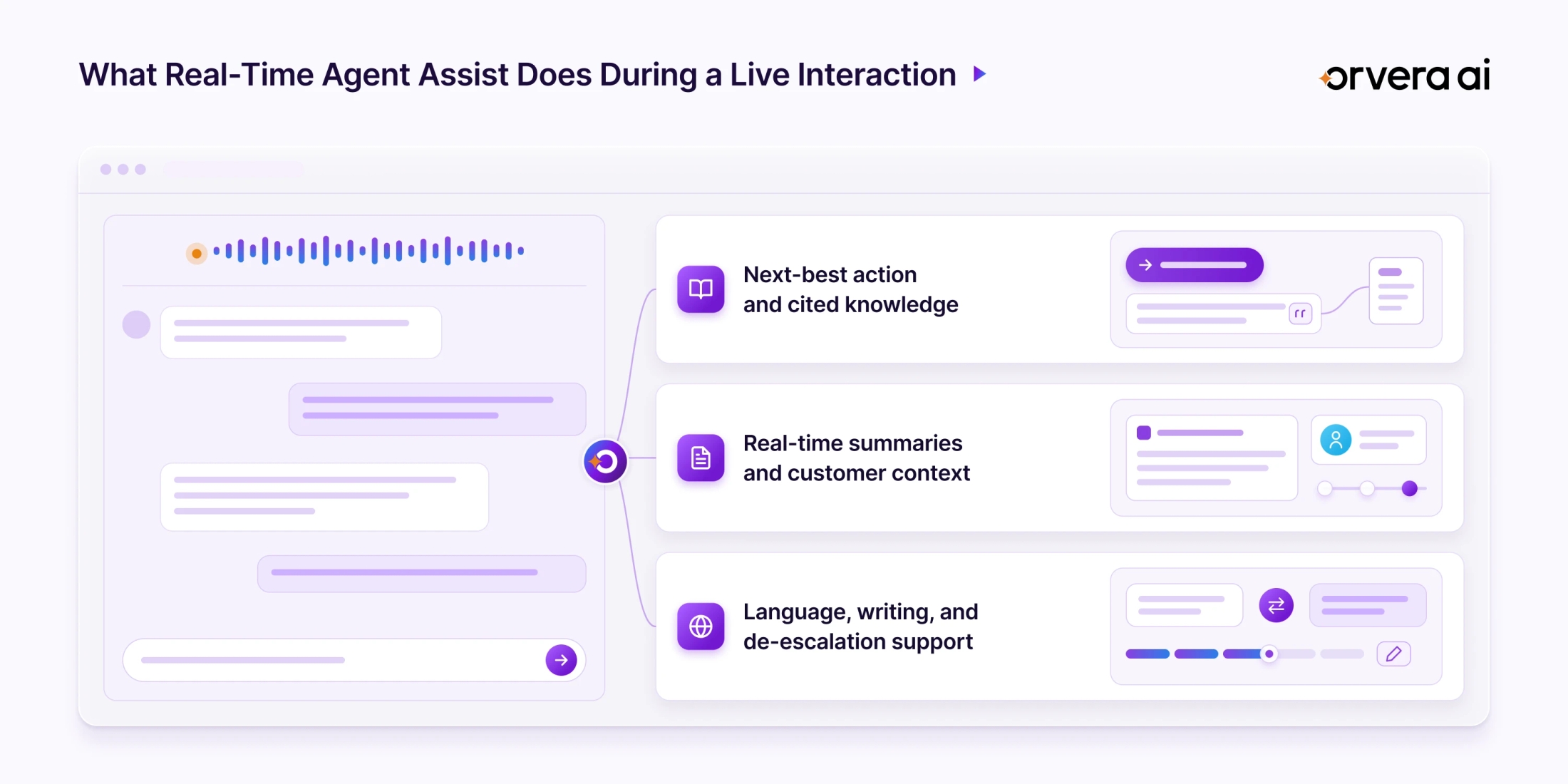
Next-best action and cited knowledge
A customer conversation can move quickly from one issue to another. A billing question can turn into a policy question. A service request can reveal an account issue. The agent needs guidance that reflects the current interaction and the approved information available to the business.
Orvera surfaces next-best action during the conversation and pairs knowledge suggestions with citations. That gives the agent a visible source behind suggested information and keeps guidance tied to approved enterprise knowledge.
Real-time summaries and customer context
Live guidance becomes more useful when the agent can see the history behind the current request.
Orvera provides transcript summary cards with relevant CRM data and information from past sessions. Customer profiles and customer-specific content can also appear inside the Agent Assist experience. This helps the agent understand what has already happened, what the customer is asking now, and what information matters to the next step.
Language, writing, and de-escalation support
Agent Assist also supports how the agent communicates. Orvera provides real-time writing assistance for tone, grammar, clarity, and verbosity. It detects the agent's language and provides real-time translation into the customer's preferred language, including language changes during the same conversation. De-escalation suggestions give the agent additional support when an interaction becomes tense.
Governance Inside the Agent Assist Layer
Live guidance becomes part of enterprise operations when the controls behind it are clear.
Orvera uses one governed architecture across its AI-agent and human-agent layers. Policy-based filtering, tool and action allowlists, parameter constraints, least-privilege execution, human review paths, and auditability are part of that architecture.
Orvera orchestrates best-in-class third-party models inside its own governed enterprise layer.
Policy controls shape what happens next
A useful Agent Assist experience has to fit the policies and operating rules of the organization using it. The platform routes low-confidence or policy-restricted paths to human review. Sensitive actions can require human confirmation before they commit. Approval options are available when Agent Assist updates systems of record.
These controls give CX and operations teams a defined way to decide where automation acts, where an agent remains responsible, and where a supervisor or other reviewer steps in.
Auditability connects guidance to operating control
Governance also depends on evidence. Orvera records system actions and applies audit trails across connected workflows. That matters when a quality leader or security reviewer needs to understand what happened during an interaction, what changed, and which action followed the conversation.
Grounded Knowledge and Context for Human Agents
A live support layer has to give agents information they can use at the moment they need it.
Orvera grounds responses in approved enterprise knowledge through retrieval-augmented generation with source attribution. Inside Agent Assist, knowledge suggestions carry citations so the agent can see the source behind the suggested information.
Cited knowledge gives agents source visibility
Source visibility matters when the conversation involves policy, eligibility, service rules, account information, or another area where the agent needs to use approved information accurately. Agent Assist brings that information into the live interaction and keeps the source visible. The agent works from the same approved knowledge environment that supports the wider Orvera platform.
Context continuity reduces repeated work
Orvera retains context across AI and human handoffs. A handoff carries a structured summary with next steps by default, with the full transcript available on demand.
That continuity also extends across channels. A customer can move between chat and voice with context retained, and an asynchronous conversation can resume later on another supported channel. For the human agent, the live conversation can begin with useful history already attached to it.
From Guidance to Action in Existing Systems
Agent Assist becomes more valuable when the guidance connects to the systems where the work is completed.
Orvera updates systems of record, including CRM, ITSM, and knowledge bases, with audit trails and approval options for the agent. It also routes interactions to the appropriate human agent based on skills, customer attributes, and conversation context.
System updates with agent approval
During a customer interaction, the agent may need to update a record, create or modify a case, document a follow-up, or carry information into another business system. Orvera supports those updates inside the same human-agent layer. Approval options allow the agent to remain part of the action where the workflow requires confirmation.
Routing and post-call processing
Agent Assist routes interactions using skills and context while integrating with existing CCaaS routing. It also supports post-call processing by uploading chat transcripts and call summaries into the database. Commitments made by a human agent are tracked, with incomplete follow-ups flagged for attention.
For desktop integration, AI Agent Assist connects as a browser extension or through a webhook, so it lands on the agent desktop already in use.
Quality Intelligence Around Assisted Conversations
Live assistance and quality management work better when they use the same operating criteria.
Orvera allows human-handled conversations, AI-handled conversations, and AI Agent Assist sessions to be scored on the same configured criteria. The quality program can evaluate conversation behavior and what happened afterward in the customer's systems.
One quality framework across the operation
Orvera runs full-coverage QA across every channel.
The quality framework can evaluate whether a case was created or updated, whether a field was written, whether a follow-up task was raised, whether a credit or refund was applied, and whether a callback was scheduled. Each action criterion is evaluated against what the agent committed to during the conversation.
This connects the conversation to the operational record that shows whether the promised work happened.
Calibration keeps scoring tied to the customer's standard
Calibration is built around the customer's own evaluators and scorecards. Grading behavior is tuned to the customer's evaluators and calibration runs again when the scorecard changes.
Across Orvera engagements, average handle time is down 8 to 15% in the first 90 days, largely through Agent Assist.
How Orvera Builds, Deploys, and Runs Agent Assist
Enterprise Agent Assist is an operating program as much as a product capability. The deployment has to connect knowledge, systems, scorecards, workflows, routing, and the people who use it.
Orvera runs discovery and CX process mapping, solution design, build, integration on the customer's existing stack, testing, go-live, run, and optimization.
A full enterprise deployment lands in 3 to 6 weeks.
Built around the customer's existing operation
The implementation starts with the systems and operating processes already in place. Orvera connects the contact platform, CRM, helpdesk, and line-of-business systems used by the customer.
The customer's own forms, rubrics, compliance checklists, QA analysts, and system fields become inputs to the configured operation.
Operating capability after go-live
Orvera's leadership brings 18+ years of contact-center experience. That operating background underpins Orvera's ability to build, deploy, integrate, and run the solution on a customer's behalf.
The engagement continues through run and optimization, keeping the deployed capability connected to the customer's workflows and operating standards.
What CX Leaders Should Evaluate in Real-Time Agent Assist
The evaluation should focus on how Agent Assist works inside the customer's actual operating environment.
· Live guidance: Does the platform deliver next-best action during voice and synchronous non-voice conversations?
· Source visibility: Do knowledge suggestions carry citations that agents can inspect?
· Context: Can the agent see CRM data, past-session context, summaries, and customer-specific information during the interaction?
· Governance: Are approval paths, policy controls, audit trails, and execution boundaries built into the operating model?
· System action: Does the human-agent layer update the systems where the work is completed?
· Quality: Are assisted conversations evaluated against the customer's own scorecards and calibration standard?
· Desktop fit: Does Agent Assist connect to the existing agent desktop through supported integration methods?
· Operating model: Who builds, integrates, runs, calibrates, and optimizes the deployment after go-live?
These questions keep the evaluation focused on the live operation, where guidance, action, quality, and governance have to work together.
Bringing Human-Agent Support Into the Same CX Operation
Agent Assist becomes more powerful when it shares context, knowledge, governance, and quality intelligence with the rest of the CX operation.
In Orvera, the same platform that runs AI agents also supports human agents. AI-handled conversations can move to a person with context attached. Human-handled conversations can be scored through the same quality framework. Agent guidance, coaching, system actions, and Voice of Customer insight draw from the same conversation record.
For CX leaders, that creates one operating model across automated and human-assisted interactions.
Bring your workflows, systems, scorecards, and escalation requirements to Orvera to see how governed real-time Agent Assist would fit your enterprise CX operation (opens in a new tab).
Frequently asked questions
Real-time Agent Assist supports a human agent during a live customer interaction. In Orvera, it provides next-best action, cited knowledge suggestions, interaction summaries, CRM and past-session context, writing assistance, translation, routing, system updates, and coaching.
Orvera surfaces cited knowledge suggestions, real-time interaction summaries, CRM data, past-session context, customer profiles, and customer-specific content. The configuration follows the customer's workflow and operating requirements.
Governance runs through the same enterprise layer that supports the wider Orvera platform. Controls include policy filtering, tool and action allowlists, parameter constraints, least-privilege execution, human review paths, approval options, and audit trails.
AI Agent Assist sessions can be scored on the same configured criteria used across human-handled and AI-handled conversations. Calibration uses the customer's own evaluation standard and runs again as scorecards change.
AI Agent Assist connects as a browser extension or through a webhook, allowing it to land on the agent desktop already in use.
A full enterprise deployment lands in 3 to 6 weeks.
Written by
Anindita Majumder
Anindita Majumder is a communications professional with nearly four years of experience in public relations, corporate communications, and journalism. She creates content that helps brands communicate their vision, products, and expertise through press releases, thought leadership, and editorial pieces. Outside of work, she is a vocalist, which keeps her creativity flowing.