How Does Catastrophe Voice of Customer Analysis Show What Is Breaking Each Day?
A catastrophe claims operation loses sight of what policyholders are running into because the pattern sits across the full volume of event conversations, and no single person hears enough of that volume to see it. During a catastrophe event, Orvera's Voice of Customer analysis reads every...

Key highlights
- A catastrophe claims operation loses sight of what policyholders are running into because the pattern sits across the full volume of event conversations, and no single person hears enough of that volume to see it.
- Event-level Voice of Customer analysis means reading every policyholder conversation tied to one catastrophe event and grouping it into themes, drivers, and sentiment for that event and its loss footprint.
- The analysis reads the entire population of event conversations and reports each day on what the population shows.
- One day of the analysis looks like a short list of themes with owners attached, read by claims leadership at the daily catastrophe call.
- The analysis surfaces what policyholders are experiencing and where, and claims leadership decides every action taken in response.
- A carrier wants the platform built and run for it because catastrophe season runs on its own calendar.
- Four measures tell claims leadership the analysis is working, and the carrier holds the values for all four in its own reporting.
- A head of catastrophe claims takes four statements that each stand on their own in an executive room.
Why does a catastrophe claims operation lose sight of what policyholders are running into?
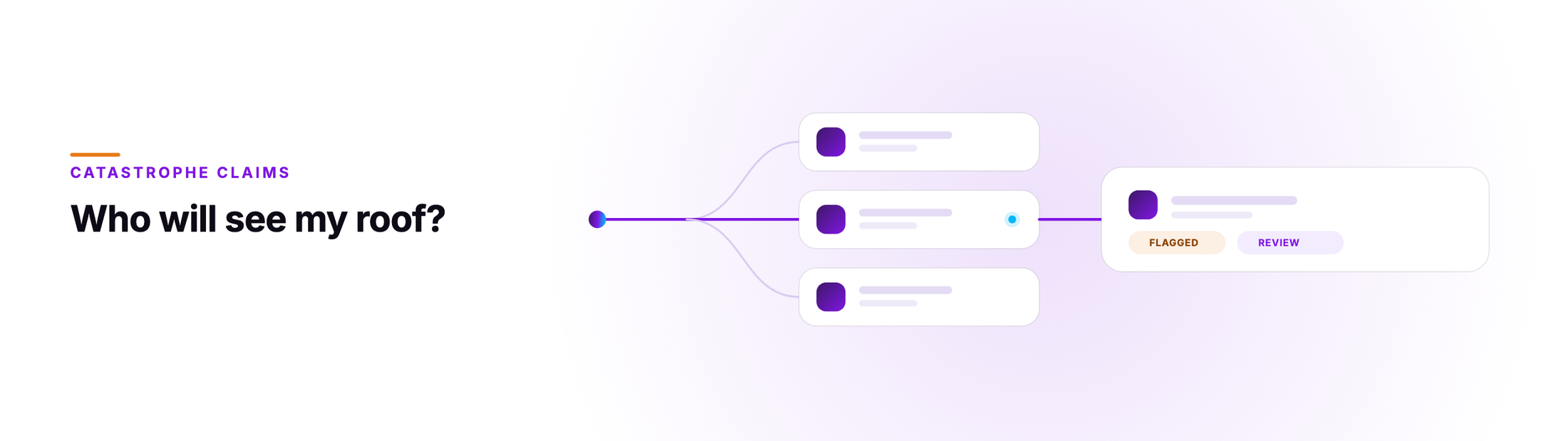
A catastrophe claims operation loses sight of what policyholders are running into because the pattern sits across the full volume of event conversations, and no single person hears enough of that volume to see it. During a catastrophe event, Orvera's Voice of Customer analysis reads every policyholder conversation and surfaces each day the themes, drivers, and sentiment that show what is breaking in the loss footprint, with the policyholder verbatims behind each theme, so claims leadership can change the response while the event is still running, and claims leadership decides what to change.
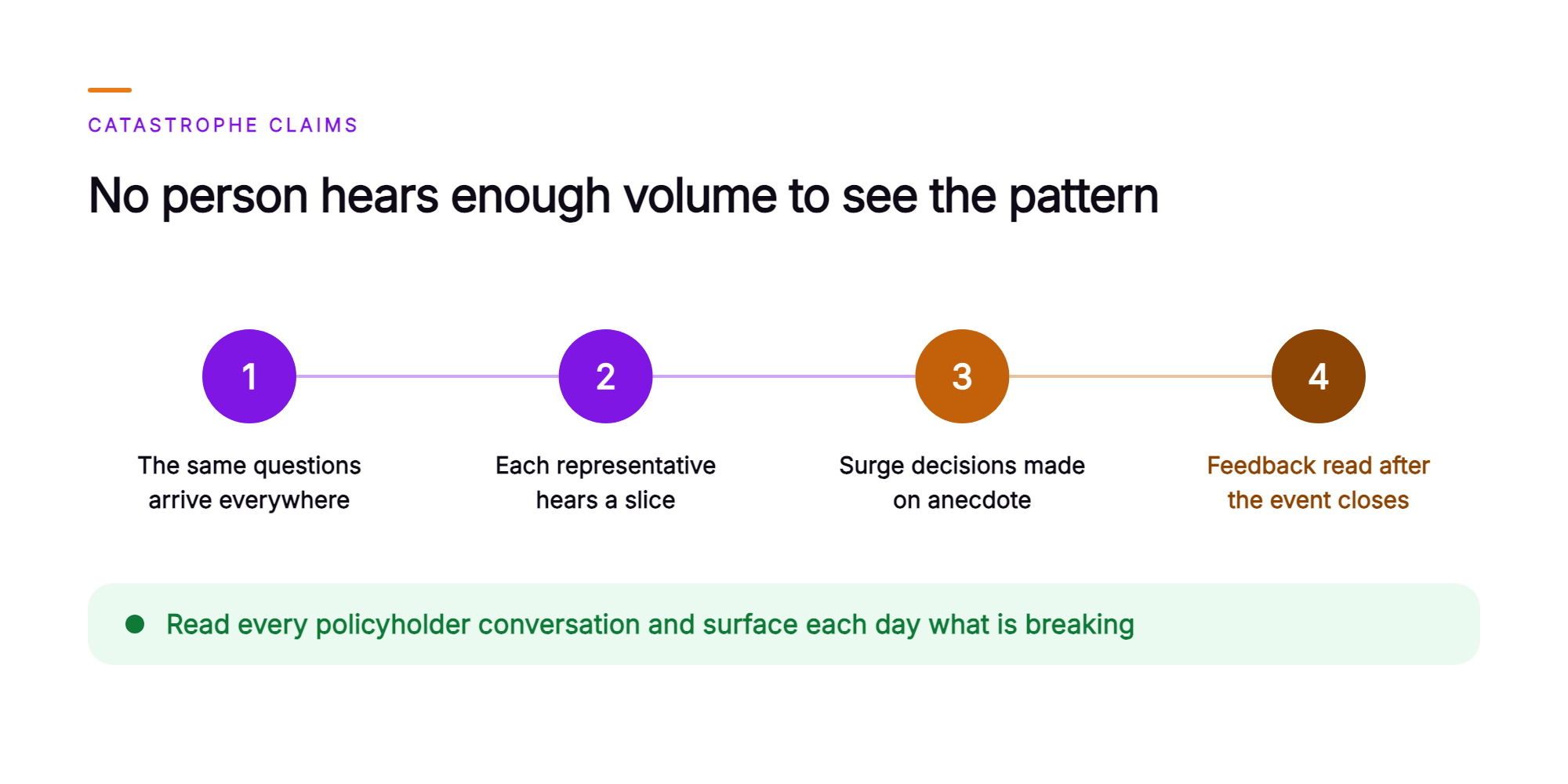
In the first days after a hurricane, hail swath, or wildfire, the same questions arrive everywhere at once. When will someone inspect the roof? Does the policy cover a hotel? Is the mitigation contractor on the approved list? What is the status of a claim filed right after the storm? Those questions land on the phone, in chat, by email, and in the claims portal, and they land at a volume the insurance claims contact center was never staffed for.
Each representative hears only a slice. One hears four callers confused about additional living expense. Another hears six asking for an inspection date. Neither has the vantage point to say which step in the response is actually failing, or where. Surge decisions get made on anecdote and queue depth.
Post-event surveys and debriefs read policyholder feedback after the event closes. By then the response being described has already ended, and the next event is already forming.
What is event-level Voice of Customer analysis for a catastrophe?
Event-level Voice of Customer analysis means reading every policyholder conversation tied to one catastrophe event and grouping it into themes, drivers, and sentiment for that event and its loss footprint.
It is a different object than a quarterly satisfaction report. A quarterly report tells a carrier how policyholders felt about claims handling in general. Event-level customer analysis tells a VP of Claims that first notice of loss calls in three ZIP codes are running long because callers cannot describe the damage without an adjuster on site, and that the theme appeared yesterday.
Three properties make the analysis event-level:
- It is scoped to one event and its loss footprint, so themes can be read by area within the footprint and by step of the claim.
- It is refreshed each day of the event, while the response can still change.
- Each theme carries the policyholder verbatims behind it, so a claims leader can read the actual sentences that produced the theme.
Themes attach to the steps of a catastrophe claim: first notice of loss, field inspection scheduling, additional living expense, mitigation vendor assignment, and claim status. That is what makes catastrophe claims analysis usable by the operations leader running the event.
What does the Voice of Customer analysis do across every policyholder conversation during the event?
The analysis reads the entire population of event conversations and reports each day on what the population shows.
Two things make that coverage real. First, the analysis reads conversations handled by Orvera's AI agents and conversations handled by human representatives, so a theme that surfaces in the human queue stays in the analysis. Second, the analysis takes in the inputs the carrier already collects: post-call surveys, complaint records, portal messages, and open-text feedback. Each input links back to the interaction behind it, so a theme is traceable to its source conversations and their transcripts.
The output is a Voice of Customer dashboard scoped to the event and refreshed each day. Each theme reaches claims leadership with the verbatims behind it and a named owner on the carrier side, whether that owner runs field operations, vendor management, or the contact center floor.
Claims leadership decides what to change. The analysis establishes what is happening and where, in time for the decision to still matter.
What does one day of the analysis look like during a hail event?
One day of the analysis looks like a short list of themes with owners attached, read by claims leadership at the daily catastrophe call.
Here is an illustration of one day of the report at a regional property carrier, four days into a hail event across a metropolitan area. The day's report flags a rising theme: policyholders who already have a claim number are calling back to ask when a field inspection will be scheduled. The theme has risen sharply compared to the previous day and concentrated in two counties on the north edge of the swath.
The drivers attached to the theme are specific. Callers received a claim number and an acknowledgment, received no inspection date, and cannot authorize a roofer to begin temporary repairs without someone seeing the damage first. The verbatims say it plainly. Policyholders are asking when a person will look at the roof so mitigation work can start, and several say a neighbor with a different carrier already has a date.
Claims leadership makes the call. The carrier shifts independent adjuster capacity into the two counties and sends a status message with an expected inspection window to every open claim in the affected ZIP codes. If the change works, the same report shows the theme falling over the following days.
That decision belonged to the claims organization. The analysis made it visible on day four, while the event was still running.
Which parts of the response does the analysis surface, and which does claims leadership decide?
The analysis surfaces what policyholders are experiencing and where, and claims leadership decides every action taken in response.
Each day the event runs, the analysis surfaces:
- Themes by event, peril, claim stage, and geographic area within the loss footprint.
- The drivers behind each theme, stated as the specific step that is failing.
- Sentiment movement day over day, so a theme that is worsening is separable from one that is resolving.
- The policyholder verbatims behind each theme, linked to the conversation, its transcript, and its summary.
Claims leadership decides:
- Claim decisions and coverage determinations.
- Reserves and payment authority.
- Adjuster assignments, independent adjuster deployment, and field capacity by area.
- Vendor and mitigation network actions.
- Every change to the catastrophe response plan, including staffing, messaging, and queue priority.
That division matters for a US property and casualty carrier under state market conduct oversight. An agentic platform reading conversations and reporting themes is an operational lens. Adjudication and every coverage decision stay with the carrier's claims organization. Full auditability means every theme links to the conversations behind it, so an internal audit team can review the source material.
Why would a carrier want the platform built and run for it?
A carrier wants the platform built and run for it because catastrophe season runs on its own calendar.
Orvera AI is an agentic AI platform for enterprise customer experience, provided as a managed service. Orvera builds, deploys, integrates, and runs it. Orvera's team carries out the onboarding, training, and change management. A full deployment goes live in three to six weeks, which fits inside the window between one season and the next.
The delivery draws on 18+ years of contact center operations heritage, which shows up in the details that matter during a surge. AI Quality Management audits every conversation, human-handled and AI-handled, across every channel, so surge traffic is audited on the same scorecards as the rest of the operation. AI Agent Assist supports the human representatives and adjusters handling the complex files, surfacing approved knowledge and the next action while the call is live. Orvera's AI agents handle repeatable policyholder conversations such as claim status and inspection confirmation, so the carrier's licensed people stay on the work that needs them.
Orvera connects to the claims, policy, and contact systems the carrier already runs through 500+ integrations. Orvera is SOC 2 Type II certified, HIPAA compliant, and GDPR compliant. One platform, adopted in stages.
Which numbers tell claims leadership the analysis is working?
Four measures tell claims leadership the analysis is working, and the carrier holds the values for all four in its own reporting.
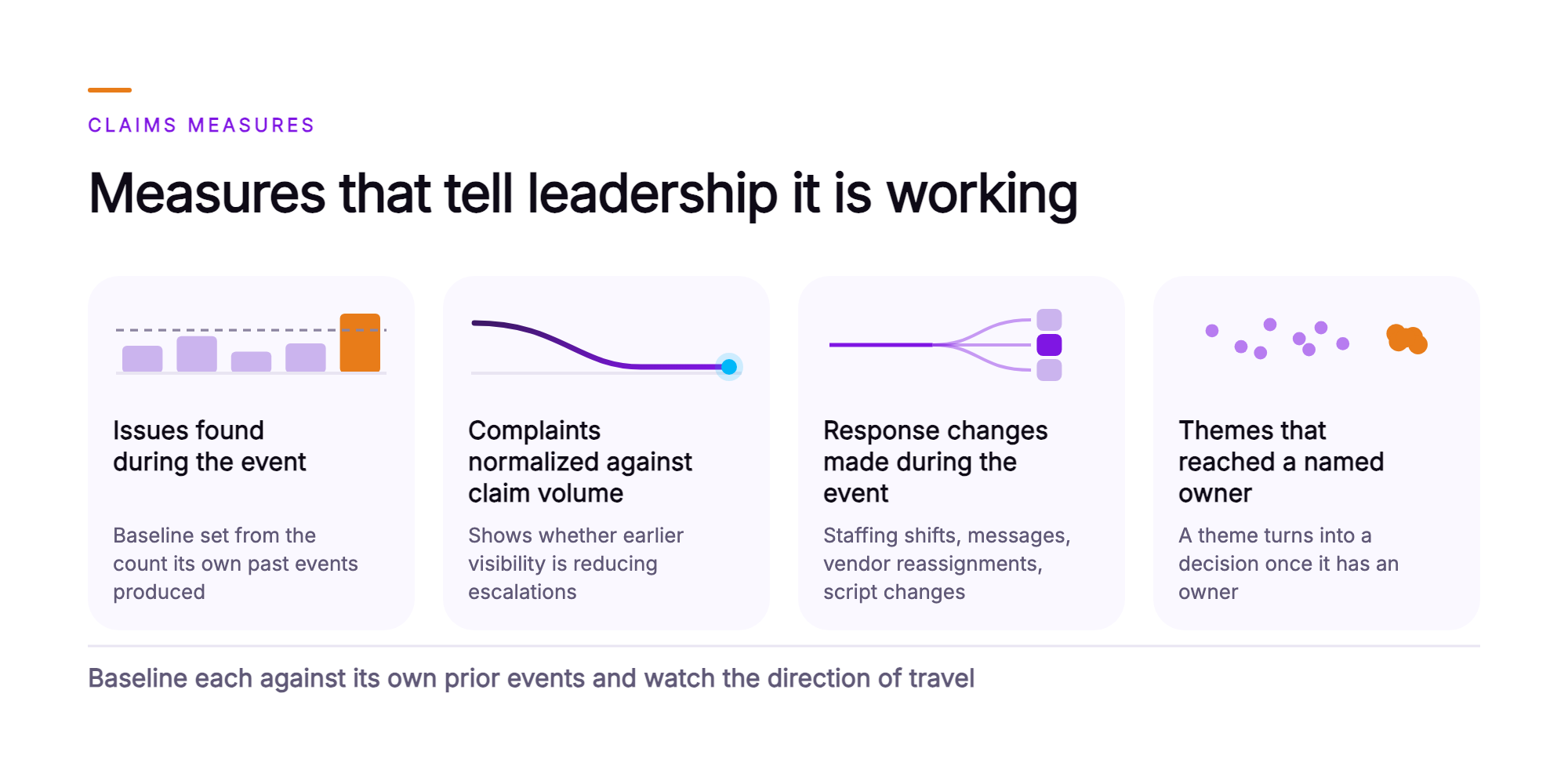
Issues found during the event. Count the distinct response problems identified while the event was still active. A carrier sets the baseline from the count its own past events produced, and tracks the movement event over event.
Complaints per thousand catastrophe claims. Normalized against claim volume, this measure shows whether earlier visibility is reducing the escalations that reach a state department of insurance. The carrier reads it from its own complaint records.
Response changes made while the event is still running. Count the staffing shifts, proactive messages, vendor reassignments, and script changes made during the event because a theme surfaced. This measure shows whether the analysis changed the response during the event.
Themes with an owner and the verbatims attached. Track the share of surfaced themes that reached a named owner on the carrier side with source conversations attached. A theme turns into a decision once it has an owner.
The carrier baselines each one against its own prior events and watches the direction of travel.
What does a head of catastrophe claims take to the leadership team?
A head of catastrophe claims takes four statements that each stand on their own in an executive room.
- During an active event, the analysis reads every policyholder conversation tied to that event across voice, chat, email, and digital channels, including conversations handled by human representatives and by AI agents.
- Themes reach claims leadership each day the event is running, in time to change the response.
- Claims leadership decides every change to the response, including adjuster deployment, coverage determinations, reserves, and policyholder messaging.
- Every theme traces back to the specific policyholder conversations behind it, so any finding can be verified or challenged on the source material.
Those four statements answer the questions a CEO, a chief claims officer, and a general counsel ask about a platform touching catastrophe response. They address coverage, timing, decision authority, and auditability, and the leadership team can check each one against the carrier's own records.
What does a catastrophe response look like once the analysis runs on every event?
Once the analysis runs on every event, the catastrophe response becomes something claims leadership can steer while it is happening.
Each day of the event, claims leadership reads the latest themes, the drivers behind them, the sentiment movement, and the verbatims attached. Decisions follow. Capacity moves to the counties where inspection delay is generating callbacks. A proactive message goes to the claims where confusion about additional living expense is driving repeat contact. The next day's themes show whether it worked.
After the event closes, the carrier reviews it against the full record: every theme that surfaced, when it surfaced, the owner it reached, and the verbatims behind it. Claims leadership carries that record into the next catastrophe response plan, so the lessons of one event shape the plan for the next.
If your team is planning for the next catastrophe season, talk to the team (opens in a new tab) about what event-level analysis would look like on the claims and contact systems you already run.
Frequently asked questions
Event-level Voice of Customer gives claims leadership, each day the catastrophe is active, the themes, sentiment drivers, and policyholder verbatims that reveal where the response is breaking down. A carrier working a hurricane or wildfire event will see themes surface each day: inspection scheduling delays, claim status callback requests, confusion about temporary housing coverage limits, and questions about emergency advance payments. Those themes come with the actual language policyholders used when they called the catastrophe claims contact center, which gives leadership the context to act on evidence. Claims leadership reads those themes to decide what changes in the response: which FAQs the AI agents need, where human rep queues require reinforcement, and how to staff the claims contact center across shifts. Orvera AI's Voice of Customer feeds that decision loop daily, so claims leadership can tighten the response as the event progresses.
Orvera's Voice of Customer analysis reads every policyholder conversation across voice, chat, email, and digital channels, whether an AI agent or a human rep handled it. Every interaction is analyzed, from the first contact of the event to the last. The analysis covers the full contact volume reaching the catastrophe claims contact center, whether the event is hail, hurricane, flood, or wildfire. The analysis also reads the surveys, complaint records, and open-text feedback your carrier already collects, and it links each piece of feedback to the specific interaction behind it. That connection lets claims leadership see what policyholders said after the call alongside what happened during it.
Claims leadership sees a fresh set of themes, sentiment, and policyholder verbatims every day while the loss event is active. When a theme surfaces on Monday, such as policyholders misreading their temporary housing benefit, claims leadership can decide on Tuesday to adjust messaging, correct the information the AI agents give, and reinforce the right human rep queues. The response changes while the event is still running. Each day you read what the catastrophe claims contact center heard the day before, and you choose what changes in the response.
Claims leadership decides. The Voice of Customer analysis is the source of themes and policyholder verbatims that leadership reads before making those calls. Claim decisions, coverage determinations, reserve adjustments, adjuster assignments, and updates to the catastrophe response plan belong to the carrier. Claims leadership makes each of those decisions. What Orvera AI provides is the operational picture: the themes surfacing across the insurance claims contact center, the sentiment behind them, and the exact language policyholders used. Claims leadership reads the analysis and decides what changes.
Each theme in Orvera's Voice of Customer carries the policyholder verbatims behind it and links directly to the individual interactions that produced them. A claims leader can open any theme and read what policyholders said, word for word. Behind each verbatim sits the transcript and a plain-language summary of that specific conversation, whether an AI agent or a human rep handled it. That connection answers operational questions from the conversations themselves. To see why policyholders abandon claims calls during a surge, a claims leader reads the verbatims of policyholders who called back after giving up on an earlier attempt. The connection between theme and source interaction also keeps the analysis auditable. Claims leadership acts on evidence it can read and verify.
Orvera AI connects Voice of Customer analysis directly to the claims, policy, and contact systems your carrier already runs, through 500+ integrations. That connection lets each theme reach its owner on the carrier side with the policyholder verbatims attached. Orvera's AI agents handle policyholder conversations such as first notice of loss intake, claim status, and inspection confirmation. Complex files go to the carrier's licensed adjusters and human representatives with a full summary attached, and every claim decision stays with the carrier's licensed people. If a system your carrier runs is not in the integration directory, Orvera builds the connection during deployment. The full platform goes live in three to six weeks, and Orvera runs it as a managed service throughout. Your teams read the analysis. Orvera manages the infrastructure behind it. To see what event-level analysis would look like on your systems, talk to the team.

Written by
Anindita Majumder
Anindita Majumder is a communications professional with nearly four years of experience in public relations, corporate communications, and journalism. She creates content that helps brands communicate their vision, products, and expertise through press releases, thought leadership, and editorial pieces. Outside of work, she is a vocalist, which keeps her creativity flowing.


