How to Scale Personal Auto FNOL Intake Without Adding Seats
Personal auto FNOL intake is hard to staff because the call is structurally long, demand arrives in spikes, and a floor built for average volume has...

Key highlights
TL;DR - How to Scale Personal Auto FNOL Intake Without Adding Seats
- Personal auto FNOL intake is hard to staff because the call is structurally long, demand arrives in spikes, and a floor built for average volume has no answer for a catastrophe day.
- A personal auto FNOL call today runs through six discrete steps in sequence, and each one exists for a reason that cannot be removed by asking reps to move faster.
- An AI voice agent resolves the full FNOL transaction from greeting to resolution on a single-vehicle no-injury first-party loss, without a human rep touching the call.
- A conversational AI voice agent captures every structured field an adjuster needs to open and assign a personal auto loss, writing each value directly into the claim system before a human touches the file.
- An AI voice agent platform resolves a single-vehicle, no-injury, first-party personal auto loss from greeting to resolution, and every other loss type belongs with a person.
- An AI voice agent platform holds up during a catastrophe event because intake demand arrives in hours while hiring, licensing, and training cycles take weeks.
- Automated FNOL intake moves two metrics before anything else changes: claims opened per hour and minutes to claim number.
- Automated FNOL intake is governed through 100% conversation auditing, structured data writing into the claim system of record, and a SOC 2 Type II certified operating environment.
- A claims leader should evaluate an AI voice agent for FNOL intake on four tests, applied before any contract conversation begins.
Why is personal auto FNOL intake so hard to staff at the volume it arrives?
Personal auto FNOL intake is hard to staff because the call is structurally long, demand arrives in spikes, and a floor built for average volume has no answer for a catastrophe day.
A single first notice of loss call moves through authentication, policy confirmation, claim opening, and full loss detail capture before a rep can close out. Each step requires the rep to pull from a different system. The policy administration system confirms coverage and effective dates. The claims management system accepts the new claim and returns the claim number. ISO ClaimSearch gets its submission. None of those lookups happen instantly, and a rep who pauses to wait on a screen response remains on the call. The intake sequence cannot be shortened by speeding up the conversation.
Intake volume does not arrive on a schedule. A hailstorm that tracks across three counties or a multi-day winter weather event pushes a week of inbound demand into 48 hours. A floor staffed to handle a Tuesday afternoon in April will queue a Friday after a storm. Hold time lands on a policyholder who has just had a collision, whose vehicle may be undrivable, and who is waiting on a claim number before they can authorize a tow or open a rental. Minutes to claim number stretch exactly when the policyholder can least absorb them.
That is the structural case for an ai voice agent for fnol intake. The call sequence is structured enough to operate without a human rep on every contact. The next section details that sequence step by step.
What happens on a personal auto FNOL call today, step by step?
A personal auto FNOL call today runs through six discrete steps in sequence, and each one exists for a reason that cannot be removed by asking reps to move faster.
Authentication opens the call. The rep asks for a policy number or verifies the caller against a phone match in the policy system. This step is not a formality. It gates every downstream action, and a failed match means the rep works through a secondary verification flow before a single claim detail is captured.
Coverage confirmation follows. The rep pulls the policy record, checks effective dates, and confirms the vehicle is listed. A lapsed policy or a coverage gap discovered here stops the intake entirely. The rep must read the screen, not from memory, because errors at this step create claim disputes later.
Claim record creation comes next. The rep opens a new claim in the claim system, assigns a date of loss, and logs the reported loss cause. This is the first point where automated auto insurance claims reporting could change the work, but today a human rep enters every field manually.
Loss detail capture is where the call stretches longest. The rep collects contact information for all parties, vehicle identification, damage description, police report status, and injury indicators. Each field is a question, and any ambiguous answer generates a follow-up question.
ISO ClaimSearch submission runs while the rep is still on the call or immediately after. The step exists to surface prior claims on the same vehicle or the same named insured. Waiting on the return adds system-dependent pause time that the rep cannot compress.
Segmentation closes the intake. The rep reviews the collected detail and assigns the claim to the appropriate handling path, a straight-through settlement queue, a field inspection, or a special investigations unit referral. The decision requires judgment, and it requires all prior fields to be accurate.
The pattern across every step is the same. The rep asks, the system responds, the rep reads and enters, and the call pauses on each cycle. The next question is whether an AI voice agent can run that same sequence without the pauses.
What does an AI voice agent do differently on the same inbound loss report?
An AI voice agent resolves the full FNOL transaction from greeting to resolution on a single-vehicle no-injury first-party loss, without a human rep touching the call.
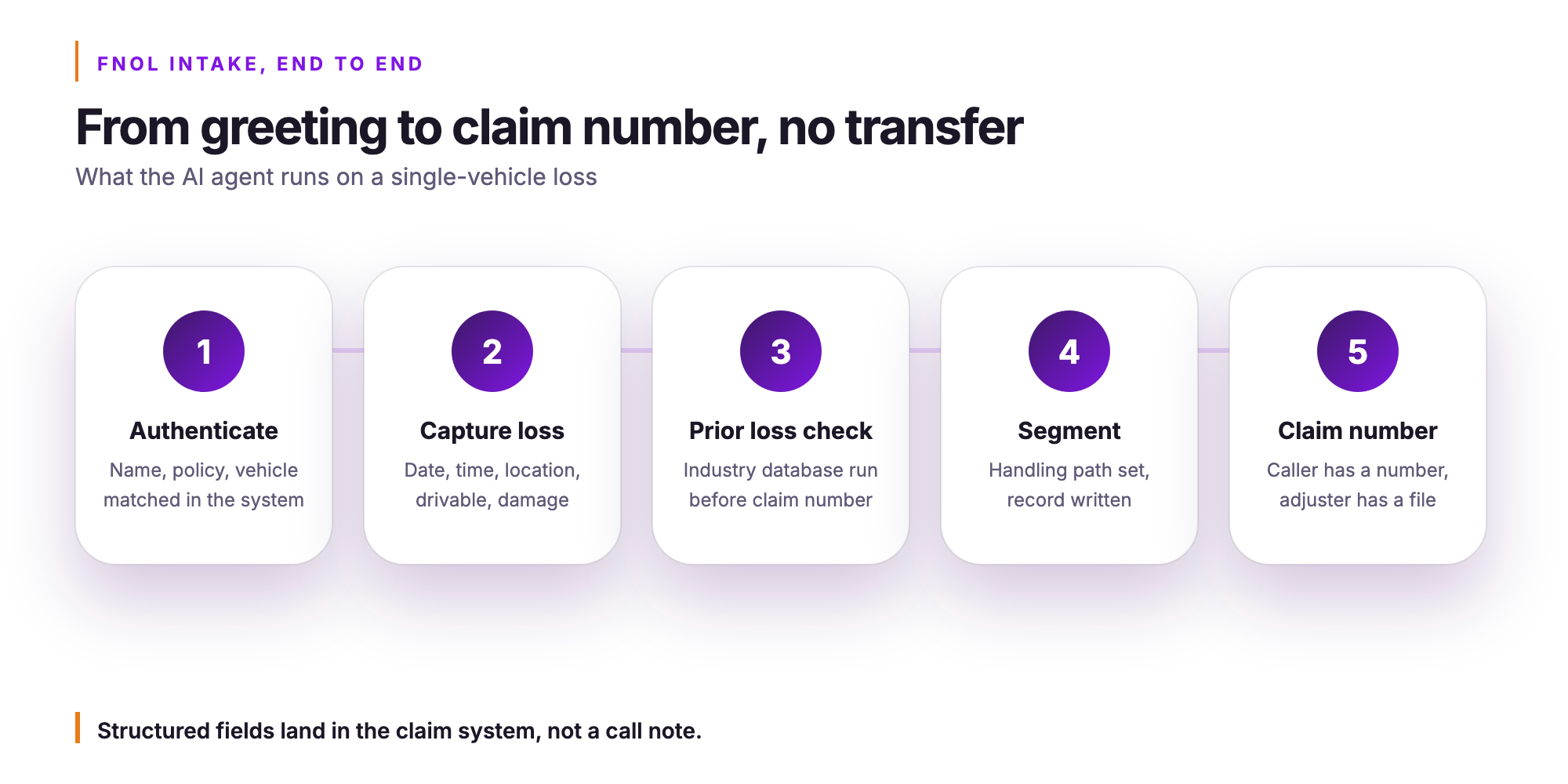
The call arrives, and Orvera AI answers. Authentication runs first. The AI agent confirms the caller's identity against the carrier's policy administration system, matching name, policy number, and vehicle before a single loss detail is collected. That step matters because a claim written against the wrong policy is not a minor error. It creates a correction cycle that can run for days.
Once authenticated, the AI agent captures the structured loss record in sequence. Loss date, time, location, drivable status, and damage description move directly into the carrier's claim management system as discrete fields, not as an unstructured note an adjuster has to read and re-key later. That distinction is the core value of claims processing automation. The record is clean and structured the moment the call ends. Orvera then runs the same ISO ClaimSearch submission step a human rep would run, checking for prior related losses against the industry database before the claim number is written.
The claim segment is determined, the record is written, and the call concludes. The caller has a claim number. The adjuster has a complete, structured file. Nothing transfers to a queue.
This is resolution. Orvera AI finishes the call with a claim number issued. It works inside the systems your team already runs, and it produces the same downstream output a rep would produce. The difference is that it produces it on every call, without a seat added to the floor. The next question is exactly which data fields that structured record contains, and why each one matters to the adjuster who picks up the file.
Which loss details does the AI capture before the claim record is written?
A conversational AI voice agent captures every structured field an adjuster needs to open and assign a personal auto loss, writing each value directly into the claim system before a human touches the file.
The fields collected are not merely a compressed summary. They are the discrete data points that drive reserve calculation, vendor dispatch, and coverage verification. When any one arrives blank, vague, or miskeyed from an unstructured call note, the adjuster stops working the claim and starts correcting the intake. That delay costs time and, on a CAT day, compounds across hundreds of files simultaneously.
- Loss date. Sets the policy period the carrier must verify. A wrong date triggers a coverage gap review that stalls every downstream step.
- Loss time. Establishes sequence of events for liability analysis. Missing time makes an ISO ClaimSearch cross-reference ambiguous.
- Loss location. Drives tow and appraisal vendor assignment by geography. A vague location means a dispatcher calls back, adding handle time.
- Vehicle identification (year, make, model, VIN). Required to pull the valuation and confirm the vehicle is on the active policy. A mismatched VIN reopens underwriting.
- Drivable status. Determines whether a tow is dispatched immediately and whether a rental is authorized that day. Blank means a second call.
- Injuries reported. Changes the reserve category and the duty owed. Any positive response routes the file before the record is written.
- Other party information. Required for subrogation and liability split. Absent data delays third-party contact by days.
- Witness information. Supports liability determination. Lost at intake, it is rarely recovered.
Every value writes to the claim system as a structured field, not a paragraph a rep re-keys from a call note. The record is complete and assignable the moment the call ends. The next section defines exactly which calls that workflow applies to and which ones belong with a person.
Which FNOL calls should the AI finish, and which ones belong with a person?
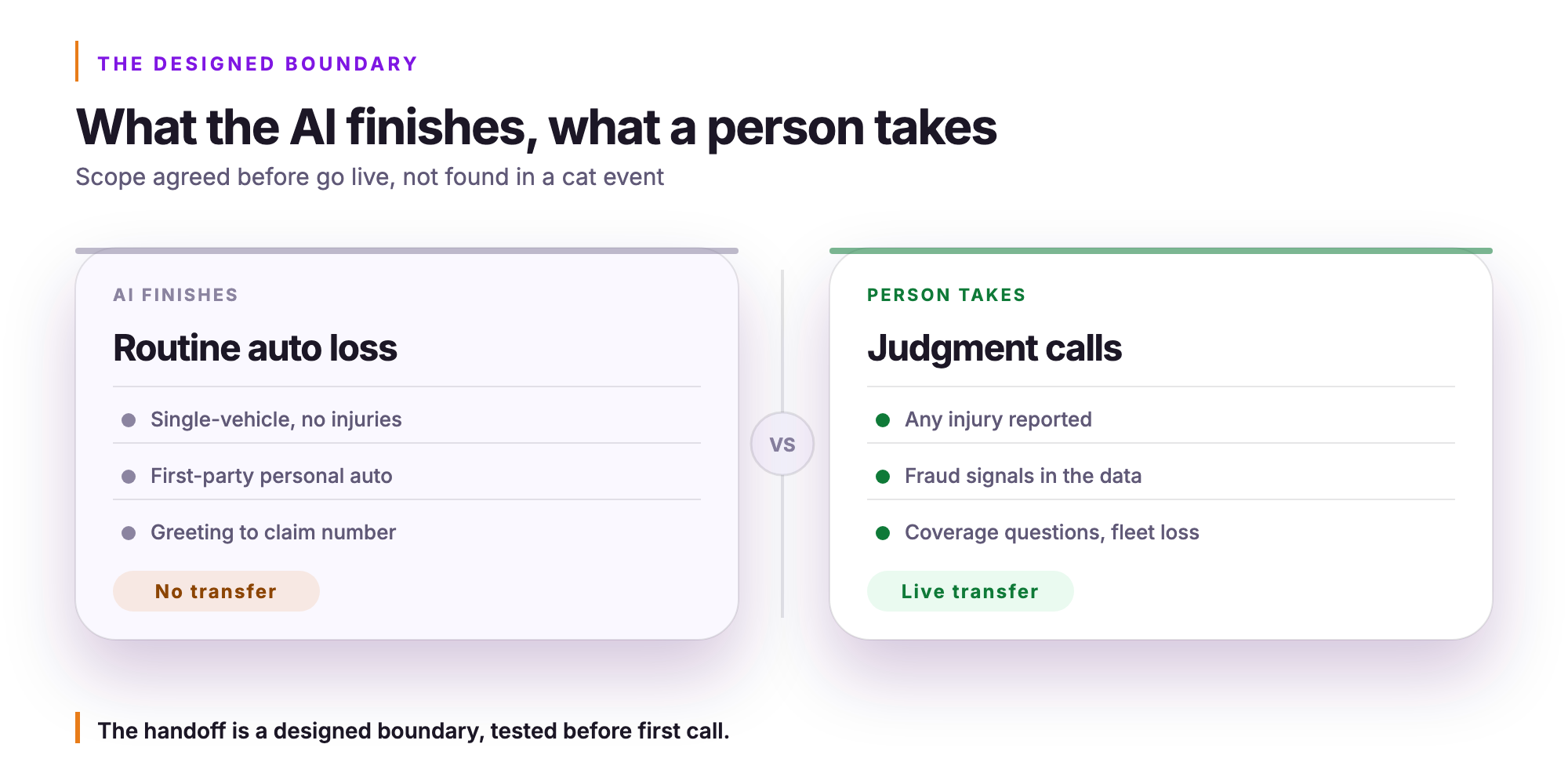
Orvera AI's agentic platform resolves a single-vehicle, no-injury, first-party personal auto loss from greeting to resolution, and every other loss type belongs with a person.
That boundary is not a limitation to apologize for. It is a designed scope, agreed before go live, that protects the carrier from the four situations where a wrong decision costs more than the intake call was ever worth.
The moment a caller reports any bodily harm, the AI transfers the call. A rep takes over. The reserve and the coverage obligation are not decisions an automated channel should hold.
Fraud indicators surface in the intake data and in the ISO ClaimSearch return. A trained examiner reads those signals. A pattern in the reported facts, a mismatch in prior loss history, a vehicle location that does not fit the narrative. Those signals require judgment, not a structured data capture.
Coverage questions are carrier decisions. Whether a lapse applies, whether an exclusion binds, whether a rider changes the outcome. Those answers carry legal weight and they belong to a person with authority.
Commercial or fleet exposure sits on a different policy form with different limits, different endorsements, and different reserve logic. Routing it through a personal auto intake path creates errors that compound downstream.
And the handoff in every one of these cases is a designed boundary, not a failure. The escalation path is defined, tested, and agreed by the claims leadership team before the first call goes live.
How does an AI voice agent hold up when a catastrophe event spikes call volume?
An AI voice agent platform holds up during a catastrophe event because intake demand arrives in hours while hiring, licensing, and training cycles take weeks.
The shape of the problem is familiar to every VP of Claims Operations who has staffed through a hail corridor or a major weather event. Inbound volume climbs steeply within the first day. The floor that was sized for average daily demand cannot absorb that spike without overtime, mandatory callback queues, or an overflow vendor standing by. Those answers cost more and they still produce longer wait times and stretched minutes to claim number. The experienced staff who could be triaging complex losses are instead answering single-vehicle, no-injury, first-party calls that follow a completely predictable intake path.
What changes when voice AI for call centers covers that predictable intake lane is a reallocation of human judgment, not a replacement of it. The AI voice agent greets the caller, confirms coverage, captures the loss location and vehicle details, documents weather conditions, collects the field that flags tow and rental needs, and opens the claim record in the claims management system. That work does not require a licensed adjuster. And because that intake lane is no longer gated by how many reps are on shift, callers on routine losses reach a claim number faster.
Your experienced staff move to the calls that genuinely need judgment. Complex injuries, coverage disputes, represented claimants, and policy questions that fall outside the documented intake path stay with the people who are qualified to handle them. The catastrophe plan does not disappear. The AI changes who answers the routine lane during one, which is a meaningful operational shift even before any downstream metric moves.
Which claims metrics actually move when FNOL intake is automated?
Automated FNOL intake moves two metrics before anything else changes: claims opened per hour and minutes to claim number.
The platform is engineered to handle substantial capacity without throttling, so intake throughput is not set by how many seats are staffed that hour. A floor sized for average daily volume processes a catastrophe spike without a corresponding headcount addition, and the count of claims opened in any given hour reflects actual inbound demand rather than available capacity.
Minutes to claim number falls for the same reason, and the downstream effect compounds quickly. A claim number issued in fewer minutes means the segment is set sooner. The assignment reaches an adjuster sooner. And the vehicle moves sooner, which reduces rental exposure and controls cycle time before the first human decision is made. That sequence is where shortened intake time converts into measurable claims outcome improvement, not just a faster phone call.
Average handle time follows. Across Orvera AI's own customer engagements, average handle time falls 8% to 15% in the first 90 days with Agent Assist supporting the human-handled calls that remain. First-contact resolution runs around 80% across those same engagements. Both figures describe averages, not guarantees, and both are drawn from Orvera AI deployments, not from external benchmarks.
The metrics connect to one another. A shorter handle time on AI-resolved calls frees rep capacity for the complex losses that require judgment. A higher first-contact resolution rate reduces the callback volume that stretches your queue the following day. And 100% of conversations, human-handled and AI-handled alike, are audited, so you are not managing these metrics from a sampled view. That audit coverage matters when a claims leader needs to explain a trend, not just report one. The governance picture behind those numbers is worth examining on its own terms.
How is an automated FNOL intake governed and audited?
Automated FNOL intake is governed through 100% conversation auditing, structured data writing into the claim system of record, and a SOC 2 Type II certified operating environment. Most claims operations review a sampled slice of recorded calls, which means a material portion of intake activity is never inspected at all. Orvera AI audits every conversation, AI-handled and human-handled alike, closing that gap before a regulator or an internal audit team surfaces it.
What a claims leader can inspect after the fact is specific and complete. The transcript and AI-generated summary of every intake call are retained and searchable. The structured claim record written directly into the claim system, whether that is Guidewire ClaimCenter, Duck Creek Claims, or Majesco, reflects exactly what the caller reported, field by field, not a call note that requires a rep to interpret later. The escalation boundary is the third inspectable artifact. The record captures the exact moment the AI agent transferred the call to a human rep, including the trigger condition, so a supervisor can verify that the boundary held.
SOC 2 Type II certification governs the platform environment where that data lives and moves. No personal auto FNOL intake system should be evaluated without reviewing the audit controls that cover data handling from the moment a caller connects through the point where the claim record is written. Personal auto loss reporting sits under state insurance regulations that vary by jurisdiction. Orvera does not position a single compliance claim as a substitute for a carrier's own regulatory review, and that restraint is itself an audit point worth noting.
The combination of complete coverage audit, structured output, and a verifiable escalation log is what distinguishes a governed AI voice agent platform from a recording system with a transcript attached. Before a claims leader can evaluate which vendor meets that standard, they need a consistent set of tests to apply.
How should a claims leader evaluate an AI voice agent for FNOL intake?
A claims leader should evaluate an AI voice agent for FNOL intake on four tests, applied before any contract conversation begins.
The vendor space is full of carriers who deployed a voice AI and found it handled simple address confirmations but stalled on total-loss disclosures, uninsured motorist losses, and multi-vehicle contacts. Four tests separate a system that resolves from one that merely collects.
- Will the vendor name the exact loss types it closes from greeting to claim number? Not a category, not a channel, not a demo environment. Specific loss types: single-vehicle collision, glass only, hit-and-run with a police report number, rental initiation on a comprehensive contact. If the answer is a slide, the system is not ready for your intake mix.
- Does it write structured data into the claim system of record, or does it drop a call note? Structured fields in Guidewire ClaimCenter, Majesco, or Duck Creek move directly into adjuster workflow. A call note goes nowhere without a person reading it first.
- Is the escalation boundary written before go live? The conditions that hand a contact to a human rep need to be defined, documented, and auditable, not discovered during a cat event.
- Is every call auditable after the fact? 100% conversation auditing is the standard. A sampled audit does not hold up in a coverage dispute or a state DOI inquiry.
Full enterprise deployment lands in three to six weeks. The right next step is a conversation about your carrier's own intake volume and loss mix.
Frequently asked questions
Personal auto FNOL automation means the caller reaches the claims line, completes intake, and hangs up with a claim number, all without waiting for a licensed human to become available.
Four exception types always route to a licensed human rep, every time, without exception. No tuning preference governs them.
An IVR only routes a call. Automated insurance claims intake resolves it, and the difference determines whether a claim number exists when the caller hangs up.
Ensuring compliance in automated FNOL involves four controls: knowledge grounding, full auditability, certified security posture, and a governance layer that sits above the models.
Agentic AI for claims processing moves two numbers this floor owns: claims opened per hour without adding seats, and minutes from call answered to claim number issued.
Before any claims leader checklist for AI adoption clears a pilot, four questions separate a vendor who has run a claims floor from one who has only described one.

Written by
Anindita Majumder
Anindita Majumder is a communications professional with nearly four years of experience in public relations, corporate communications, and journalism. She creates content that helps brands communicate their vision, products, and expertise through press releases, thought leadership, and editorial pieces. Outside of work, she is a vocalist, which keeps her creativity flowing.