Why Patient Access Leaders Are Moving Beyond Callbacks to Booked Appointments
New patient calls get lost because the access team cannot answer every call the moment it arrives, and a caller who waits too long hangs up and calls somewhere else. This post explains how AI voice agents turn those calls into booked appointments.

Key highlights
Why Patient Access Leaders Are Moving Beyond Callbacks to Booked Appointments
- New patient calls get lost because the access team cannot answer every call the moment it arrives, and a caller who waits too long simply hangs up and calls somewhere else.
- An unanswered new patient call is an access failure. The appointment was never at risk of being lost to a process. It was lost because no one picked up.
- Taking a message does not book an appointment, and a callback that arrives hours later finds a caller who has already chosen another provider.
- An AI voice agent can answer a new patient call, apply your scheduling protocol, search live availability, book the appointment and record it in the EHR, without a human rep involved in any step.
- An AI voice agent follows your scheduling protocol because the rules loaded into it are your rules, configured from the logic your access team already runs.
- An AI voice agent connects to the EHR your access team already works in, so the booking lands in the same record your staff opens every morning without any manual re-entry.
- An AI voice agent for patient access is secure and compliant when the vendor behind it carries the governance credentials your legal and compliance teams will ask for before any deployment moves forward.
- Health systems choose a managed service over software alone because a patient access operation runs every day, and someone has to own it after go live.
- Patient access measures whether an AI voice agent is working by reading the same operational signals it has always tracked, before and after the change, using its own systems as the source of truth.
Why do new patient calls get lost before an appointment is booked?
New patient calls get lost because the access team cannot answer every call the moment it arrives, and a caller who waits too long simply hangs up and calls somewhere else.
Monday morning inside a private health system looks the same across most multi-site provider groups. The queue fills faster than the access team can work it. Representatives are finishing Friday's callback list, handling insurance questions from existing patients, and fielding referral calls, all while new patient lines ring unanswered. The longest waits end in a hang-up. That caller is gone before a scheduler ever knew they were there.
An unanswered new patient call is an access failure. The appointment was never at risk of being lost to a process. It was lost because no one picked up.
Your access team already measures this on two numbers: appointments booked per 100 calls, and call abandonment against your own sub-5% target. Both tell the same story in different directions. When abandonment climbs, booked appointments per 100 calls falls. Increasing staffing has flattened the curve, but it has not moved either number to where the organization needs it. That is where healthcare voice agent scheduling (opens in a new tab) enters the picture. A caller who does not reach a person books with whoever answers first, and in a competitive private provider market, that is rarely a second chance.
Why is taking a message and calling back no longer enough?
Taking a message does not book an appointment, and a callback that arrives hours later finds a caller who has already chosen another provider.
The callback loop is familiar to every patient access leader. A call arrives, the queue is full, a message is logged. A staff member works through that list later in the day, dials back, and then restarts the entire scheduling conversation from the beginning. Two contacts are consumed to do what one should have finished. And if the patient does not answer the return call, the cycle starts again.
“The only measure that matters on a new patient call is whether an appointment was booked before the caller hung up.”
The patient side of this exchange looks different. Someone choosing a new provider is not evaluating your callback process. They are evaluating availability right now, in that moment. If the answer is "we will call you back," many callers treat that as a signal to try the next provider on their list. An ai patient access center that resolves the call the first time removes that decision point entirely. Booking the appointment on the first call (opens in a new tab) is not an operational preference. It is the difference between a new patient relationship and a lost one.
What can an AI voice agent actually complete on a new patient call?
That is the difference between answering a call and finishing it. Patient scheduling automation in healthcare has, for years, stopped at the answer. The call gets picked up, information gets collected, and the actual booking happens somewhere else, by someone else, later. What a fully capable AI voice agent does is close that gap inside the original call.
Walk through what that looks like in practice. The agent answers with a natural-sounding greeting personalized to the caller's history where it exists. It confirms who is on the line. It then applies your organization's own rules, the visit types your access team has defined, the provider preferences you have set, the specialty routing your protocol requires. Those rules are yours. The agent applies them as written. It searches live availability inside your EHR, presents options, and takes the caller's selection. The appointment is written back to the schedule before the call ends.
And that final step is the one that matters. A call ending without a booked appointment is an incomplete transaction, regardless of how well the interaction sounded. Orvera AI is a managed agentic AI platform for enterprise customer experience, resolving across voice, chat, email and every other channel your callers reach, and voice inbound is one layer of it. The capability described here works alongside Agent Assist and quality intelligence, because the goal is resolution across every surface your callers reach.
How does an AI voice agent follow our own scheduling protocol?
An AI voice agent follows your scheduling protocol because the rules loaded into it are your rules, configured from the logic your access team already runs.
The protocol belongs to your health system. Orvera AI applies your scheduling logic as written. Provider preferences, visit type definitions, specialty-specific prerequisites, and slot-release rules all originate from your operations team and are applied by the AI agent exactly as written. What an ai call center for healthcare providers must avoid is the common failure of imposing a generic scheduling sequence over the top of a protocol that took years to build. Orvera AI applies the protocol your team built, exactly as written.
The kinds of rules a patient access team typically hands over include:
- Provider preference rules, such as new-patient visit types restricted to specific days or session blocks
- Specialty routing logic that determines which visit type a caller qualifies for before a slot is offered
- Prerequisite steps, such as confirming a referral is on file before a specialist appointment is released
- Slot-release sequences tied to capacity thresholds your scheduling manager controls
- Location and care-site rules that route callers to the correct facility within a multi-site network
Orvera custom-trains its own contextualization models on de-identified data so that the agent reads caller intent accurately enough to apply the right rule at the right step. The training adapts to your vocabulary, your visit-type names, and the way your callers describe what they need. And because the protocol itself stays under your control, your scheduling managers can update a rule without waiting on a vendor change request.
How does an AI voice agent fit with the EHR we already run?
An AI voice agent connects to the EHR your access team already works in, so the booking lands in the same record your staff opens every morning without any manual re-entry.
Your protocol is already configured inside the AI agent, as covered in the previous section. The integration layer is where that protocol meets your live schedule. Orvera maintains a connector directory of more than 500 integrations, and the major EHR systems used by US private health systems sit inside it. Systems such as Epic and athenahealth are examples of what that directory includes. Orvera connects to them as systems, and the connection is operational from the first call.
What that means in practice is straightforward. When a new patient completes a call that was handled by the AI agent, the appointment lands in the record the access team already works from. No parallel tool, no workaround queue, no reconciliation step at the end of the day. The team sees the booking the same way it sees every other scheduled appointment.
For patient access leaders evaluating new patient appointment scheduling software, the integration question usually surfaces early and correctly so. A scheduling capability that sits outside your EHR creates a data gap your staff will close manually. Orvera's connector directory is designed to eliminate that gap from the start.
Is an AI voice agent for patient access secure and compliant?
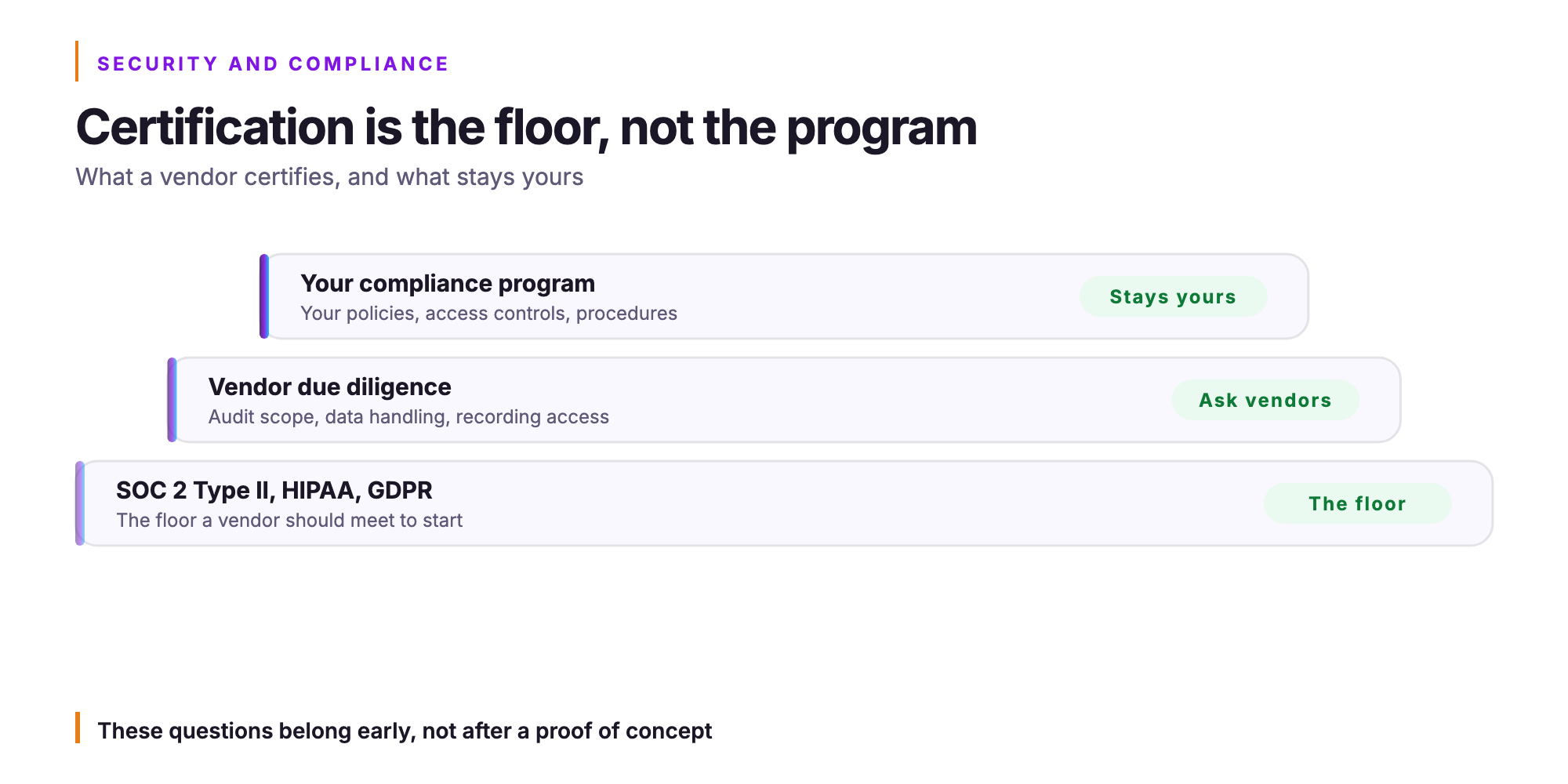
Orvera AI is SOC 2 Type II certified, HIPAA compliant, and GDPR compliant. Those three positions define the floor any healthcare contact center AI vendor should meet before a conversation about patient scheduling begins.
Certification, however, is not the same as a compliance program. Your own policies, access controls, and operational procedures determine whether your program meets the standards your organization is held to. A vendor's certification list is a starting point for due diligence, not a substitute for it.
When your compliance and IT teams evaluate any AI voice agent for patient scheduling, the governance questions worth putting to every vendor include:
- What third-party audit covers your security controls, and how recent is the report?
- Which regulatory regimes does your program address, and what documentation supports each position?
- How does your model training process handle patient data, and what de-identification practices govern that process?
- Who retains access to recorded conversations, and what controls limit that access?
- How are your connector integrations governed when data moves between your platform and our EHR?
Those questions belong early in the evaluation, not after a proof of concept. The vendor answers determine whether the conversation continues.
Why do health systems choose a managed service over software alone?
Health systems choose a managed service over software alone because a patient access operation runs every day, and someone has to own it after go live.
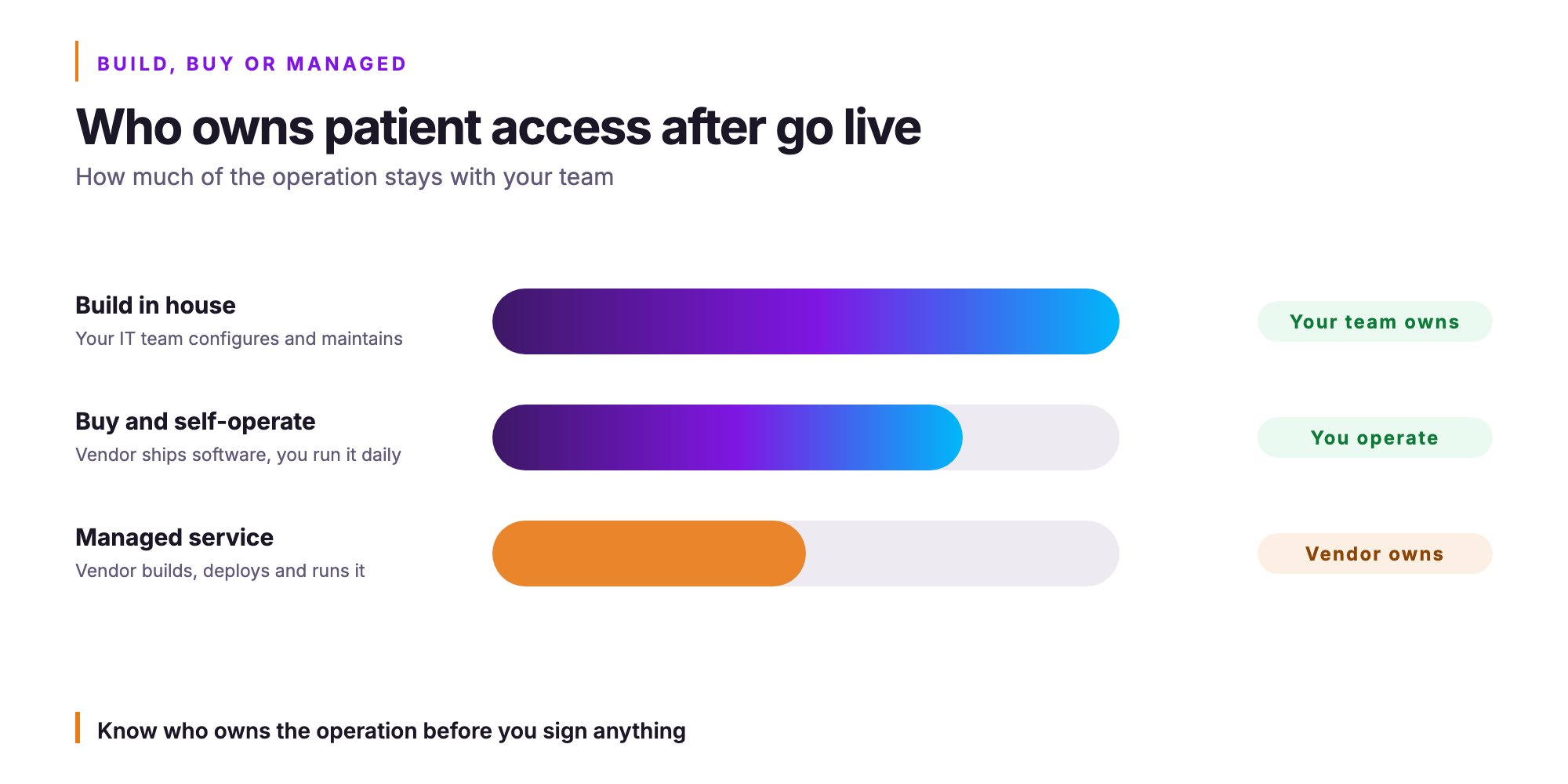
The real decision a Director of Patient Access faces is not which platform to license. It is who holds accountability from the moment the first caller dials in. That question takes three distinct shapes.
Build. Your IT team configures, trains, and maintains the AI voice agent on your own infrastructure. Your analysts tune the scheduling logic. Your supervisors field the edge cases. The upside is direct control. The downside is that the work lands on a team already managing an EHR, a workforce management system, and a queue that does not pause while configuration happens.
Buy and self-operate. You license a platform and staff the operation yourself. The vendor delivers software. Interpretation, refinement, and daily governance stay with your team. That works when you have the internal expertise and the bandwidth. In practice, new patient scheduling queues rarely have either to spare.
Managed service. The vendor builds, deploys, and runs the operation. Orvera AI, based in San Francisco and carrying 18+ years of operational heritage running customer experience operations, takes that ownership position. The AI agent is configured, monitored, and refined by a team that has stood on the floor, not described it from outside.
The day after go live, that distinction is concrete. Someone has to read the data, tune the conversation design, and decide what the AI agent does next when call patterns shift. Knowing who that is before you sign anything is the most important structural question in the evaluation. The next question is how you will measure whether the answer was right.
How should patient access measure whether an AI voice agent is working?
Patient access measures whether an AI voice agent is working by reading the same operational signals it has always tracked, before and after the change, using its own systems as the source of truth.
The measures that matter are already inside your scheduling platform and your telephony reporting. No new instrumentation is required to form a judgment. What changes is that you establish a clean baseline before the AI voice agent handles a single new patient call, then watch the same numbers move.
The measures worth tracking include:
- Appointments booked per 100 inbound new patient calls
- Abandonment rate against your own stated goal
- The share of new patient scheduling calls resolved on the first contact, without a callback or transfer to complete the booking
- Queue depth at peak hours, measured from your own telephony data
- The volume of new patient calls that reach a human rep, and why
These are measures your health system reads out of its own systems. They are not results Orvera AI promises, and no target is embedded in the list above. How far those numbers move, and whether the direction holds, is a question your data answers. Knowing which signals to instrument before go-live is the practical starting point, and the next question is how the deployment itself unfolds in a live patient access operation.
How do we bring an AI voice agent into a live patient access operation?
Bringing an AI voice agent into patient access starts with one defined call type, one agreed scheduling protocol, and a confirmed connection to the systems of record your representatives already work in.
Orvera AI, San Francisco, 18+ years of operational heritage, begins every engagement by aligning on the scheduling rules that govern a specific call type, new patient appointment requests being the most common starting point. The AI voice agent handles that call type first, in full, from greeting to resolution. Orvera custom-trains its own contextualization models on de-identified data drawn from that protocol, so the agent answers within the parameters your patient access leadership has already approved.
The systems connection comes next. Orvera connects to EHR platforms in its connector directory, including Epic and athenahealth, so appointment data moves into the record without a representative re-entering it manually. The agent reads availability, confirms the slot, and closes the call. When a caller's situation falls outside the defined protocol, the agent escalates with a full summary and hands directly to a human representative, never a cold transfer.
Once that first call type runs consistently, the scope widens to additional call types, additional locations, and additional channels, voice, chat, email, messaging, and every other channel your operation runs. SOC 2 Type II certified, HIPAA compliant, and GDPR compliant, Orvera runs on the stack you already have.
The next step is hearing the agent handle a live new patient call on your own scheduling protocol. Talk to the team to arrange it.
Frequently asked questions
An AI voice agent for healthcare applies the scheduling rules your access team already works, exactly as written, so a new patient booking follows the same protocol a trained representative would follow.
An AI voice agent for new patient scheduling writes bookings directly into the EHR your access team already runs, not into a separate queue that requires manual reconciliation.
An AI voice agent for new patient scheduling answers every call at peak, not just the calls that arrive before the queue fills.
Orvera AI is SOC 2 Type II certified, HIPAA compliant, and GDPR compliant.
When automated appointment scheduling cannot complete a request, the call moves directly to a member of your patient access team, and the caller does not repeat information they already provided.

Written by
Anindita Majumder
Anindita Majumder is a communications professional with nearly four years of experience in public relations, corporate communications, and journalism. She creates content that helps brands communicate their vision, products, and expertise through press releases, thought leadership, and editorial pieces. Outside of work, she is a vocalist, which keeps her creativity flowing.