Orvera AI vs Yellow.ai: AI Agents, Agent Assist, Quality and Deployment Compared
Yellow.ai gives teams a platform to build their own AI agents. Orvera AI deploys and operates AI agents on the team's existing stack, with Agent Assist, AI Quality Management and Voice of Customer for human agents. Here is how they compare.

Key highlights
Key takeaways: Orvera AI vs Yellow.ai: AI Agents, Agent Assist, Quality and Deployment Compared
- Yellow.ai describes itself as an agentic AI platform for customer experience (CX) and employee experience (EX) automation.
- Orvera AI's platform has two layers on one architecture.
- Yellow.ai lists 35+ channels and 135+ languages on its omnichannel page.
- Yellow.ai's Agent Assist runs inside an AI helpdesk it calls Inbox, with response suggestions, coaching insights and conversation summaries across chat, email and voice.
- Yellow.ai's homepage lists 150+ pre-built integrations, including Salesforce, Zendesk, Genesys and NICE.
- Yellow.ai's Agent Builder 2.0 page says anyone from business users to developers can create agents in minutes from prompts.
The short answer. Yellow.ai is an agentic AI platform that teams use to build, test and manage their own AI agents across 35+ channels, for both customer experience and employee experience, according to its website as of November 6, 2026. Orvera AI runs AI agents for customer experience teams across voice, chat and digital on the stack the team already uses, and backs human agents with Agent Assist, AI Quality Management and Voice of Customer. Yellow.ai suits teams that want their own staff building agents on a broad platform. Orvera AI suits teams that want a partner to deliver and operate the agents and to score both AI agents and human agents in one QA program.
Orvera AI publishes this blog. Every Yellow.ai detail below comes from Yellow.ai's own pages, read on November 6, 2026, and the URLs are listed under the comparison table.
What is Yellow.ai?
Yellow.ai describes itself as an agentic AI platform for customer experience (CX) and employee experience (EX) automation. It started in 2016 as Yellow Messenger, lists a US office in San Mateo, California, and says 650+ global brands trust the platform.
The platform includes AI Agent Builder 2.0, a Conversational Knowledge Base, AI Copilot, Automated Testing, Analytics and Agent Assist, on a multi-LLM architecture with 15+ models. Newer products sit under the Nexus name. Nexus is a natural-language interface that Yellow.ai says can design, deploy and self-heal AI agents. Nexus VOX is its voice agent, listed at 500+ languages and dialects with responses under 400 milliseconds. Nexus EDGE is a desktop agent for employee IT and HR support.
What is Orvera AI?
Orvera AI's platform has two layers on one architecture. The first layer is omnichannel AI agents that handle inbound and outbound voice, web and in-app chat, SMS, email and other digital channels, in 80+ languages. The second layer supports the people still handling conversations: Agent Assist during live conversations, Auto QA across AI-handled and human-handled conversations, Voice of Customer, and reporting with conversation summaries and transcripts.
The architecture is model-agnostic. Orvera AI orchestrates third-party models inside a governed orchestration layer, so a team can move to a better model without re-engineering its deployment. Orvera AI is built on 18+ years of contact-center experience and is SOC 2 Type II certified, HIPAA compliant and GDPR compliant.
How do Orvera AI and Yellow.ai compare at a glance?
| Area | Yellow.ai (per yellow.ai, November 6, 2026) | Orvera AI (our product) |
|---|---|---|
| Channels | 35+ channels, including voice, chat, email, SMS, WhatsApp, Instagram and Slack | Inbound and outbound voice, web and in-app chat, SMS, email and other digital channels, with one shared memory across them |
| Languages | 135+ languages, and 500+ languages and dialects listed for Nexus VOX | 80+ languages |
| Human-agent support | Agent Assist inside an AI helpdesk (Inbox) with response suggestions, coaching insights and conversation summaries | Agent Assist with approved knowledge, next-best actions, escalation cues, compliance flags and automated summaries |
| Quality and analytics | Automated Testing before release, analytics dashboards, sentiment and topic clustering, AI vs human agent performance comparison | Auto QA across AI-handled and human-handled conversations on the team's own scorecards, with each result linked to transcript evidence, plus Voice of Customer |
| Integrations | 150+ pre-built integrations (homepage), including Salesforce, Zendesk, Genesys and NICE | 500+ integrations, including Genesys Cloud, Five9, NiCE CXone, Amazon Connect, Salesforce, Zendesk, ServiceNow and Epic |
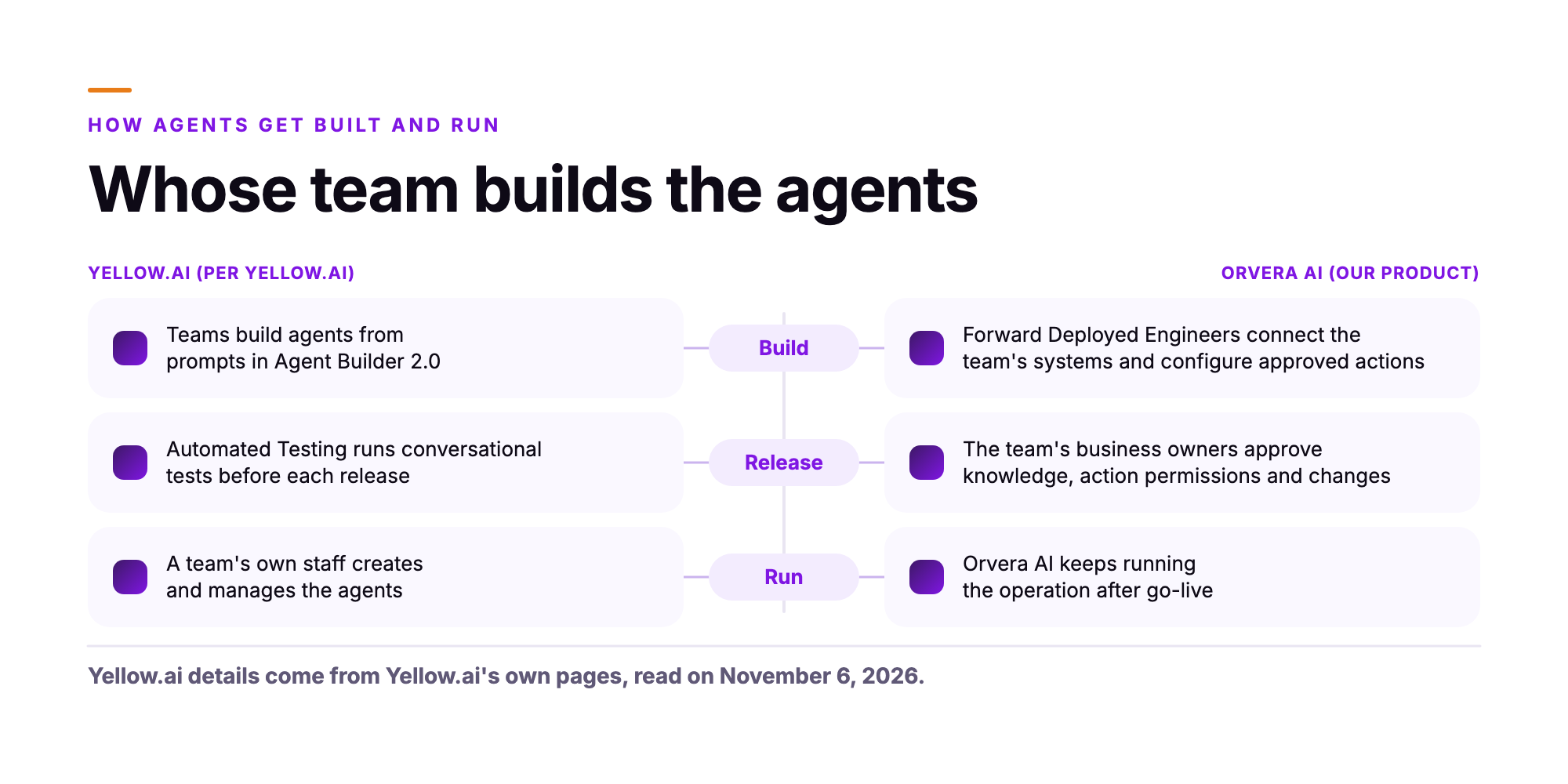
| How agents get built and run | Teams build agents from prompts in Agent Builder 2.0, with AI Copilot, Automated Testing and Nexus | Orvera AI builds, deploys and runs the agents, with full deployment in 3 to 6 weeks on average across Orvera AI customer engagements |
| Compliance listed | HIPAA, ISO 27001, ISO 27701, SOC 2 Type II, PCI-DSS v4.0.1 (service provider) | SOC 2 Type II certified, HIPAA compliant, GDPR compliant |
Sources (Yellow.ai, read November 6, 2026): https://yellow.ai/, https://yellow.ai/about-us/, https://yellow.ai/agentic-ai-platform/, https://yellow.ai/omnichannel-ai-automation/, https://yellow.ai/voice-automation/, https://yellow.ai/email-support-simplified/, https://yellow.ai/nexus/, https://yellow.ai/nexus-vox/, https://yellow.ai/nexus-edge/, https://yellow.ai/platform/agent-assist/, https://yellow.ai/platform/ai-analytics/, https://yellow.ai/platform/automated-testing/, https://yellow.ai/platform/ai-agent-builder/, https://yellow.ai/platform/integrations/, https://yellow.ai/platform/enterprise-grade-security/, https://yellow.ai/investors/, https://yellow.ai/pricing/
How do Orvera AI and Yellow.ai handle channels and languages?
Yellow.ai lists 35+ channels and 135+ languages on its omnichannel page. Its voice product, VoiceX, handles interruptions and transfers calls between AI and human agents, and its email automation picks out several intents in one message. It also covers messaging and social channels such as WhatsApp, Instagram and Slack.
Orvera AI runs one agent across voice, chat, SMS, email, web and the other channels a team operates, inbound and outbound, in 80+ languages. The agent keeps one shared memory and a live customer profile across channels, so a customer who texts and then calls picks up where they left off. A handoff to a human agent arrives with a full summary attached, and the agents complete actions such as refunds, updates and bookings inside the team's systems, then write each outcome back to the CRM.
Yellow.ai publishes the larger language count. A team with long-tail language needs should test its own languages and dialects on both platforms with real recordings.
What do Orvera AI and Yellow.ai offer human agents and quality teams?
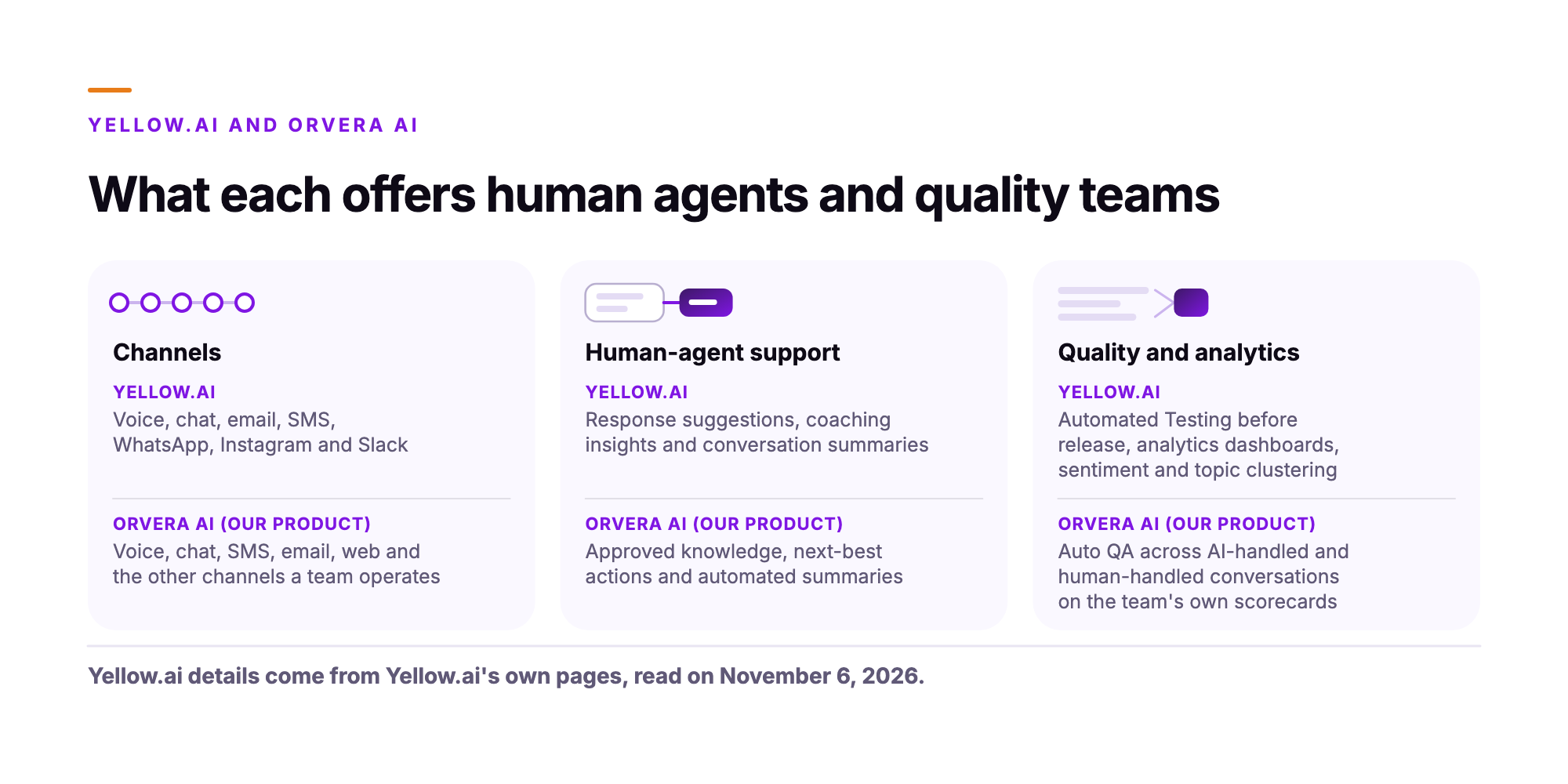
Yellow.ai's Agent Assist runs inside an AI helpdesk it calls Inbox, with response suggestions, coaching insights and conversation summaries across chat, email and voice. Its Analytics module adds sentiment analysis, topic clustering and a dashboard that compares AI and human agent performance. Its Automated Testing product runs hundreds of conversational tests in parallel before each release.
Orvera AI's Agent Assist supports human agents during live conversations. It surfaces approved knowledge, recommends next-best actions, flags escalation cues and compliance requirements, and writes automated summaries. It connects through webhooks, Genesys Cloud AudioHook or a browser extension.
Orvera AI's AI Quality Management runs Auto QA. Scores use the team's own scorecards, weights and fatal compliance checks, and each criterion result links to the transcript moments behind it.
On Yellow.ai's published pages, quality work centers on pre-release testing for its AI agents and analytics that compare AI and human agent performance. Orvera AI scores its AI agents and the team's human agents against the same scorecards.
Which systems do Orvera AI and Yellow.ai integrate with?
Yellow.ai's homepage lists 150+ pre-built integrations, including Salesforce, Zendesk, Genesys and NICE. Its integrations page also names Freshdesk, ServiceNow, Jira, HubSpot, Zoho, Avaya and Shopify, its platform page adds SAP, Oracle and Workday, and Yellow.ai says its team builds custom integrations for tools without built-in APIs.
Orvera AI's integration directory lists contact center platforms such as Genesys Cloud, Five9, NiCE CXone, Amazon Connect, Talkdesk and Twilio Flex. CRM and helpdesk systems include Salesforce, Microsoft Dynamics 365, HubSpot, Zendesk, ServiceNow and Freshdesk. Healthcare systems include Epic, athenahealth and Cerner, insurance systems include Guidewire and Duck Creek Technologies, and commerce and payments include Shopify and Stripe.
Both vendors connect to Salesforce, Zendesk, HubSpot, ServiceNow, Genesys and NICE. A team running Five9, Amazon Connect, Epic or Guidewire will find those named in Orvera AI's directory.
How do deployment, operation and reported results differ?
Yellow.ai's Agent Builder 2.0 page says anyone from business users to developers can create agents in minutes from prompts. Its agent discovery feature reads past data, knowledge bases and SOPs to propose agents. Yellow.ai's investors page lists an average deployment of under 30 days.
Orvera AI's own teams handle the delivery. Forward Deployed Engineers connect the team's systems and configure approved actions around its workflows. Operations experts define handling standards and quality checks and calibrate scorecards against the team's own QA analysts. The team's business owners approve knowledge, action permissions and changes. Full deployment, from build through integration to agents live, takes 3 to 6 weeks on average across Orvera AI customer engagements, and Orvera AI keeps running the operation after go-live.
Orvera AI reports first-contact resolution of about 80% and average handle time down 8 to 15% in the first 90 days, as averages across Orvera AI customer engagements. Each vendor publishes its own figures, so ask both for numbers modeled on your own use case and volumes.
Which teams is each best suited to?
Yellow.ai is best suited to teams that:
- want their own staff to design, test and change AI agents in a builder
- need a long channel list, including social and messaging apps, and a large language list
- want customer and employee experience automation, such as IT and HR support, from one vendor
- need data hosting in the EU, Singapore, India, Indonesia or the UAE, or require ISO 27001 or PCI-DSS on the vendor's list
Orvera AI is best suited to teams that:
- want a partner to deliver and operate AI agents on the contact center platform they already use, such as Genesys Cloud, Five9, NiCE CXone or Amazon Connect
- want AI agents, Agent Assist, AI Quality Management and Voice of Customer on one platform
- want one set of QA scorecards applied to both their AI agents and their human agents
- work in regulated areas such as healthcare and insurance, where SOC 2 Type II, HIPAA compliance and connectors like Epic and Guidewire matter
Frequently asked questions
Yes. Both run AI agents across voice, chat and email for customer service teams. The main differences are whose team builds the agents, and how each handles quality for human agents.
Yellow.ai is a builder platform where a team's own staff creates and manages the agents, and Nexus EDGE extends it to employee IT and HR support. With Orvera AI, Forward Deployed Engineers and operations experts put the agents live and keep operating them, while Agent Assist, AI Quality Management and Voice of Customer support the human team.
Orvera AI connects to 500+ systems, including Genesys Cloud, Five9, NiCE CXone, Amazon Connect, Salesforce, Microsoft Dynamics 365, Zendesk, ServiceNow, Epic and Guidewire.
Orvera AI reports first-contact resolution of about 80% and average handle time down 8 to 15% in the first 90 days. These figures are averages across Orvera AI customer engagements, and a given account is modeled on its own numbers once there is a named use case.
Yes. Orvera AI runs on the team's existing stack, and Genesys Cloud, Five9 and NiCE CXone are all in its integration directory. Agent Assist connects through webhooks, Genesys Cloud AudioHook or a browser extension.
Written by
Anindita Majumder
Anindita Majumder is a communications professional with nearly four years of experience in public relations, corporate communications, and journalism. She creates content that helps brands communicate their vision, products, and expertise through press releases, thought leadership, and editorial pieces. Outside of work, she is a vocalist, which keeps her creativity flowing.