Cresta and Orvera AI in 2026: Two CX AI Platforms Side by Side
A side-by-side look at Cresta and Orvera AI on AI agents, agent assist, coaching, quality, integrations and deployment, with Cresta details read from cresta.com on November 6, 2026.

Key highlights
Key takeaways: Cresta and Orvera AI in 2026: Two CX AI Platforms Side by Side
- Cresta calls itself "the AI operating system for customer experience." Its about page says the company started at Stanford's AI Lab in 2017 and that its first customer used a transformer-based model for real-time Agent Assist in 2018.
- Orvera AI's platform has two layers on one architecture.
- Cresta's AI Agent connects to CRM, billing, scheduling and other systems through secure function calling and Model Context Protocol (MCP) support.
- Cresta's first customer used real-time Agent Assist in 2018, and its Agentic Assist page describes behavioral recognition that spots specific agent behaviors and customer signals as they happen, then triggers targeted guidance.
- Cresta and Orvera AI each connect to the systems a team already has.
In short: Cresta is an AI platform for customer experience that combines AI Agent, Deputy Agent, Agentic Assist and Conversation Intelligence. Its roots are in real-time agent assist, which it first deployed in 2018. Orvera AI runs AI agents for customer experience teams. It builds and deploys them across voice, chat and digital on the stack a team already uses, and backs human agents with Agent Assist, AI Quality Management and Voice of Customer. Cresta suits teams that center their program on guiding and coaching human agents, and Orvera AI suits teams that want AI agents built and deployed for them on their current systems, with one quality program across AI and human conversations.
Orvera AI publishes this blog. Cresta details come from cresta.com, read on November 6, 2026.
What is Cresta?
Cresta calls itself "the AI operating system for customer experience." Its about page says the company started at Stanford's AI Lab in 2017 and that its first customer used a transformer-based model for real-time Agent Assist in 2018.
Today Cresta sells four products. AI Agent automates customer conversations across voice and digital channels. Deputy Agent is a long-running agent for the operational work behind customer conversations. Agentic Assist guides human agents during live calls and chats. Conversation Intelligence covers Insights, AI Analyst, Automation Discovery, Quality Management, Coach and a Training Simulator. Cresta's platform page says it combines 20+ large and small language models and fine-tunes models on each customer's data.
Cresta's FAQ says it is built for high-volume customer operations in industries such as financial services, insurance, telecom and travel.
What is Orvera AI?
Orvera AI's platform has two layers on one architecture. The first is omnichannel AI agents for inbound and outbound voice, chat, SMS, email and web, in 80+ languages. The second supports the people who still handle conversations: Agent Assist guides them live, AI Quality Management scores their work and the AI agents' work, and Voice of Customer finds the themes and drivers behind conversations.
Orvera AI orchestrates third-party models inside its own governed layer. The architecture is model-agnostic, so a customer can move to a newer model and keep the deployment it already has. Orvera AI is SOC 2 Type II certified, HIPAA compliant and GDPR compliant.
How do Orvera AI and Cresta compare at a glance?
| Area | Cresta (per cresta.com, as of November 6, 2026) | Orvera AI (our product) |
|---|---|---|
| What it is | AI platform with AI Agent, Deputy Agent, Agentic Assist and Conversation Intelligence | AI agents plus Agent Assist, AI Quality Management and Voice of Customer on one architecture |
| AI agents | AI Agent across voice and digital channels in 30+ languages, with shared memory across channels and handoffs | AI agents for inbound and outbound voice, chat, SMS, email and web in 80+ languages, with one live customer profile across channels |
| Human-agent assist | Agentic Assist with real-time guidance, Knowledge Agent answers and Summary Agent summaries | Agent Assist with approved knowledge, next-best actions, escalation cues, compliance flags and automated summaries |
| Quality and coaching | Quality Management with human-in-the-loop calibration for human and AI agents, plus Coach and Training Simulator | Auto QA across AI-handled and human-handled conversations, on the customer's own scorecards |
| Analytics | Insights, AI Analyst and Automation Discovery | Voice of Customer themes, drivers and sentiment, plus summaries and transcripts for each interaction |
| Integrations | Telephony, chat, knowledge, CRM, marketing and data systems, including Salesforce, Genesys, Five9 and NICE | 500+ integrations, including Salesforce, ServiceNow, Genesys Cloud, Five9, NiCE CXone and Epic |
| Delivery | Three operating models: Cresta-managed, guided transfer and customer-managed | Orvera AI builds and deploys on the customer's existing stack, with full deployment averaging 3 to 6 weeks across Orvera AI customer engagements |
| Security | ISO/IEC 42001 certified, with PCI-DSS and ISO 27701 compliance and automatic PII redaction stated, and SOC 2 Type 2, HIPAA and TISAX badges shown | SOC 2 Type II certified, HIPAA compliant and GDPR compliant |
Sources: Cresta details read on November 6, 2026, from https://cresta.com, https://cresta.com/about-us, https://cresta.com/platform-overview, https://cresta.com/ai-agent, https://cresta.com/ai-agent-omnichannel, https://cresta.com/ai-agent-build, https://cresta.com/ai-agent-test-and-deploy, https://cresta.com/agent-operations-center, https://cresta.com/agentic-assist, https://cresta.com/conversation-intelligence, https://cresta.com/cresta-quality-management, https://cresta.com/cresta-coach, https://cresta.com/deputy-agent, https://cresta.com/integrations, https://cresta.com/ai-agent-implementation and https://cresta.com/trust.
What can each platform's AI agents do?
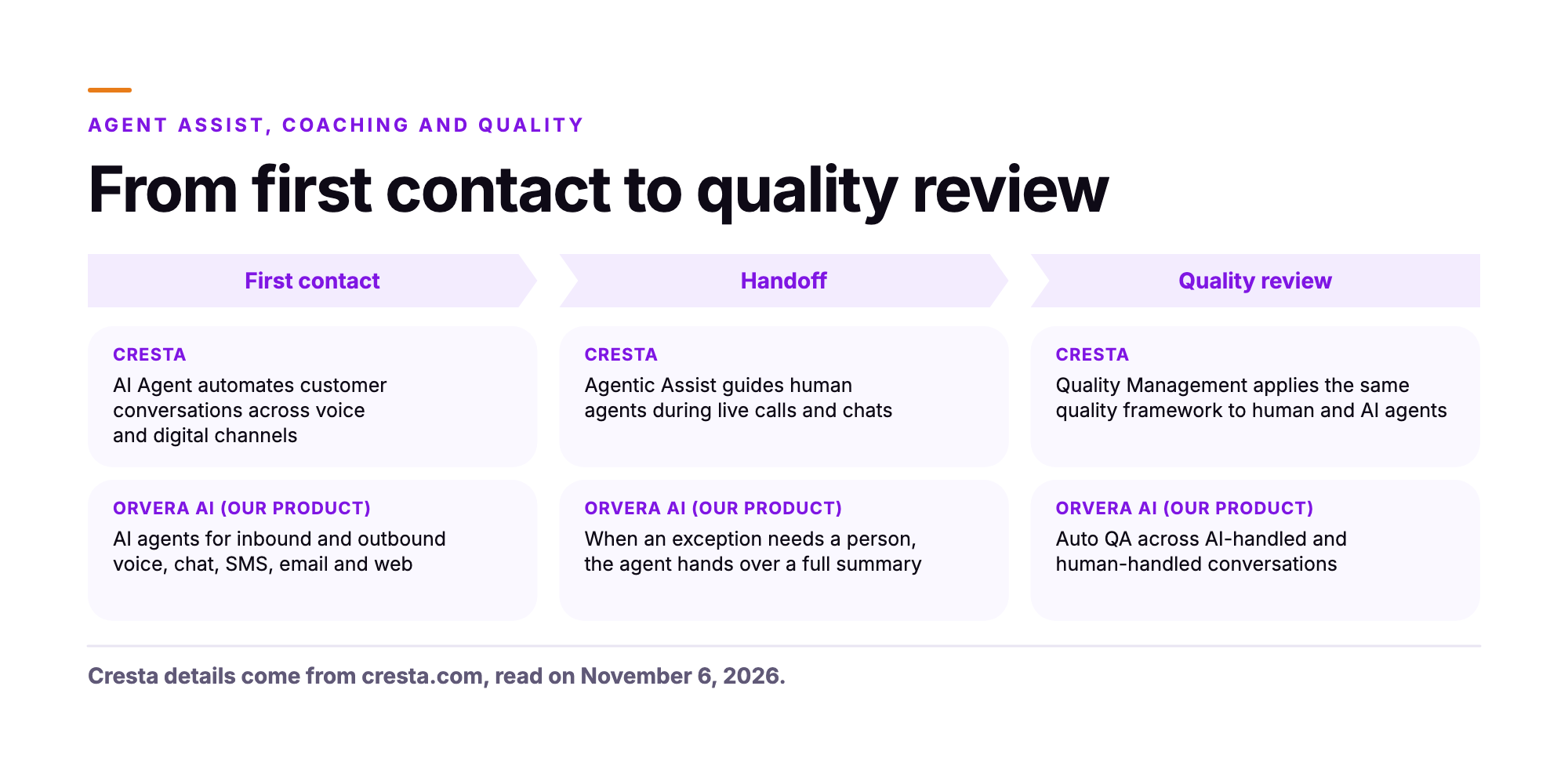
Cresta's AI Agent connects to CRM, billing, scheduling and other systems through secure function calling and Model Context Protocol (MCP) support. Cresta builds agents as networks of specialized subAgents, and it pairs AI reasoning with deterministic code that tracks conversation state and enforces required steps. Cresta tests agents against Synthetic Customers built from a customer's own conversation data and supports A/B tests, versioning and one-click rollback. Its Agent Operations Center lets supervisors watch live AI agent conversations, guide the next response and take over in high-risk moments.
Orvera AI's agents handle verification, billing, service requests and updates through to resolution. They update data across systems, trigger workflows, run multi-step flows with branching logic and escalate with full history. Every channel feeds one live profile, so a customer who texts and then calls an hour later picks up the same case. When an exception needs a person, the agent hands over a full summary, and the outcome is written back to the CRM. Permissions, guardrails and policy are set per channel and per use case inside Orvera AI's governed orchestration layer.
What does each offer for agent assist, coaching and quality?
Cresta's first customer used real-time Agent Assist in 2018, and its Agentic Assist page describes behavioral recognition that spots specific agent behaviors and customer signals as they happen, then triggers targeted guidance. Knowledge Agent combines what is being said with on-screen context to give source-backed answers. Cresta Quality Management scores compliance, behaviors and outcomes with bespoke models, supports human review, calibration and appeals, and applies the same quality framework to human and AI agents. Cresta Coach turns quality data into personalized coaching plans and tracks whether coaching changes agent behavior.
Orvera AI's Agent Assist surfaces approved knowledge, recommends next-best actions, flags escalation cues and compliance requirements before risky actions, and generates automated summaries. It connects through webhooks, Genesys Cloud AudioHook and a browser extension.
Orvera AI's AI Quality Management runs Auto QA across AI-handled and human-handled conversations. It applies the customer's own scorecards, weights and fatal compliance checks, links every score to the transcript evidence behind it and is calibrated against the customer's own QA analysts at deployment. Findings feed coaching themes for supervisors and prompt improvements for the AI agents.
Each vendor audits AI and human agents with one quality framework. Cresta's FAQ says it is especially suited to "large teams of agents." Orvera AI ties quality to the AI agents it builds and deploys, so a finding can become a change to an agent's workflow.
How do integrations and deployment work on each?
Cresta and Orvera AI each connect to the systems a team already has. Cresta's integrations page groups its connections into telephony and chat, knowledge, CRM and customer engagement, marketing and data, and shows logos that include Salesforce, ServiceNow, Zendesk, HubSpot, Genesys, Five9, NICE, Amazon Connect, Twilio, Avaya and Cisco.
Orvera AI connects through 500+ integrations across CCaaS and telephony, CRM, helpdesk and ITSM, healthcare, insurance, scheduling, billing and analytics. Named systems include Salesforce, Microsoft Dynamics 365, HubSpot, ServiceNow, Zendesk, Freshdesk, Genesys Cloud, Five9, NiCE CXone, Talkdesk, Amazon Connect, Twilio, Epic, athenahealth, Guidewire and Duck Creek Technologies. If a team's system is already on the list, turning it on is a configuration step inside the deployment.
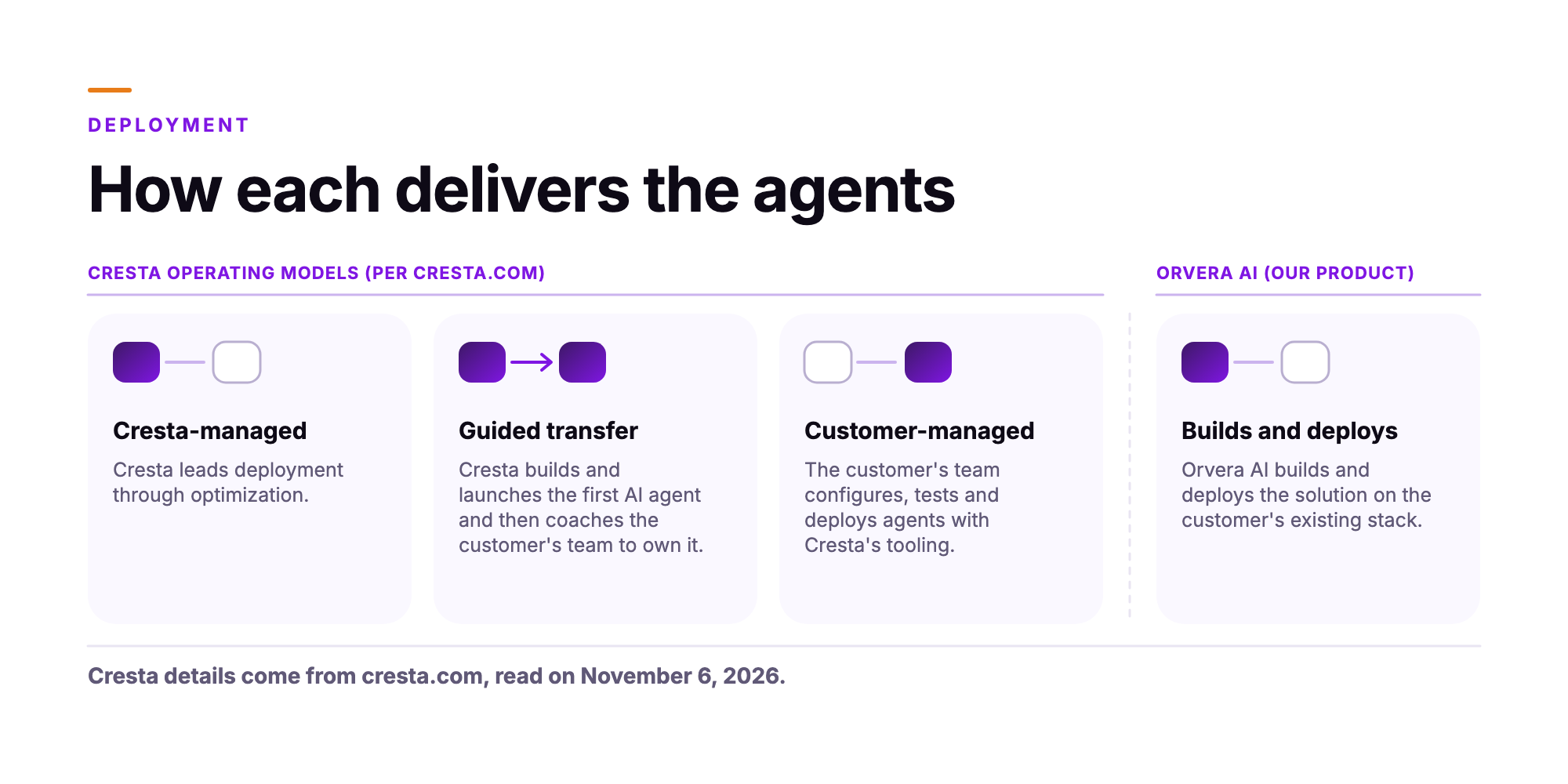
On delivery, Cresta's implementation page offers three operating models. In the Cresta-managed model, Cresta leads deployment through optimization. In guided transfer, Cresta builds and launches the first AI agent and then coaches the customer's team to own it. In the customer-managed model, the customer's team configures, tests and deploys agents with Cresta's tooling. Every deployment is backed by Cresta's team, which includes forward-deployed product managers and engineers.
Orvera AI builds and deploys the solution on the customer's existing stack. Across Orvera AI customer engagements, full platform deployment averages 3 to 6 weeks, first-contact resolution averages about 80%, and average handle time falls 8 to 15% in the first 90 days. Each account is modeled on its own numbers once there is a named use case.
Which teams is each best suited to?
Cresta is best suited to teams that:
- Put real-time guidance, coaching and training of large teams of agents at the center of their CX program.
- Want conversation analytics and AI Analyst research across human and AI agents.
- Want the option to bring agent building in-house over time through guided transfer or the customer-managed model.
- Plan to automate operational and back-office work with Deputy Agent, Cresta's long-running agent.
Orvera AI is best suited to teams that:
- Want AI agents built and deployed across voice, chat, SMS, email and web on the systems they already run.
- Want their human-agent tools from the same vendor that runs their AI agents.
- Want Auto QA across AI-handled and human-handled conversations, scored against their own scorecards.
- Serve customers in many languages.
A useful evaluation of both follows one real workflow from first contact through handoff and quality review, and asks who owns it after go-live.
Frequently asked questions
Yes. Cresta and Orvera AI both run AI agents for customer conversations, guide human agents in real time and score quality across AI and human conversations. Cresta started in real-time agent assist and now also sells AI Agent and Deputy Agent, and Orvera AI builds and deploys AI agents on a team's existing stack with the human-agent layer attached.
The delivery model and the starting point differ. Cresta offers three operating models, from Cresta-managed to customer-managed, and its roots are in real-time agent assist. Orvera AI builds and deploys AI agents for the customer and connects its human-agent layer to those same agents.
Orvera AI has 500+ integrations, including Salesforce, Microsoft Dynamics 365, ServiceNow, Zendesk, Genesys Cloud, Five9, NiCE CXone, Amazon Connect and Epic.
Across Orvera AI customer engagements, first-contact resolution averages about 80%, average handle time falls 8 to 15% in the first 90 days, and full deployment averages 3 to 6 weeks. Each account is modeled on its own numbers once there is a named use case.
Yes. Cresta's Quality Management page says it applies the same quality framework across human and AI agents. Orvera AI runs Auto QA across AI-handled and human-handled conversations, scored against the customer's own scorecards with every result linked to transcript evidence.
Written by
Anindita Majumder
Anindita Majumder is a communications professional with nearly four years of experience in public relations, corporate communications, and journalism. She creates content that helps brands communicate their vision, products, and expertise through press releases, thought leadership, and editorial pieces. Outside of work, she is a vocalist, which keeps her creativity flowing.