Observe.AI or Orvera AI? A 2026 Comparison for CX Teams
Observe.AI and Orvera AI both run AI agents for CX teams. This comparison sets out how each one handles AI agents, agent assist, quality, integrations, security and deployment, using each vendor's published material.

Key highlights
Key takeaways: Observe.AI or Orvera AI? A 2026 Comparison for CX Teams
- Observe.AI describes itself as an Agentic CX Platform that uses AI agents "to resolve interactions, assist in real-time, and improve CX outcomes" (observe.ai, as of November 6, 2026).
- Orvera AI runs AI agents for customer experience teams.
- Both vendors run AI agents that take actions inside connected systems.
- Observe.AI lists 250+ pre-built connectors across CRM, CCaaS, knowledge management, telephony, ticketing and BI, and adds open APIs and Model Context Protocol support for anything outside that list (Integrations).
- Observe.AI's FAQ says most teams go from initial setup to production "in a month or two", using pre-built workflows, integrations and testing tools (observe.ai).
Short answer: Observe.AI is an agentic CX platform with Voice AI and Chat AI agents, a real-time Companion Agent for live reps, Insights and Performance Agents for operations, and Auto QA in its Interaction Intelligence layer. Customer teams can author agents with a plain-English tool called CoBuilder. Orvera AI runs AI agents for customer experience teams: it builds and deploys agents across voice, chat and digital on the stack a team already uses, and backs human agents with Agent Assist, AI Quality Management and Voice of Customer. Observe.AI suits teams that want to author and tune agents in-house, and Orvera AI suits teams that want the vendor to build, deploy and run the agents for them.
Orvera AI publishes this blog. Observe.AI details below come from observe.ai pages read on November 6, 2026, and each one is linked where it appears.
What is Observe.AI?
Observe.AI describes itself as an Agentic CX Platform that uses AI agents "to resolve interactions, assist in real-time, and improve CX outcomes" (observe.ai (opens in a new tab), as of November 6, 2026). The company says its journey began in 2017, lists its address in Redwood City, California, and states that it serves 350+ companies (About Us (opens in a new tab)).
Its product set has three groups of agents:
- For customers: Voice AI (opens in a new tab) for inbound and outbound calls, and Chat AI (opens in a new tab) for web, app, SMS and social channels.
- For frontline teams: the Companion Agent (opens in a new tab), which briefs a rep before a call, recommends next best actions, prompts compliance disclosures and drafts post-call summaries.
- For operations: Insights Agents (opens in a new tab) that investigate conversation data in natural language, and Performance Agents (opens in a new tab) that build coaching plans from scored behaviors.
Underneath sit the Agent Platform (opens in a new tab), Agent Harness (opens in a new tab) for versioning, simulation and phased releases, CoBuilder (opens in a new tab) for authoring agents in plain English, and Interaction Intelligence (opens in a new tab), the layer that runs Auto QA, manual QA, calibration and case management.
What is Orvera AI?
Orvera AI runs AI agents for customer experience teams. Orvera AI builds and deploys them across voice, chat and digital, on the stack the team already uses, and supports the team's human agents on the same platform.
The platform has two layers. The first is omnichannel AI agents that work inbound and outbound across voice, chat, SMS, email and web, with one live customer profile across channels, so a customer who texts and then calls keeps the same order number and history on both channels. The agents act in connected systems, write the outcome back to the CRM and hand a full summary to a person when an exception needs one. The second layer supports human agents with Agent Assist, Auto QA across AI-handled and human-handled conversations, Voice of Customer and reporting.
One architecture sits under both layers and unifies multilingual understanding in more than 80 languages, agentic planning, workflow execution and governance. Orvera AI is model-agnostic. It orchestrates third-party models inside its own governed layer, so a team can move to a newer model without rebuilding its deployment. The company draws on 18+ years of contact-center experience.
How do Orvera AI and Observe.AI compare at a glance?
| Area | Observe.AI (per observe.ai, November 6, 2026) | Orvera AI (our product) |
|---|---|---|
| What it is | Agentic CX Platform with purpose-built agents for customers, frontline teams and operations | AI agents for customer experience teams, plus a human-agent layer, built, deployed and run by Orvera AI |
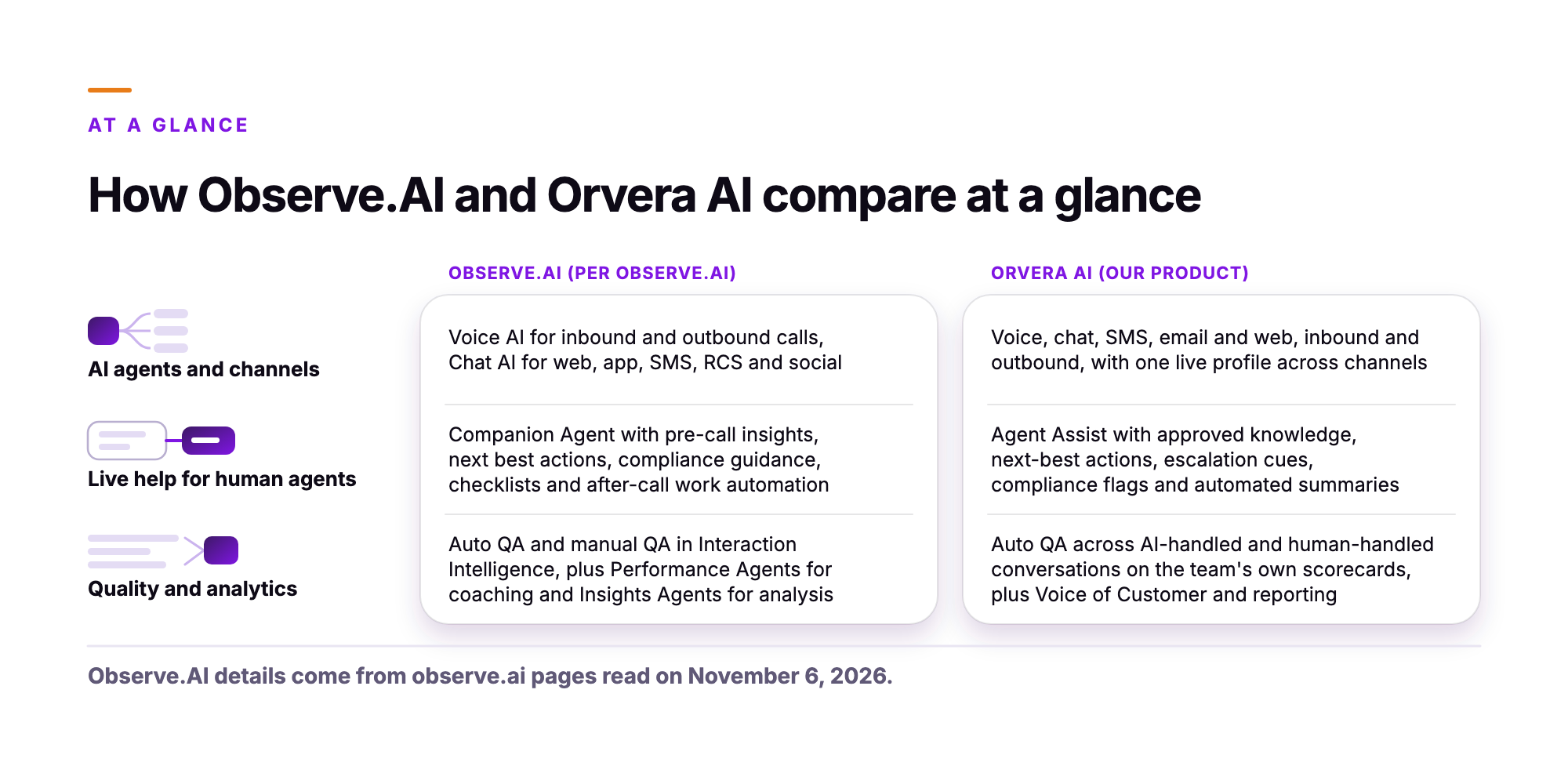
| AI agents and channels | Voice AI for inbound and outbound calls, Chat AI for web, app, SMS, RCS and social, with 12+ action types | Omnichannel AI agents for voice, chat, SMS, email and web, inbound and outbound, with one live profile across channels |
| Live help for human agents | Companion Agent with pre-call insights, next best actions, compliance guidance, checklists and after-call work automation | Agent Assist with approved knowledge, next-best actions, escalation cues, compliance flags and automated summaries |
| Quality and analytics | Auto QA and manual QA in Interaction Intelligence, plus Performance Agents for coaching and Insights Agents for analysis | Auto QA across AI-handled and human-handled conversations on the team's own scorecards, plus Voice of Customer and reporting |
| Integrations | 250+ pre-built connectors, open APIs and Model Context Protocol support | 500+ integrations across CCaaS, CRM, helpdesk, healthcare, insurance and other systems |
| Security and compliance | Security page cites ISO 27001:2013 certification and SOC 2 Type 2, PCI DSS, GDPR and CCPA practices, with US, CA, EU and AU data residency | SOC 2 Type II certified, HIPAA compliant, GDPR compliant |
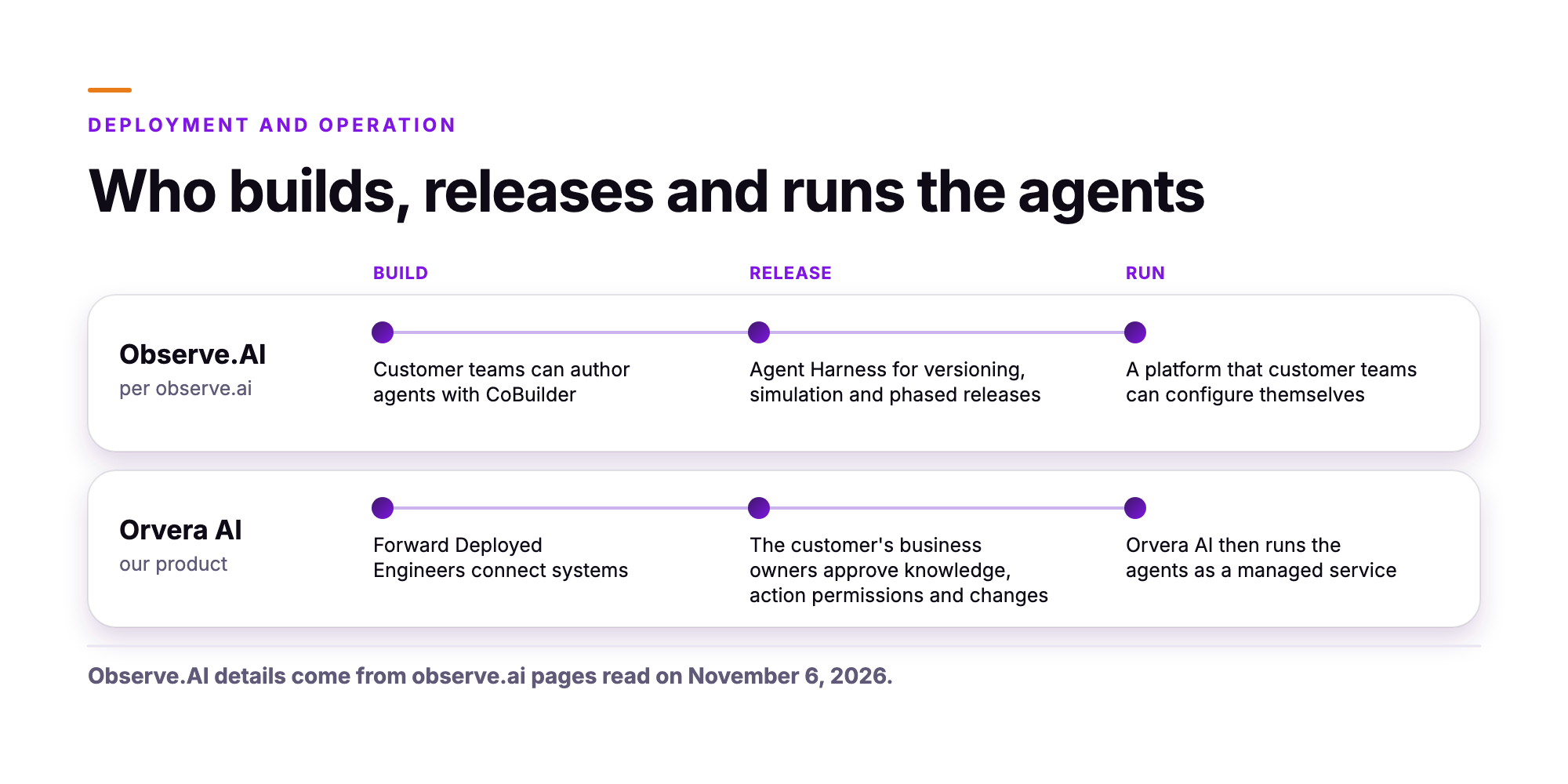
| Who builds the agents | Customer teams can author agents with CoBuilder and release them through Agent Harness | Orvera AI builds, deploys and runs the agents with the team's business owners approving knowledge and actions |
| Stated time to production | "A month or two" for most teams, per its FAQ | 3 to 6 weeks for a full deployment, end to end, on average across Orvera AI customer engagements |
Sources (Observe.AI, all read November 6, 2026): observe.ai (opens in a new tab), Voice AI (opens in a new tab), Chat AI (opens in a new tab), Companion Agent (opens in a new tab), Interaction Intelligence (opens in a new tab), Integrations (opens in a new tab), Security (opens in a new tab), Trust (opens in a new tab), CoBuilder (opens in a new tab), Agent Harness (opens in a new tab).
What can each vendor's AI agents do?
Both vendors run AI agents that take actions inside connected systems. Observe.AI says its Voice AI (opens in a new tab) authenticates callers, looks up records and completes actions across 12+ action types, with streaming speech recognition and synthesis for "sub-300ms responses", smart turn detection and noise suppression (Voice AI). Its Chat AI (opens in a new tab) deploys through a JavaScript embed, SMS or RCS, and hands off to a human with the full transcript (Chat AI).
Orvera AI's agents handle verification, billing, service requests and updates through to a defined resolution state. They update data across systems, trigger downstream workflows and run multi-step flows with branching logic. A single conversation can start on text, continue on web chat and finish on a call, with identity, history and case state carried across all three. When a person needs to step in, the agent passes a complete summary and Agent Assist surfaces the next best action.
The practical difference sits in operation. Observe.AI gives teams tools to build, test and release agents, including simulation with hundreds of synthetic conversations and A/B traffic splits in Agent Harness (opens in a new tab) (Agent Harness). Orvera AI's Forward Deployed Engineers connect the customer's systems and configure approved actions around the customer's workflows, and Orvera AI keeps running the agents after go-live.
How does each platform support human agents and quality?
Observe.AI's Interaction Intelligence (opens in a new tab) layer scores interactions against a team's rubric with "the exact transcript moments behind every score", runs calibration sessions between AI and human reviewers, and stitches calls, chats and emails about one issue into a single case (Interaction Intelligence). Performance Agents (opens in a new tab) turn those scores into coaching plans and track behavior change before and after coaching (Performance Agents).
Orvera AI runs its human-agent layer on the same platform as its AI agents. Agent Assist surfaces approved knowledge, recommends next-best actions, flags compliance requirements before risky actions and writes post-call summaries. It connects through webhooks, Genesys Cloud AudioHook and a browser extension. AI Quality Management runs Auto QA across AI-handled and human-handled conversations on the team's own scorecards, weights and fatal compliance checks, with every score linked to transcript evidence and calibrated against the team's own QA analysts at deployment. Voice of Customer links survey, NPS and CSAT responses to the interactions behind them.
Which systems and security standards does each vendor list?
Observe.AI lists 250+ pre-built connectors across CRM, CCaaS, knowledge management, telephony, ticketing and BI, and adds open APIs and Model Context Protocol support for anything outside that list (Integrations (opens in a new tab)). Named connectors on that page include 8x8, Aircall, Amazon Connect, Avaya, athenaOne and AdvancedMD.
Orvera AI has 500+ integrations. They include Salesforce, Microsoft Dynamics 365, HubSpot, Zendesk and ServiceNow on the CRM and helpdesk side, Genesys Cloud, Five9, NiCE CXone, Amazon Connect, Talkdesk and Twilio on the contact center side, and Epic, Cerner, athenahealth and Guidewire for healthcare and insurance teams.
On security, Observe.AI's security page cites ISO 27001:2013 certification and practices including SOC 2 Type 2, PCI DSS, GDPR and CCPA (Security (opens in a new tab)). Its trust page describes pre-model redaction of PII, PCI and PHI, customer-managed keys and data stored in the US, CA, EU or AU (Trust (opens in a new tab)). Orvera AI is SOC 2 Type II certified, HIPAA compliant and GDPR compliant.
What do deployment, operation and reported results look like?
Observe.AI's FAQ says most teams go from initial setup to production "in a month or two", using pre-built workflows, integrations and testing tools (observe.ai (opens in a new tab)). Its CoBuilder (opens in a new tab) page says CX leads, QA managers and ops teams can author agents without engineering help (CoBuilder).
Across Orvera AI customer engagements, a full deployment averages 3 to 6 weeks, end to end, starting once scope is agreed and system access is in place. Forward Deployed Engineers connect systems, operations experts set handling standards and calibrate scorecards, and the customer's business owners approve knowledge, action permissions and changes. Orvera AI then runs the agents as a managed service. The platform can also be adopted in stages.
Orvera AI reports average handle time down 8 to 15% within the first 90 days and first-contact resolution of about 80%, as averages across Orvera AI customer engagements.
Which teams is each best suited to?
Observe.AI is best suited to teams that:
- Want Auto QA, calibration and coaching programs on the same platform as their AI agents.
- Plan for their own CX, QA and operations staff to author and change agents, and want release controls such as versioning, simulation and phased traffic.
- Need data stored in a specific region among the US, Canada, the EU or Australia.
Orvera AI is best suited to teams that:
- Want a vendor to build, deploy and run AI agents across voice, chat and digital, with an operations team that has run contact centers.
- Want AI agents, Agent Assist, Auto QA and Voice of Customer on one platform, on top of systems such as Genesys Cloud, Five9, NiCE CXone, Amazon Connect or Salesforce.
- Serve customers in more than 80 languages across voice, chat and digital.
Frequently asked questions
Observe.AI is a platform that customer teams can configure themselves, with CoBuilder for authoring agents and Agent Harness for releases. Orvera AI builds, deploys and runs the AI agents for the customer and pairs them with a human-agent layer on one platform.
Orvera AI has 500+ integrations, including Salesforce, Zendesk, ServiceNow, Genesys Cloud, Five9, NiCE CXone, Amazon Connect, Epic and Guidewire.
Yes. Observe.AI's homepage says AI and human conversations are evaluated on its platform, and Orvera AI runs Auto QA across AI-handled and human-handled conversations on the team's own scorecards. Both link scores to transcript evidence and support calibration against human reviewers.
Observe.AI's FAQ, as of November 6, 2026, says most teams reach production in a month or two. Across Orvera AI customer engagements, a full deployment averages 3 to 6 weeks, end to end, once scope is agreed and system access is in place.
Orvera AI reports average handle time down 8 to 15% within the first 90 days and first-contact resolution of about 80%. Both figures are averages across Orvera AI customer engagements, and a given team's numbers are modeled on its own use case.
Written by
Anindita Majumder
Anindita Majumder is a communications professional with nearly four years of experience in public relations, corporate communications, and journalism. She creates content that helps brands communicate their vision, products, and expertise through press releases, thought leadership, and editorial pieces. Outside of work, she is a vocalist, which keeps her creativity flowing.