Orvera vs Cognigy: Comparing Enterprise CX AI Platforms in 2026
Orvera vs Cognigy is a relevant comparison for enterprise CX teams evaluating how...

Key highlights
TL;DR — In a Nutshell
- Orvera and Cognigy both cover enterprise CX AI across AI agents, voice and digital channels, human-agent assistance, integrations, orchestration, and analytics
- The key comparison goes beyond features to governance, system actions, quality measurement, handoff continuity, and who owns the platform after go-live
- Orvera emphasizes governed orchestration with controlled system actions, human review for restricted paths, and auditable execution across enterprise systems
- Orvera connects QA to both conversation evidence and system-of-record actions, evaluating AI and human interactions through the same quality framework
- A major distinction is the operating model: Orvera can build, deploy, integrate, run, and continuously optimize the solution with the customer, while Cognigy emphasizes platform tools for teams to build and manage AI agents
- Enterprise teams should evaluate both platforms using real workflows, focusing on action governance, quality evidence, handoff continuity, system integration, and post-go-live ownership
Orvera vs Cognigy is a relevant comparison for enterprise CX teams evaluating how AI should handle customer conversations, system actions, human handoffs, and quality control. Both platforms cover core enterprise CX AI territory, including AI agents, voice and digital channels, human-agent assistance, enterprise integrations, orchestration, and analytics.
Orvera AI is an agentic AI platform for enterprise customer experience. It combines agentic, omnichannel AI agents with a human-agent layer that includes Agent Assist, AI Auto QA and QM, Voice of Customer, and reporting. Orvera builds, deploys, integrates, and runs the platform on the customer's behalf.
NiCE Cognigy positions Cognigy.AI as an enterprise agentic AI platform for customer service. Its current platform includes AI Agents, AI Agent Studio, Voice Gateway, Agent Copilot, Insights, orchestration, and enterprise integration capabilities.
The feature overlap is broad. The more useful enterprise comparison is how each platform governs action, measures quality, connects findings back to operations, and assigns ownership after go-live.
Orvera vs Cognigy at a Glance
How Orvera and Cognigy Approach Enterprise CX AI
Orvera's whole-surface CX model
Orvera treats AI-handled and human-handled conversations as two layers of one CX operation. Layer 1 runs agentic AI agents across voice, chat, and digital channels. Layer 2 supports people handling conversations through Agent Assist, Auto QA and QM, Voice of Customer, and reporting.
One architecture runs underneath both layers. Conversations can move from an AI agent to a human agent or another AI agent with context retained. The handoff includes a structured summary and next steps, with the full transcript available on demand.
That structure connects automation with the conversations people continue to handle. Quality, coaching, agent guidance, and Voice of Customer can draw from the same conversation record.
Cognigy's current platform model
Cognigy.AI also covers a wide enterprise CX AI surface. Cognigy describes AI Agents that combine model reasoning, memory, enterprise tools, deterministic workflows, and multi-agent collaboration. Its platform also includes Voice Gateway, Agent Copilot, and Insights.
AI Agent Studio provides a visual authoring environment for building, testing, refining, and publishing agents. Cognigy also provides APIs, CLI tooling, an extension framework, and prebuilt tools for enterprise systems.
In August 2026, Cognigy added Agentic Building for CX AI. Supported coding assistants can create, test, modify, and deploy Cognigy resources while those resources remain available for inspection and management inside Cognigy.
Where the comparison becomes meaningful
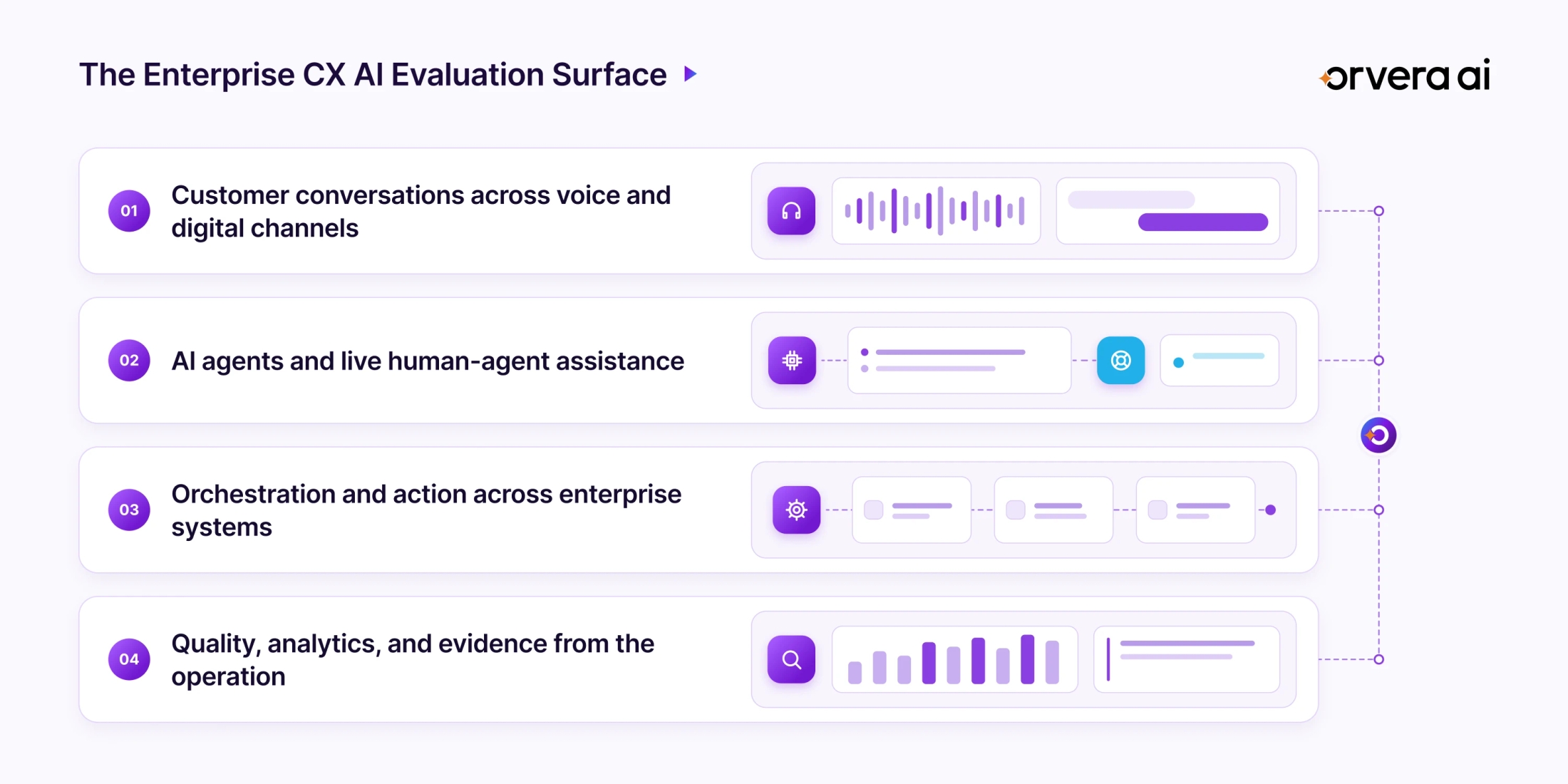
A feature checklist reaches overlap quickly. Both platforms publish capabilities across AI agents, voice, digital channels, enterprise systems, orchestration, analytics, and human-agent assistance.
The operational questions are more useful. Enterprises need to know how autonomous actions are controlled, how quality is calibrated, what evidence supports a score, how findings reach the team or workflow responsible for the issue, and who owns the platform after go-live.
Governed Orchestration and Action Across Enterprise Systems
Orvera's governed orchestration layer
Orvera combines deterministic workflow logic with model reasoning, confidence scoring, business rules, and real-time information from connected systems. Deterministic workflows carry control while reasoning handles ambiguity. Low-confidence and policy-restricted paths can move to human review or handoff.
System action is bounded through tool and action allowlists, parameter constraints, least-privilege execution, retries, idempotency, and compensating actions. An understood intent can trigger APIs, microservices, and RPA. Legacy systems without APIs can also be reached through a back-office execution agent that works through the interface and returns the result to the customer-facing agent.
For enterprise CX teams, governance therefore reaches beyond whether an agent has access to a tool. The review should establish which actions are permitted, which require approval, what happens after a failed transaction, and what evidence remains for audit.
Cognigy's orchestration and control surface
Cognigy's AI Ops and Orchestration materials describe centralized model management, model selection, real-time oversight, safety controls, role-based access, and audit logs. Cognigy also supports enterprise tools and MCP connectivity for AI Agents.
Its February 2026 release added a Maximum Loops control for autonomous and semi-autonomous AI Agents. This gives developers a fixed ceiling for repeated reasoning and execution cycles.
Both platforms therefore give enterprise teams meaningful governance questions to test. A production evaluation should follow a real workflow from customer intent through authentication, action, approval, exception handling, and completion.
Quality Across AI and Human Conversations
Orvera's quality model
Orvera's Auto QA layer audits every AI-handled and human-handled conversation against configurable QA frameworks. The customer's existing evaluation forms, rubrics, and compliance checks become automated scorecards with configurable criteria, weights, thresholds, pass or fail logic, and separate fatal compliance checks.
Calibration is tied to the customer's own standard. Orvera runs calibration on real conversations with the customer's QA analysts and re-runs calibration as the scorecard changes. The same criteria can then be used across AI agents and human agents.
The important comparison point is the quality mechanism behind that coverage. The quality layer sits in the same product that runs AI agents and supports human agents, giving findings a direct connection to the operation being evaluated.
The system-of-record layer
Orvera quality criteria can evaluate two surfaces.
The first is conversation behavior, including verification, disclosures, process adherence, and handling. The second is action in the customer's systems, including case updates, field values, follow-up tasks, credits, refunds, and scheduled callbacks.
This lets a quality criterion compare what an agent committed to in the conversation with the operational record that shows whether the work occurred. Resolution can therefore be evaluated through both the conversation and the business action attached to it.
That distinction matters in workflows where the customer expects something to happen after the conversation. A refund promise, case update, or scheduled callback has an operational record that can be checked.
Cognigy's current quality and analytics surface
Cognigy introduced Conversation Analyzer in June 2026 as part of Cognigy Insights. Cognigy's current material says it applies qualitative analysis to production AI Agent conversations and evaluates every transcript. It includes topic discovery, built-in analysis, and custom evaluation against business-specific criteria and compliance requirements.
Cognigy Insights provides the wider analytics layer for AI Agent conversations. It covers live activity, historical trends, conversation exploration, customer paths, operational metrics, and goal tracking across channels.
For an Orvera vs Cognigy evaluation, CX and quality leaders should verify the populations included in the proposed quality program, the evidence available behind each result, and the extent to which completed business-system actions can be evaluated alongside the conversation.
Build, Deploy, and Run: Who Owns the Operation After Go-Live?
Orvera's delivery model
Orvera's operating model starts with discovery and CX process mapping, then moves through solution design, build, integration, testing, go-live, and ongoing run and optimization. Orvera performs those phases on the customer's existing stack.
The services team works alongside the customer's quality and operations teams through the build and the run. The people involved in configuring the deployment remain connected to the customer after go-live.
Orvera supports two operating end states. It can continue running the solution as a managed Build-Run service, or transfer the configured deployment to the enterprise to operate.
Cognigy's public platform posture
Cognigy's current product materials focus heavily on the platform surfaces teams use to build and manage AI Agents. AI Agent Studio covers creation, testing, debugging, deployment, APIs, developer tooling, and extensions.
Agentic Building adds a second development path through supported coding assistants. Cognigy describes a create, test, improve, test-again, and deploy loop that works against the same platform resources.
For buyers, this makes post-go-live ownership an important part of the evaluation. The proposed deployment should make clear who owns production configuration, change control, calibration, operational review, and continuous improvement.
Omnichannel AI, Agent Assist, and Handoff Continuity
Orvera's primary channels include inbound and outbound voice, web and in-app chat, SMS, email, and WhatsApp. Context can remain intact when a customer moves between chat and voice, uses multiple channels, or resumes an asynchronous conversation later.
Agent Assist carries the same operating context into human handling. It provides next-best actions, cited knowledge, interaction summaries, customer context, writing assistance, translation, coaching, system updates, and commitment tracking.
Cognigy also supports voice and digital AI Agent deployments, AI-to-human handoff, Voice Gateway, and Agent Copilot. Cognigy's platform describes contextual memory across AI and human handoffs, while Agent Copilot provides live knowledge, customer context, recommendations, and support for post-interaction work.
The evaluation question is continuity. CX leaders should test what the next handler receives, what work is already complete, which actions remain open, and whether governance and approved knowledge remain consistent through the transition.
How to Evaluate Orvera and Cognigy for Your Enterprise
A useful Cognigy vs Orvera evaluation starts with a real operating workflow and follows it through customer contact, business-system action, handoff, quality review, and change management.
· Who builds the first production workflows and who operates them after go-live?
· Does the quality program cover the AI agents, human agents, and assisted human interactions the enterprise plans to govern?
· Can QA verify completed system actions alongside what happened in the conversation?
· How are sensitive actions, approvals, exceptions, retries, and failed transactions controlled?
· What context survives AI-to-human and human-to-AI handoffs across channels?
· What evidence does a quality leader see when a score or automated action is disputed?
For Orvera, the operating model is explicit. The platform combines agentic AI agents and the human-agent layer, runs on the customer's existing stack, governs system action, applies quality across AI-handled and human-handled conversations, and is built, deployed, integrated, and run with the customer.
Cognigy brings a broad enterprise CX AI platform with Agentic AI, AI Agent Studio, Voice Gateway, Agent Copilot, Insights, and orchestration tooling. Its current product direction also gives enterprise teams multiple ways to create and manage AI Agents through visual and agentic development environments.
The enterprise decision should reflect the operating model that will move into production. A useful proof of concept tests the workflow, controls, handoff conditions, quality criteria, evidence, and ownership model the live operation will require.
See How Orvera Runs Enterprise CX AI
See how Orvera builds, deploys, integrates, and runs agentic AI on your existing CX stack, with one quality program across AI-handled and human-handled conversations.
Book a demo (opens in a new tab) to walk through the workflows, controls, handoffs, and quality model your operation needs.
Frequently asked questions
Yes. Orvera and Cognigy overlap across enterprise CX AI, including AI agents, voice and digital channels, enterprise integrations, human-agent assistance, orchestration, and analytics. The useful comparison is how each platform handles governance, quality evidence, system action, handoff, and operating ownership.
Orvera explicitly centers its comparative position on governed orchestration, quality across AI-handled and human-handled conversations, system-of-record scoring, and Build-Deploy-Run delivery. Cognigy's current public platform materials emphasize AI Agent creation, orchestration, voice, Agent Copilot, analytics, model operations, and extensibility.
Yes. Orvera supports inbound and outbound voice together with digital channels and cross-channel context. Cognigy also supports voice and digital AI Agent deployments through Cognigy.AI, Voice Gateway, platform endpoints, and Agent Copilot.
Operating ownership, action governance, system-of-record integration, quality evidence, calibration, handoff continuity, and the route from a quality finding to an operational change should all be part of the evaluation. These areas show how the platform will operate once customer conversations and business-system actions move into production.
Written by
Anindita Majumder
Anindita Majumder is a communications professional with nearly four years of experience in public relations, corporate communications, and journalism. She creates content that helps brands communicate their vision, products, and expertise through press releases, thought leadership, and editorial pieces. Outside of work, she is a vocalist, which keeps her creativity flowing.