How Auto QA Scans Every Recruitment Call for Misrepresentation in Higher Education
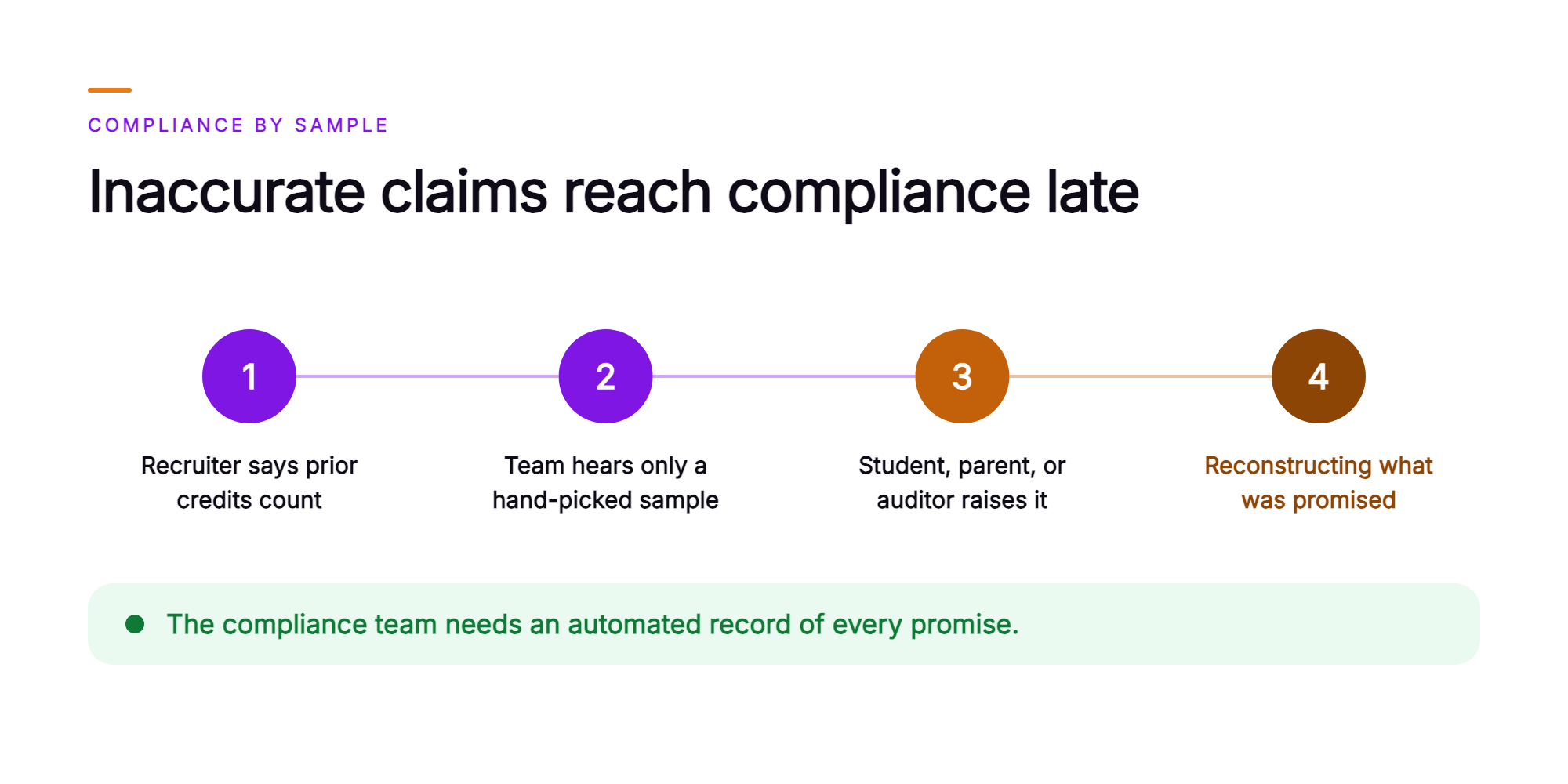
Inaccurate claims reach compliance late because the team only hears the calls it pulls, and a hand-picked sample is a fraction of what was said that week. A recruiter takes a call from an adult learner and, wanting to be helpful, says the prior credits will count. That call might not be reviewed.

Key highlights
- Inaccurate claims reach compliance late because the team only hears the calls it pulls, and a hand-picked sample is a fraction of what was said that week.
- A misrepresentation scan is Auto QA scoring every recruitment call against the institution's own compliance scorecard and approved statements, then flagging statements that depart from them for the compliance team to review.
- Auto QA scores a call by reading its transcript against every line of the institution's compliance scorecard and marking statements that depart from approved wording, with the exact words attached.
- When a representative overstates transfer credit, Auto QA flags the exact sentence against the transfer credit line of the scorecard and routes it to a compliance reviewer with the transcript attached.
- The institution writes every rule on program outcomes and job placement, accreditation, transfer credit, and tuition and financial aid, and Auto QA applies each one to every call and reports what it finds.
- An institution wants the platform built, deployed, and run for it because the compliance problem sits across systems and vendors that the compliance team does not control.
- Four measures tell a compliance leader whether the scan is working, and every one of them comes from the institution's own reporting.
- A compliance leader takes four statements to leadership, each one specific enough to check and plain enough to put to a board, an accreditor, or a regulator.
Why do inaccurate claims on recruitment calls reach the compliance team so late?
Inaccurate claims reach compliance late because the team only hears the calls it pulls, and a hand-picked sample is a fraction of what was said that week. A recruiter takes a call from an adult learner and, wanting to be helpful, says the prior credits will count. That call might not be reviewed.
A compliance team that reviews a hand-picked sample of calls learns about a statement made on any other call only when a student, a parent, or an auditor raises it. By then the statement is months old, the recruiter may have left, and the institution is reconstructing what was promised from memory.
The claims that carry the most weight are those prospective students act on, such as program outcomes, job placement, credit transfer and credential equivalency, accreditation status, and tuition and financial aid. Each one is written down somewhere in approved form.
A misrepresentation is rarely a fabrication. It is a small departure from approved wording, spoken warmly, inside a conversation that otherwise reads as excellent service. That is why a sample is such a thin basis for any misrepresentation audit colleges run on their own recruitment calls. What the compliance team needs is an automated record of every promise made to a prospective student.
What is a misrepresentation scan on recruitment calls?
A misrepresentation scan is Auto QA scoring every recruitment call against the institution's own compliance scorecard and approved statements, then flagging statements that depart from them for the compliance team to review.
The scorecard covers the claim categories the institution sets, including four that draw regulatory attention. Program outcomes and job placement come first, because a recruiter describing what graduates go on to do speaks for the institution, and a prospective student is likely to act on what they hear. Credit transfer and credential equivalency come next, since any promise about prior coursework counting toward a degree is a promise about time and money.
Accreditation status is its own category. There is approved language describing what the institution and each program hold, and the scorecard flags descriptions of that status that depart from it. Tuition and financial aid form the fourth category, covering cost, aid eligibility, and what a student will owe.
How does Auto QA score a recruitment call against the institution's scorecard?
Auto QA scores a call by reading its transcript against every line of the institution's compliance scorecard and marking statements that depart from approved wording, with the exact words attached.
The sequence runs after each call ends. The recording and transcript arrive. Auto QA scores each scorecard line in turn. Each flag carries the exact words spoken and the scorecard line they were scored against, so a reviewer opens the flag and sees the sentence next to its score.
AI admissions call auditing works on meaning, scoring each statement by what it promises the student. Multilingual natural-language understanding reads the statement in context, so a paraphrased promise about transfer credit or job outcomes is scored against the same scorecard line as a scripted one. A recruiter who says the credits will be fine is scored the same way as one who says they will transfer. The governance layer grounds every score in the institution's approved statements, which is what makes a flag defensible when someone asks why it was raised.
Auto QA scores every recruitment conversation, whether human-handled or AI-handled, across all channels the institution runs. The compliance team then reviews each flag and decides the next steps.
What happens when a representative overstates transfer credit on a call?
When a representative overstates transfer credit, Auto QA flags the exact sentence against the transfer credit line of the scorecard and routes it to a compliance reviewer with the transcript attached.
Consider a hypothetical call. A prospective adult learner asks whether the 30 credits earned at a community college eight years ago will count toward the degree. The representative, working from memory and wanting to keep the conversation moving, says they will transfer. In this example, the institution's approved statement says transfer credit is evaluated after official transcripts are received, and that no specific award can be confirmed before that evaluation.
The workflow runs in four steps. Auto QA flags the statement against the transfer credit line. A compliance reviewer opens the flag, reads the sentence in the transcript, and confirms it. The enrollment manager coaches the representative on the approved wording, working from the exact sentence in the recording. The institution then decides whether to send the student a corrected written statement, which is a policy decision the compliance team owns.
Because every recruitment call is scored, the call carrying a statement like this one is already inside the compliance team's review. That is the whole difference between recruitment call compliance by sample and recruitment call compliance by record.
Which rules does the institution set, and what does Auto QA do under each one?
The institution writes every rule on program outcomes and job placement, accreditation, transfer credit, and tuition and financial aid, and Auto QA applies each one to every call and reports what it finds.
- Approved program outcome and job placement statements. Auto QA flags departures from that wording, including implied promises about earnings, employment, or licensure that the approved statement does not make.
- Approved accreditation wording. Descriptions of accreditation status that depart from it, at the institutional or programmatic level, are flagged for review.
- The transfer credit and equivalency policy. Promises of specific credit, a specific number of credits, or a guaranteed equivalency that go past what the policy allows are flagged against the policy line.
- Published tuition and financial aid statements. Departures from published cost, aid eligibility, or net price language are flagged with the sentence spoken.
The same scorecard applies to calls handled by in-house representatives, outsourced recruitment partners, and AI agents working the admissions queue. All three are held to the same approved statements, and every flag lands in the same log.
Judgment stays with the institution. The compliance team reviews each flag and decides the follow-up under its own policy, whether that is coaching, a corrected statement to the student, a change in approved wording, or no action at all.
Why does an institution want the platform built, deployed, and run for it?
An institution wants the platform built, deployed, and run for it because the compliance problem sits across systems and vendors that the compliance team does not control.
When an enrollment operation splits recruitment calls between in-house teams and outside partners, the partner runs its own contact center, its own recording stack, and its own quality process, which means the quality numbers the institution sees are the ones the partner reports. One scorecard applied to both sides changes that. Flags are reviewed by team and by partner, on the same definitions, from the same scorecard lines.
Orvera AI is an agentic AI platform for enterprise customer experience, and Orvera builds, deploys, and runs it on the institution's existing call recording, CRM, and contact center systems. Orvera supports 500+ integrations with enterprise systems of record, and a full enterprise deployment goes live in three to six weeks.
Orvera's education contact center AI work draws on 18+ years of contact center operations experience. The platform audits every conversation, human-handled and AI-handled, across every channel, and is SOC 2 Type II certified, HIPAA compliant, and GDPR compliant. Those controls matter when higher ed compliance calls become part of an audit file.
Which numbers tell a compliance leader the scan is working?
Four measures tell a compliance leader whether the scan is working, and every one of them comes from the institution's own reporting.
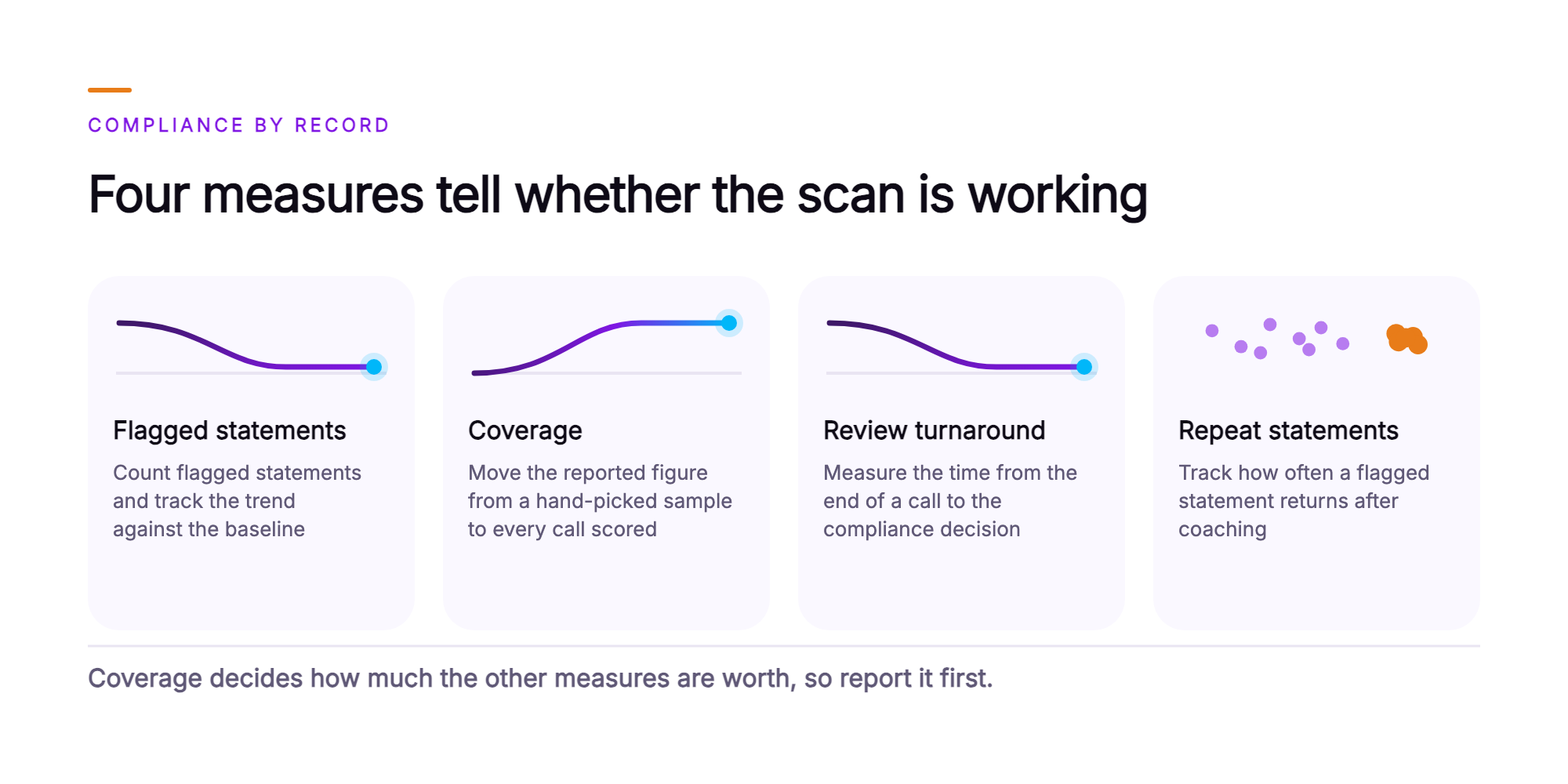
Flagged statements. Count flagged statements across every recruitment call and track the trend against the institution's own starting baseline. The first month sets the baseline. Every month after that shows whether coaching and wording changes are holding.
Coverage. Move the reported figure from a hand-picked sample of calls to every recruitment call scored. Coverage decides how much the other measures are worth, which makes it the figure to report first.
Review turnaround. Measure the time from the end of a call to the compliance team's decision on its flags. Short turnaround is what makes a corrected statement to a student possible while the student is still deciding.
Repeat statements. Track how often a flagged statement returns after coaching or after an update to the approved wording. A statement that keeps coming back usually means the approved wording needs to be clearer.
For the VP of Enrollment Management and the Chief Compliance Officer, these four form a standing view of admissions quality assurance that the institution keeps over time.
What does a compliance leader take to the institution's leadership team?
A compliance leader takes four statements to leadership, each one specific enough to check and plain enough to put to a board, an accreditor, or a regulator.
- Every recruitment call is scored against the institution's own compliance scorecard and approved statements, with the exact words spoken attached to each flag.
- The compliance team reviews each flag and decides what happens next, under the institution's own policy.
- In-house representatives and outsourced recruitment partners are held to one set of approved statements, reviewed on the same scorecard lines.
- Orvera AI builds, deploys, and runs the platform on the systems the institution already operates, with full enterprise deployment live in three to six weeks.
The question leadership asks is whether the institution can show what was said on a specific call to a specific student on a specific date. Having a scored record of every recruitment conversation answers that question. Everything else in the program depends on having it.
What does recruitment compliance look like once every call is scored?
Once every call is scored, recruitment compliance becomes a steady daily working queue.
The compliance team opens a queue of flagged statements each morning, reads each one in the transcript, and clears it or escalates it. Enrollment managers coach representatives on the exact words spoken, which gives each representative a specific sentence to correct. When the same flag repeats across calls and across representatives, the institution treats that as a signal about its own approved statements and updates the wording, then watches whether the flag stops returning.
That steady state keeps judgment with the compliance function. It gives the Chief Compliance Officer the full record of every recruitment call, and that record shows what was promised when a student, a state attorney general, or an accreditor asks. The institution still writes every rule, reviews every flag, and decides every follow-up.
To see how Orvera AI scores every recruitment conversation against your approved statements, talk to the team (opens in a new tab).
Frequently asked questions
Auto QA scores each recruitment call against the institution's own compliance scorecard and its approved statements. Auto QA reads the transcript and marks where the wording on the call departs from what the institution has approved. The scorecard covers the claim types the institution sets, including four that carry misrepresentation exposure: program outcomes and job placement, credit transfer and credential equivalency, accreditation status, and tuition and financial aid. Each one is scored on every recruitment call the institution runs. The same scorecard applies to conversations handled by in-house admissions representatives, outsourced recruitment partners, and AI agents, across voice, chat, email, messaging, and every other channel Orvera runs. Auto QA scores every one of those conversations, human-handled and AI-handled, so an admissions call compliance audit works from a scored record of what was said.
The scorecard flags statements that depart from the institution's approved wording on outcomes, placement, transfer credit, equivalency, accreditation, or tuition and financial aid. A flag indicates a deviation from approved language, scored line by line. Plain-language examples of what gets flagged include a promise that all prior credits will transfer, an accreditation description that departs from the approved statement, a statement about job outcomes that goes past the approved wording, and a statement about financial aid availability that departs from the published one. A flag marks a statement for human review. The compliance team reads each flagged statement and makes the finding, deciding whether it breaks policy, needs coaching, or points to approved language the institution needs to update. That judgment stays with your people.
A compliance reviewer examines the flagged statement in the call transcript alongside the scorecard line it was scored against and decides the next steps. The flag brings the transcript, the score, and the approved wording together, so the reviewer starts from the sentence that was spoken. From there, the institution follows its own policy. Common follow-ups include clearing the flag when the statement matches approved language, confirming the flag and coaching the representative on the exact words to use, sending the prospective student a corrected statement in writing, and updating the approved statement when the policy itself is out of date. When each decision is logged against the call, a college admissions misrepresentation audit can see what was flagged and what the institution decided.
With every recruitment call scored, the review queue reflects the whole recruitment floor, including the calls a hand-picked sample would skip. Sampling shows you the calls you happened to pull. Full coverage shows you the ones you did not. Flags group by statement type, by representative, by team, and by outsourced partner. A single representative repeating an unapproved transfer-credit promise is visible in the same view as a statement repeating across dozens of calls, which usually points at a script or a training gap across the team. Compliance monitoring for admissions calls then tracks four measures: flagged statements across every recruitment call, coverage that moves from a sample to every call, review turnaround, and repeat statements. All four come from the institution's own reporting, ready when a higher education compliance audit asks for them.
Orvera builds the connection into the call recording, contact center, and CRM systems the institution and its recruitment partners already run, drawing on 500+ integrations with enterprise systems of record. Every system stays in place, and Auto QA works from the current recording stack. Recordings and transcripts come in from the existing platform. Scores, flags, conversation summaries, and transcripts appear in the compliance team's review queue and in the reports enrollment and legal already review. Student records stay in the system of record they live in today. The platform is SOC 2 Type II certified, HIPAA compliant, and GDPR compliant, and it keeps full report logs and transcripts for every scored conversation. Security reviewers vetting the platform for student recruitment compliance work get each control named, and documentation goes to the institution's procurement team on request.
Orvera AI builds, deploys, and runs the platform on the institution's existing systems, and a full enterprise deployment goes live in three to six weeks. It is delivered as a managed service, so Orvera operates the infrastructure and the enrollment team keeps its focus on prospective students. The institution provides its compliance policy, scorecard, and approved statements. Orvera handles the build, the integration, onboarding, and change management with the compliance and enrollment teams, backed by 18+ years of contact center operations experience. Orvera is one platform, adopted in stages, so AI agent admissions compliance work can start where the institution needs it and extend as the operation is ready. To scope this against your current QA process, talk to the team.
Written by
Anindita Majumder
Anindita Majumder is a communications professional with nearly four years of experience in public relations, corporate communications, and journalism. She creates content that helps brands communicate their vision, products, and expertise through press releases, thought leadership, and editorial pieces. Outside of work, she is a vocalist, which keeps her creativity flowing.