How an AI Agent Runs Service-Down Triage and Remote Diagnostics for ISPs
Service-down triage fails when the representative on the line cannot read outage, provisioning, and equipment status in a single view before the call ends, and a technician visit becomes the default outcome.

Key highlights
- Service-down triage fails when the representative on the line cannot read outage, provisioning, and equipment status in a single view before the call ends, and a technician visit becomes the default outcome.
- Service-down triage is the process of determining, during a live call, whether a subscriber's outage traces to an area fault, a provisioning gap, customer equipment, or a physical fault that requires a technician visit.
- The provider decides when the agent runs a reset or books a technician visit.
- A VP of Customer Care can make the case for automated fault triage in four operational facts: who owns the rules, what the agent reads and resets, when it books a technician visit, and how Orvera builds, deploys, and runs the agent.
- Once the agent is running, service-down support becomes a continuous loop: each call routes to the outcome the provider's rules set for what the outage, provisioning, and equipment readings show at that moment.
Why do service-down calls turn into truck rolls a remote reset could have cleared?
Service-down triage fails when the representative on the line cannot read outage, provisioning, and equipment status in a single view before the call ends, and a technician visit becomes the default outcome.
A subscriber calls to report that their internet is down. The human representative begins working across separate screens: one for area outage status, another for the account's provisioning state, a third for equipment diagnostics. The caller waits. The rep pieces the picture together manually, and the clock runs.
A service-down call has four possible causes. The fault could be an area outage affecting the subscriber's address. It could be an account or provisioning state that the provider's own team corrects in its systems. It could be customer equipment, a modem, gateway, or ONT, that a remote reset restores. Or it could be a physical fault on the line or at the premises that genuinely requires a technician. Each cause points to a different resolution. But when the cause stays unread until after the call, the path of least resistance is a truck roll.
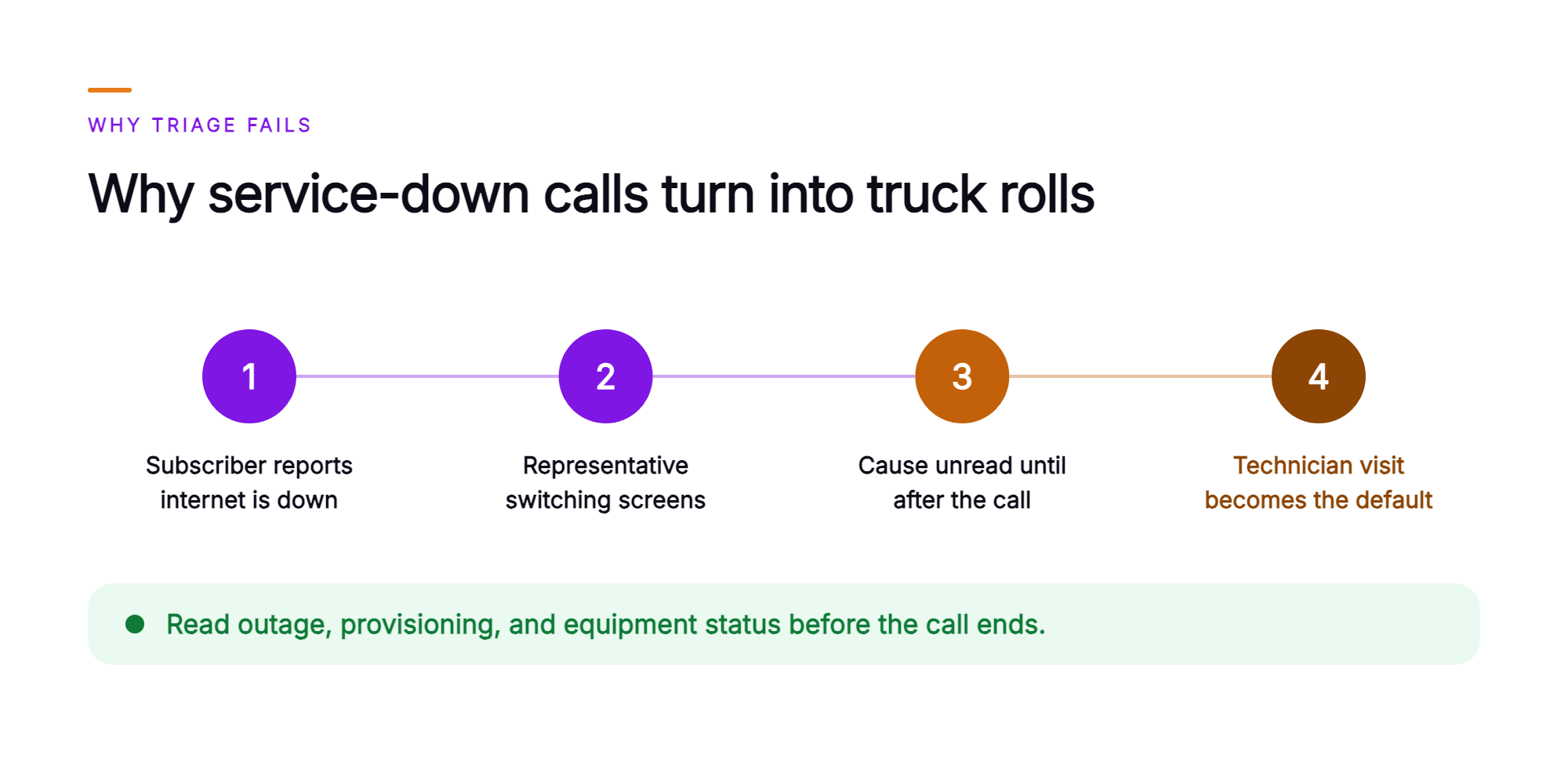
When triage depends on a representative switching between screens under call pressure, the cause that a remote reset would have cleared gets routed to a dispatch queue instead.
The provider's rules define which outcome each fault warrants. Applied to the outage, provisioning, and equipment status the AI agent reads during the call, those rules decide whether the conversation ends in a restored connection, an outage update, the technician visit the fault needs, or a transfer to a human rep with the readings attached.
What are service-down triage and remote diagnostics?
Service-down triage is the process of determining, during a live call, whether a subscriber's outage traces to an area fault, a provisioning gap, customer equipment, or a physical fault that requires a technician visit.
Remote diagnostics is the companion step. An ISP contact center AI agent reads the status the provider's systems report for the modem, gateway, or ONT, then runs the remote reset the provider's troubleshooting policy allows. That read-and-reset sequence happens while the caller stays on the line. The agent then reads the equipment status again, confirms with the caller whether service is back, and books a technician visit when that second reading points to a physical fault.
The two processes are distinct but sequential. Triage narrows the cause. Remote diagnostics confirms it and, when the cause is customer equipment and the provider's policy allows, clears it with a remote reset on the same call.
That division lets a reviewer trace every agent action back to a provider rule. Provider rules stay in the provider's hands. The AI agent implements them.
What does an AI agent do on an ISP service-down call?
On a service-down call, an AI agent runs remote diagnostics by reading the outage, provisioning, and equipment status the provider already maintains, then acts on those readings under the provider's rules with an outage update, a remote reset to restore service, a booked technician visit, or a transfer to a human rep.
The call follows four steps, each performed within the provider's systems:
- Verify the caller. The AI agent confirms the caller's identity against the account on file before any diagnostic work begins.
- Read status. The agent pulls outage status for the service address, provisioning status, and equipment readings. All three are read in one pass, within the same interaction.
- Act on what it reads. When equipment status points to a gateway that a remote reset can clear, the agent runs the reset the provider's policy allows, stays on the line while the device restarts, and reads the equipment status again.
- Close the call. If the second reading confirms service is restored, the agent confirms with the caller. If the reading still points to a physical fault, the agent books a technician visit in the provider's scheduling system with the readings and the reset result attached.
The booking record matters. A technician arriving at a subscriber's address can see what the AI agent already checked and start the visit from that record.
What happens on a service-down call that a remote reset clears?
On a service-down call that a remote reset clears, an AI agent for ISP support verifies the caller, reads the outage and equipment status, runs the reset the provider's policy allows, and confirms service is restored before the conversation ends.
A subscriber reports the internet is down. The AI agent verifies the caller against the account record and checks the address against the outage system. The area is clear. No network fault is affecting that address.
The agent then reads the provisioning record. The service is active and the account is in good standing. The equipment status, however, shows the gateway as unresponsive. That single reading narrows the fault to the device at the subscriber's address.
The agent performs the remote reset specified by the provider's policy for an unresponsive gateway and stays on the line while the device restarts. When the restart completes, the agent reads the equipment status a second time. The gateway is back online. The agent confirms with the caller that the connection is restored and closes the call. The readings, the reset action, and the confirmed restoration all stay in the call record. The fault cleared remotely on a single call, and the queue moves on.
But not every second reading confirms a clean recovery. When the status still points to a physical fault after the reset, the agent books a technician visit with the readings and the reset result attached, so the technician arrives with a documented starting point.
Who decides when the agent runs a reset or books a technician visit?
The provider decides when the agent runs a reset or books a technician visit. The AI agent applies those decisions, call by call.
The troubleshooting and dispatch rules belong to the provider's technical support operation. Broadband support automation works when those rules are the source of record for every call. Orvera AI configures the provider's rules as the provider writes them and executes them against live outage, provisioning, and equipment data.
Each provider rule drives a specific agent action:
- Outage thresholds. When the outage system confirms a network fault at the subscriber's address, the agent tells the caller the status the outage system shows and skips steps that cannot clear a network-level event.
- Reset policy. When no area outage is present, the agent runs the reset the provider's policy allows on the equipment that policy names.
- Dispatch rules. When the readings match the provider's criteria for a physical fault, including after a reset that did not restore service, the agent books a technician visit with those readings attached.
- Escalation path. When the call falls outside the agent's permitted steps, the agent transfers to a human rep with every reading and action already documented.
After each conversation, the provider's technical support team can review every decision in the call record, including what the readings showed at each step and which action the agent took on them. That record makes the operating model auditable, which is what IT and security reviewers check when they assess how the platform operates.
Why would a cable or fiber provider have Orvera build and run the agent?
A cable or fiber provider works with Orvera AI because Orvera builds, deploys, and runs the agent on the outage, provisioning, equipment, and ticketing systems the provider already operates, with full enterprise deployment in three to six weeks.
Orvera AI builds the connections to those systems, drawing on 500+ integrations across enterprise systems of record, so the agent reads outage, provisioning, and equipment status and writes back to the ticket on the provider's own stack. The troubleshooting and dispatch rules the provider's technical support team already owns become the agent's operating instructions from day one. First-contact resolution in telecom, often called first call resolution, depends on that direct connection to the systems of record. When the agent pulls accurate readings and applies the provider's policy, the call closes on the outcome the fault warrants, such as a restored connection, an outage update, or a technician visit booked with the readings attached.
The following checklist covers what IT, security, and operations reviewers typically ask before a deployment proceeds.
- Deployment timeline. Full enterprise deployment in three to six weeks. Orvera's team runs the integration, onboarding, and change management.
- Contact-center experience. Built on 18+ years of contact-center operations, with deep specialization in Voice AI for inbound and outbound calls.
- Audit coverage. Orvera AI audits 100% of conversations, human-handled and AI-handled, across every channel, and scores each one against the provider's own scorecards.
- Compliance posture. SOC 2 Type II certified, HIPAA compliant, and GDPR compliant.
Those four points address the questions reviewers raise before approving a platform that touches subscriber data and live network systems.
Which numbers show the service-down agent is working?
The four measures that confirm the service-down agent is performing are: technician visits booked from service-down calls, first-contact resolution on service-down calls, repeat service-down calls after a remote reset, and technician visits that find a physical fault on arrival.
Each measure connects to a record the provider already keeps, so the results sit in systems its teams use every day.
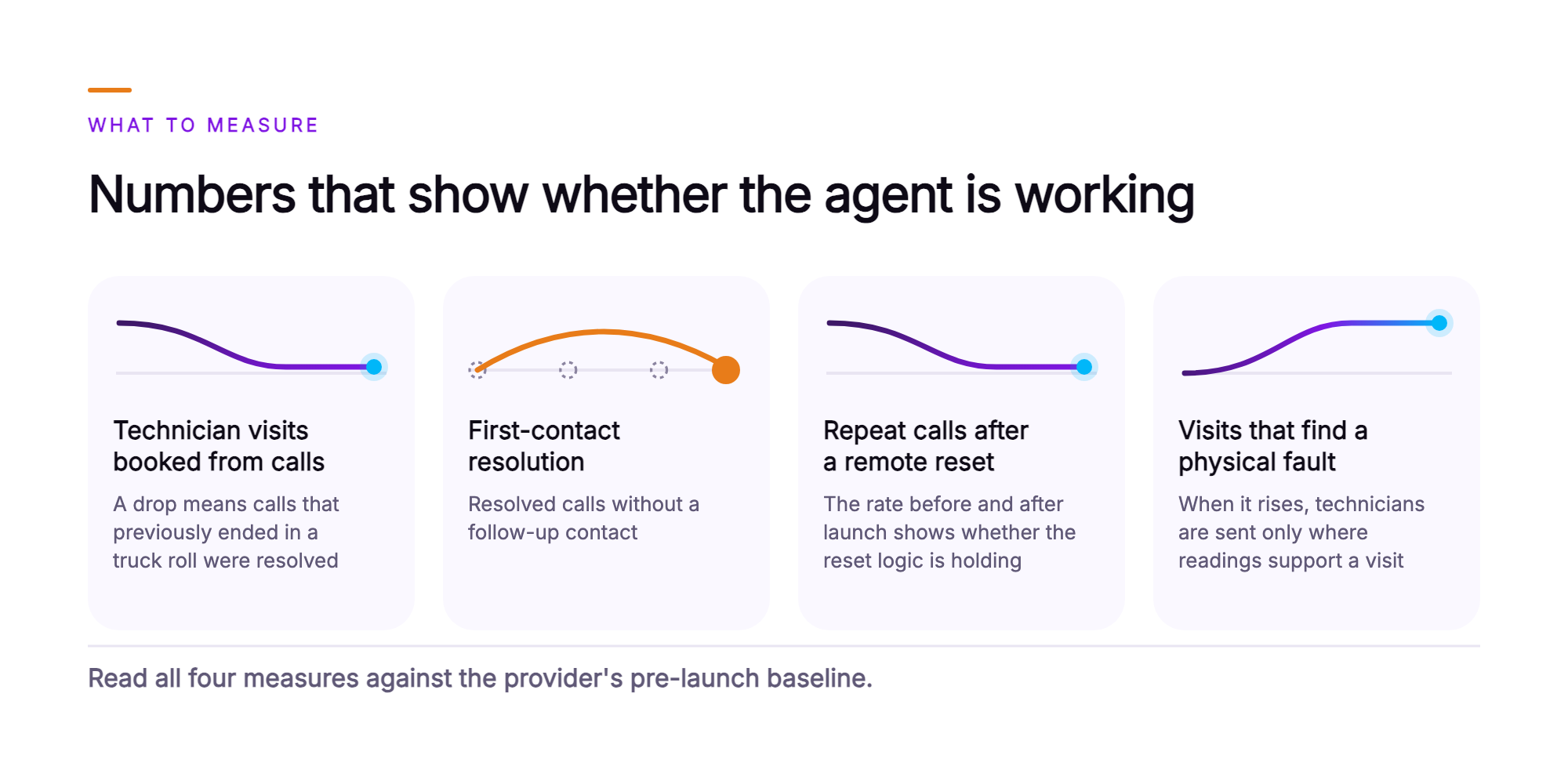
- Technician visits booked from service-down calls. This is the dispatch record. After the agent goes live on network outage triage, read the dispatch volume against the provider's own pre-launch baseline. A drop here means the agent resolved calls that previously ended in a truck roll.
- First-contact resolution on service-down calls. This is the call record. Orvera AI audits 100% of conversations, human-handled and AI-handled, across every channel, so the provider can count resolved calls without a follow-up contact. Read that count against the pre-launch baseline.
- Repeat service-down calls after a remote reset. This measure lives in the ticket and the call record together. A subscriber who calls back within a defined window signals an incomplete resolution, and the rate before and after launch shows whether the reset logic is holding.
- Technician visits that find a physical fault on arrival. This is the dispatch record again, one level deeper. When this rate rises as overall dispatch volume falls, the agent is sending technicians only where the readings support a visit.
Read all four measures against the provider's pre-launch baseline. They draw on three sources: the ticket system, the dispatch record, and the call records Orvera AI audits after every conversation. Those records give the leadership team the numbers to judge the agent.
What should a VP of Customer Care take to the leadership team?
A VP of Customer Care can make the case for automated fault triage in four operational facts: who owns the rules, what the agent reads and resets, when it books a technician visit, and how Orvera builds, deploys, and runs the agent.
First, the provider keeps its troubleshooting policy, dispatch rules, and outage thresholds. The AI agent applies those rules on each service-down call it handles, so the provider's decisions stay in the provider's hands.
Second, the agent reads outage, provisioning, and equipment status during the live call and runs the remote reset the provider's policy allows. Every lookup runs automatically, and the caller stays in the conversation from the first reading to the last.
Third, when the fault readings point to a physical problem, the agent books a technician visit with those readings attached. The technician arrives with a documented starting point, and the booking also carries the result of the remote reset.
Fourth, Orvera AI builds, deploys, and runs the agent on the systems the provider already operates, reaches full enterprise deployment in three to six weeks, and audits every conversation, human-handled and AI-handled, across every channel. The platform is SOC 2 Type II certified, HIPAA compliant, and GDPR compliant. Those four facts give leadership the operational picture and the compliance posture in one briefing.
What does service-down support look like once the agent is running?
Once the agent is running, service-down support becomes a continuous loop: each call routes to the outcome the provider's rules set for what the outage, provisioning, and equipment readings show at that moment.
A caller in an area outage hears the status the provider's outage system reflects, and the call closes on that outage update, leaving technician visits for the faults that need one. A caller whose gateway stopped responding gets the reset the provider's troubleshooting policy allows. When the gateway reads healthy again, the agent confirms the connection on the same call. And when the readings after a reset still point to a physical fault, the field schedule carries a visit with those readings attached, so the technician arrives ready to work.
Orvera's AI agents execute the provider's rules, call by call. AI Quality Management audits every conversation, human-handled and AI-handled, across every channel, and Voice of Customer surfaces the patterns leadership needs to keep the rules current. The provider's troubleshooting policy, dispatch rules, and outage thresholds stay in the provider's hands throughout.
If you are ready to see how this model works on your network systems and contact-center stack, talk to the team (opens in a new tab).
Frequently asked questions
Orvera's AI agents read outage status for the service address, provisioning status for the account, and equipment status for the modem, gateway, or ONT, pulled from the systems the provider already runs. Equipment status means what the provider's own tools report: whether the device is online, when it last registered, and the signal and health readings those diagnostic tools expose. The agent reports each reading as the provider's system holds it. Before any of that happens, the agent verifies the caller against the account using the provider's own identity rules. Only then does it read records or take an action. The whole sequence is remote diagnostics for ISP support performed inside the provider's systems, with the agent reading the device's own status while the subscriber stays on the line.
The agent reads the outage, provisioning, and equipment status first, then runs a remote reset when those readings meet the reset conditions in the troubleshooting policy. The provider sets those conditions, and the agent applies them. The agent stays on the line through the restart, reads the equipment status again, and confirms with the caller whether service is back before the call ends. In cable modem troubleshooting, that second reading verifies the result of each reset the agent runs. When the second reading still points to a physical fault, the agent books a technician visit under the provider's dispatch rules.
The agent books a technician visit when the readings point to a physical fault on the line or at the premises, under the provider's dispatch rules. Signal levels outside tolerance after a reset, or a device that fails to re-register, are the kind of readings those rules weigh when deciding on a visit. The booking happens in the provider's scheduling system during the call. The agent attaches the readings it took and the reset result to the ticket, so the technician arrives knowing what was already checked. When the outage system shows an area outage at the address, the agent skips the reset path entirely and tells the caller the outage status the system holds, including the restoration window when one is recorded.
Every call produces a transcript, a summary, and a report log, and AI Quality Management audits 100% of conversations, human-handled and AI-handled, across every channel. Calls the AI agent handled and calls a person handled land in one review, scored against the provider's own scorecards. The record shows what the agent read, which reset it ran, and whether it booked a visit. Your technical support leads can review each decision against your own policy and see where the policy itself needs adjusting. This is what makes ISP technical support AI auditable on every call. When a call moves to a human rep, AI Agent Assist hands that rep the call summary with the readings and the steps already taken, so the rep picks up the triage where the agent left it.
Orvera builds and runs the connections to the systems the provider already operates, drawing on 500+ integrations across enterprise systems of record. The provider's current systems stay in place, and every read comes from them. Service-down triage touches four functions. The agent reads area status from the outage system and account status from the provisioning system. It reads device health from, and issues the remote reset through, the equipment management system. It books visits in the ticketing and field scheduling systems. Access is governed throughout. The platform is SOC 2 Type II certified, HIPAA compliant, and GDPR compliant, and every action the agent takes is logged against the account it touched.
Orvera builds, deploys, and runs the agent on the systems the provider already operates, and full enterprise deployment lands in three to six weeks. Orvera's team leads the integration, onboarding, training, and change management for your support floor. You set the troubleshooting policy, the dispatch rules, and the outage thresholds the agent applies. Orvera configures them and runs them. It is one platform, adopted in stages, so an AI voice agent for telecom triage can go live on the highest-volume queue before broadband customer support AI extends to chat, email, messaging, and every other channel the provider runs. Orvera brings 18+ years of contact-center experience to the rollout. To see the diagnostic workflow against your own stack, talk to the team.

Written by
Anindita Majumder
Anindita Majumder is a communications professional with nearly four years of experience in public relations, corporate communications, and journalism. She creates content that helps brands communicate their vision, products, and expertise through press releases, thought leadership, and editorial pieces. Outside of work, she is a vocalist, which keeps her creativity flowing.