How an AI Agent Confirms Arrival Windows and Reschedules Residential Service Visits
Residential service visits still end in failed stops because the reminder that goes out before them records an answer without being able to change the appointment. A customer confirms a Tuesday morning window on Friday, their week shifts over the weekend, and the reminder gave them no way to...

Key highlights
- Residential service visits still end in failed stops because the reminder that goes out before them records an answer without being able to change the appointment.
- An appointment confirmation and arrival window call is an outbound call placed before a scheduled service visit that states the service, the address, the date, and the arrival window, and asks the customer to confirm or move it.
- On a confirmation call, the AI agent places the outbound dial, states the visit and its arrival window, understands the customer's spoken answer, and acts on that answer against the live schedule.
- One confirmation call runs from the outbound dial through the customer's answer to a written record in the scheduling system, all inside a single conversation.
- The service company sets every scheduling rule, and the AI agent takes only the actions those rules permit.
- A residential service company wants the platform built and run for it because the hard part is the integration into the scheduling and routing systems that already govern the route, and the governance the security reviewer will ask about.
- Four measures tell an operations leader whether confirmation calls are doing scheduling work, confirming and moving visits on the live route.
- An operations leader takes four points to the leadership team, each tied to the route, the schedule, or the review the IT team will run.
Why do scheduled residential service visits still end in failed stops?
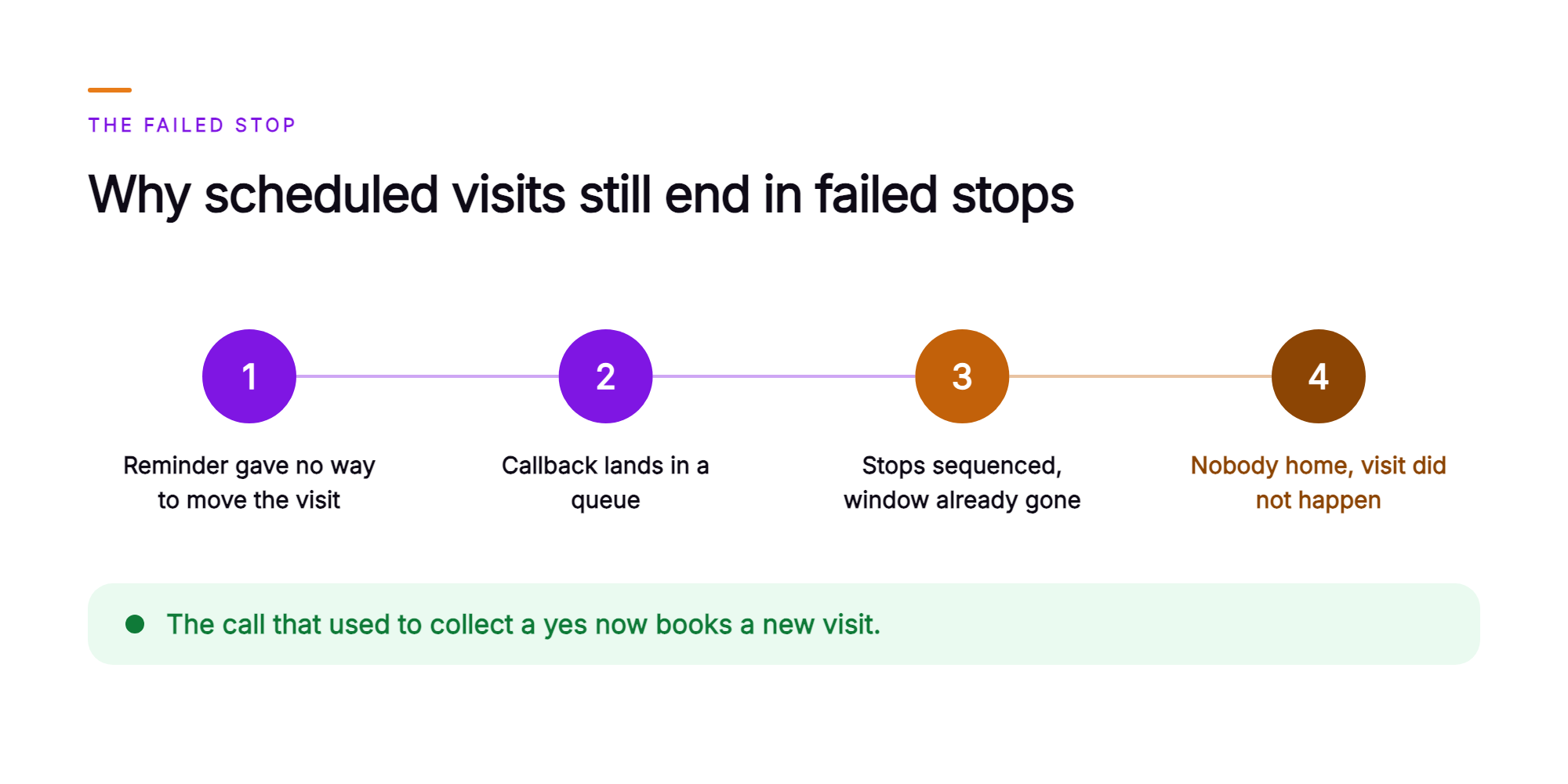
Residential service visits still end in failed stops because the reminder that goes out before them records an answer without being able to change the appointment. A customer confirms a Tuesday morning window on Friday, their week shifts over the weekend, and the reminder gave them no way to move the visit.
The mechanism is simple. A service appointment confirmation that only collects a yes leaves the customer who cannot make the arrival window with one option, which is to call back later. That callback lands in a queue behind inbound service requests, billing questions, and new sales. By the time a human rep returns it, the day's stops are already sequenced and the window the customer wanted is gone.
The other path is worse for the route. The customer calls early that morning and cancels, which reaches dispatch after the route is locked, the technician is loaded, and the drive time is already committed.
What the operations leader sees when the day's routes close is familiar. A technician drove to a house where nobody was home, the subscription visit did not happen, and an open slot sat on that route that another customer on the same street would have taken. Both losses came from the same confirmation touchpoint.
What is an appointment confirmation and arrival window call?
An appointment confirmation and arrival window call is an outbound call placed before a scheduled service visit that states the service, the address, the date, and the arrival window, and asks the customer to confirm or move it. It is a scheduling action, and its result is written into the schedule the technician works from.
The call works inside boundaries the service company owns. The route plan, the technician schedule, the length and timing of each arrival window, and the rules governing how a visit may be rescheduled all belong to the company and live in its scheduling and routing systems. An arrival window confirmation operates under those rules, reading the current plan and acting only where the plan allows.
That scope defines the two outcomes a confirmation call should end on. Either the visit is confirmed as scheduled and the route stands, or the visit is moved during the same call into a slot the live route can actually take. Anything between those two, a voicemail, a logged yes that later turns into a no, or a promise that a human rep will call back, leaves the route carrying a stop that may not happen.
The value of the call is decided by whether it can handle the customer who says no.
What does the AI agent do on an appointment confirmation call?
On a confirmation call, the AI agent places the outbound dial, states the visit and its arrival window, understands the customer's spoken answer, and acts on that answer against the live schedule. It completes the confirmation or the reschedule inside that same call, and hands anything outside the appointment to the company's team.
The sequence runs in order. The AI agent dials the customer ahead of the visit and states the service, the date, and the arrival window by voice. It then listens to whatever the customer actually says, which may be a plain yes, a question about when in the window the technician will arrive, a request for a text copy of the details, or a statement that the window will not work.
When the window will not work, the agent reads the open slots from the live route state in the residential service dispatch software the company runs. It offers only the slots the company's rescheduling rules permit, takes the customer's choice, and books it while the customer is still on the line.
What does one confirmation call look like from dial to write-back?
One confirmation call runs from the outbound dial through the customer's answer to a written record in the scheduling system, all inside a single conversation.
Take a homeowner on a quarterly pest control plan, the kind of route where customer reminders go out the day before the visit. She is scheduled for a Tuesday morning arrival window. The AI agent calls, states the service, the address, and the window, and she answers that she will be at work Tuesday morning and cannot be home. The agent checks the live route state, finds the slots the company's rescheduling rules allow for her service type and address, and offers her two windows later that week. She takes Thursday afternoon. The agent confirms the service, the date, and the new window back to her, and the call ends.
The record is what makes the call count. The agent writes the Thursday appointment into the scheduling system, and the Tuesday slot releases on the route before dispatch sequences that day's stops. A technician who would have driven to an empty house now has a window the company can fill, and a subscription visit that would have been missed is on the calendar with the customer's agreement behind it.
Which scheduling rules does the company set and which actions does the agent take?
The service company sets every scheduling rule, and the AI agent takes only the actions those rules permit. The route, the windows, and the rescheduling policy stay exactly as the company set them when an AI agent makes the call.
- The company defines the arrival windows and publishes them on the scheduling record. The agent states that window to the customer exactly as the record shows it.
- The company decides which slots can absorb a rescheduled visit, how far out a visit may move, and whether same day rescheduling is permitted for a given service type. The agent offers only slots inside those limits.
- The company owns the write-back rules for its scheduling system. The agent books the confirmed or rescheduled appointment under them, so dispatch sees one authoritative record.
- The company sets who handles anything outside the appointment itself, from billing disputes to service complaints to plan changes. The agent routes those requests to the company's team under the company's own handoff rules and passes along the context from the call, so the human rep picks up where the conversation stopped.
A second example shows the range. A lawn care customer confirms her window as scheduled, then asks whether the technician needs the side gate unlocked. The agent answers from the visit notes the company already keeps on that property, and the call ends confirmed, with the gate question settled before the technician arrives.
Why would a residential service company want the platform built and run for it?
A residential service company wants the platform built and run for it because the hard part is the integration into the scheduling and routing systems that already govern the route, and the governance the security reviewer will ask about.
Orvera AI is an agentic AI platform for enterprise customer experience, and Orvera does the build, the deployment, and the integration on the stack the enterprise already runs, with 500+ integrations available into CCaaS, CRM, and systems of record. A full deployment goes live in three to six weeks. Confirmation work runs outbound, against the live route, and it writes back to the schedule.
Orvera brings 18+ years of contact-center experience to the build, and the agent's natural-language understanding and agentic planning handle the customer who hesitates, the customer who asks a question mid-answer, and the customer who wants a different week.
Governance is built in. AI Quality Management audits every conversation, human-handled and AI-handled. The platform runs on approved-knowledge grounding with explicit controls and full auditability, and it is SOC 2 Type II certified, HIPAA compliant, and GDPR compliant.
Which numbers tell an operations leader the confirmation calls are working?
Four measures tell an operations leader whether confirmation calls are doing scheduling work, confirming and moving visits on the live route. Each one is read against the company's own baseline before the program started.
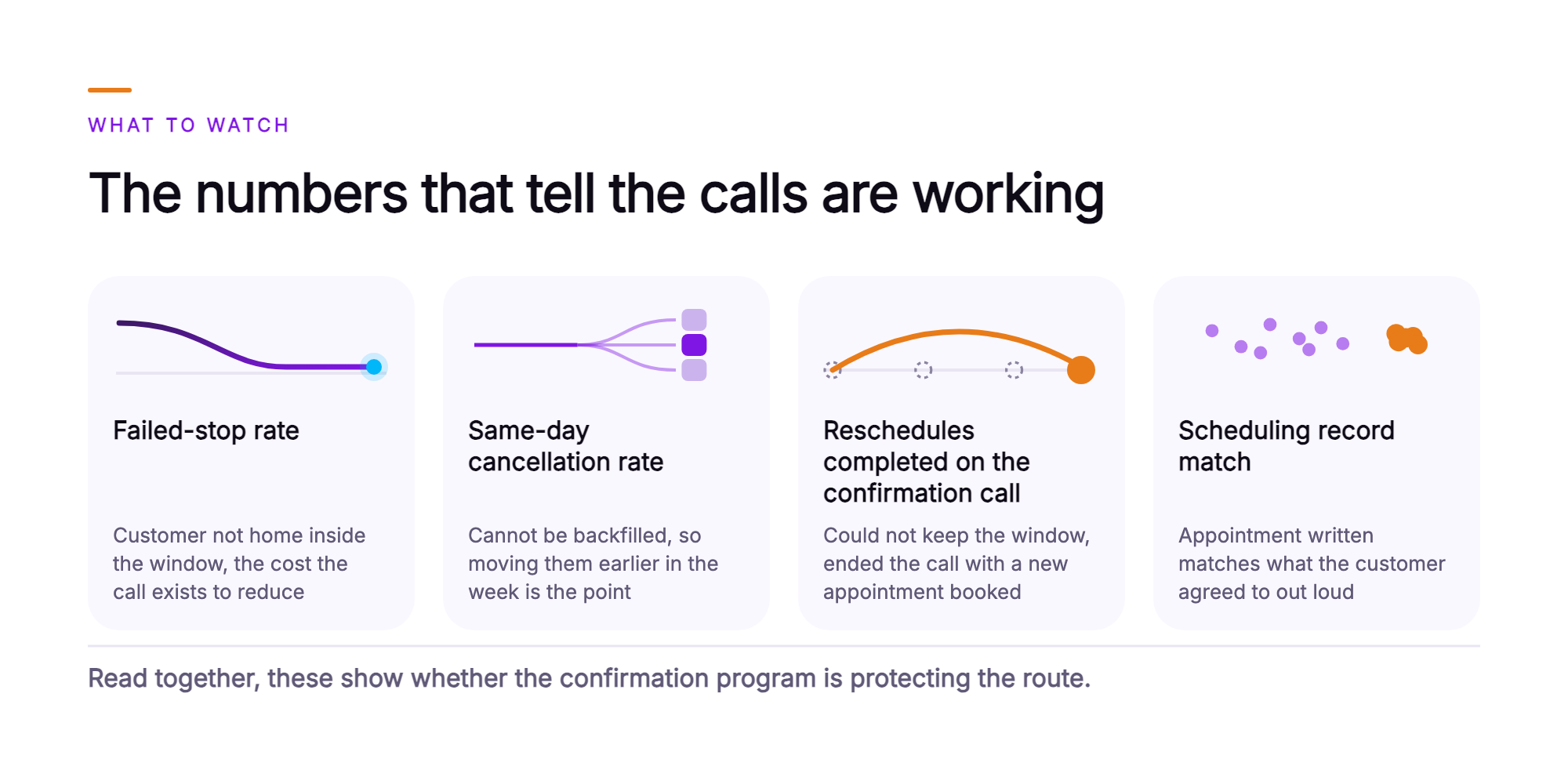
- Failed-stop rate. The share of visits where the technician arrives inside the window and the customer is not home. This is the cost the confirmation call exists to reduce, measured in drive time, technician hours, and a subscription visit that did not get delivered.
- Same-day cancellation rate. The share of visits cancelled after the route for that day is set. Cancellations that arrive this late cannot be backfilled, so moving them earlier in the week is the point of the call.
- Reschedules completed on the confirmation call. The share of customers who could not keep their window and ended the call with a new appointment already booked. A low number here means the call is still handing work to the callback queue.
- Scheduling record match. The share of calls where the appointment written into the scheduling system matches what the customer agreed to out loud, checked when conversations are reviewed. This is the integrity measure that dispatch and the audit team both care about.
Read together, these four show whether the confirmation program is protecting the route.
What does an operations leader take to the leadership team?
An operations leader takes four points to the leadership team, each tied to the route, the schedule, or the review the IT team will run.
- The confirmation call becomes the moment a visit is either locked or moved, inside the company's own scheduling rules, with the move booked on that same call.
- The AI agent reschedules against the live route state and writes the result back to the scheduling system, so the route and the technician's schedule reflect the customer's answer when the call ends.
- The company keeps the route plan, the arrival windows, the rescheduling limits, and the handoff rules, and the AI agent acts only inside them. Dispatch authority stays with the company.
- Deployment goes live in three to six weeks on the systems the company already runs, with AI Quality Management auditing every conversation, human-handled and AI-handled, under approved-knowledge grounding and full auditability.
The business case is read on failed stops, same-day cancellations, and the share of reschedules that close on the first call. All three trace back to one change: the call that used to collect a yes now books a new visit when the customer cannot keep the old one.
What does the schedule look like once the AI agent runs confirmation calls?
Once the AI agent runs confirmation calls, the schedule the dispatcher opens in the morning carries the answers customers gave on those calls.
The steady state is straightforward. Customers confirm or move their visit on one call, the scheduling system carries the outcome straight from the call, and routes are sequenced around households that said they will be home. Reschedules land before the route is locked, which gives dispatch room to fill the released slot with another stop in the same area.
Of the four measures, failed-stop rate and same-day cancellation rate are the two read directly on the route, which is where the cost of a missed visit is actually paid.
To review how Orvera AI would run confirmation and rescheduling calls on your scheduling and routing stack, talk to the team (opens in a new tab).
Frequently asked questions
The customer hears the company name, the service booked, the service address, the date, and the arrival window, followed by a request to confirm. That sequence answers the questions customers most often ask about a service appointment before they ask them, and it works the same whether the visit is a quarterly pest treatment, a lawn care appointment, or a home security appointment. From there the customer answers in their own words. Orvera's AI agent confirms the visit, answers a timing question with the arrival window exactly as the scheduling record shows it, or offers to move it. Where the company's visit notes carry prep instructions, the call states them: secure the dog, clear the side gate, leave the gate code.
The AI agent reads open slots from the live route state in your scheduling system at the moment of the call, so every slot offered reflects the route as it stands right then. If a technician appointment confirmation turns into a reschedule, the customer is offered real capacity, on the real route, for the territory that covers their address. The agent offers only the slots your rescheduling rules allow. Whatever limits your company sets on notice, service type, or technician skill constrain what the customer hears. When the customer picks a slot, the AI agent books it in the same call. The new appointment is written to the route while the customer is still on the line. A reschedule handled this way ends the conversation with a committed slot, and a committed slot is what protects the route.
The outcome is written to the scheduling system you already run. A confirmed visit is marked confirmed. A moved visit carries the new date and arrival window, along with any note the customer gave on the call, such as a gate code or a pet on the property. Your dispatchers and your office team work from the record the agent updated, so confirmation results land where the day is planned. Write-back is what turns the confirmation call into scheduling work, because the route changes when the record changes.
The AI agent routes the request to your team under your own handoff rules. Billing disputes, contract changes, damage claims, and service complaints are common on these calls, and pest control customer questions in particular often extend to treatment coverage or warranty terms. The handoff includes the full context from the call: who the customer is, what appointment was discussed, and what they asked for. Your rep picks up the request where the customer left it, with the call summary and transcript in hand. Where the rep takes over, AI Agent Assist surfaces approved knowledge and the next action while the conversation is live.
Orvera does the integration work into the scheduling, routing, and CRM systems you already run, drawing on 500+ integrations across CCaaS, CRM, helpdesk, and enterprise systems of record. Your team grants the access, and the build is Orvera's job. A full enterprise deployment goes live in three to six weeks, and enablement spans onboarding, knowledge-base setup, agent training, and change management. Your service call confirmation checklist, your arrival windows, and your rescheduling rules are configured as they exist today, so the platform runs on your current rules from the first call.
AI Quality Management audits every conversation, human-handled and AI-handled, against the scorecards your evaluators already use. Most operations score a one to three percent sample, which leaves nearly every confirmation call unreviewed. Reviewers check one thing closely on this call type: that the appointment written back to the scheduling system matches what the customer actually agreed to. Every call carries a transcript, so that check runs against the customer's own words. Approved-knowledge grounding keeps what the agent says on confirmation calls tied to your own rules and visit notes. Full auditability means every call is traceable, and Orvera AI is SOC 2 Type II certified, HIPAA compliant, and GDPR compliant. To see how this connects to your scheduling stack, or to scope a single service line first, talk to the team.

Written by
Anindita Majumder
Anindita Majumder is a communications professional with nearly four years of experience in public relations, corporate communications, and journalism. She creates content that helps brands communicate their vision, products, and expertise through press releases, thought leadership, and editorial pieces. Outside of work, she is a vocalist, which keeps her creativity flowing.