Cognigy Alternatives for Enterprise CX: 4 Platforms to Compare in 2026
Alternatives are worth comparing when an enterprise needs more than a conversational interface. The decision covers...

Key highlights
TL;DR — In a Nutshell
- Cognigy alternatives should be evaluated on workflow completion, context continuity, human-agent support, AI governance, and enterprise system integration rather than feature count alone
- The 2026 comparison covers Orvera AI, PolyAI, Kore.ai, and Parloa, with each taking a different approach to enterprise AI conversations, workflow execution, agent support, governance, and deployment
- Orvera combines agentic AI, human-agent support, AI Auto QA, Voice of Customer, reporting, and workflow execution within one enterprise CX platform
- Orvera connects conversation quality with operational evidence, allowing teams to measure whether promised actions such as case updates, refunds, follow-ups, or callbacks were actually completed
- Enterprise buyers should examine AI action controls, human approval paths, system access, auditability, and evidence traceability, especially for regulated CX workflows
- Choosing a Cognigy alternative ultimately involves comparing how each platform completes workflows, preserves context, supports human agents, governs AI actions, measures quality, and operates after deployment
Alternatives are worth comparing when an enterprise needs more than a conversational interface. The decision covers how AI agents complete customer workflows, how voice and digital conversations stay connected, how human agents are supported, how AI actions are controlled, and how the platform fits into existing business systems.
Cognigy, presented as NiCE Cognigy across its current product pages, is an enterprise CX AI platform with agentic AI, voice and digital channels, workflow orchestration, Agent Copilot, enterprise integrations, and AI-to-human handoffs. NiCE is also bringing Cognigy deeper into its wider CX AI portfolio.
Teams looking for the best alternatives to Cognigy should therefore compare operating models as carefully as product features. The shortlist should answer a practical question: what happens from the moment a customer asks for something to the moment the work is completed, recorded, measured, and, when required, transferred to a person?
For a wider market view, see our guide to best conversational AI platforms (opens in a new tab).
What Does Cognigy Offer Enterprise CX Teams?
Cognigy gives enterprise teams a broad set of capabilities for building and operating AI-driven customer interactions. Understanding that scope first makes the alternatives comparison more useful.
Agentic AI agents and workflow execution
In practical terms, agentic AI means the AI can decide which steps to take, use approved tools, and perform actions within the systems connected to it.
NiCE Cognigy's current Agentic AI offering combines model reasoning, enterprise context, knowledge grounding, structured workflows, and tool use. Its AI agents can break a customer request into steps and invoke tools for tasks such as authentication, bookings, payments, and record updates. It also supports a mix of model-driven decisions and deterministic processes when an enterprise needs tighter control over part of the interaction.
The platform also supports collaboration between AI agents and handoff to human agents with contextual memory. For buyers, this means Cognigy belongs in evaluations where the AI needs to move beyond answering questions and participate in an operational workflow.
Voice, chat, and digital channels
Cognigy operates across voice and digital interactions. Its platform material covers phone, web, messaging, live chat, and other digital channels, with more than 30 omnichannel connectors listed across its enterprise offering.
Channel coverage matters because a customer journey rarely follows one interface from beginning to end. A customer may begin in chat, continue through voice, and eventually need a human agent. Cognigy's current product material also describes shared context across multimodal and hybrid journeys, including voice, visual interfaces, structured forms, and backend workflows.
An enterprise comparison should therefore examine how context travels between channels, whether the customer has to repeat information, and how the platform handles both inbound and outbound use cases.
Agent Copilot for human agents
Cognigy's scope also reaches the people handling live customer conversations.
Agent Copilot provides real-time support inside the agent experience. Cognigy describes capabilities including relevant knowledge, next-best actions, suggested responses, customer history, live translation, summaries, and CRM updates. It operates across voice and digital channels.
Cognigy in the current NiCE product portfolio
NiCE acquired Cognigy in September 2025 and has continued bringing the technology into its broader CX AI strategy. Current NiCE material describes NiCE Cognigy alongside CXone, with a September 2026 deployment at AOK PLUS connecting NiCE Cognigy AI agents with CXone-supported member service operations.
NiCE has also continued releasing Cognigy-specific capabilities during 2026, including agent testing, agent development, multimodal journeys, and deeper orchestration across systems.
For buyers, the next question is therefore less about matching individual features and more about choosing the operating model and controls that fit their CX environment.
How to Evaluate the Best Alternatives to Cognigy
The best alternatives to Cognigy depend on what an enterprise expects the platform to accomplish after the conversation starts. Four areas deserve particular attention.
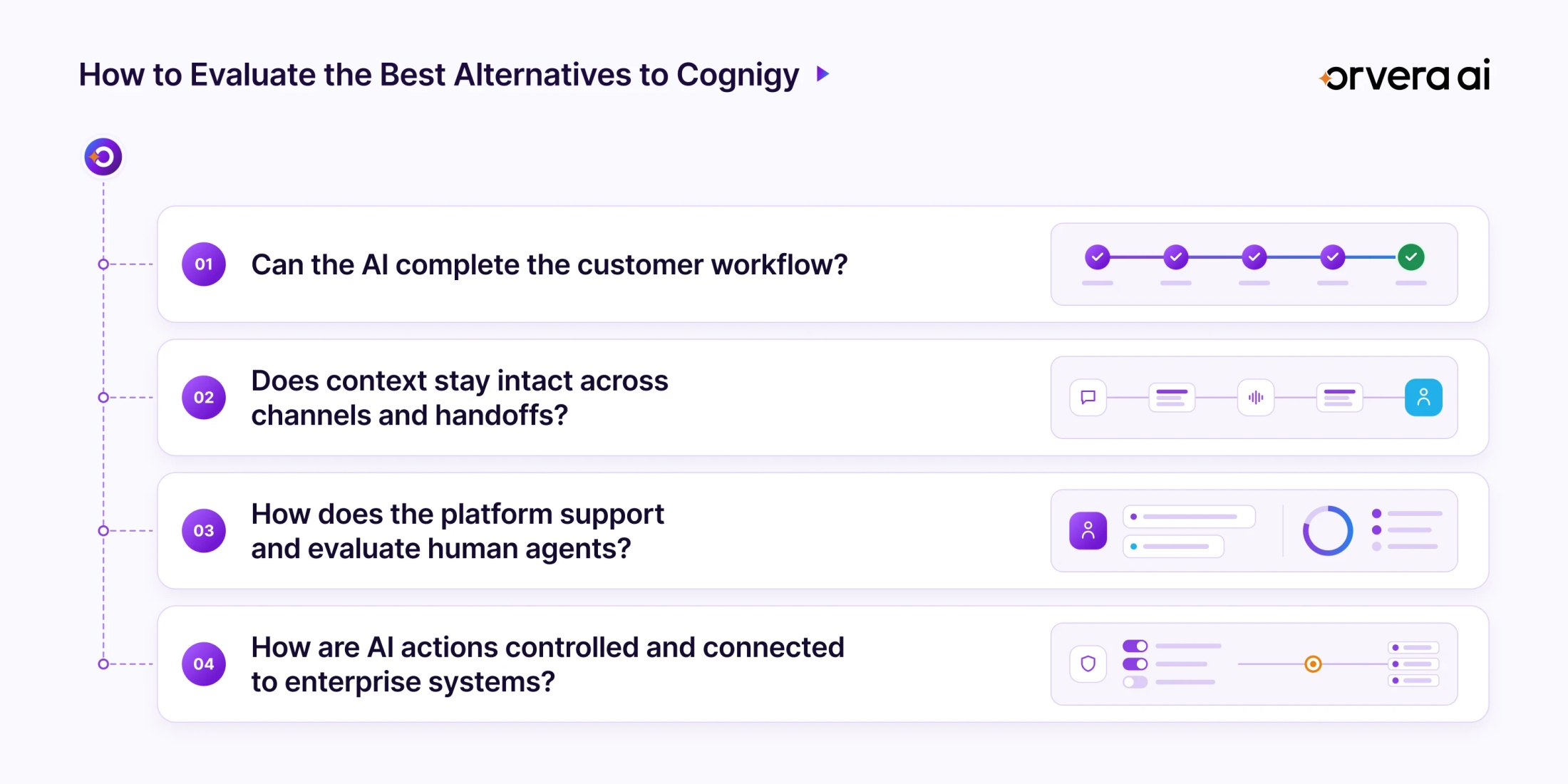
Can the AI complete the customer workflow?
Start with the work the customer expects to finish.
Suppose a customer asks about an order. Answering where the order is located is one part of the interaction. The wider workflow could require identity checks, retrieval of the latest order record, a delivery change, an update to the system, and confirmation back to the customer.
Ask how the AI understands intent, retrieves information, uses connected systems, handles required approvals, records actions, and transfers the conversation when a person needs to take over. The strongest demo is one built around a real customer workflow, not a scripted question-and-answer exchange.
For more on this evaluation, see reasons to switch AI voice agents (opens in a new tab).
Does context stay intact across channels and handoffs?
Channel coverage tells you where an AI agent operates. Continuity tells you what happens when the customer moves.
A buyer should test whether a conversation that starts in chat can continue in voice with the previous context intact. If the interaction reaches a person, the human agent should receive the information needed to continue the work, including the conversation history, a summary, and the next step.
The same test applies in the other direction. Enterprise workflows can include inbound service, outbound follow-up, asynchronous messaging, and multiple interactions over time. The platform should make clear how context is retained through those changes.
How does the platform support and evaluate human agents?
AI adoption does not remove the human side of an enterprise CX operation. Some conversations require judgment, approval, or direct human involvement.
Evaluate what support agents receive while the interaction is live. Useful areas include next-best-action guidance, approved knowledge, conversation summaries, writing assistance, coaching, and customer context.
Then examine quality. Ask which conversations are evaluated, how the scoring criteria are configured, how supervisors inspect the evidence behind a score, and whether customer themes and recurring contact drivers can be identified across the conversation base.
How are AI actions controlled and connected to enterprise systems?
Governance becomes easier to evaluate when it is translated into specific controls.
Ask what tools an AI agent is allowed to call, which parameters it can use, when a person must approve an action, how access is limited, and what gets logged after an action occurs.
Then map those controls to the systems involved in the workflow. That may include CRM, CCaaS, helpdesk, billing, order management, scheduling, payments, or an industry-specific system.
The final operational question is who builds and tests those workflows, who connects the systems, who manages changes after go-live, and who operates the platform once customer traffic begins.
4 Cognigy Alternatives for Enterprise CX in 2026
Four platforms belong on an enterprise shortlist for different reasons. The useful comparison is how each approaches customer conversations, workflow execution, human-agent support, governance, and ongoing operation.
1. Orvera AI
Orvera AI is an agentic AI platform for enterprise customer experience, built, deployed, integrated, and run by Orvera on the customer's behalf. It combines agentic, omnichannel AI agents with a human-agent layer in one platform.
The first layer runs AI conversations across voice, chat, and digital channels. The agents plan steps, use connected systems, take permitted actions, and drive the interaction toward an outcome. Voice is Orvera's deepest specialization within that broader CX surface.
The second layer supports human-handled conversations through Agent Assist, AI Auto QA and QM, Voice of Customer, and reporting. Agent Assist provides capabilities such as next-best actions, approved knowledge with citations, real-time summaries, translation, coaching, and updates to systems of record. Orvera audits 100% of AI-handled and human-handled conversations across every channel. Voice of Customer analyzes those conversations for themes, contact drivers, sentiment, and CX signals.
Orvera also connects quality measurement to operational action. A QA criterion can evaluate what happened in the conversation and whether the promised action appears in the customer's CRM or case system. That creates a direct link between what an agent said and what was completed afterward.
At the architecture level, Orvera orchestrates best-in-class third-party models inside its own governed enterprise layer.
For enterprises assessing omnichannel AI agents (opens in a new tab), the useful demo question is whether the platform can complete one of their real workflows from customer request through system action, human involvement when required, and quality measurement afterward.
Customer deployments and approved proof can be explored through Orvera's case studies (opens in a new tab).
2. PolyAI
PolyAI positions its offering as an Agentic Dialog Platform for building, running, adapting, and governing dialog agents at enterprise scale. Its current platform messaging places complex enterprise conversations at the center of the product.
The platform offers a visual environment for enterprise builders as well as developer tooling. PolyAI emphasizes conversational agents that handle demanding dialog, particularly voice interactions, while supporting enterprise teams that want different levels of control over how agents are created and managed.
For a buyer, the useful demo is a complex customer conversation with interruptions, changing intent, backend actions, and escalation. The evaluation should then examine how the dialog agent is built, tested, governed, and connected to the wider CX operation.
For a deeper comparison, see Orvera vs. PolyAI (opens in a new tab).
3. Kore.ai
Kore.ai's AI for Service portfolio spans AI agents, Agentic Contact Center capabilities, Agent AI for human-agent assistance, Quality AI, voice AI agents, conversation intelligence, and outbound campaigns.
Its customer-service offering covers self-service and agent support in the same broader portfolio. Agent AI provides summaries, guidance, and coaching for human agents. Quality AI provides automated evaluation across voice and chat interactions. Kore.ai also offers proactive outreach across voice and digital channels.
An enterprise evaluating Kore.ai should bring the same workflow into the demo that it uses for every vendor. Follow the request from first customer contact through the systems involved, agent assistance, quality evaluation, and any outbound follow-up required.
4. Parloa
Parloa positions its AI Agent Management Platform around the lifecycle of enterprise customer-service AI agents. Its current platform covers agent design, integration, simulation, evaluation, deployment, monitoring, and improvement.
Parloa supports voice, chat, messaging, click-to-call, and multimodal interactions. Its platform also includes enterprise CX integrations, agent composition, model orchestration, testing tools, monitoring, and conversation data capabilities.
Recent additions such as Parloa Navigator and Parloa Lens focus on building, troubleshooting, monitoring, and improving AI agents in production. Parloa also provides centralized audit logs that record platform and configuration events.
A buyer evaluating Parloa should test the full agent lifecycle. Start with how the agent is designed and connected, then examine how the team tests it before release, observes live conversations, identifies failures, and changes agent behavior after deployment.
Why Orvera AI Belongs on a Cognigy Alternative Shortlist
Orvera's place on this shortlist comes from how it connects AI conversations, human-agent operations, quality measurement, enterprise systems, and deployment work into one operating model.
AI agents and human-agent support run as one operation
Orvera has two layers inside one platform.
Layer 1 handles customer conversations through agentic AI agents across voice, chat, and digital channels. Layer 2 supports the people who continue handling customer interactions through Agent Assist, AI Auto QA and QM, Voice of Customer, and reporting.
The practical connection between those layers is context. When an AI-handled conversation reaches a human agent, the handoff carries a structured summary and next steps. The human receives what has already happened instead of rebuilding the interaction from the beginning.
Quality also spans the two populations. AI-handled and human-handled conversations can be evaluated against the same quality framework. That gives CX leaders one basis for examining how customer interactions are being handled across the operation.
The platform tracks whether the promised work was completed
A conversation can sound correct while the operational task remains unfinished.
An agent may promise a callback that never gets scheduled. A refund may be discussed but never applied. A case may be resolved verbally while the system record remains unchanged.
Orvera's quality layer can evaluate the conversation and the customer's operational record together. Action criteria can inspect evidence such as a disposition being logged, a case being created or updated, a follow-up task being raised, a credit or refund being applied, or a callback being scheduled.
This gives the quality team a more concrete question to answer. Did the interaction follow the expected process, and did the promised work appear in the system where completion is recorded?
AI actions have explicit controls
When an AI agent can act inside a CRM, billing platform, or order-management system, the enterprise needs clear limits around those actions.
Orvera's governance layer uses tool and action allowlists to control which functions an agent can call. Parameter constraints limit how those tools are used. Least-privilege execution restricts what the agent can access, while human approval gates cover workflows where an action requires confirmation. Actions are logged so they can be reviewed later.
Orvera also supports retries and compensating actions for workflow execution, which matter when an operational transaction does not complete as expected.
The result is a clear control structure around what an AI agent may do, when it must stop for human input, and how the action is recorded.
Orvera stays involved after the software is selected
Orvera's delivery model covers both Build and Run.
Build starts with discovery and CX process mapping. It continues through solution design, workflow build, integration, testing, and go-live. The platform connects to the customer's existing contact platform, CRM, helpdesk, and line-of-business systems as required by the deployment.
Run begins after go-live and covers the continued operation and optimization of the deployment. Orvera's forward-deployed services team works alongside the customer's operations and quality teams through the build and the ongoing run.
That matters because agent behavior, scorecards, business processes, and customer requirements keep changing after launch. The operating model accounts for that ongoing work as part of how the platform is delivered.
What Regulated CX Teams Should Check Before Choosing a Cognigy Alternative
Teams searching for the best Cognigy alternatives for regulated industries like banking and healthcare should look closely at auditability, action controls, compliance wording, and human review before they compare feature counts.
Check the exact compliance claim
Start by asking each vendor exactly what compliance position it holds today.
The wording matters because different security and privacy standards use different forms of assessment. Buyers should ask for the precise status and then follow the vendor's security-review process for the underlying detail.
For Orvera, the public compliance position is SOC 2 Type II, HIPAA compliant, GDPR compliant. Those statements describe Orvera's compliance position. Customer-data questions are handled separately through the security process.
Check what the AI can do without human approval
Regulated customer workflows need clear boundaries around automated action.
Ask which workflows can run autonomously, which actions require human confirmation, what happens when the model has low confidence, and how exceptions move to a supervisor or another reviewer.
Also ask what happens to a workflow while approval is pending. A production system should make the status visible and resume the task after the required human input arrives.
The objective is to understand the action boundary before the AI reaches a live customer system.
Check whether every decision can be traced to evidence
Auditability becomes useful when a reviewer can follow a decision back to its source.
For quality management, that means seeing why a criterion passed or failed. For operational actions, it means seeing the system record that confirms the work was completed. For platform administration, it means knowing who accessed or changed a record and when.
Orvera's QA records link criterion results to the relevant transcript moment. Where a criterion evaluates an operational action, the record can also link to the customer's CRM or case-system evidence. Access to conversations, QA records, and reporting is role-based and logged.
Check the operating fit for regulated customer workflows
Finally, test the platform against the real workflows the CX operation handles.
In healthcare, that could include patient access, appointment scheduling, eligibility verification, authorization status, registration, or inbound patient billing questions. The important point is to test the actual sequence of identity, knowledge, system access, action, escalation, and quality review that the organization expects in production.
The same method applies to other regulated environments. Start with the workflow, identify where human approval is required, map the systems involved, and define what evidence the organization needs afterward.
That gives buyers a more useful basis for comparison than a generic compliance checklist.
Choosing the Right Cognigy Alternative
Choosing among Cognigy alternatives is an operating-model decision as much as a software decision. The shortlist should show what the AI can complete, how customer context moves between channels and people, how human agents are supported, how actions are controlled, how quality is measured, and who owns the work after deployment.
Orvera AI combines agentic AI agents, human-agent assistance, quality intelligence, and workflow execution in one enterprise CX platform. Orvera builds, deploys, integrates, and runs the solution with the customer.
For commercial research on Cognigy itself, see our Cognigy pricing guide (opens in a new tab).
Written by
Anindita Majumder
Anindita Majumder is a communications professional with nearly four years of experience in public relations, corporate communications, and journalism. She creates content that helps brands communicate their vision, products, and expertise through press releases, thought leadership, and editorial pieces. Outside of work, she is a vocalist, which keeps her creativity flowing.