How an AI Agent Records the Conversation a Retailer Needs for Chargeback Representment
When a chargeback notice arrives weeks after the contact center already resolved the issue, the evidence that should win the dispute is scattered across systems that were never designed to talk to each other.

Key highlights
- When a chargeback notice arrives weeks after the contact center already resolved the issue, the evidence that should win the dispute is scattered across systems that were never designed to talk to each other.
- The record is produced as part of resolving the contact, keyed to the order the moment the interaction ends, and the payments team retrieves it by order number.
- The record already exists when the dispute opens, so the payments team retrieves a complete, timestamped package built during the original contact.
- The rules the agent applies are the retailer's own, configured during the build, and the agent's job is to apply them consistently and leave a complete trail for every contact.
- Identity confirmed before any order change.
- Refund above threshold routed to a human rep.
- Return window stated from approved knowledge.
- Replacement offered only when tracking confirms delivery.
What goes missing when a customer disputes an order the contact center already handled?
When a chargeback notice arrives weeks after the contact center already resolved the issue, the evidence that should win the dispute is scattered across systems that were never designed to talk to each other.
The issuing bank's reviewer requires a specific set of facts: what the customer said, what the retailer's representative told them, what they agreed to, and which order it concerned, with timestamps on every exchange. That is not an unreasonable ask. It is exactly what a well-run contact center produced during the original conversation.
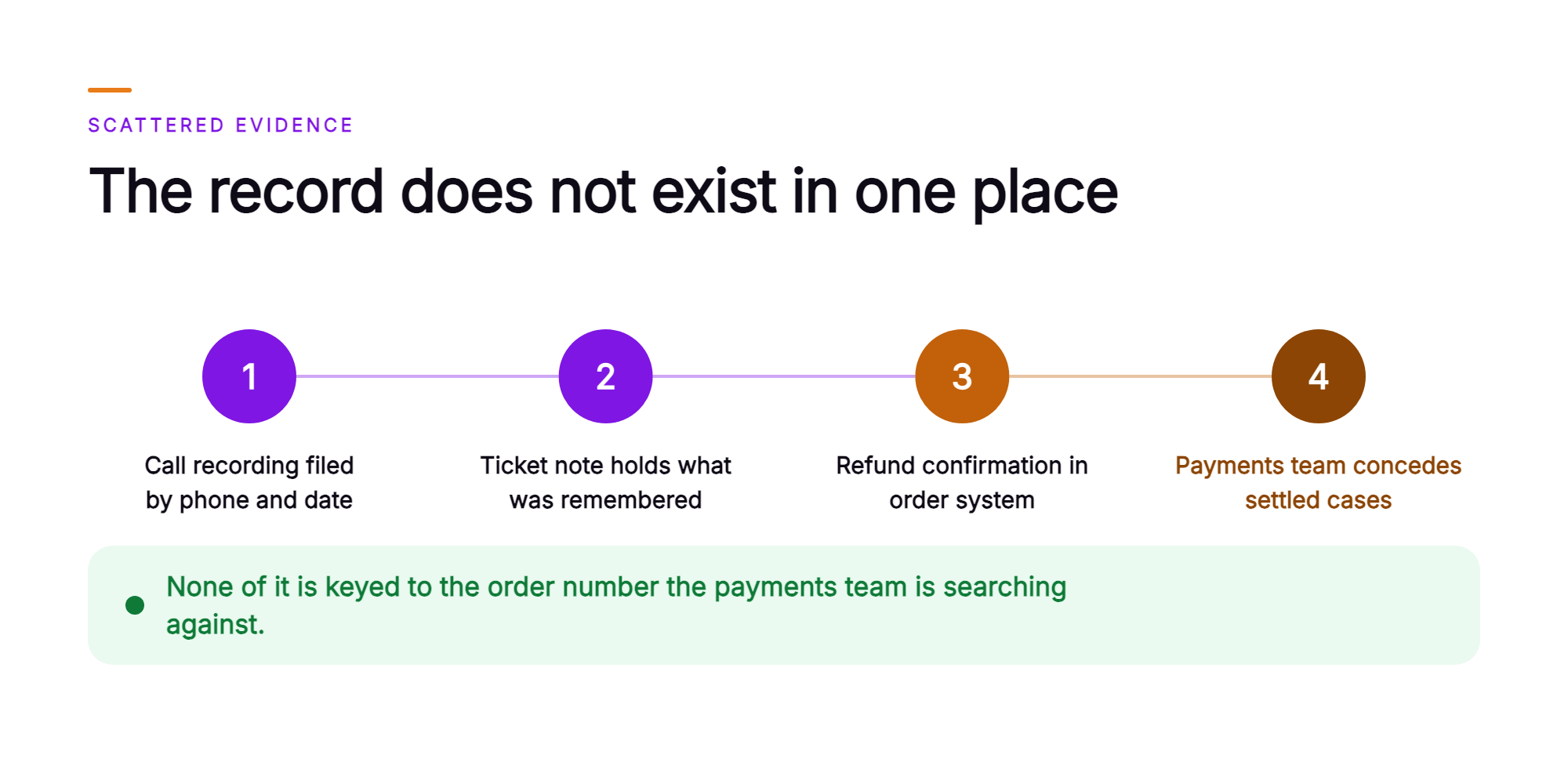
But in most retail operations, that record does not exist in one place. The call recording is filed by phone number and date. The helpdesk ticket holds a note field where the representative typed what they remembered. The refund confirmation lives in the order management system. None of it is keyed to the order number the payments team is now searching against, and none of it surfaces in a single query.
The operational outcome is predictable. The payments team spends hours per dispute chasing records across three or four systems, and regularly concedes cases the retailer had already settled because the conversation cannot be found before the response window closes. Chargeback representment automation addresses exactly this gap, by capturing the record at the moment of the conversation, so it is complete and keyed to the order when a dispute arrives. The next section defines what that record needs to contain.
What is a transcript record for chargeback representment?
For chargeback representment, a transcript record is the complete, retrievable account of what happened during a customer contact: the full exchange, the actions taken in the order and payment systems, and a written summary, all stored together and keyed to the order number.
A complete record holds several distinct elements. The timestamped exchange from greeting to resolution captures the customer's own words, as they were spoken or typed. Alongside that exchange, the record includes the intent recognized during the contact, the resolution status, the channel the contact arrived on, and each action executed. A refund issued, a replacement order created, an address corrected. Every one of those actions is logged with the timestamp that connects it to the conversation.
AI agent transcript evidence and human-rep transcripts live in the same record structure. The payments team queries by order number and retrieves the same package whether an AI agent or a human rep handled the contact. That consistency matters when a dispute arrives weeks after the fact and the team is working against a narrow response window.
One boundary is worth stating plainly. The transcript record is the contact center's contribution to ecommerce chargeback management. It is the input to the evidence package the payments team assembles. The payments team decides whether to represent the charge, writes the chargeback rebuttal letter, and files the response. Orvera supplies the record. How an AI agent produces that record while it is resolving the contact is the more precise question, and the next section walks through it step by step.
How does an agentic AI agent build the record while it resolves the order contact?
The record is produced as part of resolving the contact, keyed to the order the moment the interaction ends, and the payments team retrieves it by order number.
The AI agent begins by confirming the order. It pulls the purchase detail, the delivery status, and the payment record from the systems the retailer already runs, then answers the question in front of it, whether that is a return window, a refund eligibility check, or a delivery commitment. When the resolution requires an action, the agent executes it directly in the order and payment systems. Executing the action writes the log entry.
The record is automatically generated during that work. Each turn accumulates in the transcript. At the close of the contact, the agent generates a plain-language summary of what was stated and what was done. Every action, the refund amount, the replacement issued, the policy rule applied, carries a timestamp and is keyed to the order number. The agent works from the retailer's approved knowledge base, so the return window or refund rule it communicates to the customer is drawn from the policy on record. The transcript shows exactly what was stated, in the customer's own words and in the agent's response.
That combination is what makes the record useful when a chargeback notice arrives weeks later. The conversation is already on file by the time the payments team looks for it. They search by order number, retrieve the full record, and have what they need to write the chargeback rebuttal letter and assemble the evidence package. How that looks against a real disputed order is the next step.
What does one disputed order look like with the record in hand?
The record already exists when the dispute opens, so the payments team retrieves a complete, timestamped package built during the original contact.
Consider a concrete case. A customer opens a chat about a damaged item on an order placed the previous week. The AI agent confirms the order, pulls the delivery record, and applies the retailer's damaged-goods rule from the approved knowledge base. It issues a partial refund and creates a replacement shipment in the order management system. The customer types, in the chat window, that the resolution is acceptable and the matter is settled. The interaction closes. The record, carrying the full exchange, the summary, and a log entry timestamped against the refund amount and the replacement tracking number, is keyed to the order and stored.
Three weeks later, a chargeback notice arrives on that same order. The cardholder is disputing the full charge and states the promised refund never arrived. The payments team searches by order number in the ecommerce chargeback management workflow. What comes back is the transcript with the customer's own words confirming settlement, the agent summary, and the system log showing the refund amount and the replacement shipment, both timestamped.
The evidence here is the customer's own words, captured in a governed transcript at the time of the contact. The payments team assembles the evidence package directly from that record and files the representment. The record was complete before the notice arrived. Every element of the package came from that one place. The retailer's own team filed it, and the conversation itself is the evidence that supports the response.
Which retailer rules does the agent apply, and what lands in the record for each?
The rules the agent applies are the retailer's own, configured during the build, and the agent's job is to apply them consistently and leave a complete trail for every contact.
Retailers asking how to win a chargeback dispute start from that consistency, because a governed interaction puts the same evidence in front of the payments team each time. The agent follows the retailer's configured policies, and every action it takes or routes to a human rep is documented. Four rule types illustrate the pattern.
- Identity confirmed before any order change. The agent verifies the caller against the retailer's required authentication criteria before touching the order. The log records the verification step, including the method and the outcome.
- Refund above threshold routed to a human rep. When a refund request exceeds the retailer's dollar threshold, the agent escalates. The transcript continues through the human-handled portion as one record. Agent Assist summarizes the contact for the rep in real time, and the record closes when the rep closes the contact.
- Return window stated from approved knowledge. The agent draws the return policy from the retailer's configured knowledge base, states it to the customer, and the transcript captures both the window quoted and the customer's reply.
- Replacement offered only when tracking confirms delivery. The agent checks the carrier record before offering a replacement. The log shows the tracking check, the result, and the customer's acceptance.
A contact handed to a human rep produces the same record structure as a contact resolved by the AI agent. The transcript and system log continue to the close, and the payments team retrieves one complete package regardless of who handled the final step. That consistency in the record is what a chargeback evidence package depends on, and it starts with how the platform is built and deployed.
Why does a retailer want the platform built and run for it?
Building the record is only reliable when the system producing it is configured correctly, integrated completely, and audited on every conversation from day one.
Orvera does the build, the deployment, and the integration, then runs the agents and the record they produce as a managed service. A full enterprise deployment lands in three to six weeks. The team carrying that deployment has 18+ years of contact center operations behind it, which means the configuration decisions reflect what actually matters when a payments team opens a chargeback notice, and which details a dispute response has to stand on.
The agent reads and writes the order management, payments, helpdesk, and CRM systems the retailer already runs. That reach comes from a catalog of 500+ integrations, and the agents operate on the retailer's own stack. The platform is model-agnostic, so the retailer can adopt a newer foundation model as the technology improves, and that change happens inside the orchestration layer.
The audit posture closes the remaining gap. Auto QA covers every conversation, human-handled and AI-handled, across every channel. That coverage is what makes chargeback evidence consistent across contact types. A record produced by a human rep carries the same structure as one produced by the AI agent, because the same auditing layer governs both. The platform is SOC 2 Type II certified, HIPAA compliant, and GDPR compliant, the compliance posture regulated buyers require before they will let AI touch a customer conversation.
Which numbers confirm the record is working is the practical question the payments team will ask next.
Which numbers tell the leader the record is working?
Four measures tell the payments team and the contact center leader whether the record is producing results. All four come from data the retailer already tracks, on the reporting stack it runs today.
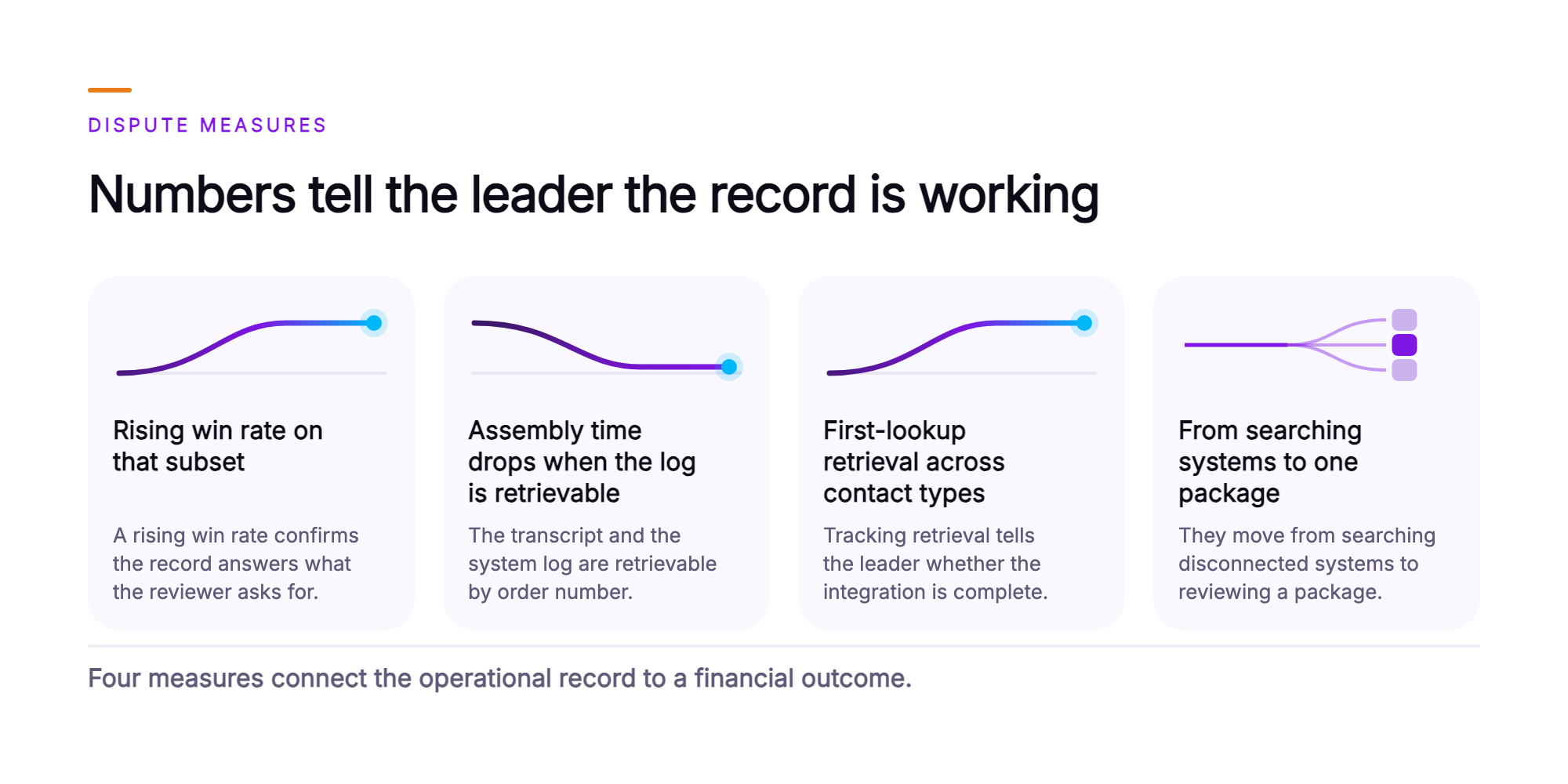
Time from chargeback notice to evidence package assembled. When the transcript, the agent summary, and the system log are retrievable by order number, assembly time drops. The payments team measures how long that step takes now and compares it after the first full quarter of operation.
Disputed orders with a record found on the first lookup. A record the payments team retrieves on the first search by order number is a record it can use. Tracking first-lookup retrieval tells the leader whether the integration is complete and whether the record is being produced consistently across contact types.
Payments-team hours per case spent assembling evidence. The hours stay on the books. They move from searching across disconnected systems to reviewing a complete package. That shift is the practical signal that chargeback representment automation is doing what it should.
These four measures connect the contact center's operational record to a financial outcome the leadership team can read. What the customer care leader brings to that conversation is the next question.
What does the customer care leader take to the leadership team?
The customer care leader brings four statements to the leadership team, each one grounded in what the contact center record now produces for the payments team.
These describe the operating state the platform creates once it is built, deployed, and running.
- Every customer interaction, on every channel, carries a full transcript, a structured summary, and an action log, all retrievable against the order number. The payments team searches by order number. The record comes back complete. Hours once spent chasing records across systems go into reviewing the evidence.
- When the payments team files the chargeback representment, they file with the customer's own words and the executed actions already in hand. The chargeback evidence is the governed transcript the AI agent produced as the contact ran, complete at the moment of resolution.
- Orvera builds, deploys, and runs the platform on the order management, payment, and helpdesk systems the retailer already runs, with full deployment complete in three to six weeks. The record starts on day one and integrates into the existing stack, which stays in place.
- Auto QA audits every conversation, human-handled and AI-handled, so the record is reviewed as well as kept. Consistency in the evidence package is structural, and every case the payments team opens arrives in the same shape.
What that looks like as a repeatable process, from the moment a chargeback notice arrives to the moment the evidence package is filed, is where this closes.
What does the dispute process look like once the record runs?
Once the record runs on every contact, the dispute process becomes a retrieval problem, and retrieval is fast.
A chargeback notice arrives. The payments team searches by order number. The transcript, the structured summary, and the system log come back together as a single package. The record is complete at the first retrieval, and the team goes straight to writing the response. The evidence is what the customer said and what the AI agent confirmed, captured in a governed transcript at the moment of resolution.
The outcome tracked by the customer care leader is direct. The measure is representment win rate on the cases where the conversation is the evidence. That figure belongs to the payments team, and they are the ones who report it. What the contact center leader sees is the complementary shift: payments-team hours that moved from searching to reviewing. The work remains, and the record changes what that work is.
And that is what chargeback representment automation actually delivers. A record that exists before the dispute does, written during the contact and stored against the order number.
If the contact center is already managing the order dispute and the conversation is ongoing, the record the payments team will file weeks from now is being captured right now, in the customer's own words. Talk to the team (opens in a new tab) to see what that looks like on your order contacts.
Frequently asked questions
AI agent transcripts for chargeback evidence contain a full transcript from greeting to resolution, a written summary, and a timestamped log of every action executed in the order and payment systems. The payments team examines specific fields when retrieving a record: - Order number the interaction was keyed to - Channel the conversation arrived on - Intent recognized by the AI agent - Resolution status at close - Actions executed, each with its amount and timestamp Agentic AI resolution audit trails for chargebacks carry the same structure whether a human representative or an AI agent handled the contact, and whether it arrived on voice, chat, email, or messaging. The record remains consistent across channels. Each of the fields above is written at the moment the action runs, while the contact is still live. Retrieval begins here, leading to the question of how to retrieve it for a specific order.
The interaction is keyed to the order number while it runs, so the payments team searches by order and the transcript, summary, and timestamped action log come back together as a single retrievable record. Retrieval follows a straightforward path: - Search by order number. Every interaction logged against that order, a delivery inquiry followed by a return request, returns in time order. - Pull the complete record. The transcript, written summary, and action log arrive together, timestamps intact. - Build the evidence package. The payments team writes the rebuttal letter from what the record shows, and every point the letter makes traces back to a line captured while the conversation ran. That structure is what makes representment evidence for AI voice interactions usable under acquirer timeframes. The record answers the exact question a dispute reviewer asks: what did the customer authorize, when, and what did the system execute in response. This method documents customer authorization in AI voice resolutions from a single record the payments team retrieves in one search. The subsequent question is where each team's responsibility concludes.
The payments team owns the decision to represent, the evidence package, the rebuttal letter, and the filing. Orvera's part is the retrievable record: the transcript, written summary, and timestamped action log keyed to the order. The division is straightforward: - Payments team. Decides whether to represent, assembles the evidence package, writes the rebuttal letter, and files with the acquirer or processor under the requirements the team already works to. - Orvera AI. Produces and retains the conversational AI logs for merchant disputes, retrievable by order number. Nothing more, nothing interpreted. The handoff terms are integrated into the build. The customer care leader and the payments leader agree, before go-live, which order identifiers the record carries and how the payments team pulls it. That agreement determines whether the record arrives ready to use when a dispute appears. The following question is how every conversation is recorded and reviewed after the contact closes.
Every conversation Orvera AI runs, whether handled by an AI agent or a human rep, produces a transcript, written summary, and timestamped action log as a natural output of resolution, complete by the time the interaction closes. That is how to use AI voice transcripts as chargeback evidence: the record exists because the resolution produced it, complete at the moment the contact closed. The review process operates similarly. Auto QA audits every conversation, human-handled and AI-handled, across every channel. A contact center leader can confirm whether the rep stated the return policy correctly, whether the AI agent recorded the authorization, and whether the resolution status matches what the log shows. Governance sits underneath both layers. The AI agent works from approved knowledge only. The platform is SOC 2 Type II certified, HIPAA compliant, and GDPR compliant. Every audit trail the payments team pulls comes from that same governed platform. That assurance depends, in part, on how deeply the platform connects to the order and payment systems already running in the retailer's environment.
Orvera AI connects to the order management, payments, helpdesk, and CRM systems a retailer already runs. That connection is part of the build, completed during deployment and working from day one. The platform supports 500+ integrations across CCaaS, CRM, helpdesk, and payments categories. It is model-agnostic and runs on the stack the retailer already has in place. When a dispute reviewer asks whether banks accept AI agent logs for representment, the answer depends on whether the log is complete and retrievable. The AI agent writes each action to the order system as the interaction runs, so the payments team pulls the finished record by order number. How that integration comes together in practice is the question the next section addresses.
Orvera builds, deploys, and runs the full operation as a managed service, with complete enterprise deployment landing in three to six weeks. Enablement means onboarding, knowledge-base setup, agent training, and change management, all handled by Orvera's team. The return, refund, and delivery policies stated by your AI agents are configured and reviewed during the build, ahead of go-live. That is what the payments team draws on when it assembles compelling evidence for automated customer service disputes: a record built on approved knowledge from the first conversation. Orvera does the integration work, and its own engineers handle the technical setup. The team behind the delivery carries over 18 years of contact center operations, running floors before building software to run them.

Written by
Anindita Majumder
Anindita Majumder is a communications professional with nearly four years of experience in public relations, corporate communications, and journalism. She creates content that helps brands communicate their vision, products, and expertise through press releases, thought leadership, and editorial pieces. Outside of work, she is a vocalist, which keeps her creativity flowing.