Why Surge Capacity Fails During a Named Storm, and What Holds the Safety Boundary
Storm-day call volume exceeds what any utility can staff for because the arrival curve compresses many times normal volume into a window that is shorter...

Key highlights
Key takeaways
- Storm-day call volume exceeds what any utility can staff for because the arrival curve compresses many times normal volume into a window that is shorter than any shift change.
- What changes between a normal day and a storm day is not the volume alone. It is the consequence of every call that does not get answered.
- A legacy IVR fails outage callers because it was designed for predictable, low-volume traffic, and a major storm delivers neither.
- An AI voice agent for outage reporting is software that takes a caller's report in their own words, files it into the operator's systems, and answers follow-up questions, without routing the caller into a queue.
- An AI voice agent files an outage report directly into the operator's outage management system during the call, with no manual keying step between the caller's words and the record the field sees.
- An AI voice agent gives a caller the restoration status for their address by reading the record their utility's own systems hold for that circuit, in plain language, at the moment of the call.
- A caller who reports a downed wire, arcing equipment, or a gas odor is hard-transferred to a human rep immediately, every time, without exception.
- Agentic AI for utilities answers every call that arrives during a storm event, and the answer rate is exactly what the operator's own regulator measures.
- A utility evaluating an AI voice platform before storm season should test the following: who runs the platform after go-live, how life-safety calls reach a person every time, what the AI agent does when it reaches the edge of its knowledge, how the platform connects to the systems already in place, and what record survives the event for your regulator.
Why does outage call volume during a major storm exceed what a utility can staff for?
Storm-day call volume exceeds what any utility can staff for because the arrival curve compresses many times normal volume into a window that is shorter than any shift change.
On a normal day, your floor runs against a published number, and your representatives and your schedule are matched to it. A major storm does not scale that number gradually. It rewrites it in hours. The same number of seats, the same overtime pool, and the same outsourced surge capacity you committed before the event are now facing a queue that the plan was never built to hold.
Forecast-built capacity breaks because every decision, overtime authorization, staffing callbacks, and additional seats, has to be committed before the storm lands. The arrival curve never matches the plan. Volume peaks when conditions are worst, when callbacks fail to connect and outsourced seats are already full. The gap is structural, not a scheduling error.
What changes between a normal day and a storm day is not the volume alone. It is the consequence of every call that does not get answered.
Your regulator measures your operation against an answer standard that is specific to your state and your license. Outage calls are the visible record of your worst week. And within that volume, a share of contacts are life-safety calls: a downed wire, arcing equipment, a gas odor. Those calls must reach a person. That is the safety boundary. It is where any conversation about AI voice agents for utility outage reporting has to start.
Why does a legacy IVR fail callers during an outage?
A legacy IVR fails outage callers because it was designed for predictable, low-volume traffic, and a major storm delivers neither.
The menu tree your callers reach today was built for billing questions and routine service requests. It performs adequately in an ordinary week. But a storm-season conversation starts with "my power is out, is anyone working on it?" and the menu has no branch for that question. The caller is offered options that were authored months before the event, and none of them match the situation on the ground.
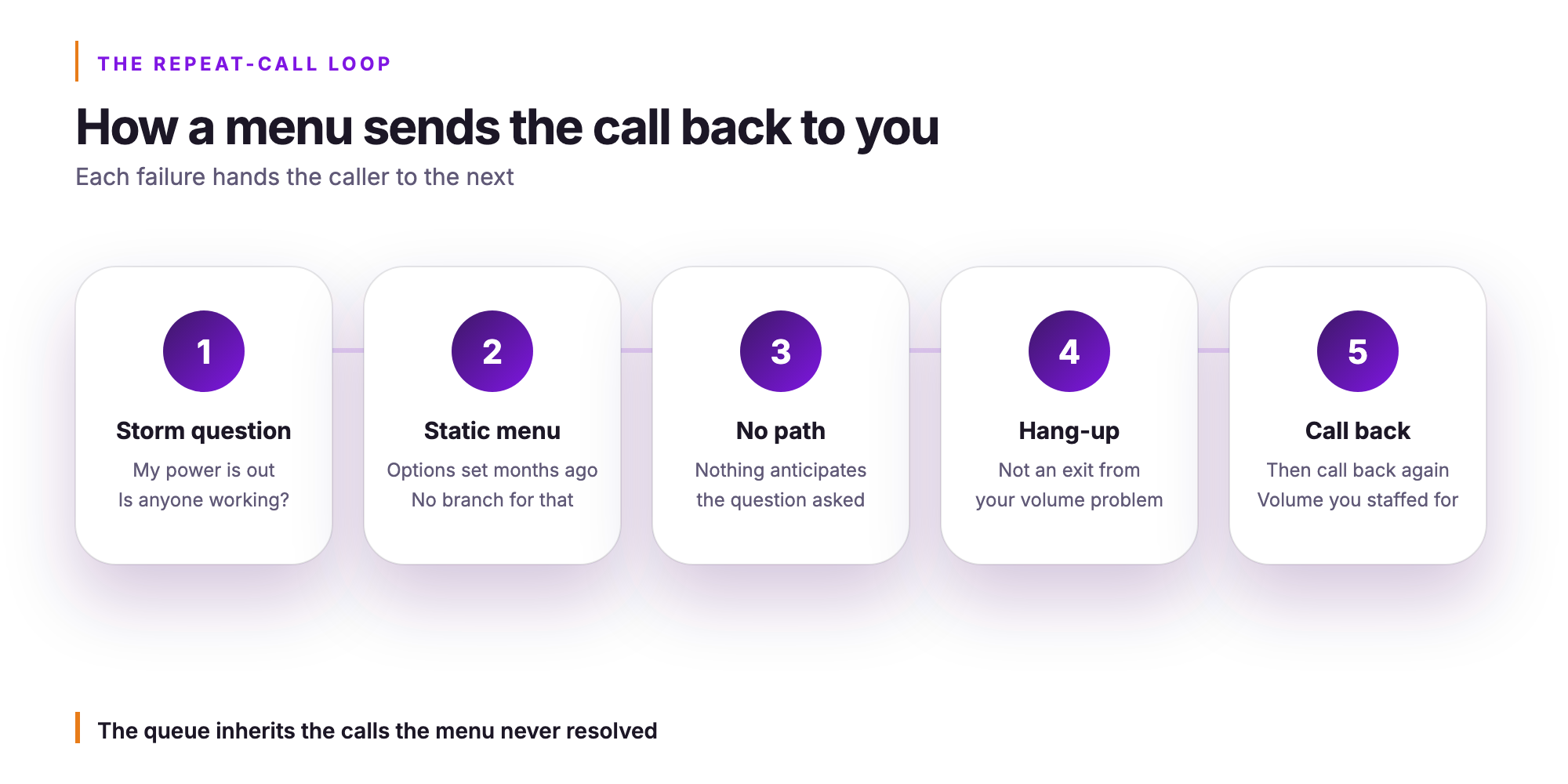
Three failures follow in sequence. The first is a static menu that cannot describe an evolving event. Restoration status changes by the hour, and no IVR menu updates itself to reflect that. The caller who wants automated storm restoration status updates hears the same recorded options whether crews are twenty minutes out or twenty hours out. The second failure is the absence of any path for a question the menu did not anticipate. The third is the hang-up, which is not an exit from your volume problem but the start of the repeat-call loop.
“A caller who hangs up without an answer calls back. Then calls back again. That second and third call is volume you staffed for, handled nothing, and will staff for again.”
That loop is the volume a Director of Customer Operations can actually remove. The IVR did not resolve the first call, so the queue inherited two more.
What is an AI voice agent for outage reporting and how is it different from an IVR?
Menu versus action. A legacy IVR presents a menu and collects a selection. An AI voice agent completes the electric outage report and then tells the caller what happens next. That distinction matters at two in the morning when a neighborhood has gone dark and a caller wants confirmation that their address is now in the system, not a prompt to press three again.
Platform run for the operator. Orvera AI is a customer experience platform that is deployed and run for the operator. Orvera AI configures, launches, and manages the operation, which means the utility does not carry the engineering burden of standing up a new capability on top of a major storm season.
Model governance. Where the platform uses AI models, Orvera custom-trains its own contextualization models on de-identified data. The voice and foundation models underneath are best-in-class third-party selections, governed through a layer Orvera AI controls and the operator can review.
That distinction, between a system that routes and a system that resolves, becomes the functional question when the operator has to explain to its regulator how outage reports were captured during the worst night of the year. The next section follows the call through that resolution path.
How does an AI voice agent file an outage report into a utility's OMS?
An AI voice agent files an outage report directly into the operator's outage management system during the call, with no manual keying step between the caller's words and the record the field sees.
Every call to a power outage hotline during a major storm is a data transaction. The caller is identified against an account or service address, the report is taken in plain language, and it lands in the outage management system as a structured record. Orvera AI connects to the systems the operator already runs, so the integration does not require a parallel workflow or a staging queue.
What the agent captures and where it lands:
- The caller's service address or account number, confirmed before the report is written.
- The reported condition, in enough detail to populate the fields the OMS expects.
- A timestamped record tied to that address, visible to dispatch and field crews in the same system they work from.
- A full call record the operator can retrieve after the event, when regulators and internal reviews reconstruct the storm response.
The operational value is direct. Dispatch sees the same report they would have received from a person, in the same place, without anyone keying it in between. And because every interaction leaves a complete record, the operator can account for every contact when the storm gets reviewed. That same record also tells the system how many addresses have reported for a given area, which is the data that drives the next step: giving callers a restoration status that reflects their specific circuit.
How does an AI voice agent give a caller the restoration status for their address?
An AI voice agent gives a caller the restoration status for their address by reading the record their utility's own systems hold for that circuit, in plain language, at the moment of the call.
Circuit-level specificity is where the difference sits. The caller gets the estimated restoration time for their own circuit, the published cause if the operator has set one, and the crew status as it stands. That is not the system-wide message read off a public feed. A caller two streets from a restored block is on a different circuit, and the system-wide message is the reason they call back. Repeated callbacks are the mechanism that collapses utility surge capacity at the exact moment volume is already many times normal.
Honesty about what the system holds is part of the design. When a crew has not yet assessed a segment and an estimate has not been entered, the AI voice agent says so. It does not produce a number. A placeholder estimate that breaks erodes trust faster than silence, and a broken estimate generates its own wave of repeat calls.
Resolution on the first call is the operational result. A caller who hears a specific, accurate answer for their address does not call back three more times asking the same question. That reduction in repeat volume is what keeps the line available for the calls that a person must take.
What happens when a caller reports a downed wire or smells gas?
No AI agent handles the call. No queue holds it. No triage step runs first. The transfer happens the moment the system identifies a life-safety report, and the person on the other end of the line is a human being.
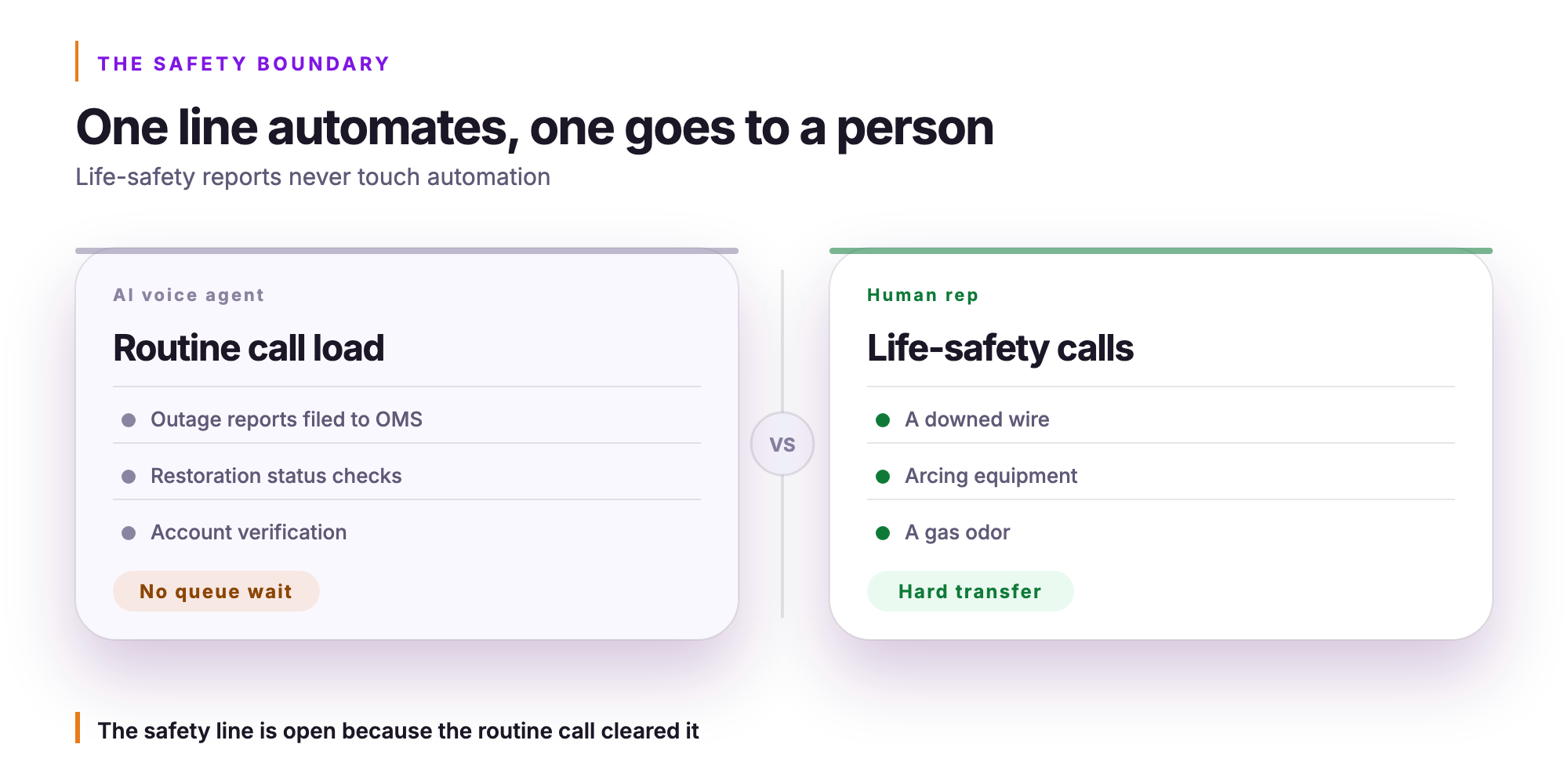
Design, not limitation. Speed to a human rep is the entire product for a life-safety call. There is no outcome the AI agent could produce that would be more valuable than getting that caller to a person without delay. The design reflects what 18+ years of contact center operations makes obvious: some calls are not about resolution rate, they are about who answers and how fast.
The indirect contribution matters. What the AI agent does for safety is clear the line. Routine outage reports, restoration status checks, and account verification all move through automation. That load reduction is what keeps the safety line open when contact center storm performance reaches its peak stress point. The phone line a caller with a downed wire reaches is only available because the routine call before it did not need a person.
How does automating outage calls help a utility meet the answer standard its regulator sets?
Agentic AI for utilities answers every call that arrives during a storm event, and the answer rate is exactly what the operator's own regulator measures.
The standard is not universal. Each state's regulator sets its own answer-time and outage-reporting requirements, and the threshold your operation is held to belongs to your jurisdiction alone. What those standards share is a simple premise: callers who report an outage or request restoration status must reach a response. Calls that sit in queue and abandon do not satisfy that premise. Calls that are answered and completed do. When volume arrives many times above normal, the question is whether the platform can answer and resolve each one. That is the operational problem agentic AI solves.
Record keeping matters equally. An event that ends with a reviewable log of every caller interaction, every status read, and every safety transfer is a defensible record. The operator can show its regulator, or any reviewer, what each caller was told and when. Without that record, the event is a gap.
The third dimension is public. Storm week is the week the utility is written about. The power outage hotline is the part of the operation that callers and journalists experience directly. A busy signal or a thirty-minute hold time becomes the story. A call that is answered, resolved, and logged does not. Getting the phone line right does not guarantee positive coverage, but failing it guarantees the opposite. That stakes profile is why the communication layer deserves the same planning discipline as the physical restoration work.
What should a utility look for in an AI voice platform before storm season?
A utility evaluating an AI voice platform before storm season should test the following: who runs the platform after go-live, how life-safety calls reach a person every time, what the AI agent does when it reaches the edge of its knowledge, how the platform connects to the systems already in place, and what record survives the event for your regulator.
Orvera AI brings 18+ years of contact center operating experience to that evaluation. That history matters because the questions below are not hypothetical. They surface in the first storm event, and a platform configured by an operator who has stood on the floor answers them differently than a tool handed to your team to build on. Orvera AI is built and run as a service for the operator. Your team directs outcomes. The platform runs the operation.
The AI agent is built to answer from your own systems, whether that is your outage management system, your restoration queue, or your caller history. And it is built not to answer beyond them. When the agent reaches the edge of its knowledge, it says so and routes the call to a human rep. That boundary is not a setting a vendor toggles. It is the design.
Carry these questions into any vendor meeting:
- Who operates the platform after go-live, and what does that team's operating history look like?
- How is a downed-wire or gas-odor call guaranteed to reach a human rep, and what is the failure path if the transfer does not complete?
- What does the AI agent say when a caller asks something the platform was not configured to answer?
- Which systems does the platform read from and write to, and how is that connection maintained during a high-volume event?
- What record of every call, every transfer, and every resolution survives the event and in what form?
- How does the platform handle the answer standard your regulator sets, and how is compliance documented after the storm?
Those questions sort platforms quickly. The next section brings them together into a single set of takeaways for the leader who needs to make the call before the next storm arrives.
What should a customer operations leader take away before the next storm?
Storm volume arrives faster than any staffing plan can match, and the answer standard your regulator sets does not move because the event was severe.
Before the next storm season opens, these realities are worth carrying into every planning conversation:
- Storm call volume arrives many times above normal volume, often within the first hour of an event, well before any additional staffing commitment can reach the floor.
- A menu built for normal days cannot answer a storm question. Callers need circuit-level restoration status, not a prompt tree that ends at an option to call back.
- The AI agent files the outage report and reads back current restoration estimates, so your representatives work the calls that require judgment, not the calls that require a timestamp.
- A downed wire, arcing equipment, or a gas odor is hard-transferred to a person immediately, every time. That boundary does not flex, and Orvera AI builds it into the platform before the first call arrives.
- The answer standard is set by your own regulator. Storm volume is not a mitigating factor in how that standard is measured.
Orvera AI builds, deploys, and runs the operation so your team reads results on the worst night of the year rather than managing infrastructure. Talk to the team to hear the platform on a live outage queue.
Frequently asked questions
Automating utility outage reporting with a managed Agentic AI platform means the call is answered and the report is taken regardless of how many calls arrive at once, with no dependency on how many representatives your operation had rostered before the storm landed.
Orvera AI can file the outage report directly into your outage management system and read back restoration status personalized to the caller's own circuit.
A downed wire, arcing equipment, or a gas odor is hard-transferred to a human rep immediately, every time, with no automated step in between.
An AI voice agent resolves the interaction. Your current power outage reporting system collects a menu selection and routes the caller to the next step.
An AI voice agent gives your operation a reviewable record of every outage call, which is the foundation of demonstrating compliance with whatever answer standard your own state regulator enforces.
Written by
Anindita Majumder
Anindita Majumder is a communications professional with nearly four years of experience in public relations, corporate communications, and journalism. She creates content that helps brands communicate their vision, products, and expertise through press releases, thought leadership, and editorial pieces. Outside of work, she is a vocalist, which keeps her creativity flowing.