How an AI Agent Confirms and Rebooks Field Appointments for Utilities
Crews arrive at an empty house or a locked gate because the appointment was set days or weeks before the visit, and nothing between the booking and the truck roll confirmed that the customer still planned to be there or that the crew could reach the equipment.

Key highlights
- On each call, the AI agent confirms who it is speaking with, reads back the appointment, captures the access details the crew needs, and books a new window when the customer cannot make the original one.
- When the customer cannot make the booked window, the call turns into a rebooking: the agent surfaces the open windows, books the one the customer chooses, and captures how the crew gets to the meter.
- The AI agent operates inside rules the utility already owns and already enforces.
- A managed program fits because building, tuning, and running a calling operation is contact center work.
- Four measures show whether the calls are working, and the utility reads all four from its own systems of record.
- Four statements carry the program through a leadership review, and each one stands on its own.
- The schedule includes customer-confirmed visits, with access details provided to the crew before departure.
Why do utility crews arrive at appointments where the customer is away or access is blocked?
Crews arrive at an empty house or a locked gate because the appointment was set days or weeks before the visit, and nothing between the booking and the truck roll confirmed that the customer still planned to be there or that the crew could reach the equipment.
The customer's absence is common. They booked the slot, their week changed, and the reminder they received pointed them to the utility's contact center for any change. A call to make that change often waits in a queue, and the slot stays held for a customer whose plans have already changed.
Access stops the rest of the visits. A locked gate, a dog loose in the yard, an indoor meter behind a locked basement door, or gas work that requires an adult at home will end a visit before the crew reaches the equipment.
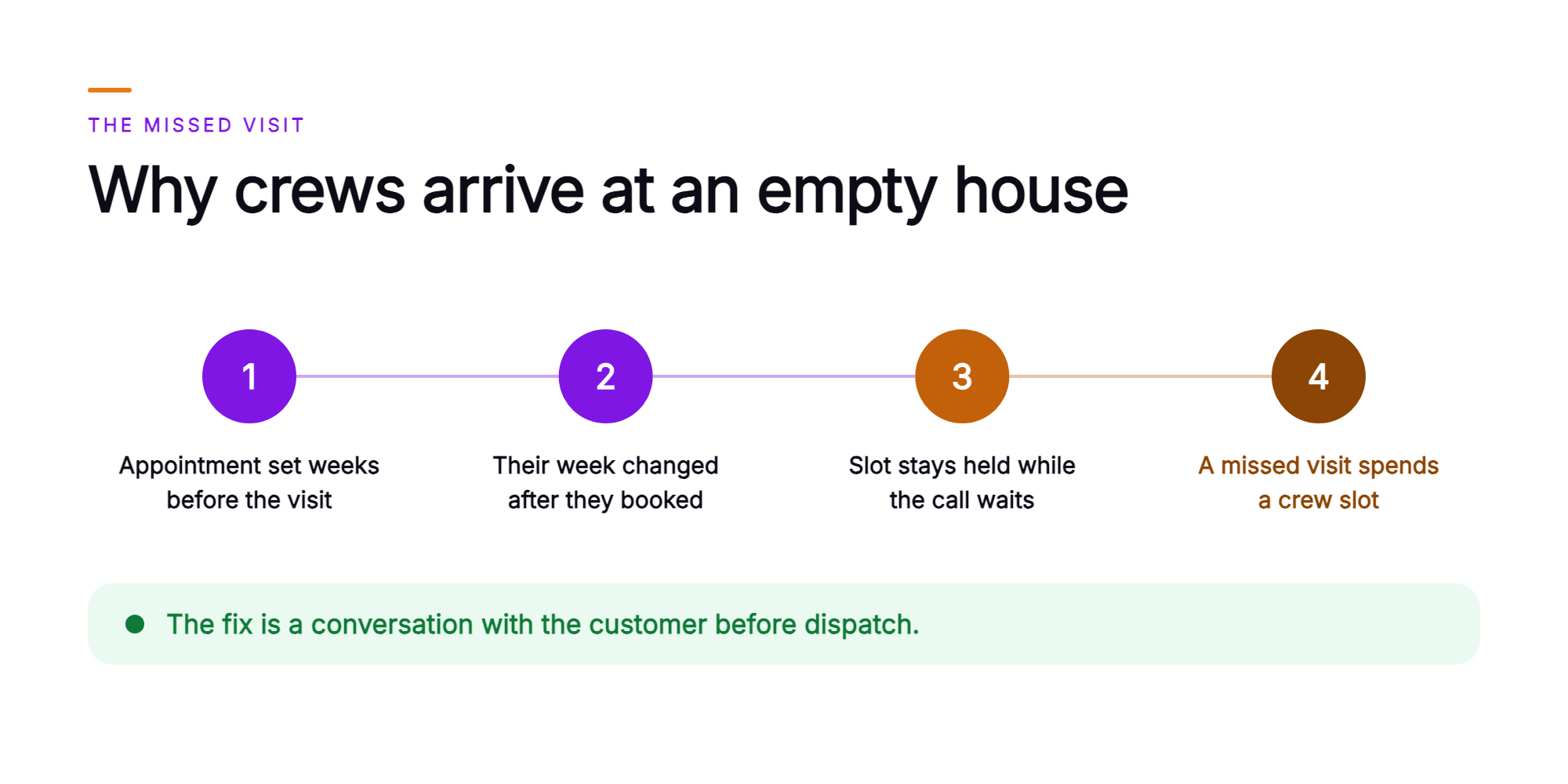
One missed visit spends a crew slot, a drive across the territory, and a second appointment on a job that should have taken one. The scheduling team then rebooks the visit by hand, and the customer waits again.
The fix is a conversation with the customer before dispatch. That conversation has to be able to change the appointment while the customer is still on the line.
Orvera AI is an agentic AI platform for enterprise customer experience, built, deployed, and run for the utility. It delivers a fully managed agentic AI operation that resolves conversations across voice, chat, email, messaging, and every other channel Orvera runs.
What are outbound field appointment confirmation and reminder calls at a utility?
Outbound field appointment confirmation and reminder calls are calls placed ahead of a scheduled field visit that confirm the customer will be there, confirm the crew can reach the meter or equipment, and rebook the visit in the same conversation when plans have changed.
Rebooking during the call is what makes it valuable. Standard outbound appointment reminder calls end when the message finishes playing, and any change still depends on the customer calling back into the queue.
The calls apply across electric, gas, and water service: meter exchanges and installs, service connections, inspections, gas appliance and safety visits, and customer-requested service orders. Any job in utility field service scheduling that depends on someone being home, or on a crew reaching equipment on the property, is a candidate.
Before the call, the board holds a booked slot with attendance unknown and premises access unknown. After the call, the utility holds a confirmed visit with access details captured for the crew, or a new slot with the original one back on the schedule as open capacity for another job.
What does the AI agent do on each appointment call, step by step?
On each call, the AI agent confirms who it is speaking with, reads back the appointment, captures the access details the crew needs, and books a new window when the customer cannot make the original one.
The process follows these steps:
- The utility's own contact rules and consent records put the appointment on the call list and set when the call goes out.
- The agent places the call and holds a two-way conversation with the customer, working as an AI voice agent for utilities.
- The agent opens by naming the utility it is calling for, then confirms who it is speaking with against the account holder or the authorized contact on file.
- The agent reads back the date, the arrival window, and the service address, pulled from the utility's work management and scheduling systems.
- The agent asks the customer to confirm they will be there for the arrival window.
When the customer needs a different time, the agent offers the open windows the utility's scheduling system returns and books the one the customer picks before the call ends. One conversation settles the change for the customer and for the scheduling team. The customer hangs up with a confirmed appointment, and the schedule reflects it immediately.
How does one gas meter appointment play out when the customer needs a new time?
When the customer cannot make the booked window, the call turns into a rebooking: the agent surfaces the open windows, books the one the customer chooses, and captures how the crew gets to the meter.
Consider an investor-owned gas utility as an example of how the call runs. An indoor meter exchange is booked into a morning window. Since the booking, the customer has picked up a work shift that starts before the window opens. Under the old pattern, the customer would have to call the contact center, wait, and explain the whole job again, or simply not be home when the crew arrives.
On the confirmation call, the AI agent confirms who it is speaking with, reads back the date, the window, and the service address, and hears the conflict as soon as the customer says it. The agent offers the open windows the scheduling system returns for that job type and that territory, and books the afternoon slot the customer picks. Before closing, the agent asks where the meter sits and how the crew gets to it. The customer indicates the meter is in the basement, accessible via the side door.
Afterward, the utility's systems show the new slot booked against the same service order, the access note ready for the crew to read, the original morning slot back on the schedule as open capacity for another job in the same territory, and the call transcript and summary on file with the account.
How does the agent work within the utility's scheduling, contact, and access rules?
The AI agent operates inside rules the utility already owns and already enforces.
- Contact rules and consent records. The utility's contact policy and consent records set who is called, when, and on what basis. The AI agent places the calls those rules schedule, on the cadence those rules define, and logs the outcome of each attempt against the account.
- Scheduling rules and crew capacity. The utility's scheduling rules, job durations, and crew capacity set which windows exist for a given job type and territory. The agent offers the open windows the scheduling system returns and books only into those windows.
- Field procedures. The utility's field procedures set which access details each job type needs, such as gate codes for outdoor meters or an adult at home for gas work. The agent asks for exactly those details and writes them back where the crew reads them.
- Routing rules. The utility's routing rules set where a question outside the appointment goes, such as billing, a high-bill dispute, or a safety report. The agent hands the customer to the utility's own team with the context already captured, so the human rep picks up the conversation where the agent left it.
Answers are grounded in the knowledge the utility has approved, and every call is fully auditable, with its transcript, summary, and logged outcome on record for IT and security reviewers.
Why would a utility want the confirmation calls built, deployed, and run for it?
A managed program fits because building, tuning, and running a calling operation is contact center work. The program places that work with Orvera, and the field service team stays on field work.
Orvera AI builds, deploys, and runs the AI agents and the platform on the systems the utility already operates, including its work management, scheduling, CRM, and CCaaS stack. Full enterprise deployment goes live in three to six weeks. The platform supports 500+ integrations, so the confirmation calls read from and write to the systems of record the utility already trusts.
That delivery model rests on 18+ years of contact center operations experience. Orvera audits 100% of conversations, human-handled and AI-handled, across every channel, so a call placed by an AI agent is reviewed on the same scorecards as a call handled by a human rep. For regulated buyers, Orvera is SOC 2 Type II certified, HIPAA compliant, and GDPR compliant.
This is one platform, adopted in stages. A utility contact center automation program can start with appointment confirmation calls and add other inbound and outbound work later on the same AI agent platform for utilities.
Which measures tell a field service scheduling leader the calls are working?
Four measures show whether the calls are working, and the utility reads all four from its own systems of record.
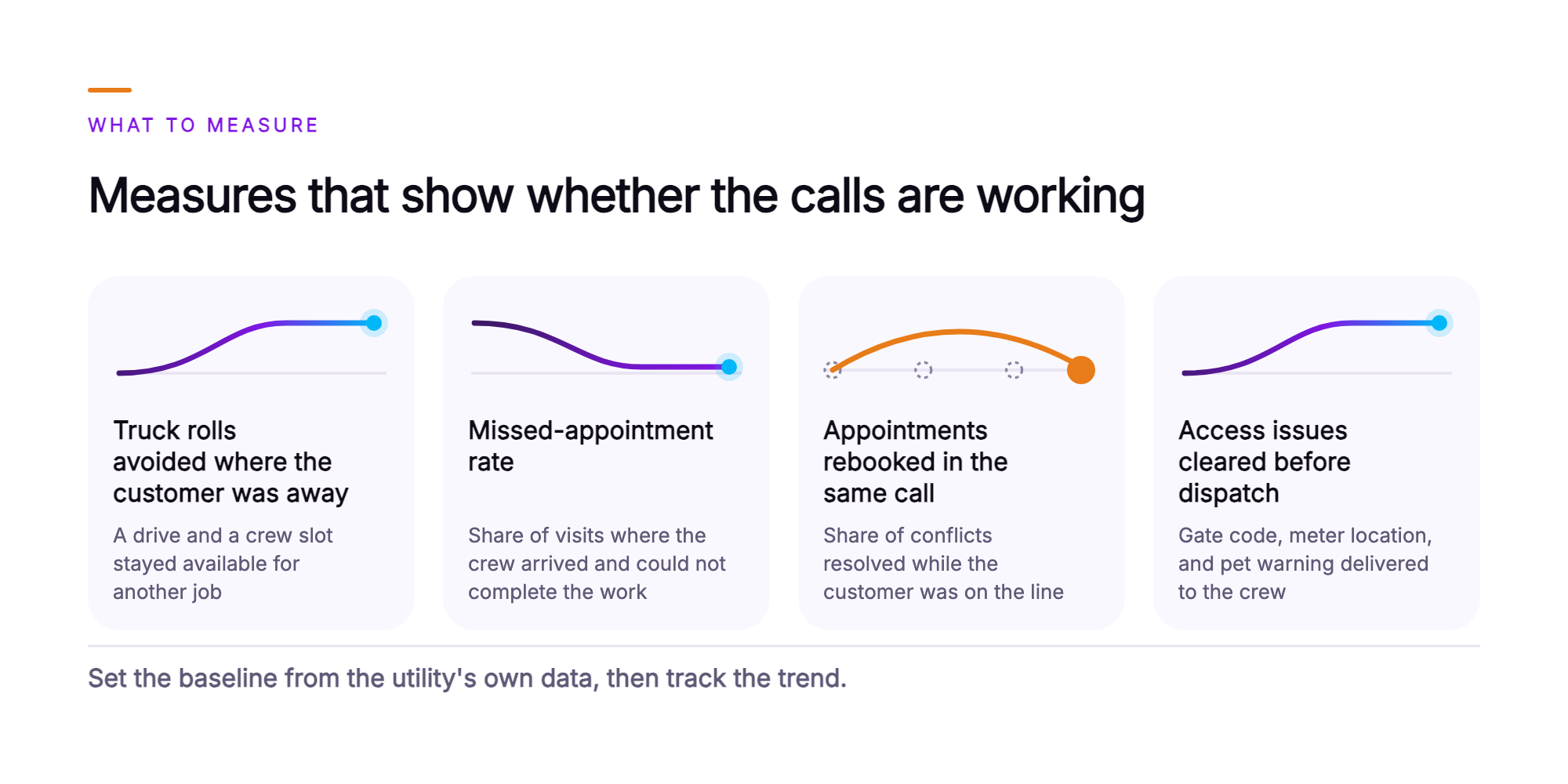
Truck rolls avoided on visits where the customer was away. Every appointment the agent rebooks before dispatch is a drive and a crew slot that stayed available for another job.
Missed-appointment rate. The share of scheduled visits where the crew arrived and could not complete the work, tracked by job type and territory in the utility's work management system.
Appointments rebooked in the same call. The share of conflicts resolved while the customer was on the line, with the new slot booked before the call ended.
Access issues cleared before dispatch. The share of visits where the gate code, meter location, pet warning, or adult-at-home requirement was captured and delivered to the crew ahead of arrival.
All four live in the utility's work management and scheduling systems. The last two also sit alongside the transcript, the summary, and the logged outcome Orvera keeps for every call.
Set the baseline from the utility's own data before the first call goes out, then track the trend in the utility's own reports. The measures are fixed. The values belong to the operation.
What does the field service scheduling leader take to the leadership team?
Four statements carry the program through a leadership review, and each one stands on its own.
- The AI agent confirms attendance and premises access with the customer before the crew rolls, so a confirmed visit reaches the crew with its access details already captured.
- The agent rebooks into open capacity drawn from the utility's scheduling system during the same call, and the original slot returns to the board for another job.
- The contact rules, consent records, scheduling rules, and crew capacity remain the utility's own, and the agent acts only within them.
- Orvera AI builds, deploys, and runs the calling program on the stack the utility already operates. Full enterprise deployment goes live in three to six weeks, and Orvera audits 100% of conversations, human-handled and AI-handled.
Those four points answer what operations owns, what the vendor owns, what changes on the schedule, and how every conversation is audited. The performance numbers come from the utility's own reports once the baseline is set.
What does the field schedule look like once the AI agent runs the confirmation calls?
The schedule includes customer-confirmed visits, with access details provided to the crew before departure.
When a customer's plans have changed, the agent books the new window before dispatch. The original window goes back on the board as open capacity, ready for dispatch to fill with other work in the territory. On confirmed visits, crews arrive knowing any gate code, where the meter sits, and whether a dog is in the yard. Customers settle a change on the confirmation call itself, which is a core goal of utility proactive customer communications.
The operations team receives a transcript and summary of each call, and Orvera audits those calls on the same scorecards the utility uses for its human-handled conversations. Supervisors can read exactly what was promised, what access instruction was captured, and how the rebooking was made. The scheduling team picks up the exceptions the calls surface, with the call record already in hand.
If a confirmation and rebooking program fits the field operation you run, talk to the team (opens in a new tab) about how it would work on your work management and scheduling stack.
Frequently asked questions
The agent confirms the visit itself and how the crew will reach the equipment. On a standard call it verifies the date and the arrival window, reads back the service address, checks who will be home during the window, and collects the access details the job requires. Those access details vary by work type. A meter exchange, for example, can call for the meter location and whether it sits inside or outside. A gas safety visit can call for a gate code, notice of a dog on the property, and a clear appliance area. Orvera's AI agents ask the questions the utility's own field procedures specify for that job type, then record the answers on the work order for the crew.
The agent rebooks during the call itself, and the customer stays on the line with the same agent from the conflict to the confirmed new slot. This is how AI voice agents handle utility rescheduling: the customer says the window does not work, the AI agent reads the open windows straight from the utility's scheduling system, the customer picks one, and the agent books it before the call ends. The windows offered are the utility's own. Crew capacity, territory rules, job duration, and any blackout dates govern what the agent can present, so the options the customer hears are the open windows the scheduling system returns. Before hanging up, the agent reads the new date and arrival window back to the customer and confirms the access details still apply.
The utility's contact rules decide, and the agent follows them. Those rules set whether a message is left at all, what the message says, how many attempts an appointment gets, and how long the platform waits before the next one. When the rules call for a message, the agent names the utility it is calling for, reads the approved wording, and logs the attempt. No account details go into a voicemail unless the utility's own policy permits it. The appointment then returns to the outbound field service reminders list on the retry schedule the utility set, and unreached appointments stay visible to dispatch.
Every call produces a transcript, a summary, and a logged outcome. The outcome is recorded as confirmed, rebooked, or unreached, and it sits in the platform's report logs next to the work order it belongs to. AI Quality Management audits 100% of conversations, human-handled and AI-handled, across every channel. AI calls are reviewed on the same quality view as calls handled by human reps, scored against the same criteria. Answers on those calls are grounded in the utility's approved knowledge, and full auditability gives a security reviewer the transcript of each call to check against that knowledge.
Orvera AI builds the integration into the systems the utility already operates and runs the platform on that same stack. That typically means the customer information system plus the work management and field scheduling systems that dispatch runs on. The platform supports 500+ integrations across CCaaS, CRM, and enterprise systems of record. The connection carries data both ways. Reading in: the appointment, the arrival window, the service address, and the job type. Writing back: the confirmation, the access details the customer gave, and any rebooked slot, posted to the work management and scheduling systems so dispatch and the crew see the same record.
Orvera builds, deploys, and runs the AI agent as a managed service on the stack the utility already operates. A full enterprise deployment goes live in three to six weeks, and Orvera's enablement work spans onboarding, knowledge-base setup, agent training, and change management. Before the first call goes out, Orvera's team configures the utility's scheduling rules, contact and retry rules, and job-specific access questions into the call flow. It is one platform, adopted in stages. A utility can start with utility technician appointment reminders and add other inbound and outbound work on the same platform once the first program is running.

Written by
Anindita Majumder
Anindita Majumder is a communications professional with nearly four years of experience in public relations, corporate communications, and journalism. She creates content that helps brands communicate their vision, products, and expertise through press releases, thought leadership, and editorial pieces. Outside of work, she is a vocalist, which keeps her creativity flowing.