How an AI Assist Gives December Hires the Same Answers as Permanent Reps
A December hire gives a different answer because the same policies, order screens, and exception rules that a permanent representative has learned over months exist nowhere in that hire's head on their first busy shift. Orvera's Agent Assist runs beside each seasonal representative during the...

Key highlights
- A December hire gives a different answer because the same policies, order screens, and exception rules that a permanent representative has learned over months exist nowhere in that hire's head on their first busy shift.
- AI agent assist is software that runs beside each representative during a live conversation and surfaces the retailer's approved knowledge and the next-best action for the exact question the customer just asked.
- With AI Agent Assist running, a seasonal customer service agent in week two of a holiday class handles a multi-issue call with the same approved knowledge and next-best action a permanent representative uses, both already on the screen.
- Every decision that commits the retailer to a policy outcome stays with the representative.
- When AI Agent Assist runs on every seasonal call, a December hire answers exchange and delivery questions from the retailer's approved knowledge from the first call forward, and the supervisor sees the record of every suggestion used.
Why does a December hire give a different answer than a permanent representative on the same call?
A December hire gives a different answer because the same policies, order screens, and exception rules that a permanent representative has learned over months exist nowhere in that hire's head on their first busy shift. Orvera's Agent Assist runs beside each seasonal representative during the live conversation, surfacing the retailer's approved knowledge and the next-best action for the customer's question, so a new December hire works from the same approved answers a permanent representative uses, and the representative decides and acts.
The customer on the other end of the call does not know that. They are asking about a holiday shipment that shows "in transit" four days past the promised delivery date, or a size exchange on a gift they cannot bring into a store, or a promotional discount that appeared in their cart and disappeared at checkout. Each of those questions is governed by a different section of the retailer's policy, and the customer expects the same answer regardless of who picks up.
Permanent representatives work from policy memory and the order screen at once. They know which fulfillment exception overrides standard return windows, and they know it without pausing. A December hire, in the same moment, is opening a second browser tab, searching a knowledge base mid-call, or placing the customer on hold to find a supervisor. The customer waits. The answer that comes back may not match what the next caller hears from a different hire.
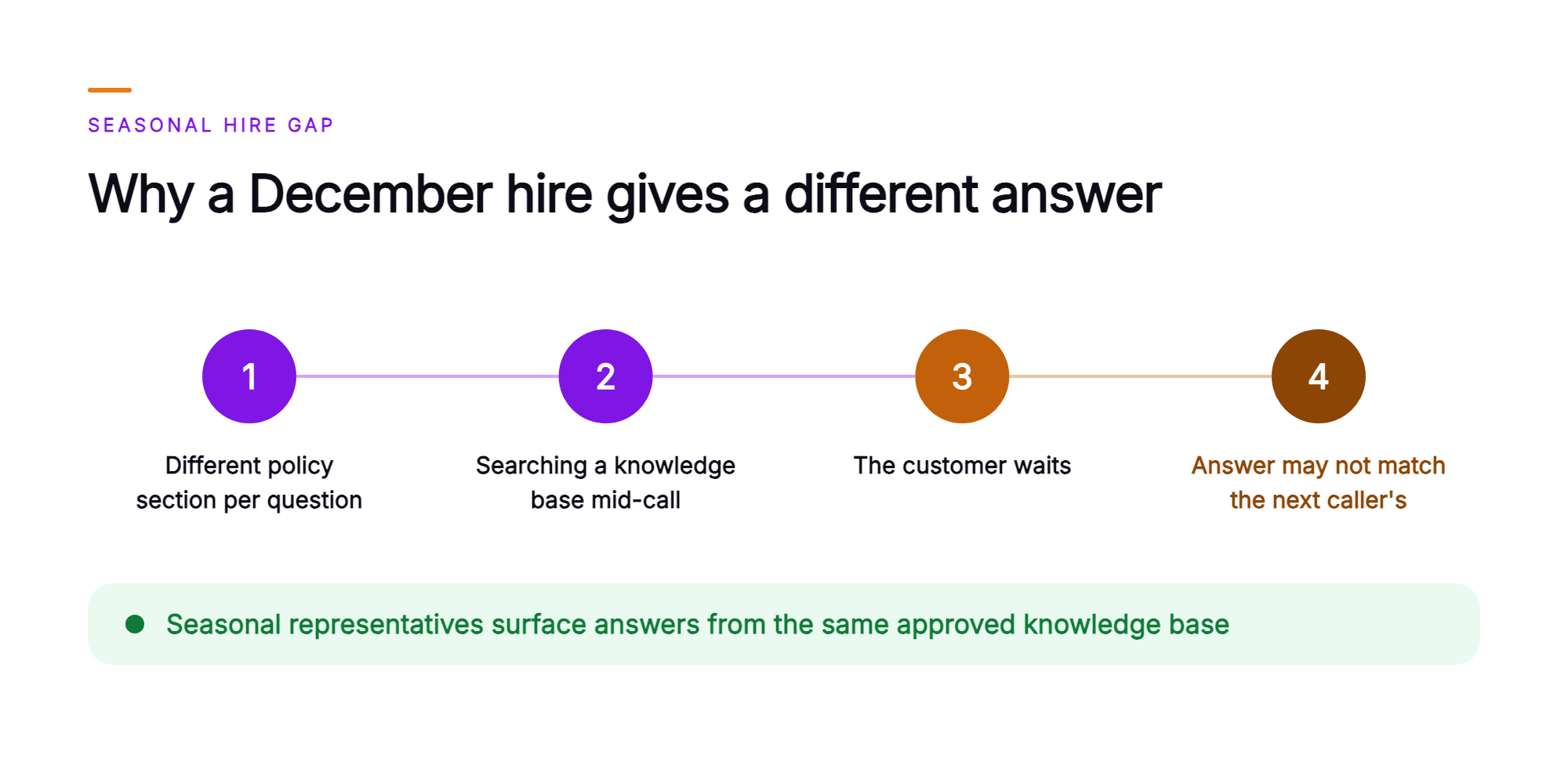
And the retailer sees this gap plainly. Permanent representatives and seasonal hires are scored on the same quality scorecard. That scorecard is where the inconsistency becomes measurable, line by line. It is also where the case for a contact center AI platform becomes an operations decision, made on the floor's own quality data.
What is agent assist for a seasonal retail contact center class?
AI agent assist is software that runs beside each representative during a live conversation and surfaces the retailer's approved knowledge and the next-best action for the exact question the customer just asked.
As the customer speaks, the assist reads the conversation in real time and presents the approved knowledge article, the correct policy, and the recommended next step on the representative's screen. The representative reads from that screen while the call continues. When a question falls outside the approved knowledge, the assist flags an escalation cue and the representative takes the retailer's escalation path to a supervisor.
For a December hire, the point is that the policies, the approved scripts, and the exception rules all belong to the retailer. The assist carries them to the screen as the retailer approved them. It shows what the retailer has already decided. A hire on their first shift sees the same approved answer that a permanent representative draws on after months of experience. The source of that answer is identical, because it comes from the same governed knowledge layer.
What appears on that screen during a live call is what a December hire works from.
What does the AI assist do beside a seasonal representative during a live call?
During a live call, AI Agent Assist listens to the conversation in real time and puts the retailer's approved knowledge, the recommended next action, and escalation cues on the representative's screen before the representative has to search for them.
In a retail contact center, that screen changes as the call unfolds. When the customer describes an issue, the assist surfaces the governing policy article for that exact situation. Alongside the article, it shows the next-best action the retailer's workflow permits for that situation. If the customer's tone shifts, live sentiment indicators and de-escalation prompts appear so the representative can respond to how the customer feels as well as to the order question.
The assist shows the retailer's approved answer and the next step, and the representative decides and acts. Before a risky action, the assist flags the compliance requirement and, where the retailer has defined an exception path, shows it. The representative then decides how to proceed with that requirement in view.
After the call ends, the assist drafts the post-call summary and logs every suggestion it generated. Whether the representative accepted, edited, copied, or dismissed each prompt, that record sits on a searchable suggestion timeline that quality and training teams can review.
What does one December call look like with the assist running?
With AI Agent Assist running, a seasonal customer service agent in week two of a holiday class handles a multi-issue call with the same approved knowledge and next-best action a permanent representative uses, both already on the screen.
A representative takes a call from a customer whose gift order missed its delivery window. The customer wants to exchange the item for a different size and asks whether a promotional discount still applies to the replacement. Two weeks into the role, the representative has not memorized every exchange path or every promotion rule. With the assist running, the approved guidance for both questions is on the screen.
As the customer describes the order issue, the assist surfaces the retailer's order status lookup steps and the exchange policy article that covers missed-window situations. The screen shows the specific next-best action the policy allows for that order type, including whether a replacement can ship at an expedited rate. The representative reads the steps, confirms the details with the customer, and moves forward with the customer still on the line.
The promotion question is a different matter. That question triggers an escalation cue. The assist puts the retailer's exception path on screen and shows the approval owner the retailer has named for a promotional credit on a replacement order. The representative either follows the exception path directly, if the policy permits it at their authorization level, or transfers the call to a supervisor with the full conversation summary already attached. So the supervisor joins a call that is already documented and picks up where the representative left it.
After the call closes, the assist drafts the post-call summary, and the representative reviews it and saves it to the customer's case. The next representative who opens that record sees what was offered and what was promised.
Which decisions stay with the representative, and what does the assist supply for each one?
Every decision that commits the retailer to a policy outcome stays with the representative. The assist supplies the approved knowledge and the suggested next step for each one.
That division holds across every interaction type an ecommerce customer support AI deployment handles, and it matters because accountability cannot transfer to software. What the assist puts on screen is a prompt, and the representative takes the action. Here is what that looks like for the calls a December hire handles most often:
- Refund request. The assist surfaces the retailer's refund policy article and the step-by-step process for that order type. The representative reads the policy, confirms it applies, and tells the customer.
- Exception request. The assist flags the escalation cue and shows the retailer's defined exception path, including who owns the approval. The representative decides whether to escalate or keep the call.
- Approved offer. The assist shows the specific offer the retailer has authorized for that situation. The representative confirms the offer is appropriate and extends it.
- Order-status question. The assist displays the lookup steps in the retailer's order management system. The representative follows them and reads the result to the customer.
The representative makes every one of these calls under the retailer's policy. And after the call, the assist logs which suggestion was accepted, edited, copied, or dismissed, so quality teams have a full record of how each prompt was used.
Why would a retailer want the assist built and run for it before the seasonal class starts?
A retailer wants the assist built and running before the seasonal class starts because real-time agent guidance only works when the knowledge base, the scorecards, and the desktop integration are already in place when the first call arrives.
Orvera AI builds, deploys, and runs AI Agent Assist as a managed service, with floor-wide rollout in two to four weeks. Started that far ahead, the assist is live when the seasonal class takes its first call. Orvera's enablement team runs the knowledge-base setup, scorecard configuration, and representative training during deployment.
The assist installs as a browser extension or webhook on the contact center desktop the retailer already runs. The retailer's telephony and CRM stay in place, and the assist runs alongside them. It reads from the knowledge the retailer already has, which means the approved policies, return rules, and exception paths that permanent representatives rely on are available to every seasonal hire on day one.
And the quality layer runs in parallel. Orvera AI comes from 18+ years of running contact centers. AI Quality Management audits every conversation, human-handled and AI-handled, scored against the retailer's own scorecards. Seasonal representatives and permanent representatives are held to the same standard from the first week.
Which numbers tell a contact center leader the seasonal class is closing the gap?
The four measures that tell a contact center leader the seasonal class is closing the gap are quality scores against permanent representatives, suggestion use by representative, session volume and escalations per seasonal representative by week, and compliance flags by severity.
Contact center workforce training carries a measurement problem: leaders know the class is trained, but they cannot see whether training is holding on live calls.
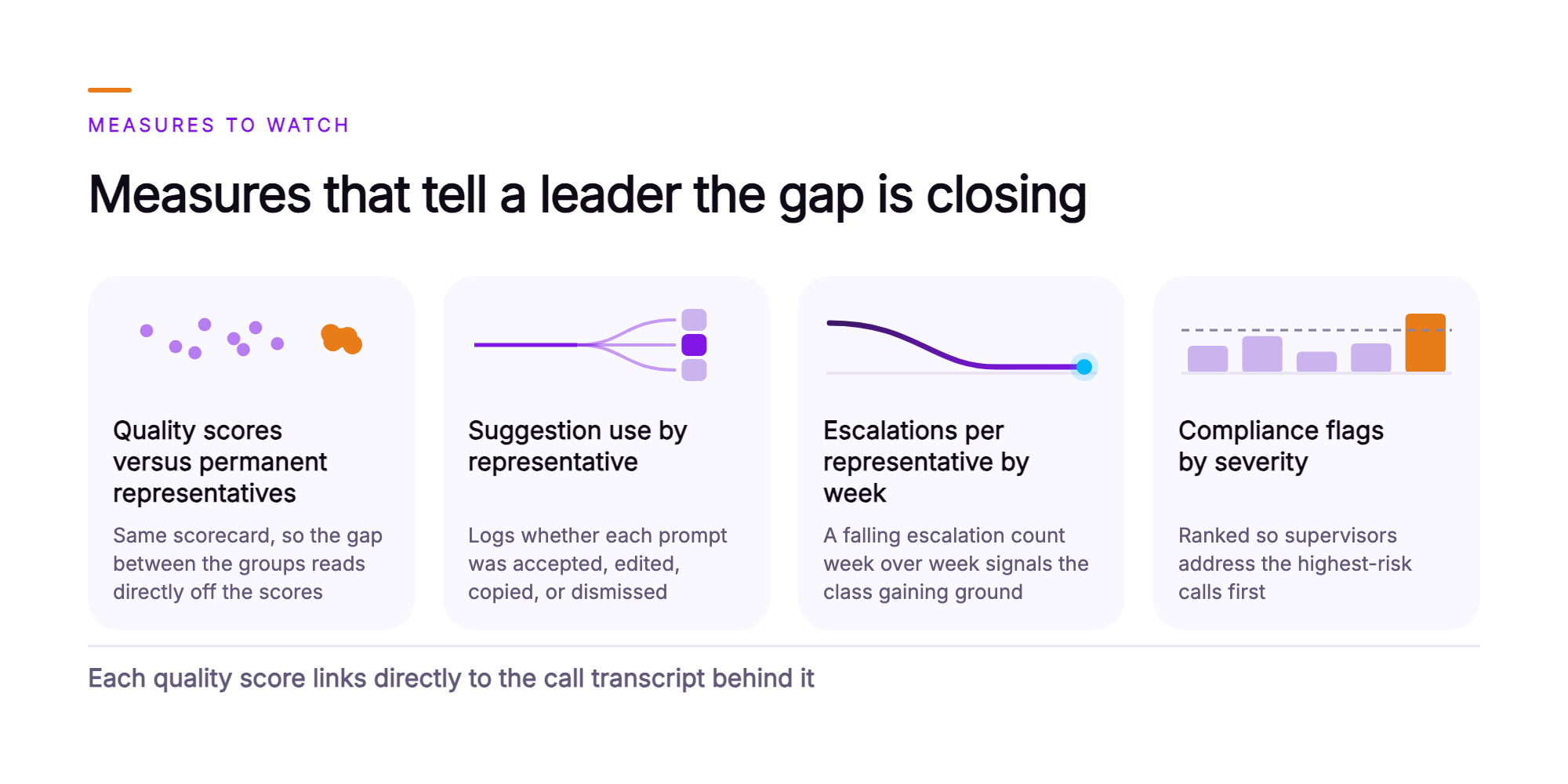
The four measures to watch are:
- Seasonal-class quality scores versus permanent representatives. AI Quality Management scores every seasonal call on the same scorecard permanent representatives are scored on, so the gap between the two groups reads directly off the scores.
- Suggestion use by representative. The assist logs whether each prompt was accepted, edited, copied, or dismissed, so a team lead can see which representatives are following approved answers and which are departing from them.
- Session volume and escalations per seasonal representative by week. A falling escalation count, week over week, is a direct signal that the class is gaining ground on the standard a permanent representative holds.
- Compliance flags by severity for the seasonal class. Flags are ranked by severity, so supervisors address the highest-risk calls first.
Each quality score links directly to the call transcript, so a supervisor can open the call behind any score and read exactly where a suggestion was missed or a policy was applied incorrectly. That auditability is what turns a weekly report into a coaching conversation. And that coaching record is what a VP of Customer Care brings to the leadership team.
What should a VP of Customer Care take to the leadership team?
A VP of Customer Care can take a single, audited argument to the leadership team: the seasonal class worked from the same approved answers as permanent representatives, every policy call stayed with the representative and the retailer's own escalation path, and every conversation was scored.
The four points that support that argument each stand on their own:
- Consistent answers, controlled knowledge. Seasonal representatives surface answers from the same approved knowledge base that permanent representatives use, so the retailer's return policies, exception paths, and offer rules are identical regardless of who answers the call.
- Representative authority preserved. Every refund, exception, and promotional offer is confirmed by the representative under the retailer's policies. The assist supplies the suggested path. The representative owns the decision. Human agent escalation follows the retailer's existing escalation path, and the assist's call summary travels with the transfer so the supervisor has the full context before picking up.
- One scorecard for the whole floor. AI Quality Management scores every conversation, human-handled and AI-handled, against the retailer's own scorecards. The seasonal class and the permanent staff are measured on the same form, so the quality gap is visible and trackable from week one.
- Live in two to four weeks, on the stack already in place. The assist reaches floor-wide rollout in two to four weeks and runs on the knowledge base and contact center systems the retailer already has, so the assist can be live before the seasonal class takes its first call.
What does peak season look like once the assist runs on every seasonal call?
When AI Agent Assist runs on every seasonal call, a December hire answers exchange and delivery questions from the retailer's approved knowledge from the first call forward, and the supervisor sees the record of every suggestion used.
The floor in December looks different when that condition holds. A seasonal representative in week one takes a call about a delayed shipment. The assist surfaces the approved carrier exception policy and the compensation offer the retailer has authorized for that situation. The representative confirms it fits this customer and extends it, and the supervisor can see on the suggestion timeline exactly what was shown and what the representative did with it. Exceptions that do escalate arrive with a summary already attached, so the supervisor starts on the situation with the background in hand.
And AI Quality Management scores that call the same way it scores every other call, human-handled or AI-handled. The quality gap between a December hire and a permanent representative is visible from week one, tracked week over week, and addressed in a coaching conversation tied to the transcript.
The case for running the assist through the seasonal class is consistent answers, a full audit trail, and a coaching record the leadership team can read. If you are preparing for the next peak period, talk to the team (opens in a new tab) at Orvera AI about putting the assist beside your seasonal class before the first call arrives.
Frequently asked questions
A first-week hire sees the retailer's approved knowledge article for the exact question the customer just asked, plus the next-best action, escalation cues, empathy and de-escalation prompts, and live sentiment on the caller. The representative reads it on screen while the customer is still describing the problem. AI Agent Assist runs as a browser extension beside the tools the representative already uses, so the guidance sits next to the order and case screens. The guidance updates as the conversation moves. When the call ends, the post-call summary is already written and waiting for review, so wrap time goes to checking a finished draft.
From the retailer's own approved knowledge base, policies, and scripts. It is the same content permanent representatives work from, which is what keeps a seasonal hire's answers consistent with a tenured one's. The retailer owns that content and updates it. When a holiday return window changes on a Tuesday, the retailer publishes the revised article and the assist surfaces that revised version on the floor. Orvera's enablement team sets up the knowledge base during deployment, structuring existing documents for mid-call retrieval. Suggestions can be scoped by role or queue, so a seasonal order-status team sees the order-status guidance for the queue it was trained on.
The human representative does, under the retailer's policy. The assist shows the relevant policy article, surfaces the next-best action the retailer has approved for that request, and flags an exception request as an escalation cue for the representative to decide. The assist keeps the policy exactly as the retailer wrote it. It puts the right paragraph of it in front of the representative at the moment of the decision. Every suggestion is logged as accepted, edited, copied, or dismissed, so a supervisor reviewing a disputed credit can see exactly what was shown and what the representative chose to do with it.
The assist suggests only from approved knowledge, so here it flags an escalation cue. The representative follows the retailer's existing escalation path to a supervisor, and the call summary travels with the handoff so the supervisor starts with the customer's full story. Those calls are the most useful ones in a peak season. Every suggestion, and what the representative did with it, is logged on a searchable timeline. Supervisors and knowledge owners can filter for escalations, see which questions had no article behind them, and write the missing article. Once that article is published, the assist surfaces it to the next seasonal hire who gets the same question.
Supervisors see analytics on suggestion acceptance rates, compliance severity, and session volume for each seasonal representative as well as for the group. A representative who dismisses most suggestions on verification steps shows up in those analytics, so a supervisor can coach that pattern directly. AI Quality Management audits every conversation, both human-handled and AI-handled, scoring each against the scorecards your evaluators already use. Every score links to the transcript evidence behind it, so a coaching conversation starts with the exact moment in the call that produced the score. Coaching themes can be reviewed for the seasonal class, which shows where the proficiency gap sits.
Through a browser extension or a webhook layered onto the contact center platform the retailer already runs. The telephony and the CRM stay in place, and floor-wide rollout runs two to four weeks, which fits inside the Q4 planning window a retailer uses to scale contact center staffing for the holiday peak. Orvera AI supports 500+ integrations across CCaaS, CRM, helpdesk, payments, and the other categories an enterprise contact center depends on. If a retailer uses a system not in the directory, Orvera builds that connection during deployment. Orvera is SOC 2 Type II certified, HIPAA compliant, and GDPR compliant, the certifications IT and security reviewers ask for first. To see AI Agent Assist work with your own knowledge base before the peak, talk to the team.

Written by
Anindita Majumder
Anindita Majumder is a communications professional with nearly four years of experience in public relations, corporate communications, and journalism. She creates content that helps brands communicate their vision, products, and expertise through press releases, thought leadership, and editorial pieces. Outside of work, she is a vocalist, which keeps her creativity flowing.