What Evidence Does a BPO Need for the Automation Business Case Procurement Demands?
Procurement pushes back because the evidence attached to the business case describes a sample, and procurement is being asked to fund a commitment that will be measured against the whole program.

Key highlights
- Procurement pushes back because the evidence attached to the business case describes a sample, and procurement is being asked to fund a commitment that will be measured against the whole program.
- Contact driver analysis is contact center analytics that reads every conversation in one client program and attributes each one to the contact reason that drove it and the outcome it reached.
- The analysis takes each conversation in the program, works out why the customer made contact, follows what happened, and rolls the result up so the whole program can be read at once.
- A contact reason becomes a line when the analysis shows its measured volume, the resolution path its conversations actually took, and what an AI agent can execute along that path.
- The BPO and its client make every scope, sequence, staffing, and commercial decision, and the analysis supplies the measured evidence each decision needs.
- A BPO wants a finished platform because its clients are buying outsourced contact center solutions from the BPO, and the operation has to carry the BPO's brand, its runbooks, and its account teams.
- Four measures, read by contact reason and tracked against the baseline the case was written from, tell a solutions leader whether the commitment is holding.
- The solutions leader takes a contact center transformation strategy built on four artifacts, each drawn from the client program's own conversations.
Why does procurement push back on a BPO's contact center automation business case?
Procurement pushes back because the evidence attached to the business case describes a sample, and procurement is being asked to fund a commitment that will be measured against the whole program.
The meeting is familiar. The client's procurement team goes program by program and asks which contact reasons automation will take on, what the BPO will commit to on each one, and how the commitment will be verified after go-live. The evidence on hand is a sampled quality review covering a fraction of last quarter's interactions, plus the disposition codes human reps selected at wrap-up.
Both have a known ceiling. A sample describes a small slice of a program. A disposition code records what the rep picked from a dropdown while the next call queued. Built on either one, a BPO contact center automation case carries estimated numbers, and the BPO still has to deliver against them.
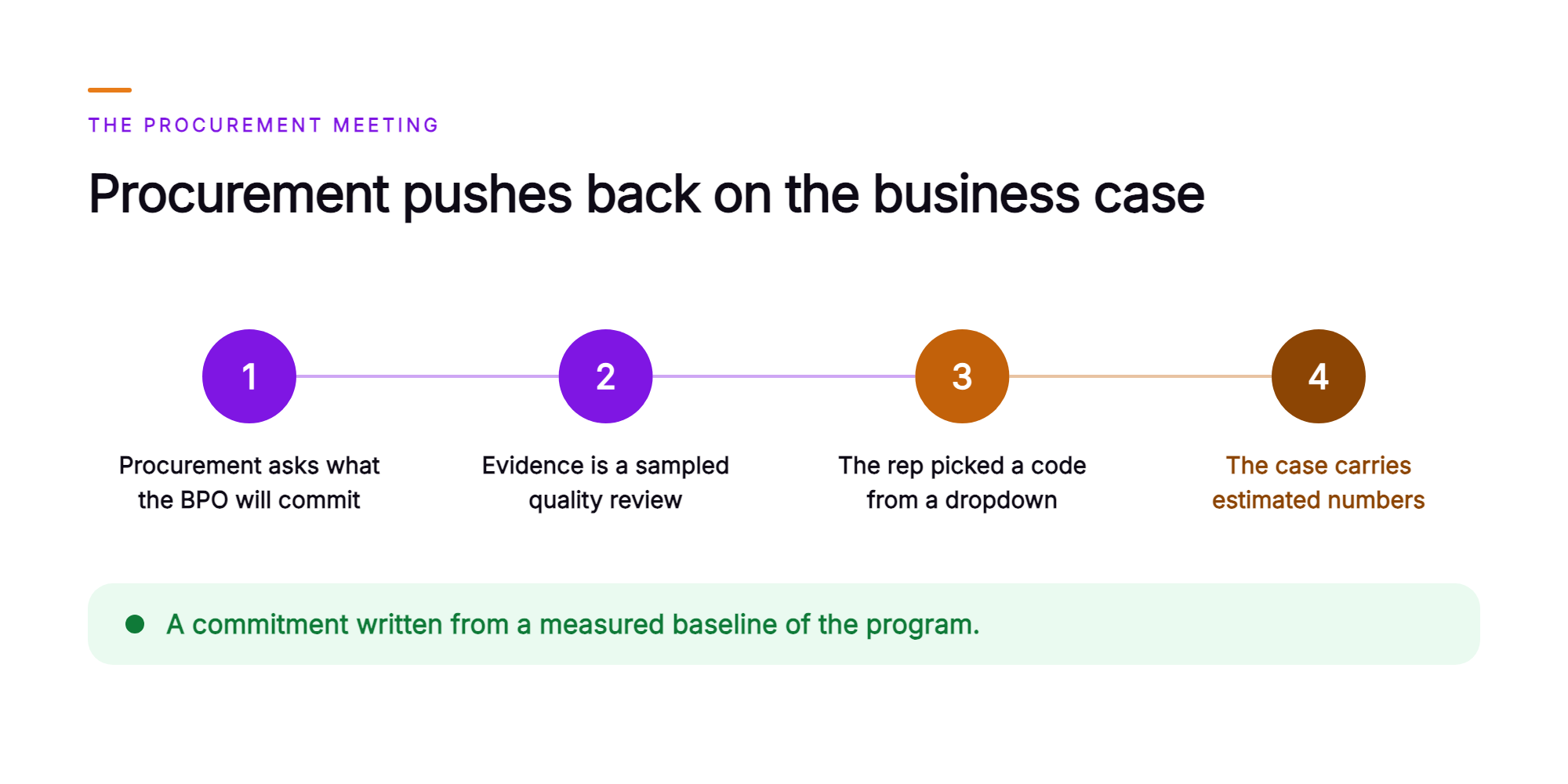
What the solutions leader needs is a commitment written from a measured baseline of the client program's own conversations. Orvera AI is an agentic AI platform for enterprise customer experience, and for your BPO it is the finished platform your teams run under your brand. One system measures the program and hosts the AI agents that take on its contact reasons, so the evidence and the execution come from the same place.
What is contact driver analysis for a BPO client program?
Contact driver analysis is contact center analytics that reads every conversation in one client program and attributes each one to the contact reason that drove it and the outcome it reached.
It covers the whole program, human-handled and AI-handled, across voice, chat, email, messaging, and every other channel the program runs. Each conversation is read in full, and its contact reason comes from the conversation itself. The analysis works from what was actually said and what actually happened next.
The output is a measured baseline for that specific program: volume by contact reason, how each reason resolves today, and where transfers, holds, and repeat contacts cluster. That baseline is the evidence procurement asked for, taken from the full program.
What does the analysis do across every conversation in a client program?
The analysis takes each conversation in the program, works out why the customer made contact, follows what happened, and rolls the result up so the whole program can be read at once.
The analysis reads the whole client program, so the baseline in the business case is the program's own conversations.
For each conversation, the analysis attributes the contact reason from what the customer actually said, in their own words. It traces the resolution path from greeting to resolution, step by step. It marks the transfers, the holds, and the long silences inside the conversation. It tags sentiment across the interaction. Then it rolls all of that up by program, queue, channel, and contact reason.
From there, contact reasons are ranked by volume and sorted by what their resolution path requires. Some paths run entirely through steps an AI agent can execute in the systems of record: verify the caller, read the order, check the shipment, issue the credit, confirm back to the customer. Other paths turn on judgment, exceptions, or a negotiation the rep has to carry.
That split is the substance of the case. It gives the BPO the evidence to sort contact reasons into three groups: reasons an AI agent can resolve from greeting to resolution, reasons that need a human rep supported live, and reasons that stay with the rep entirely. The BPO and its client decide where each reason lands. Procurement can see the reasoning behind every line because the resolution path sits underneath it.
How does one contact reason become a line in the business case?
A contact reason becomes a line when the analysis shows its measured volume, the resolution path its conversations actually took, and what an AI agent can execute along that path.
Take order status in a retail client's program as an illustration. The analysis pulls every conversation carrying that reason, on every channel the program runs. For each one it records the path: the customer identifies themselves, the rep looks up the order in the order management system, checks the carrier tracking record, and reads the status back. It records the conversations where the rep had to hold while a second system loaded. It records the ones that transferred to a returns queue because the real issue was a delayed item the customer then wanted to send back. It records the customers who contacted again two days later on the same order.
That is a resolution path a solutions team can read. The lookup steps are executable in the systems of record. The transfer into returns is a separate contact reason with its own path and its own line. The repeat contacts point at where the first conversation ended without a real resolution.
The solutions team writes the order status line from that measured volume and that measured path, decides what the BPO commits to its client on it, and attaches the evidence to the line. Procurement reviews a commitment it can check against the program's own conversations.
Which decisions belong to the BPO and its client, and what does the analysis supply?
The BPO and its client make every scope, sequence, staffing, and commercial decision, and the analysis supplies the measured evidence each decision needs.
- Which contact reasons go into scope. The BPO and its client decide. The analysis supplies volume by contact reason across the full program and the resolution path behind each reason, so scope is argued from ranked, measured demand in that client's own program.
- The order the program adopts automation in. The BPO and its client decide. The analysis supplies the same ranking read against resolution complexity, so the sequence can start where the path is executable and the volume justifies the work.
- Where a human rep stays on the conversation. The BPO and its client decide. The analysis supplies transfer patterns, repeat contacts, and sentiment by contact reason, which together show where judgment and exception handling carry the outcome.
- What the BPO commits to its client. The BPO and its client decide. The analysis supplies the baseline every commitment is written against, contact reason by contact reason, so the commitment and its verification share one evidence base.
The rollout logic follows from that evidence. A program can start with the contact reasons the analysis shows an AI agent can resolve end to end, run them live, and add reasons in stages as the measured evidence supports them. One platform, adopted in stages, on a schedule the BPO and its client set together.
Why does a BPO want a finished platform its own teams run under its own brand?
A BPO wants a finished platform because its clients are buying outsourced contact center solutions from the BPO, and the operation has to carry the BPO's brand, its runbooks, and its account teams.
Orvera AI operates as a multi-tenant platform, with one tenant per client program. Each client's baseline is measured and held in that client's own tenant, separated from every other program the BPO runs. The BPO's own teams operate the platform. Clients see the BPO.
The delivery facts matter to a solutions leader defending a timeline. A full enterprise deployment goes live in three to six weeks, on the stack the enterprise already runs. Orvera AI brings 18+ years of contact center operations experience to that deployment, and the platform supports 500+ integrations with the CCaaS, CRM, helpdesk, and system-of-record platforms the BPO and its clients already operate.
The client's security review asks a different set of questions. Governed orchestration grounds AI agent responses in approved knowledge, with full auditability on every conversation. The architecture is model-agnostic, so a client program can adopt newer models inside the deployment it already runs. The platform is SOC 2 Type II certified, HIPAA compliant, and GDPR compliant.
Which numbers tell a BPO solutions leader the business case is holding?
Four measures, read by contact reason and tracked against the baseline the case was written from, tell a solutions leader whether the commitment is holding.
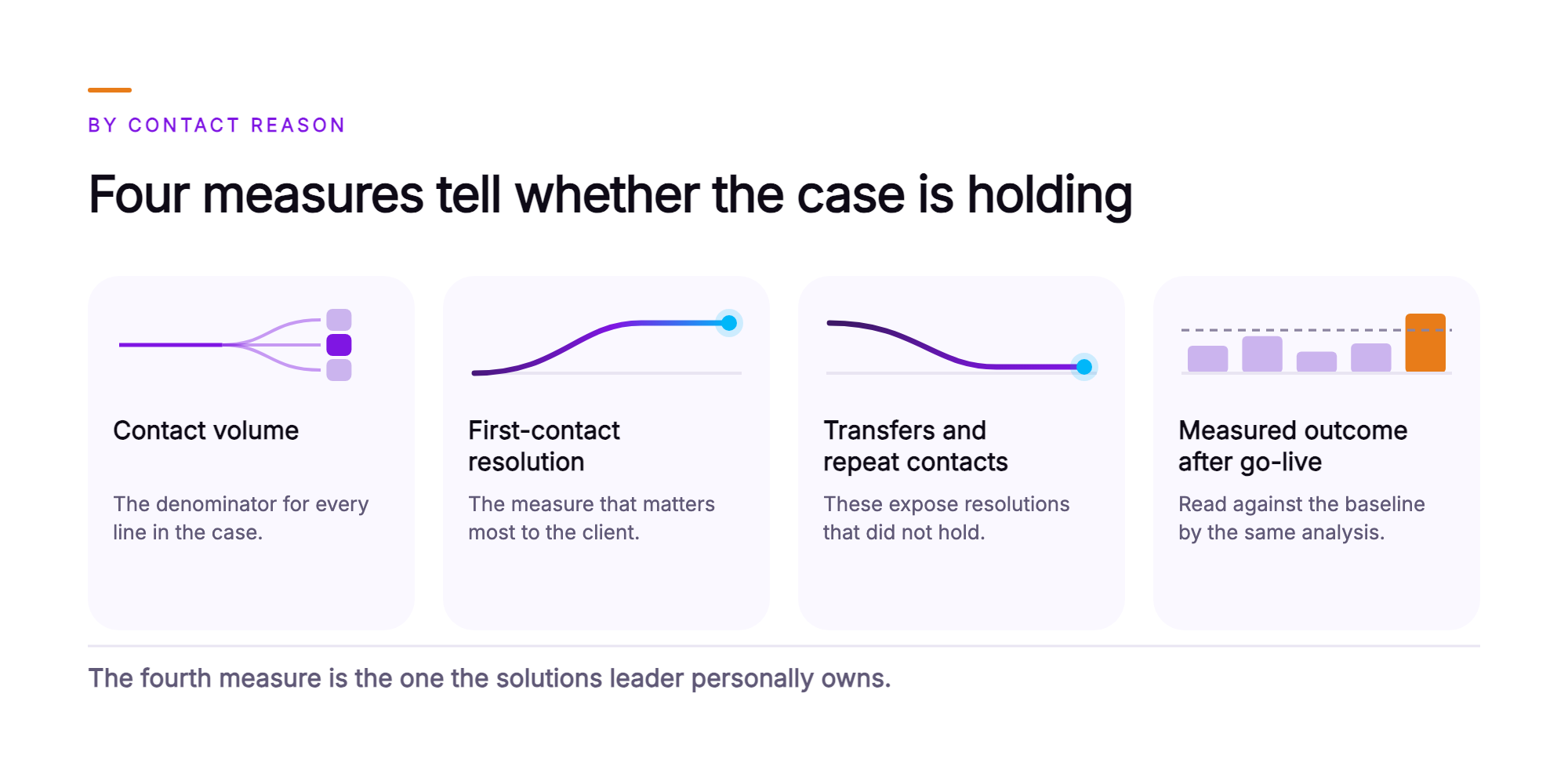
Contact volume by contact reason. This is the denominator for every line in the case. Volume shifts as an AI agent takes on reasons and as the client's own business changes, so it is read continuously from signature onward.
First-contact resolution by contact reason. Resolution is the measure that matters most to the client, with containment tracked beside it. Read per reason, it shows exactly which parts of the scope are performing and which need the resolution path reworked.
Transfers and repeat contacts by contact reason. These expose resolutions that did not hold. A reason whose conversations close cleanly while its repeat rate rises is a reason the program needs to look at before the client does.
Measured outcome after go-live, read against the baseline. The same analysis that produced the baseline reads the program after go-live, across every conversation, human-handled and AI-handled. That is one evidence base before and after, which is what makes the comparison defensible.
The fourth measure is the one the solutions leader personally owns. It is the commitment the BPO made to its client, reported by the same analysis, on the same evidence base the client's procurement team reviewed when the case was approved.
What does the solutions leader take to the BPO's leadership team?
The solutions leader takes a contact center transformation strategy built on four artifacts, each drawn from the client program's own conversations.
- A measured baseline for each client program, covering every conversation across every channel, human-handled and AI-handled, with volume, resolution, transfers, and repeat contacts broken out by contact reason.
- The contact reasons the analysis shows an AI agent can resolve from greeting to resolution, each one presented with the resolution path behind it and the systems of record the path runs through.
- The commitment the BPO proposes to its client, written contact reason by contact reason, with the measured evidence attached to each line so procurement can trace any number back to the conversations it came from.
- The plan to read the program after go-live using the same analysis across every interaction, so delivered results and the original baseline sit on one evidence base.
The business case stays with the BPO and its client, where the commercial terms and the client relationship live. The platform is the source of the evidence. Once the program is running, automated QA for contact center programs audits 100% of conversations, human-handled and AI-handled, across every channel.
What does a client program look like once the business case runs on measured evidence?
It looks like a program whose scope and reporting both trace back to its own conversations, with the BPO committing to exactly what the measured baseline supports.
Scope is argued contact reason by contact reason. When the client's procurement team asks why order status is in phase one and billing disputes are not, the answer is the resolution path behind each reason and the volume attached to it. The commitment is sized to the evidence, so the BPO defends each line with the conversations it was measured from.
After go-live, the same analysis reads every interaction across the program, human-handled and AI-handled, and the BPO reports delivered results to its client on the same evidence base the case was built on. Each quarterly business review works from that one evidence base, with the conversations behind each figure on hand.
If you are building the case for an AI agent platform across your client programs, talk to the team at Orvera AI (opens in a new tab).
Frequently asked questions
Across every conversation in the client program, human-handled and AI-handled, on every channel the program runs, the analysis measures the contact reason, how the conversation resolved, where it transferred or went on hold, whether the customer came back, and sentiment. The contact reason comes from what the customer actually said in the conversation, in their own words, so each conversation is attributed to the reason that drove it. Those measures roll up by client program, queue, channel, and contact reason. What the BPO ends up with is a measured baseline of the program as it runs today, built on full coverage of every conversation. That baseline is where a BPO starts when working out how to build a business case for contact center automation that survives client scrutiny.
It traces each contact reason's resolution path from greeting to resolution, step by step as the conversations record it, and shows which reasons resolve through steps an AI agent can execute in the systems of record. A conversation intelligence platform that reads every interaction can separate the reasons that follow a repeatable path from the ones that turn on judgment. For each contact reason, the analysis reads the volume by channel and by queue, the steps in the resolution path in the order they occur, the exceptions and judgment calls along that path, the transfers and where in the path they happen, and the repeat contacts on the same reason. The BPO and its client decide which contact reasons go into scope. The analysis supplies the evidence for each one.
The BPO takes the measured baseline for that client program: contact volume by reason, how each reason resolves today, and the reasons the analysis shows an AI agent can resolve end to end, with the transcript and conversation summary behind each line on hand to show the client. When a procurement lead questions a number, the answer is a conversation they can read. The business case and the commercial terms belong to the BPO and its client. The platform hands the BPO the evidence those terms are written from, so each line the BPO puts in front of its client traces back to the client program's own conversations. After go-live, the same analysis reads every interaction. Delivered results get reported on the same evidence base the business case was built on, which is what makes a BPO contact center automation roadmap defensible at the next quarterly business review.
Auto QA audits 100% of conversations in the program, human-handled and AI-handled, across voice, chat, email, messaging, and every other channel the program runs, and scores each one against the scorecard the program already uses. Automated QA for contact centers measures quality on the same population of conversations as containment and the other contact center efficiency metrics. Each interaction carries a full report log, a conversation summary, and a transcript. The BPO can show its client the conversation behind any line in the business case, and behind any score. The platform is SOC 2 Type II certified, HIPAA compliant, and GDPR compliant. Governed orchestration grounds AI agent responses in approved knowledge, with full auditability for the security reviewer on the client side.
Orvera AI is a finished platform the BPO's own teams run under the BPO's brand, multi-tenant with one tenant per client program. Each client program's conversations, baseline, and analysis sit in that client's tenant, separated from every other program. The BPO's teams run every program from one platform, whose AI agents serve customers in their own language across more than 80 languages. The platform connects to the systems the BPO and its clients already run, with 500+ integrations across CCaaS, CRM, helpdesk, and the other systems of record a contact center program depends on. Model-agnostic governed orchestration lets a program adopt newer models as they arrive, inside the deployment it already runs. That is what agentic AI for contact centers looks like when it has to serve many clients at once.
A full enterprise deployment goes live in three to six weeks, and the BPO's teams then run the finished platform under the BPO's brand. Enablement spans onboarding, knowledge-base setup, agent training, and change management. Orvera AI is one platform, adopted in stages. The first stage is one client program, starting with the contact reasons the BPO and its client put in scope, and the BPO adds programs as the evidence base grows. Orvera AI brings 18+ years of contact center operations experience to every deployment. To scope an AI agent platform against a live client program, talk to the team.

Written by
Anindita Majumder
Anindita Majumder is a communications professional with nearly four years of experience in public relations, corporate communications, and journalism. She creates content that helps brands communicate their vision, products, and expertise through press releases, thought leadership, and editorial pieces. Outside of work, she is a vocalist, which keeps her creativity flowing.