How an AI Agent Resolves Client Email and Case Backlogs for BPOs
Cases age because they often require multiple interactions to resolve, and each delay adds to the queue time. A case waits on a detail the customer never supplied. It waits on a lookup in a second client system that the person working it does not have open. It waits on a check against the...

Key highlights
- Cases age because they often require multiple interactions to resolve, and each delay adds to the queue time.
- Client email and case-queue backlog resolution is the practice of having an AI agent work a client program's inbound email and case queue and close each case under that client's own case-handling policies, inside that client's own systems.
- The AI agent processes the case according to the client's policy, closing it or passing it to a human rep with all necessary information.
- One aging case looks like a short, unglamorous sequence of steps that nobody had time to run, worked through in order by the AI agent.
- The AI agent resolves the cases that are stuck on a missing input, a second lookup, or a scheduled follow-up, and routes the cases the client's policy reserves for human judgment.
- Queue backlog resolution is a service the BPO sells to its clients, so the platform behind it carries the BPO's own name.
- Four measures tell you whether the queue is actually clearing, and all four belong in the client review deck.
- The leader takes four statements, each of which holds up on its own in front of a client, a security reviewer, or a finance lead.
Why do client email and case queues age inside a BPO's client programs?
Cases age because they often require multiple interactions to resolve, and each delay adds to the queue time. A case waits on a detail the customer never supplied. It waits on a lookup in a second client system that the person working it does not have open. It waits on a check against the client's case-handling policy that only a senior reviewer signs off. Each wait is small. Stacked across a program running thousands of inbound emails a week, they become a BPO email backlog that outgrows shift planning.
The impact extends beyond the inbox. A customer who has waited four days for a written answer picks up the phone and calls the same client program to chase it. That chase call is a second contact on the same case, handled by a human rep on the voice floor who often cannot close it either, because the case is still waiting on the same missing detail. Every aging email case is a source of chase calls on the voice floor.
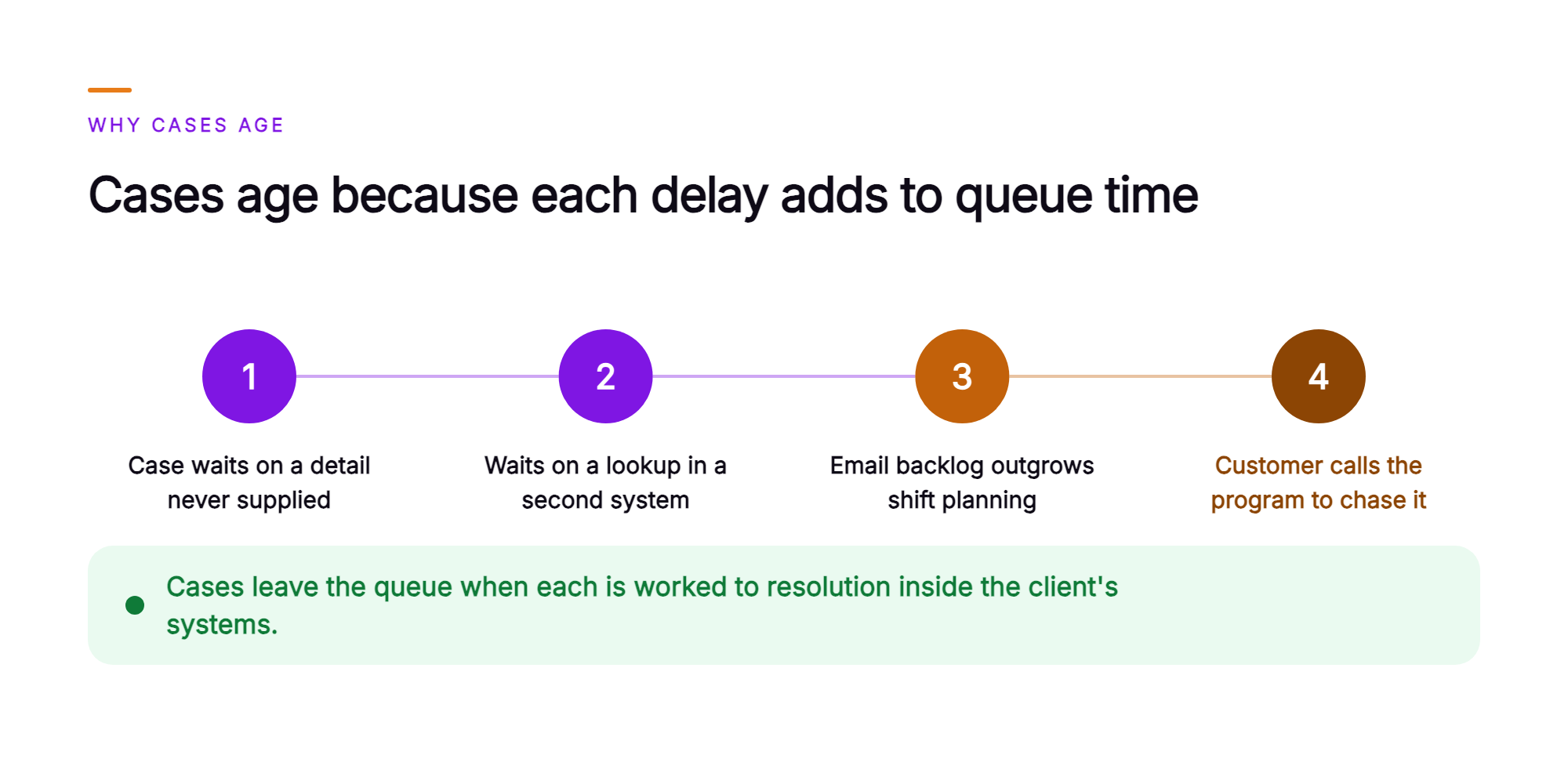
Cases leave the queue when each one is worked to resolution inside the client's own systems. Backlog age is a number the client reads out loud in program reviews.
What is client email and case-queue backlog resolution?
Client email and case-queue backlog resolution is the practice of having an AI agent work a client program's inbound email and case queue and close each case under that client's own case-handling policies, inside that client's own systems.
The structure matters. Each client program runs in its own tenant inside the BPO's environment. The AI agent operates exclusively within that program's queue, adheres to that client's policies, and interacts only with the systems the client has integrated. The client programs, the case-handling policies and the systems of record belong to the BPO and its clients. The AI agent works within them and logs what it does.
Operations leaders already have the vocabulary for this work. The client program case queue is the unit of measurement. Aging cases are the ones breaching service level. Email triage automation sorts and routes, which is useful and insufficient on its own. End-to-end case resolution is the next step, where the case is worked all the way to closure. Customer query management is the whole lifecycle, from the first inbound email to the written answer the customer keeps.
What does the AI agent do with each case in the client's queue?
The AI agent processes the case according to the client's policy, closing it or passing it to a human rep with all necessary information.
The work crosses systems. Orvera's AI agents verify the customer under the client's policy, read the records in the client's CRM or helpdesk, update the system of record where the policy allows an update, and write every action into the log inside that client program's tenant. The AI agent works from the approved knowledge and the approved actions defined for that program.
Routing is integrated into the workflow. When the client's policy reserves a decision for a person, the case goes to the BPO's human reps with the thread summarized, the request identified, the records already retrieved and attached, and the next step stated. The human rep makes the judgment call on a case that arrives already assembled.
What does one aging case look like when the AI agent works it?
One aging case looks like a short, unglamorous sequence of steps that nobody had time to run, worked through in order by the AI agent.
A customer contacts a retail client program via email to dispute an order status. The email does not include the order reference, so the case has been sitting in the queue for six days waiting for someone to ask for it. The customer has already called the program once to chase the email, which added a voice contact on top of the open case.
The AI agent picks up the case. It replies in the existing thread and requests the order reference the client's policy requires for a status dispute. The customer replies with the reference. The AI agent verifies the customer against the policy, opens the order record, checks the shipping record in a second client system, finds the status mismatch, and applies the correction the policy permits. It confirms the correction to the customer in the same thread and closes the case.
What the BPO sees is a closed case with a summary and a complete action log. AI Quality Management reviews that case like every other. The customer has their answer in writing, in the thread they started.
Which stuck cases does the AI agent resolve, and which go to the BPO's human reps?
The AI agent resolves the cases that are stuck on a missing input, a second lookup, or a scheduled follow-up, and routes the cases the client's policy reserves for human judgment.
- Missing customer detail. The AI agent requests the specific detail the policy requires, in the existing email thread, and resumes the case automatically when the customer replies.
- A record held in a second client system. The AI agent retrieves the record, reconciles it against the first system, and applies the update in both where the policy allows it.
- A pending follow-up. The AI agent sends the follow-up the policy sets, on the schedule the policy sets, and closes the case once the customer confirms.
- A policy-reserved exception. Any case type the client assigns to a person, which can include refund thresholds, goodwill credits, high-value disputes, or regulated disclosures, goes to the BPO's human reps with the thread summarized, the records attached, and the next step stated.
Work order follows the client's own rules. If a program says oldest first, the AI agent works oldest first. If a program prioritizes a case type or a service level tier, it works that sequence. The ordering logic belongs to the client program, and it is visible in the log.
Why does a BPO want a finished platform its teams run under its own brand?
Queue backlog resolution is a service the BPO sells to its clients, so the platform behind it carries the BPO's own name.
Orvera AI is an agentic AI platform for enterprise customer experience, delivered to partners as a finished platform your teams run under your own brand. The architecture is multi-tenant, with one tenant per client program. Each tenant holds that client's case-handling policies, that client's system connections, and that client's data boundary. Each program's configuration stays inside that program's own tenant.
Orvera is built on 18+ years of contact center operations experience, which shows up in the parts that usually stall a rollout: policy mapping, exception design, and the handoff to human reps. A full deployment goes live in three to six weeks on the stack each client already runs, connected through 500+ integrations across CCaaS, CRM, and helpdesk systems. The platform is SOC 2 Type II certified, HIPAA compliant, and GDPR compliant.
AI Quality Management audits every conversation, human-handled and AI-handled, across every channel. Every resolved case carries a quality reading the BPO can put in front of its client. That full coverage compares with the one to three percent sample that manual review typically reaches.
Which numbers tell a BPO operations leader the queue is working?
Four measures tell you whether the queue is actually clearing, and all four belong in the client review deck.
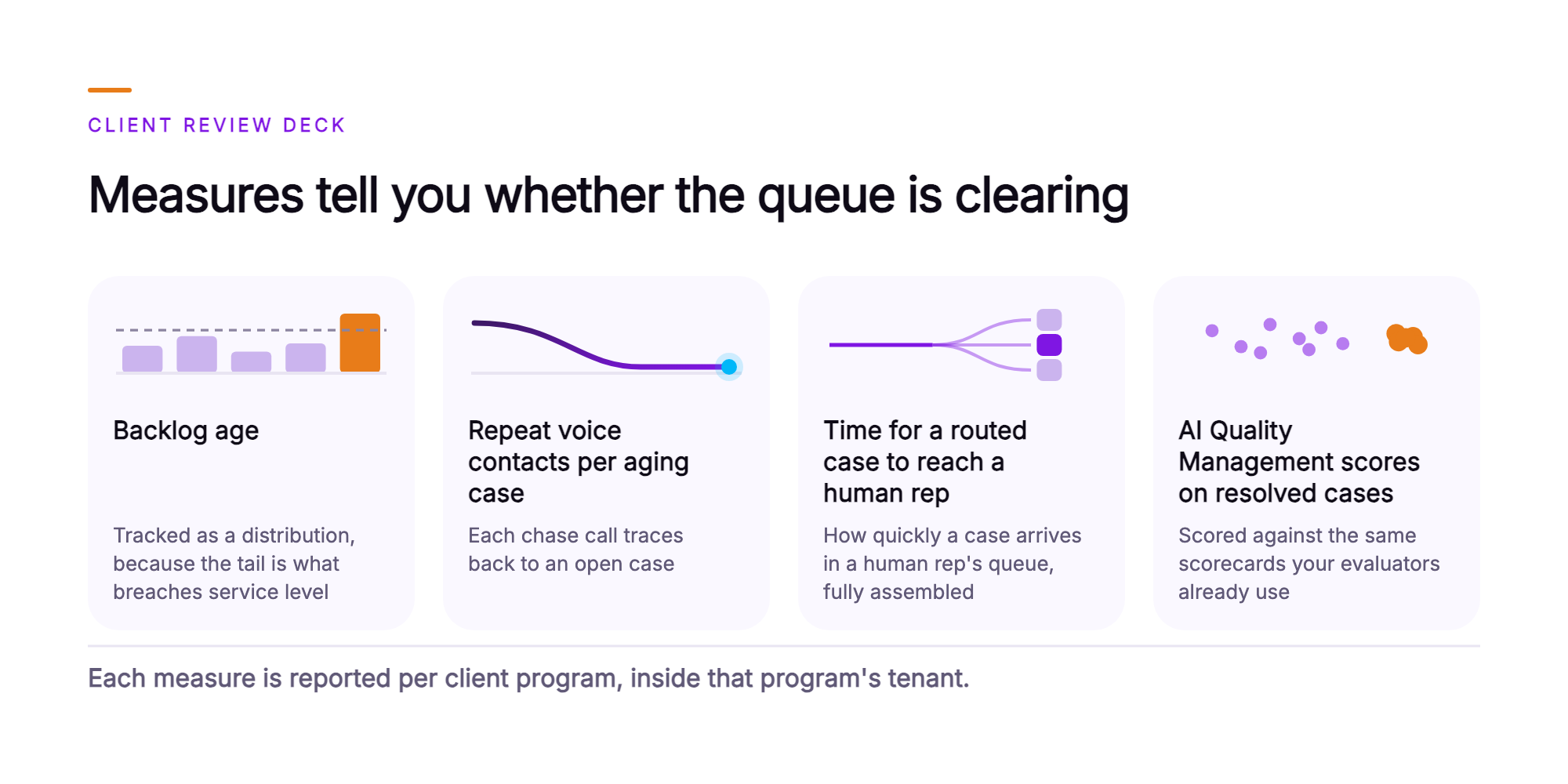
- Backlog age. The age of the oldest open cases in each client program, tracked as a distribution, because the tail is what breaches service level.
- Repeat voice contacts per aging case. The chase calls an open email case generates on the voice floor. When backlog age falls, this number falls behind it, because each chase call traces back to an open case.
- Time for a routed case to reach a BPO human rep. How quickly a case the client's policy sends to a person arrives in a human rep's queue, fully assembled, with the thread summarized and records attached.
- AI Quality Management scores on resolved cases. The quality reading on every case the AI agent closes, scored against the same scorecards your evaluators already use on human-handled work.
Each measure is reported per client program, inside that program's tenant. The operations leader takes the program's own numbers straight into the client review.
What does a BPO operations leader take to the leadership team?
The leader takes four statements, each of which holds up on its own in front of a client, a security reviewer, or a finance lead.
- The AI agent works each client's inbound email and case queue inside the BPO's dedicated tenant for that program, under that client's policies and connected to that client's systems of record.
- The AI agent resolves cases end to end, from the first inbound email to the written confirmation and the closed case, executing only the actions the client's policy permits and logging every one of them.
- Anything the client's policy reserves for a person reaches the BPO's human reps with the thread summarized, the records retrieved, and the next step stated, so the human rep goes straight to the decision.
- AI Quality Management reviews every resolved case against the program's own scorecards, and one platform runs across every client program under the BPO's brand, with a full deployment live in three to six weeks.
The one-platform point is the one procurement cares about. This is one platform, adopted in stages, serving customers in more than 80 languages across every client program. The BPO owns the run.
What does a client program look like once the AI agent works the queue?
It looks like a queue that is worked as cases arrive, so cases are picked up while they are still fresh.
In steady state, each inbound email is picked up, resolved inside the client's systems where the policy allows, and closed with a summary and a log. Backlog age is reported per program as a distribution, so the trend is in front of the client at every review. The BPO's human reps spend their shift on the exceptions the client's policy sends to a person, which is the judgment work the client hired the BPO to deliver. Seasonal spikes raise the volume on the queue, and the AI agent works the added cases under the same policies.
The voice team experiences the impact as well. A case resolved in the email thread gives the customer a written answer, and a written answer is the thing they would otherwise call the client program to chase. Each case closed in writing removes the reason for a chase call on that case, which is why repeat voice contacts belong in the same review as backlog age.
If you have client programs where the email and case queue is aging, bring the program names and the backlog numbers when you talk to the team (opens in a new tab).
Frequently asked questions
Orvera's AI agents work each client program's email and case queue inside the BPO's tenant for that program, alongside chat, messaging, and the other channels the program runs. The queue stays in place, and cases route under the rules the client program already sets. The queues, the case-handling policies, and the client's systems of record belong to the BPO and its clients. The AI agent works inside them, reading and acting under the permissions that program grants. Customers are served in their own language across more than 80 languages, so the same AI agent works each language the program's customers write in.
The AI agent reads the full thread, identifies what the customer is asking for, retrieves the matching records in the client's systems, executes the update the client's policy allows, replies to the customer, and closes the case. That is the sequence for a complete resolution, and the AI agent runs it inside the client's own systems. When a required detail is missing, such as an order number or a verification field, the AI agent requests it in the thread, and holds the case open. On the customer's reply, it resumes from where it stopped and finishes the work. The AI agent carries each case from the first email to resolution and sends the answer itself.
The case goes to the BPO's human reps with the work already assembled: the thread summarized, the request identified, every record the AI agent retrieved attached to the case, and the next step stated. Your human reps pick up a case with the full context in front of them and move straight to the decision. AI Agent Assist stays with them during the work, surfacing approved knowledge and the next action while the case is live. Policy decides which cases route this way. High-value disputes, regulated disclosures, and exceptions the client wants a person to own can all be held back by rule.
Orvera AI is multi-tenant. Each client program gets its own tenant, holding that client's policies, knowledge, data, and system connections. That one-tenant-per-program structure is the first thing your IT security reviewers and your clients ask about. Operationally, this means a BPO AI agent configured for a healthcare payer program and one configured for a telecom program run on the same platform with separate governance. Your teams run the finished platform under your own brand. One platform is adopted in stages, program by program, so you prove the model on one queue before extending it across the book.
AI Quality Management audits every conversation, human-handled and AI-handled, across every channel. Every resolved case carries a full log, a summary, and a transcript, so a client QA lead can open any case and see what was read, what was retrieved, what was changed, and what was sent. Orvera AI is SOC 2 Type II certified, HIPAA compliant, and GDPR compliant. Answers are grounded in approved knowledge, so the AI agent responds from the client's own documented policy. Voice of Customer turns the same audited conversations into themes and drivers your program reviews can act on. Full-coverage review scores every case, where manual QA typically reaches a one to three percent sample.
A full deployment goes live in three to six weeks, connecting to the CCaaS, CRM, and helpdesk systems the client already runs through 500+ integrations. The client keeps its own stack and its own system of record, and the AI agent works inside them. Enablement spans onboarding, knowledge-base setup, training for the BPO's human reps, and change management. An email backlog AI agent can start on one queue in one program, then extend. That staged path lets a BPO work the email backlog on an aging program while the SLA clock keeps running, and it is how an AI agent for customer service earns the next program. To scope a program, talk to the team.

Written by
Anindita Majumder
Anindita Majumder is a communications professional with nearly four years of experience in public relations, corporate communications, and journalism. She creates content that helps brands communicate their vision, products, and expertise through press releases, thought leadership, and editorial pieces. Outside of work, she is a vocalist, which keeps her creativity flowing.