Why Your Financial Aid Verification Rate Stalls (and How AI Voice Agents Fix the Last Mile)
Verification files sit incomplete because every handoff in the current outreach chain relies on the student noticing something, and most students do...

Key highlights
Key takeaways
- Verification files sit incomplete because every handoff in the current outreach chain relies on the student noticing something, and most students do not.
- An AI voice agent during a missing-document call states the institution's name, the student's verification tracking group, the exact outstanding document, the submission channel, and the deadline, in that order, drawing only from approved institutional knowledge and the student's own record.
- A voice agent can chase most standard verification documents to completion on the outbound call itself, but V4 and V5 identity items require an appointment that the call sets up rather than closes.
- A Voice AI agent can book and confirm a V4 or V5 identity verification appointment on the same outbound call, then run a reminder call before the appointment and a follow-up call once the document lands in the imaging queue.
- A Voice AI agent closes a verification gap. A portal reminder, a text, and a recorded menu tree each announce that one exists.
- The AI agent transfers a call to a financial aid administrator the moment the conversation moves beyond chasing a known outstanding document for a known tracking group and into any question that requires professional judgment.
- Outbound calling to students selected for verification stays inside FERPA, TCPA and GLBA when the AI agent operates on institution-defined rules, confirms identity before disclosing anything, and logs every exchange for audit.
- Days from verification selection to a complete file moves first, because that interval measures the exact gap that automated outbound verification calling closes.
- Before the next FAFSA verification cycle opens, a financial aid director needs four things written down: last cycle's real numbers, a split selected list, a named escalation boundary, and the institution's outbound calling rules handed to the AI agent as hard rules.
Why do verification files sit incomplete until a student panics near a deadline?
Verification files sit incomplete because every handoff in the current outreach chain relies on the student noticing something, and most students do not.
The selection event triggers the tracking group posting to the student's account. A portal notification fires. An email goes out to whatever address is on file, often a high school account the student stopped checking in August. Both go unread. The aid office has a selected list, but counselors work through it only when the appointment queue opens a gap, which means a meaningful share of selected students never receive a live contact at all before the file ages.
The file then sits. The student does not know a document is missing until a hold appears on their account, a billing statement arrives showing a balance they expected aid to cover, or a disbursement that was supposed to post simply does not. By that point the calendar has moved to within days of the census date or the disbursement run. The student calls the aid office in genuine alarm, the counselor works the exception under pressure, and the whole cycle compresses into a crisis that was avoidable from the first week of selection.
For a private or for-profit institution, this pattern is the single largest source of avoidable aid-cycle delay. It does not show up as a counseling failure. It shows up as days from selection to complete file and as the percent verified before census, and both metrics are recoverable. That is exactly the gap ai voice agents for financial aid verification are designed to close, reaching every selected student on the day the tracking group posts rather than when someone on staff finds time.
What does an AI voice agent actually say on a missing-document call?
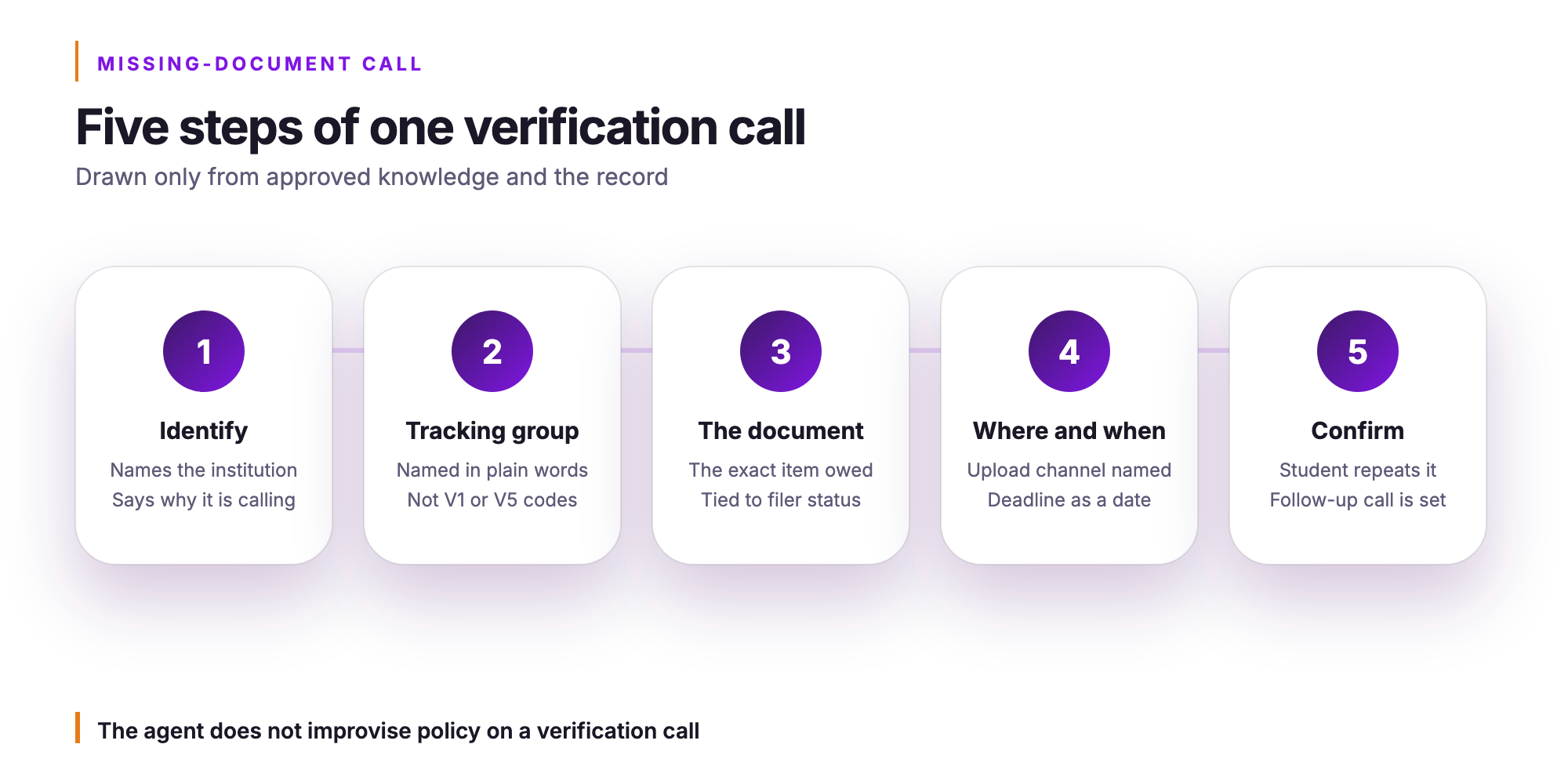
An AI voice agent during a missing-document call states the institution's name, the student's verification tracking group, the exact outstanding document, the submission channel, and the deadline, in that order, drawing only from approved institutional knowledge and the student's own record.
Automated missing document outreach for students follows a defined sequence, and the precision of that sequence is what separates it from a generic reminder.
The call begins with identification. The AI agent states the institution's name and explains that the call is about the student's financial aid file, so the student understands immediately why they are being contacted. It then names the verification tracking group in plain language, not V1 or V5, but a phrase the student can recognize, such as standard verification or identity and statement of purpose.
The document identification step is specific. Rather than saying "documents are missing," the agent names the exact item tied to that student's tracking group and filer status. A dependent student who filed taxes hears "IRS tax return transcript." A non-filer hears "verification of non-filing letter." A student in a V1 group hears "signed verification worksheet" if that item is outstanding. No guessing and no generic language.
The submission step clarifies where and when. The agent states the channel the office actually uses, whether that is a portal upload, a document imaging inbox, or an in-person counter, and it states the deadline as a calendar date. That combination gives the student a complete action.
Confirmation closes the exchange. The agent asks the student to repeat the document name and the deadline, which is a short comprehension check that reduces the rate of wrong submissions. The agent then schedules a follow-up to confirm receipt once the document posts to the file. The agent does not improvise policy. Every fact it states comes from the approved knowledge base and the student's own record. Understanding how that knowledge base is built and governed determines how reliably the agent holds to institutional policy across every call it places.
Which verification documents can a voice agent chase, and which ones cannot be closed on a call?
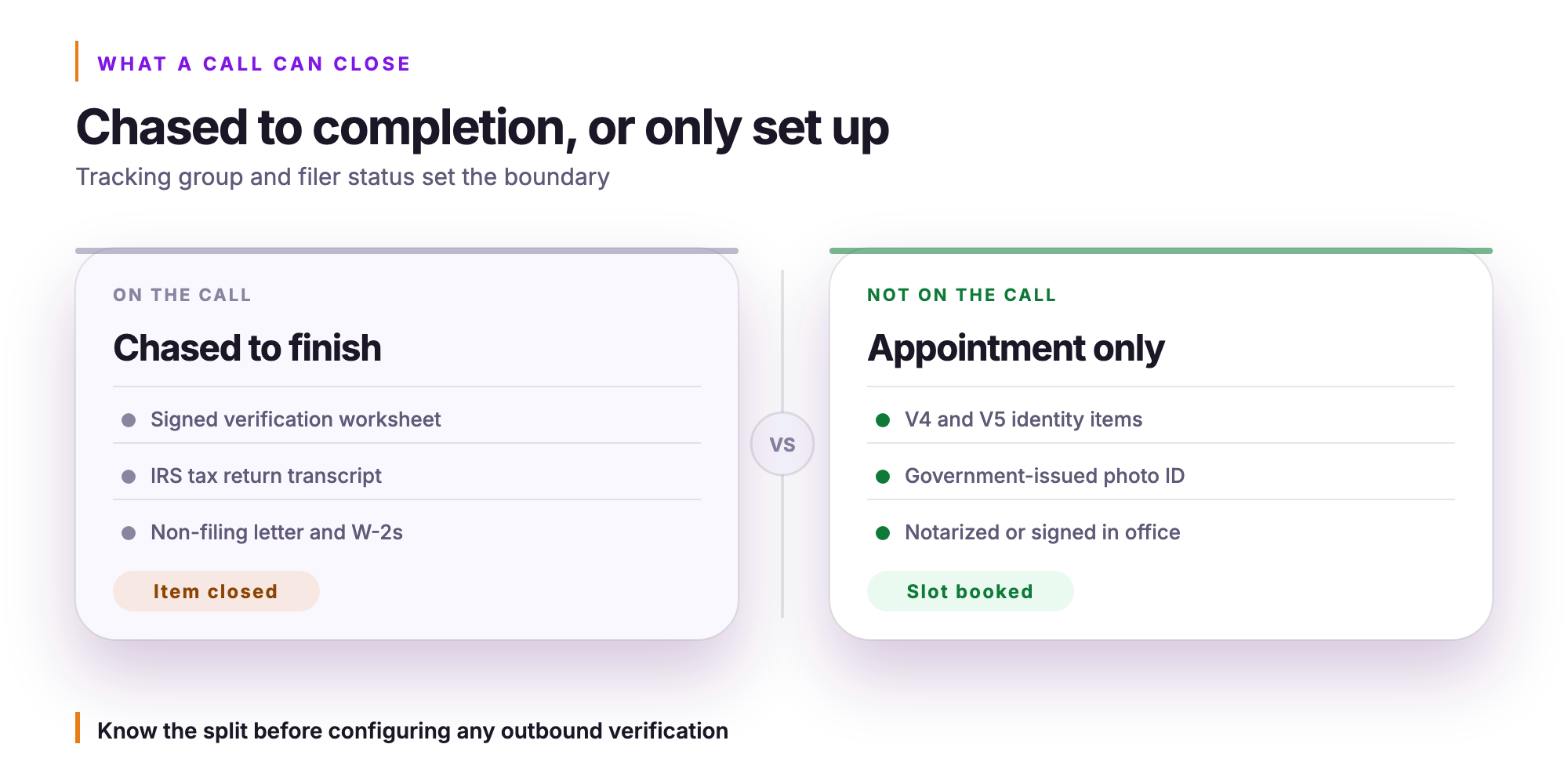
A voice agent can chase most standard verification documents to completion on the outbound call itself, but V4 and V5 identity items require an appointment that the call sets up rather than closes.
Understanding that boundary is crucial before configuring any FAFSA verification automation software. The tracking group tied to a student's record determines which documents are in scope, and the filer status determines which tax documents apply. What follows is the practical split.
Documents an outbound call can chase to completion:
- Signed verification worksheet (V1, V3, V4, V5, or V6 dependent or independent version matched to the student's group)
- IRS tax return transcript or IRS Direct Data Exchange consent form, matched to filer status
- Verification of non-filing letter, for non-filers required to document the absence of a return
- W-2 forms for each employer, when wage verification is required alongside the transcript
- Household size and number in college confirmation, collected verbally and confirmed via follow-up upload
- Child support paid documentation, where the tracking group requires it
- SNAP benefit documentation, when household eligibility is under review
Documents a call can only set up, not finish:
- Identity and statement of educational purpose for V4 and V5, which requires either an in-person appointment with a government-issued photo ID or a notarized statement delivered through a specific channel
For any item that requires an aid administrator to review and clear the file, the call flags the record and routes it appropriately. The next section details how the agent manages V4 and V5 appointment booking.
Can the agent book and confirm the V4 or V5 identity verification appointment?
A Voice AI agent can book and confirm a V4 or V5 identity verification appointment on the same outbound call, then run a reminder call before the appointment and a follow-up call once the document lands in the imaging queue.
V4 and V5 tracking groups are distinct from other verification types because they require in-person identity confirmation and a signed statement of educational purpose. A student cannot upload a selfie and close the file. The appointment is the document. That distinction is precisely where automated outbound calling for missing FAFSA documents earns its place in the verification cycle, because the gap between "student was notified" and "appointment booked" is where files stall.
On the call itself, the agent reads the open slots the office has published, takes the student's selection, confirms the appointment, and states what the student must physically bring: government-issued photo ID and a handwritten statement of educational purpose notarized or signed before a school official, depending on the option the institution offers. The agent repeats the date and the time before ending the call, so the student has a clear verbal confirmation.
The confirmation process extends beyond the initial call. A reminder runs before the appointment date, prompting the student on what to bring and where to appear. Once the document clears the imaging queue and the record updates, a follow-up call marks the file complete rather than letting it sit one step short of resolved. That three-call sequence, booking, reminder, and close, is what separates a conversation from a notification.
Orvera AI runs this sequence on the systems the institution already operates. The agent reads available slots from the scheduling module, writes the confirmed appointment back to the student information system, checks document status in the financial aid management system and the document imaging queue, and updates the admissions or student CRM record, whether that means Banner, PowerFAIDS, Salesforce, or another platform already in place. How that real-time data exchange across systems works in practice shapes what the agent can say and confirm on a live call, which becomes directly relevant when the next comparison arises: how this differs from the one-way reminders the office already sends.
How is this different from the robocalls, texts and portal reminders the office already sends?
A Voice AI agent closes a verification gap. A portal reminder, a text, and a recorded menu tree each announce that one exists.
That distinction matters for financial aid automation because the failure mode your office already knows is not a notification problem. Students receive the portal message. They see the email. The file still sits incomplete three weeks later because no single outbound touch confirmed which document, for which tracking group, to which upload channel, by which date, and whether the student actually understood all four pieces at once.
One-way reminders deliver a message. A two-way conversation delivers a resolution plan the student can act on before the call ends. When a student says "I already sent that one," a recorded press-one prompt has no answer. An AI agent recognizes the statement, checks the tracking group status in the student information system in real time, and either confirms the receipt or explains exactly why the item is still outstanding. When a student says "I cannot get my parents' tax information," the agent captures that as a professional judgment consideration and routes it accordingly. Neither of those exchanges is possible inside a notification.
That is the line Orvera AI holds. The goal is a finished conversation: the student knows the specific item, the deadline, and the exact step to complete it, or the file has moved to the next stage because the document arrived during the call. Measuring how different AI voice approaches perform on resolution rather than deflection is the right frame for any evaluation your office runs.
Not every conversation ends that cleanly, and the next section addresses exactly where the boundary falls between what an AI agent resolves and when the call reaches a financial aid administrator.
When does the call get handed to a financial aid administrator?
The AI agent transfers a call to a financial aid administrator the moment the conversation moves beyond chasing a known outstanding document for a known tracking group and into any question that requires professional judgment.
The boundary is deliberate. Student document verification is a mechanical task: a Verification Tracking Group V4 or V5 flag, a missing tax transcript, an unsigned verification worksheet. The agent knows what is outstanding, and it knows what the student needs to submit. It does not read a file holistically, weigh conflicting evidence, or make a determination about a student's aid eligibility. That line belongs to your staff.
Several exception types always route to a human rep, and the agent does not attempt to resolve them. Professional judgment requests, special circumstances appeals, and dependency override inquiries transfer immediately. Conflicting information found in the student's record, any suspected identity concern, and unusual enrollment history each require a trained administrator. A student expressing real distress about covering the term is transferred without delay.
The handoff is not a reset. The transfer carries the tracking group, the outstanding item, and a summary of what the student said on the call, so the administrator picks up with full context rather than starting from a greeting.
And the support does not stop at transfer. The human-agent assist layer surfaces relevant policy guidance during the live conversation. Automated summaries are generated after the call closes. Every conversation, whether the AI agent handled it fully or a human rep completed it, is audited. Orvera AI reviews 100% of both populations, so your quality data reflects the whole picture of how verification outreach performs.
How does outbound calling to students stay inside FERPA, TCPA and GLBA?
Outbound calling to students selected for verification stays inside FERPA, TCPA and GLBA when the AI agent operates on institution-defined rules, confirms identity before disclosing anything, and logs every exchange for audit.
FERPA governs what may be said and to whom. The call discusses a student's own education record with that student, so the agent opens every call by confirming the student's identity through approved knowledge before naming any document or outstanding item. Nothing about the verification record is stated to anyone other than the confirmed student. Voicemail presents the tightest constraint. The agent leaves only a callback number and a reference to the financial aid office, never a document name or any detail about the student's file.
TCPA places obligations on calls to mobile numbers. The institution already holds consent collected at enrollment or through a standing communication agreement, and that consent record governs whether the call may be placed. The AI agent applies the institution's defined calling windows and its do-not-call list. The agent does not decide those rules. It executes them, and every call carries a compliant caller ID routed back to the institution.
GLBA requires that Title IV student financial data be handled inside a controlled environment with documented safeguards. The AI agent answers only from verified student record data. Every exchange is logged, and the full conversation record is available for review. Orvera AI is SOC 2 Type II certified. The audit trail covers human-handled and AI-handled conversations equally, across 100% of interactions.
The metrics that compliance makes possible are exactly the ones the next section measures directly.
Which metrics move first, days from verification selection to a complete file or percent verified before census?
Days from verification selection to a complete file moves first, because that interval measures the exact gap that automated outbound verification calling closes.
The difference matters in practice. A portal notification tells a student something is missing. A call names the specific document, whether that is a signed Verification Worksheet, a tax transcript linked through the IRS Data Retrieval Tool, or proof of household size. A follow-up call confirms receipt. Each of those touches is handled by the AI agent without pulling a financial aid administrator away from complex case work. The result is a shorter interval between selection and a complete file, measured in days rather than the weeks that accumulate when manual outreach covers only a fraction of the list.
Percent verified before census is the metric the institution feels most directly. A file that closes after the enrollment count is taken cannot move aid in time to keep the student enrolled. Compressing days from selection to complete file is what moves the before-census rate. One metric drives the other.
Deployment timeline shapes when these gains appear on the dashboard. Full enterprise deployment lands in three to six weeks. Across customer engagements, Orvera AI averages first-contact resolution around 80%, with average handle time down 8% to 15% in the first 90 days and 100% of conversations audited across human-handled and AI-handled interactions. Those figures give a financial aid director a concrete baseline when projecting what the next verification cycle will look like.
What should a financial aid director do before the next verification cycle opens?
Before the next FAFSA verification cycle opens, a financial aid director needs four things written down: last cycle's real numbers, a split selected list, a named escalation boundary, and the institution's outbound calling rules handed to the AI agent as hard rules.
- Pull the real numbers from last cycle. Days from verification selection to complete file and percent verified before census are the two figures that tell you whether the gap is a staffing problem or a contact problem. An impression that "it went fine" or "we struggled late in the cycle" is not actionable. A measured figure is.
- Split the selected list before any outreach runs. Some files stall on a single document a call can chase to completion, a signed verification worksheet or a tax transcript confirmation. Others need an appointment with an aid administrator. Separate them before deployment so the AI agent works the right contacts and the human staff work the right cases.
- Write the escalation boundary down. Conflicted dependency status, professional judgment requests, and selected students flagged for identity verification all reach a human representative. Name those exception types explicitly, because a rule written in advance holds where a judgment call at volume does not.
- Hand the outbound calling rules to the AI agent as rules, not guidance. Consent status, calling windows, and voicemail content restrictions the institution already applies should arrive as configured constraints, not as expectations the system interprets on its own.
Orvera AI runs the outbound verification chase, the appointment booking, and the confirmation call that closes the file. The measured gap between selection and file completion is where it operates.
Frequently asked questions
An AI voice agent reads the outstanding item directly from the student's record, places the outbound call, names the exact document, gives the upload location and deadline, and writes the result back to the system of record before the call ends.
An AI voice agent can chase any verification item that requires a document, a signature, or a status confirmation, and it must stop at any item that requires a counselor to interpret eligibility.
Under FERPA, an AI agent may discuss a student's verification file with the student once identity is confirmed, but it may not disclose anything to a parent who lacks written consent on record.
Before any AI agent dials a student's mobile number about a missing verification document, the institution must confirm it holds a valid consent record for that specific number, captured at a point the student would recognize.
The metrics that move first are days from verification selection to complete file and percent of selected students verified before census, and both need a baseline from last cycle before anything goes live.
The AI agent routes to a counselor the moment the conversation reaches a judgment call, a sensitive file condition, a third party on the line, or any question about award amounts or eligibility.
Written by
Anindita Majumder
Anindita Majumder is a communications professional with nearly four years of experience in public relations, corporate communications, and journalism. She creates content that helps brands communicate their vision, products, and expertise through press releases, thought leadership, and editorial pieces. Outside of work, she is a vocalist, which keeps her creativity flowing.