How an AI Agent Verifies Parts Fitment by VIN in Dealership Parts Chat
Shoppers order the wrong part because a year, make, and model selection on a parts website does not capture the build details that fitment actually depends on.

Key highlights
- Shoppers order the wrong part because a year, make, and model selection on a parts website does not capture the build details that fitment actually depends on.
- In each auto parts fitment conversation, the AI agent moves from the shopper's opening question through VIN verification, catalog lookup, and order placement, all inside the same chat.
- Every action the agent takes, from the fitment answer to how an order ships, maps to a rule the dealer owns.
- A dealer group or OEM wants fitment chat built, deployed, and run for it because the operational complexity of VIN decoding, catalog integration, and OEM parts lookup requires contact-center operating depth.
- A Director of Fixed Operations takes four operating facts to the leadership team: what the AI agent does, how the order closes, who owns the data, and who runs the program.
- Once the AI agent runs fitment chat, the parts eCommerce operation runs on verified orders, audited records, and parts advisors focused on the work that needs them.
Why do shoppers order the wrong part from a dealer's parts website?
Shoppers order the wrong part because a year, make, and model selection on a parts website does not capture the build details that fitment actually depends on.
Most parts eCommerce flows ask the shopper to pick from a menu: year, make, model. The part looks right in the photo, and the price is right. But the catalog note beneath it often reads "fits base trim only" or "for vehicles with the sport brake package" or "production date before March 1, 2026." Those qualifiers turn on option codes, engine configurations, drivetrains, and production dates the shopper rarely knows by memory. The order goes through, the part ships, and the mismatch is discovered only when the technician opens the box.
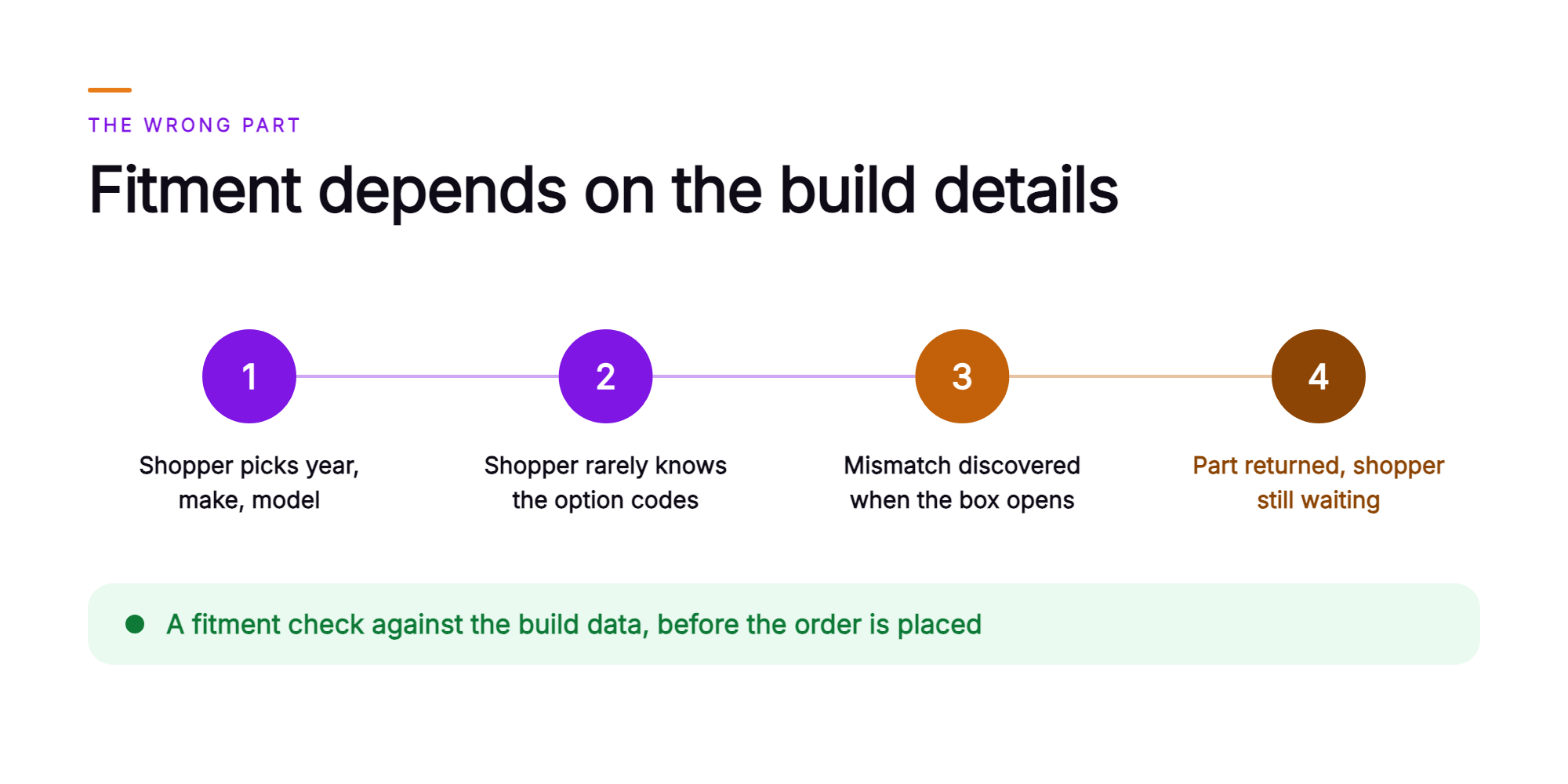
One wrong-part order means a return to receive, a part back on the shelf, a second order placed, and a shopper still waiting on a repair. The parts department carries each of those steps. In current practice, parts advisors run the VIN through the catalog by hand for fitment questions that come in by phone, email, or chat.
The fix is a fitment check against the vehicle's own build data, completed before the order is placed. Automotive contact center AI runs that check inside a dealership parts chat, against the dealer's own catalog.
What is parts fitment chat with VIN decode?
Parts fitment chat with VIN decode is a use case in which an AI agent on a dealer's or OEM's parts website takes the shopper's VIN, decodes it to the vehicle's actual build, confirms or declines fitment against the dealer's own catalog with the qualifier the catalog carries, and completes the order in the dealer's ordering system before the chat ends.
To speak this use case precisely, a parts eCommerce leader needs six terms. VIN decode is the process of reading the 17-character VIN and matching it to the build record the dealer's or OEM's catalog holds for that VIN, which gives the vehicle's full specification. Build data is that specification: the confirmed assembly configuration recorded for that specific unit. Option codes and production date refine the build further, since two vehicles with the same year, make, and model can carry different assemblies depending on trim, factory, and build week. A fitment qualifier is the catalog's own language for when a part applies, such as "for vehicles with the tow package." And supersession is the catalog's redirect from a discontinued part number to the current replacement.
The before-and-after is direct. Before the parts chat, a part in the cart matched to a year, make, and model. After the chat, the same part is checked against the vehicle's confirmed build, the catalog's qualifier is read back to the shopper, and the order is placed in the dealer's ordering system in the same conversation. That difference is the gap between a probable match and a verified one.
What does the AI agent do in each fitment chat, step by step?
In each auto parts fitment conversation, the AI agent moves from the shopper's opening question through VIN verification, catalog lookup, and order placement, all inside the same chat.
The sequence runs in a fixed order. First, the shopper asks whether a part fits their vehicle. The agent asks for the VIN and tells the shopper where to find it, typically at the lower driver-side corner of the windshield, on the driver's door jamb, or on the registration. Before decoding, the agent validates the VIN format. A mistyped or short entry prompts the agent to ask the shopper to re-enter it. Once the VIN passes validation, the agent decodes it to the vehicle's confirmed build and reads that build back, including engine, trim, and any package codes, so the shopper can confirm the vehicle is correct before the lookup runs.
With the build confirmed, the agent queries the dealer's parts catalog for that specific VIN. It reads the fitment result with the catalog's qualifier stated directly, for example, "for vehicles built with the tow package." If the catalog redirects from a discontinued part number to a current replacement, the agent follows that supersession and offers the current number. The answer the shopper receives is plain: the part fits this vehicle, or the catalog lists a different part for this build, with the qualifier quoted either way.
The agent answers fitment for the shopper's own vehicle from the dealer's own catalog, quotes the qualifier the catalog carries, and places the order in the dealer's ordering system before the chat ends. When the shopper asks for a person, or the catalog leaves the fitment open, the agent hands the conversation to the dealer's parts advisors with the decoded build and a full chat summary attached.
How does a fitment chat play out for brake rotors on a pickup truck?
In a fitment chat for brake rotors on a pickup truck, the agent decodes the VIN to the truck's brake package and offers the rotor the catalog lists for that build, closing the gap between a shopper's best guess and the build detail the catalog actually requires.
A shopper on a dealer's parts website wants front brake rotors for a half-ton pickup. The dealer's catalog lists two rotor part numbers for that model year, split by brake package: one for the standard package and one for the heavy-duty package. The shopper knows the year and the model. The shopper does not know which brake package the truck carries, and the website's year, make, and model menu offers no way to find out.
The AI agent requests the VIN. The VIN lookup for parts runs against the vehicle's own build data, and the decoded record shows the heavy-duty brake package. The agent confirms the rotor that fits, quotes the catalog's qualifier word for word, and flags that the part number the shopper found earlier has been superseded. The agent then offers the current replacement number the catalog lists today, and the shopper confirms the order.
What the dealer's systems show afterward is precise. The order sits in the dealer's ordering system, completed under its pickup and shipping rules, tied to the confirmed part number. The chat transcript on file carries the VIN, the decoded build, the qualifier quoted, and the supersession path the agent followed. The shopper got the fitment answer and placed the order for the heavy-duty rotor in one chat.
How does the agent work within the dealer's catalog, fitment, and order rules?
Every action the agent takes, from the fitment answer to how an order ships, maps to a rule the dealer owns.
- Catalog and qualifier rules. The dealer's or OEM's catalog sets which parts apply to which builds and the qualifier each part carries. The agent answers fitment questions from that catalog and quotes the qualifier word for word, so the shopper hears the dealer's own language.
- Supersession records. The catalog's supersession records set the current part number when an older number has been discontinued. The agent offers the number the catalog lists today and flags when the number the shopper found is no longer current.
- Order rules. The dealer's order rules set what the order carries, including pickup options, shipping terms, and special-order conditions. The agent completes the order in the dealer's ordering system under those rules, end to end, inside the chat.
- Routing and handoff rules. When a question falls outside fitment, or the catalog leaves fitment open, the dealer's routing rules determine where the conversation goes. The agent hands the shopper to the team those rules name, such as the dealer's parts advisors, with the decoded vehicle build and a full chat summary attached.
Return terms follow the dealer's own policy, and the agent states them in the dealer's own words.
Why would a dealer group or OEM want fitment chat built, deployed, and run for it?
A dealer group or OEM wants fitment chat built, deployed, and run for it because the operational complexity of VIN decoding, catalog integration, and OEM parts lookup requires contact-center operating depth.
Orvera AI delivers that depth as a managed service. Here is what that means in practice:
- Built, deployed, and run on your existing stack. Orvera AI builds the AI agent and runs the platform on the systems the dealer group or OEM already operates. Full enterprise deployment lands in three to six weeks. Orvera's team also leads the integration, onboarding, and training.
- 18+ years of contact-center operations experience. Orvera AI brings that operational history to every configuration step, from building the dealer's routing rules into the agent to setting it to quote each catalog qualifier word for word.
- Every conversation audited. Human-handled and AI-handled conversations, across every channel, are audited and scored.
- Compliance posture regulated buyers require. Orvera AI is SOC 2 Type II certified, HIPAA compliant, and GDPR compliant.
- 500+ enterprise system integrations. The platform connects to the CCaaS, CRM, parts catalog, ordering, and other systems the dealer group already runs.
- Multi-tenant architecture for dealer groups. One platform supports many stores under a single parent organization.
- One platform, adopted in stages. A dealer group starts with parts fitment chat and adds other work later on the same platform.
Which measures tell a parts eCommerce leader the fitment chat is working?
Four measures tell a parts eCommerce leader whether the fitment chat is working: wrong-part returns on digital orders, time from VIN to fitment answer, fitment chats that end in a completed order, and fitment answers that match the dealer's catalog on quality review.
Each measure ties directly to a record the dealer can check. Wrong-part returns on digital orders track in the dealer's own returns process, under the return reason codes the dealer already records. As more shoppers verify fitment by VIN in chat before they order, that figure should move down. Time from VIN to fitment answer reads from the chat transcript Orvera AI keeps for every conversation, giving the dealer a clear line from the moment the VIN is submitted to the moment the qualifier is delivered. Fitment chats that end in a completed order sit in the dealer's own ordering system, counted against the total fitment conversations the transcript record shows. And fitment answers that match the dealer's catalog on quality review come directly from the audit Orvera AI runs on every chat, scored against the catalog and qualifiers the dealer set.
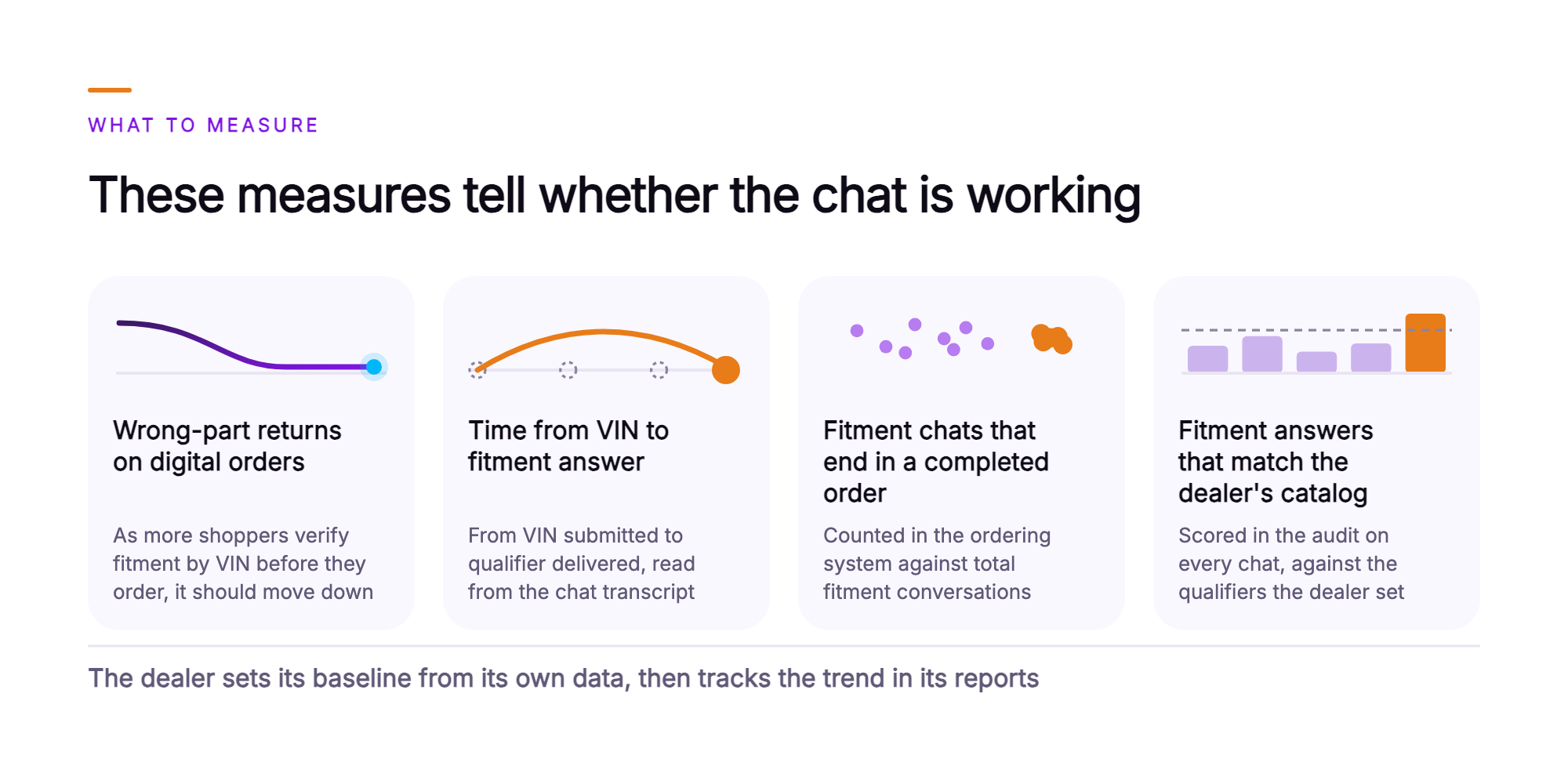
The dealer sets its baseline from its own data before the first chat runs, then tracks the trend in its own reports. The measures stay the dealer's. Orvera AI supplies the transcript, the summary, and the quality audit that make those measures readable.
What does a Director of Fixed Operations take to the leadership team?
A Director of Fixed Operations takes four operating facts to the leadership team: what the AI agent does, how the order closes, who owns the data, and who runs the program.
Those four facts cover the questions a leadership team asks before approving any new capability in dealership parts chat.
- The AI agent decodes each shopper's VIN to the vehicle's confirmed build and answers fitment from the dealer's own catalog, quoting the qualifier the catalog carries.
- The agent completes the order in the dealer's own ordering system in the same chat, with the fitment answer carried straight into the order record.
- The parts catalog, fitment data, supersessions, and order rules stay the dealer's or the OEM's own. The agent reads from and writes to the systems the dealer already runs.
- Orvera AI builds, deploys, and runs the fitment chat as a managed service. Full enterprise deployment lands in three to six weeks, and Orvera audits every conversation, human-handled and AI-handled.
What does parts eCommerce look like once the AI agent runs fitment chat?
Once the AI agent runs fitment chat, the parts eCommerce operation runs on verified orders, audited records, and parts advisors focused on the work that needs them.
Shoppers get a fitment answer tied to their own vehicle's decoded build, inside the chat, before the order is placed. The catalog's qualifier is stated in the conversation, the order moves through the dealer's system, and the shopper completes the purchase in one sitting. Parts advisors spend their day on the conversations the catalog leaves open and the counter work that requires their judgment. The queue they handle is smaller and more specific.
The parts eCommerce leader gets a transcript and summary of every fitment chat showing the VIN, the decoded build, and the qualifier quoted. Orvera audits those conversations alongside every other interaction the platform handles for the dealer, human-handled and AI-handled. When a return arrives, the parts team has a record showing exactly what was quoted, in what context, and for which confirmed vehicle. The dealer then settles the return under its own policy, with that record as the evidence.
Orvera builds, deploys, and runs the fitment chat as a managed service. To see what the deployment looks like for your stores, talk to the team (opens in a new tab).
Frequently asked questions
The shopper sees a short, guided exchange that ends with a fitment answer tied to their exact vehicle. The automotive AI chat agent asks for the VIN and says where to find it: the lower driver-side corner of the windshield, the label on the driver's door jamb, or the registration or insurance card. It reads the decoded vehicle back for the shopper to confirm, then answers whether the part fits that vehicle, quoting the qualifier the dealer's catalog carries and the current part number. The shopper completes the order in the same chat under the dealer's own pickup and shipping rules. When they ask for a person, the dealer's parts advisors pick up the chat with the decoded build and a summary attached. Orvera builds, deploys, and runs the agent for the dealer on a fully managed, agentic AI platform.
The agent decodes the VIN in two layers, then confirms the result with the shopper before answering any fitment question. The 17-character VIN itself typically identifies the manufacturer, the model and body, the engine, the model year, and the assembly plant. The build data the dealer's or OEM's catalog holds for that VIN adds trim, drivetrain, production date, and option codes. Before decoding, the agent checks that the VIN is well formed. A mistyped character usually fails the VIN's check digit, so the agent asks the shopper to re-enter it and works from the corrected VIN. Once the VIN lookup for parts returns a build, the agent reads that build back for the shopper to confirm. A confirmed build is what a VIN fitment answer rests on.
The agent matches the part to the version the VIN decodes to and quotes the qualifier in its answer. A dealer's catalog carries splits inside a single model year: trim, engine, drivetrain, body style, brake or towing package, left or right side, and mid-year production-date changes. The catalog records each of those as a qualifier on the part, and the agent answers at the level of that qualifier. Some qualifiers turn on a detail the build data does not hold, such as a component replaced since the vehicle left the factory. In that case, the parts compatibility chat narrows to one question. The agent asks the shopper that question, then gives the fitment answer and the OEM part number for the version they confirm.
The agent says so and hands the chat to a person. It tells the shopper plainly that the dealer's catalog leaves fitment for this part and vehicle unconfirmed, then routes the conversation to the dealer's parts advisors with the VIN, the decoded build, the part in question, and a summary of the chat attached. The agent answers from the dealer's own catalog and approved knowledge, so the fitment call on an unconfirmed part sits with the dealer's parts team. Where the catalog does list a part that fits the decoded build, including the current replacement for a superseded part number, the agent offers that current part number and states the qualifier behind it.
Orvera builds the integration into the systems the dealer or OEM already runs, so the agent reads fitment from the catalog and writes each completed order where the parts business already lives. Those systems are the electronic parts catalog, the parts eCommerce storefront, the ordering system, and the dealer management system. The platform supports 500+ integrations with enterprise systems of record. The connection carries specific data in both directions. The VIN and build data read in. The part number, fitment result, qualifier, and supersession read out of the catalog. The completed order writes to the dealer's ordering system under the dealer's existing pricing, tax, pickup, and shipping rules, so the parts department sees the same record it would see from any other channel.
Orvera AI builds, deploys, and runs the agent on the systems the dealer group or OEM already operates, with full enterprise deployment live in three to six weeks. Orvera's enablement work spans onboarding, knowledge-base setup, agent training, and change management. The catalog connection, the dealer's order rules, and the handoff routing to parts advisors are all configured before the first chat goes live. The multi-tenant platform supports multiple organizations under a single parent, such as every store in a dealer group. One platform, adopted in stages: a dealer group starts with parts fitment chat and adds other work later. To see how the agent answers "does this part fit my car" against your own catalog, talk to the team at Orvera AI.
Written by
Anindita Majumder
Anindita Majumder is a communications professional with nearly four years of experience in public relations, corporate communications, and journalism. She creates content that helps brands communicate their vision, products, and expertise through press releases, thought leadership, and editorial pieces. Outside of work, she is a vocalist, which keeps her creativity flowing.