How an AI Agent Makes Vehicle-Ready and Parts-Arrived Calls for Dealerships
Repaired vehicles and special-order parts sit at the dealership because the work finishes before the customer is reached, and the call that closes that gap competes with everything else on a service advisor's desk. An AI agent can place that call the moment the dealer management system marks the...

Key highlights
- Repaired vehicles and special-order parts sit at the dealership because the work finishes before the customer is reached, and the call that closes that gap competes with everything else on a service advisor's desk.
- A vehicle-ready and parts-arrived notification call is an outbound voice call placed to the customer when the dealership's system marks a repair complete or a special-order part received.
- When the dealership's system marks a vehicle ready, the AI agent places the call on that status change, tells the customer the vehicle is finished, reads the total due, and books a pickup time.
- A parts-arrived call runs from the part's receipt into the parts system to a booked installation appointment, with the AI agent handling the call from start to finish while service advisors stay with the customers on the drive.
- The dealership decides what the record says, what is due and what the store offers, and the AI agent carries those decisions into the call under the policy the dealership configures for this use case.
- A dealer group wants the calls built and run for it because configuring automotive voice AI across stores is an integration project, and Orvera takes that project on for the group.
- Four numbers tell a fixed operations director whether notification calls are working, and all four already exist in the dealership's own systems.
- A service manager should take four plain statements to leadership, each one describing what the AI agent does and where the result is recorded.
Why do repaired vehicles and special-order parts sit at the dealership after the work is done?
Repaired vehicles and special-order parts sit at the dealership because the work finishes before the customer is reached, and the call that closes that gap competes with everything else on a service advisor's desk. An AI agent can place that call the moment the dealer management system marks the vehicle ready or the part arrived: it reads the total due from the repair order, books the pickup or installation from the store's schedule, logs the outcome, and passes charge, warranty, and repair questions to a service advisor.
The repair order closes at 10:40 a.m. The technician moves to the next job. The vehicle stays in the lot, and nothing about its status changes until a person picks up a phone. The special-order part follows the same pattern. It is received into the parts system, binned, and tagged with a customer name, and then it waits on the shelf for a call that has not been placed.
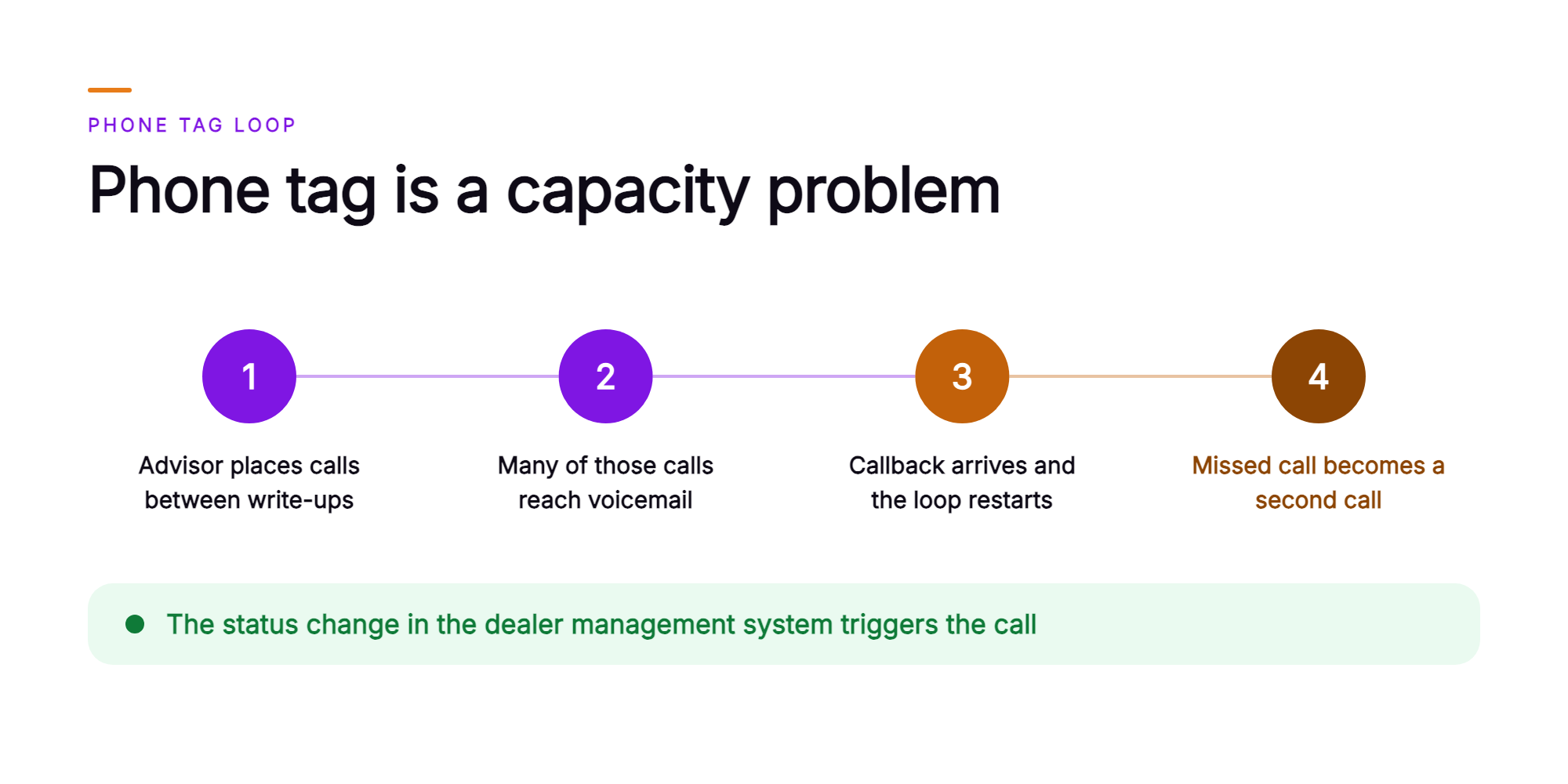
Here is how it plays out on a service drive. A service advisor places vehicle-ready and parts-arrived calls between write-ups, in whatever minutes survive the morning rush. Many of those calls reach voicemail. The callback arrives an hour later, when the advisor is standing at a vehicle with another customer, and the loop restarts. Phone tag is a capacity problem, because every missed call becomes a second call the advisor still has to place.
Fixed operations directors measure the result in two places: vehicle dwell after repair order close, and aged special-order parts. Both numbers grow for one reason. The communication did not happen when the status changed.
What is a vehicle-ready and parts-arrived notification call?
A vehicle-ready and parts-arrived notification call is an outbound voice call placed to the customer when the dealership's system marks a repair complete or a special-order part received.
That status change in the record is the trigger. A vehicle ready notification goes out when the repair order closes. A parts arrived notification goes out when the part is received into the parts system against a customer name. These are service status updates with a fixed job to do, and each one carries four things.
First, what the record says: the vehicle, the work completed, or the part that came in. Second, the total due, read exactly as the closed repair order shows it. Third, how the dealership takes payment, stated in the store's own terms. Fourth, a pickup or installation time drawn from the store's live schedule, offered and booked on the call.
Ownership stays where it belongs. The repair order, the parts status, and the amount due belong to the dealership and the systems it already runs, and every warranty and recall decision stays with the dealership and the manufacturer programs it services. The call communicates those decisions and books the next appointment.
What does the AI agent do when the dealership's system marks a vehicle ready?
When the dealership's system marks a vehicle ready, the AI agent places the call on that status change, tells the customer the vehicle is finished, reads the total due, and books a pickup time.
The order of operations is fixed. The status change in the dealer management system triggers the call. The AI agent reaches the customer, identifies the store and the vehicle, and states that the work is complete. It reads the total due exactly as the closed repair order shows it. It then states how the dealership takes payment, whether that is in the lane, at the cashier, or through a payment link the dealership sends.
Then the booking step. The agent offers pickup times from the store's own schedule, books the slot the customer picks, and confirms the day and time back on the call before it ends. Because the agent writes the booking straight to the store's schedule, a customer who answers settles the pickup in one call. A customer who misses the call gets the attempt plan the dealer group sets.
What does a parts-arrived call sound like from trigger to booked installation?
A parts-arrived call runs from the part's receipt into the parts system to a booked installation appointment, with the AI agent handling the call from start to finish while service advisors stay with the customers on the drive.
A rear bumper cover for a customer's sedan is received on Tuesday morning and tagged to their name. That receipt is the trigger. The AI agent then calls the customer, identifies the dealership, and says the ordered part is in and ready to install. It offers installation times from the store's live schedule, the customer takes Thursday at 8:00 a.m., and the agent books the slot and repeats it back.
On the same call, the customer asks why a diagnostic fee appeared on the earlier estimate. That question belongs to a service advisor. The agent tells the customer a service advisor will call back about the charge, and passes the question to the advisor queue with the full call summary attached, including the booked appointment.
Both results land on the record. The Thursday installation is written to the store's schedule, and the call outcome and the open advisor question are written to the dealership's system for the advisor who will see that customer.
What does the dealership decide and what does the AI agent do on each call?
The dealership decides what the record says, what is due and what the store offers, and the AI agent carries those decisions into the call under the policy the dealership configures for this use case.
- Ready status set in the system. The AI agent places the outbound call on that status change.
- Total due on the closed repair order. The agent reads the amount exactly as the record shows it.
- Payment methods the dealership accepts. The agent states those methods in the store's own wording.
- Open slots on the store's schedule. The agent offers a time, books the one the customer picks, and confirms it on the call.
Charge questions, warranty coverage, recall questions, and repair questions go to a service advisor with the full context of the call, including what the customer asked and what was already booked. The advisor picks up a conversation that is already documented.
The dealer group sets the call script, the attempt plan, and the voicemail wording, and that becomes the policy for this use case across every store. The agent runs that policy at every store and in more than 80 languages, so a customer of any franchise gets the call the group designed.
Why would a dealer group want the calls built and run for it?
A dealer group wants the calls built and run for it because configuring automotive voice AI across stores is an integration project, and Orvera takes that project on for the group.
Orvera AI is an agentic AI platform for enterprise customer experience, delivered as a managed service. Orvera builds, deploys, and runs the AI agent for the dealer group, connected to the dealer management system, the parts system, the scheduler, and the CRM the stores already use, with 500+ integrations available. A full deployment goes live in three to six weeks. Orvera's team carries out the integration, onboarding, training, and change management.
That approach comes out of 18+ years of contact-center experience, which shows up in the details operators care about: attempt plans, voicemail handling, advisor callbacks, and what happens when a customer asks something outside the script. AI Quality Management audits every conversation, human-handled and AI-handled, so a Director of Customer Care can hold every franchise to one standard of communication quality.
Orvera runs as one platform across voice, chat, email, and every other channel. One platform, adopted in stages. Vehicle-ready and parts-arrived calls are a reasonable first stage.
Which numbers tell a fixed operations director the calls are working?
Four numbers tell a fixed operations director whether notification calls are working, and all four already exist in the dealership's own systems.
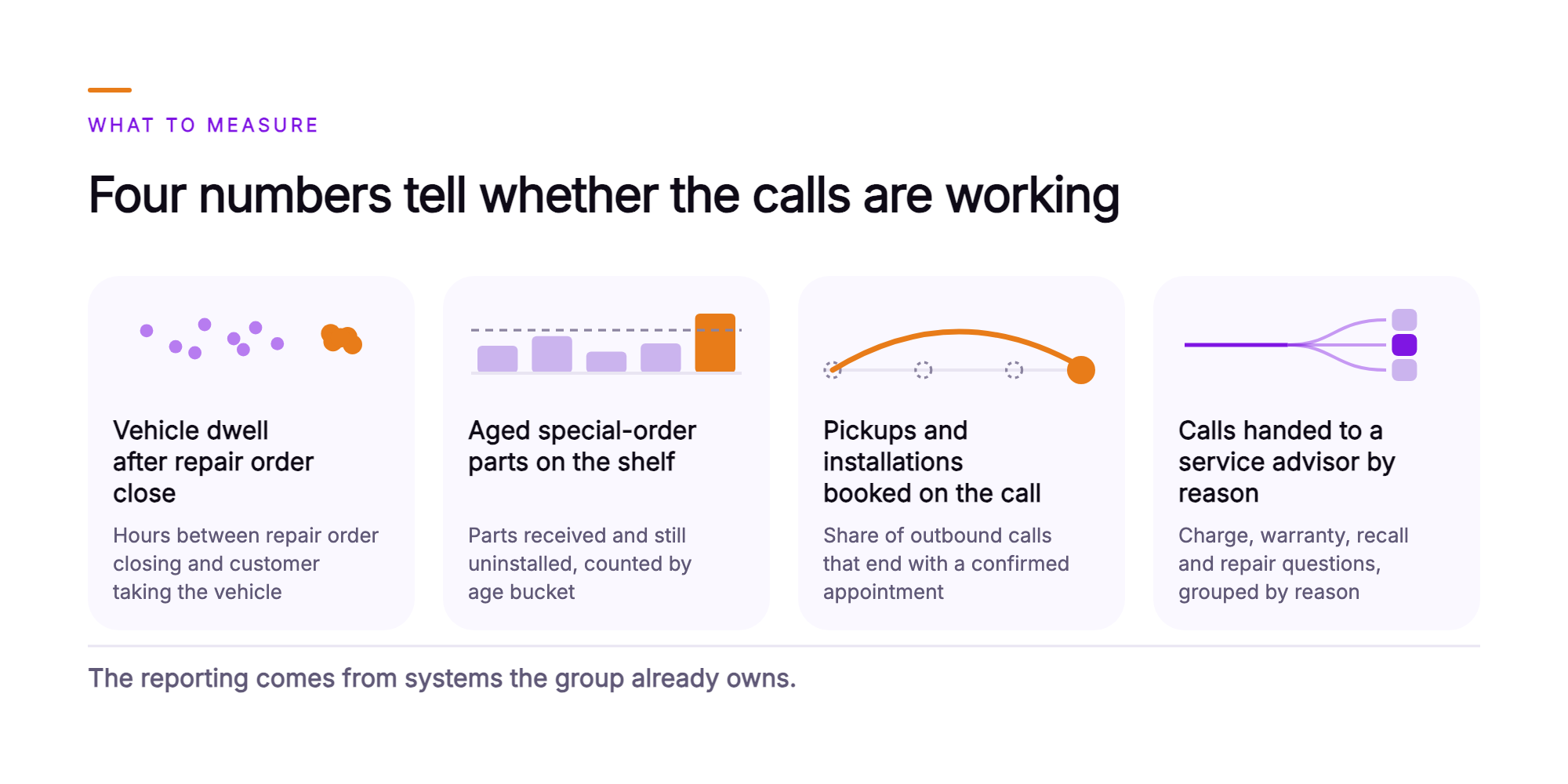
- Vehicle dwell after repair order close. The hours between the repair order closing and the customer taking the vehicle. This is the number that frees parking and clears the lot for the next intake.
- Aged special-order parts on the shelf. Parts received and still uninstalled, counted by age bucket. Every day a tagged part sits there is capital the parts department has tied up on the shelf.
- Pickups and installations booked on the call. The share of outbound calls that end with a confirmed appointment written to the store's schedule.
- Calls handed to a service advisor and the reason for each. Charge questions, warranty coverage, recall items, and repair questions, grouped by reason, so the group can see what customers keep asking about.
The dealer group reads the first two from its own system of record and the second two from the call log the AI agent writes back after each attempt. The reporting comes from systems the group already owns.
What should a service manager take to the dealer group's leadership team?
A service manager should take four plain statements to leadership, each one describing what the AI agent does and where the result is recorded.
- The AI agent calls the customer when the dealership's system marks a vehicle ready or a special-order part arrived. The trigger is the status change in the record, so the call follows the work, inside the calling hours the group sets.
- The agent reads the total due exactly as the closed repair order shows it, states how the store takes payment, and books the pickup or installation from the store's live schedule, confirming the time back to the customer on the call.
- Charge questions, warranty coverage, recall items, and repair questions go to a service advisor with the call summary attached, so the advisor opens a conversation that is already documented, with the customer's question and any booked time in front of them.
- Every call outcome is logged in the dealership's system of record and audited by AI Quality Management, which covers every conversation, human-handled and AI-handled, against the scorecards the group already uses.
Add one line on governance for the IT reviewer in the room. Orvera AI is SOC 2 Type II certified, HIPAA compliant, and GDPR compliant, with approved-knowledge grounding and full auditability.
What does the service drive look like once the notification calls are running?
Once the notification calls are running, the service drive works from status changes in the dealership's system, with each call triggered by the record and each outcome written back to it.
A repair order closes and the AI agent places the vehicle-ready call on that status change. A part is received and the AI agent calls with installation times from the store's schedule. Advisors take the calls that need an advisor, which are the charge questions, the warranty decisions, and the repair conversations, and they take them with the call summary already in front of them.
The service manager opens the dealership's system and sees a call log showing who was reached, who was not, what was booked, what went to an advisor, and why. Aged parts and post-close dwell become metrics the group can address, as the communication step is standardized across stores and shifts.
An AI voice agent for automotive service departments is measured on the four numbers above, led by vehicle dwell after repair order close and aged special-order parts. To see how this would run across your stores, talk to the team (opens in a new tab).
Frequently asked questions
The customer hears a short, natural-sounding call that states the vehicle is ready, the total due, and how to pay. Orvera AI agents read the amount exactly as the closed repair order shows it, then name the payment methods the store accepts, whether that is in-lane card, pay-by-link, or settlement at the cashier. From there the call moves to logistics. The AI agent offers open pickup times from the store's own schedule, confirms the slot the customer picks, and repeats it back before ending. That is the whole vehicle ready notification: status, amount, payment, time. The service advisors stay at the write-up desk with the customers in front of them.
The AI agent hands the question to a service advisor. Warranty coverage stays with your dealership and the manufacturer programs it services, and line-item charges, the diagnosis and the repair itself stay with your service team, so your advisors take those conversations. When a customer asks why a charge appears or whether a component is still covered, the call is transferred or a callback is queued, with a summary of what was already said attached so the advisor picks up where the call left off. On the amount itself, the AI agent restates the total due exactly as the closed repair order shows it, and the explanation of any charge stays with your advisors. That boundary keeps your advisors in charge of the conversations that need judgment.
The AI agent calls on the status your own system sets. When the repair order closes, or when a special-order part is received against a line, that status change is the trigger. The call follows the record, inside the calling hours you set. Your dealer management system remains the source for the repair order and the parts status. Orvera AI reads that status and acts on it, so a part received against a customer's name triggers the parts arrival alert from the receipt itself.
The AI agent reads open times from the store's own schedule and offers them on the call. For a vehicle-ready call, that is a pickup window. For a parts-arrived call, it is an installation appointment from the same schedule your advisors book against. When the customer picks a time, the AI agent writes the booking to your schedule and confirms it on the call before hanging up. The customer leaves the conversation with a committed slot, and the appointment sits on the schedule the service team already works from. One call sets the time.
The AI agent follows the attempt plan you set: how many tries, how far apart, which hours, and whether to leave voicemail. The voicemail wording is yours, including whether the total due is spoken or withheld. Every attempt and its outcome is logged in your system, so the service team can see at a glance who is still unreached. Unreached customers surface as a working list for advisors to act on. That matters most on aged units holding a lift and on special-order parts waiting on a shelf.
Every call writes back to your system of record. The AI agent posts the outcome, the booked time, the payment methods the agent named, and the detail of any advisor handoff on the customer's record, so the call history sits beside the repair order status updates your team already reads. A transcript and a summary are kept for each call. AI Quality Management audits every conversation, human-handled and AI-handled, across every channel, and scores them against the scorecards your evaluators already use, which gives a fixed ops director coverage of every dealership service notification. Voice of Customer analyzes those conversations to identify themes you can act on across the automotive contact center. To see how Orvera AI connects to your dealer management system and phone stack, talk to the team.

Written by
Anindita Majumder
Anindita Majumder is a communications professional with nearly four years of experience in public relations, corporate communications, and journalism. She creates content that helps brands communicate their vision, products, and expertise through press releases, thought leadership, and editorial pieces. Outside of work, she is a vocalist, which keeps her creativity flowing.


