How an AI Agent Handles Billing Dispute Emails for Telecom and Broadband Providers
Today, a billing dispute sent by email or web form lands in a queue and waits for a human rep to work out which charge the customer is actually disputing. That first step is the bottleneck, and it happens before any policy is applied or any credit is decided.

Key highlights
- Today, a billing dispute sent by email or web form lands in a queue and waits for a human rep to work out which charge the customer is actually disputing.
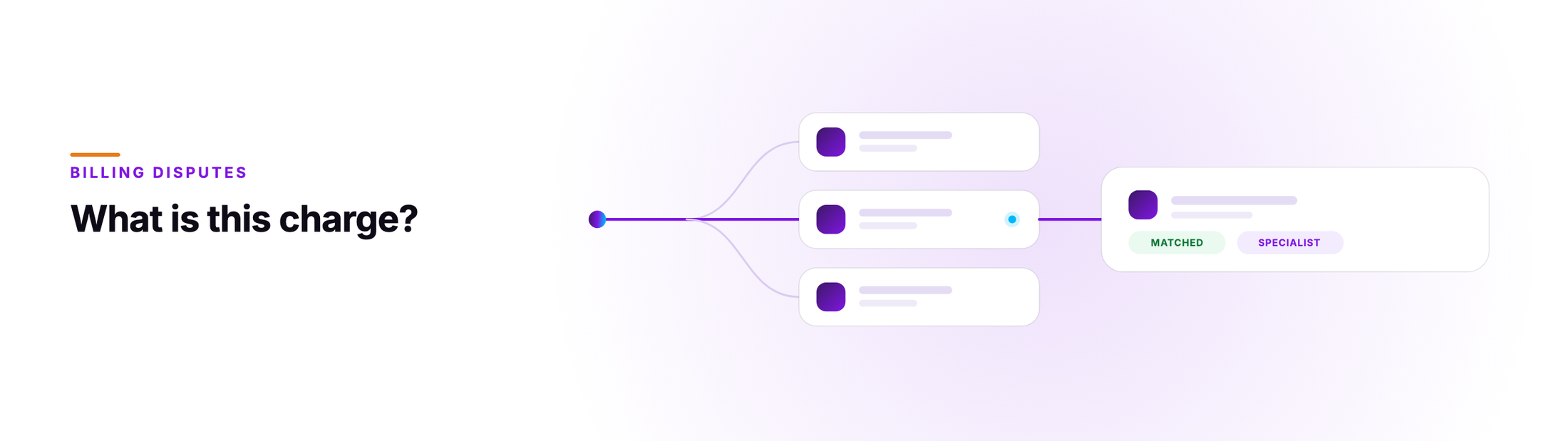
- An AI agent for billing disputes reads the inbound message, matches it to the account and the charge, retrieves that account's charge history, applies the provider's adjustment rules, and replies with line-item reasoning.
- One dispute runs from an ambiguous web form submission to a line-item reply, with the agent performing the lookup, provided the provider's rules cover the charge.
- The agent executes the steps, and the provider's systems and policies set every rule that determines money.
- Providers want the dispute agent delivered as a managed service because the hard part is the integration.
- Four measures tell a VP of Customer Care whether billing dispute automation is holding.
- Four statements carry the case for telecom customer service automation on the dispute desk, and each one stands on its own in a steering committee deck.
- Once the agent is running, disputes that fit the provider's rules are read, researched, decided, and answered by the agent end to end, and billing specialists work only the cases the rules send them.
What happens when a billing dispute arrives by email or web form today?
Today, a billing dispute sent by email or web form lands in a queue and waits for a human rep to work out which charge the customer is actually disputing. That first step is the bottleneck, and it happens before any policy is applied or any credit is decided.
The customer writes in their own words. They describe an unfamiliar charge on the statement, often without the account number, without the statement date, and without the line item as it appears on the bill. A telecom billing dispute written as "you charged me twice after I switched plans" is clear to the customer and ambiguous to the queue.
The human rep then does the same sequence on every case. Open the account in the billing system. Pull the charge history for the statement period in question. Look up the provider's adjustment rules for that charge type. Write a reply that explains the decision in terms the customer will accept.
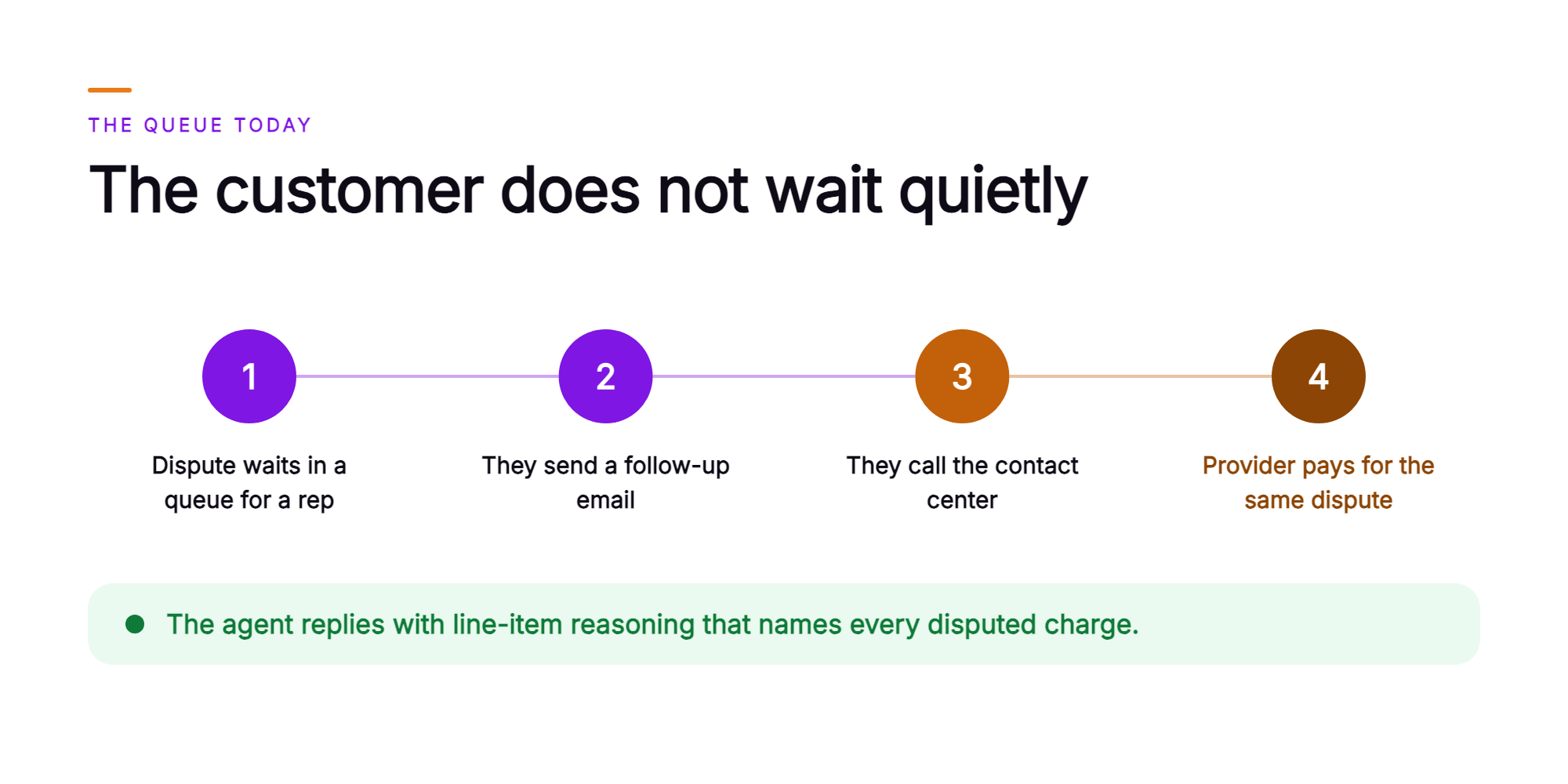
While that work waits in the queue, the customer does not wait quietly. They send a follow-up email asking whether anyone received the first one. Then they call the contact center about the same charge, and the provider pays to handle one dispute twice.
What is billing dispute and adjustment intake for a telecom, cable or broadband provider?
Billing dispute and adjustment intake is the work of reading a dispute that arrives by email or web form, identifying the account and the specific charge, and deciding whether the provider's adjustment rules entitle the customer to a credit.
The use case covers the full dispute resolution workflow for unstructured digital channels. A customer submits a service charge dispute or a billing adjustment request in their own words. Someone has to turn that text into a named account, a named statement period, and a named charge line, then apply policy to it and respond.
Two measures tell a billing operations leader whether this intake is healthy. The first is time to first substantive response, meaning a reply that addresses the charge itself. The second is dispute cycle time, measured from intake to a resolved and posted outcome.
What does the AI agent do with a billing dispute email or web form?
An AI agent for billing disputes reads the inbound message, matches it to the account and the charge, retrieves that account's charge history, applies the provider's adjustment rules, and replies with line-item reasoning.
The agent runs these four steps in order on every case.
- Read and identify. The agent parses the customer's message, matches it to the account record, and resolves which statement period and which charge line the customer means, including when the customer names neither.
- Retrieve. The agent pulls the specific charge history for that account from the billing system, live and line by line. The BSS holds the authoritative charge detail, and that is where the agent reads.
- Apply the rules. The agent runs the provider's current adjustment policy against each disputed line, including proration on mid-cycle changes, promotional credit expiry, and duplicate charges.
- Reply. The agent writes back, naming each disputed line, the rule that governs it, and the outcome.
The agent decides entitlement under the provider's adjustment rules, and it explains each line of that decision to the customer in the reply.
Disputes the provider's rules send to a person go to a person. They arrive with the case assembled: the account matched, the retrieved charge history, the rule that applied, the point where the rule stopped, and the customer's own words. The billing specialist starts at the decision, with customer complaint triage already done.
What does one billing dispute look like from intake to reply?
One dispute runs from an ambiguous web form submission to a line-item reply, with the agent performing the lookup, provided the provider's rules cover the charge.
A broadband customer submits a web form. The text reads, in substance, that a charge appeared after a mid-cycle plan change and that the customer does not recognize it. It gives no amount, no charge type, and no statement date, and the customer skipped the account number field.
The agent matches the submission to the account using the contact details and service address on the form. It retrieves the charges for both billing periods, the one before the plan change and the one after, because a mid-cycle change splits across two statements. It then checks each line in the post-change period against the provider's rule for plan changes: the prorated charge for the old plan, the prorated charge for the new plan, and the promotional credit that did not carry across.
The customer receives a reply that names every disputed line. For each one, it states what the provider's rule says, and then the outcome that follows. One line is credited, and the reply quotes the provider's plan-change rule that grants the credit. The proration stands, with the rule's stated reason given in plain words and the dates it was calculated from. Every sentence in the reply speaks to a specific line on the customer's bill.
Which steps does the agent take and which decisions stay with the provider's rules?
The agent executes the steps, and the provider's systems and policies set every rule that determines money.
Each provider-owned element pairs with one agent action:
- Adjustment policy and the entitlement decision. The policy states which charges are creditable and under what conditions. The agent applies that policy to the specific lines in dispute and records which clause governed the outcome.
- Billing system and the charge retrieval. The BSS holds the authoritative charge history. The agent reads it live for the account and statement period in question.
- Account record and the identity match. The CRM holds the account, the service address, and the contact details. The agent matches the inbound dispute to the right account before it reads any charges.
- Escalation rule and the hand-off. The provider defines what leaves automation. The agent routes those cases and assembles them.
The provider sets the adjustment rules and changes them whenever the business changes. The agent applies the current version of those rules to each dispute it reads.
A dispute that falls outside the rules reaches a billing specialist with the account matched, the charge history retrieved, the applicable rule identified, and the point of exception marked. The specialist opens the case at the decision point and makes the judgment call.
Why do telecom providers want the dispute agent built and run for them?
Providers want the dispute agent delivered as a managed service because the hard part is the integration. The agent has to read the right charge history from a billing stack that has run in production for years.
Orvera AI is an agentic AI platform for enterprise customer experience. Orvera builds, deploys, and runs the dispute agent inside the billing system, CRM, and helpdesk the provider already runs, drawing on 500+ integrations across CCaaS, CRM, helpdesk, and enterprise systems of record. Billing stays on the platform it runs on today while the disputes against it are automated.
A full deployment goes live in three to six weeks. Orvera's team carries out the integration, onboarding, training, and change management. That work draws on 18+ years of contact-center experience.
Governance is built into the run itself. Orvera's AI Quality Management audits every conversation, human-handled and AI-handled, which means every dispute reply is scored, where most operations review a one to three percent sample. Orvera AI is SOC 2 Type II certified, HIPAA compliant, and GDPR compliant. Approved-knowledge grounding ties the agent's answers to the provider's own policy and records.
Which numbers tell a VP of Customer Care the dispute desk is working?
Four measures tell a VP of Customer Care whether billing dispute automation is holding.
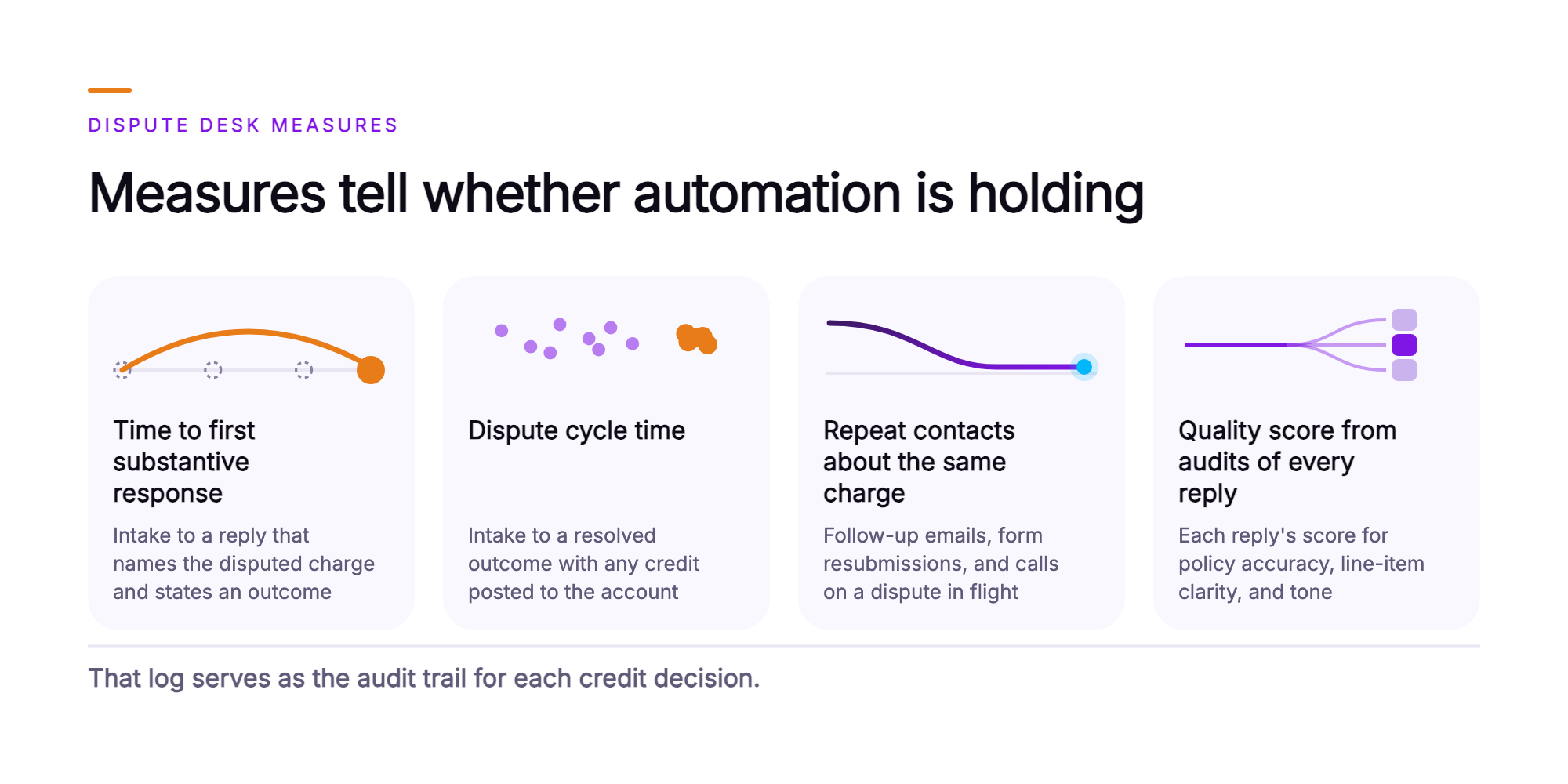
- Time to first substantive response. The interval between intake and a reply that names the disputed charge and states an outcome. Acknowledgment emails do not count toward it.
- Dispute cycle time. The interval from intake to a resolved outcome with any credit posted to the account. This is the measure finance and care agree on.
- Repeat contacts about the same charge. The count of follow-up emails, web form resubmissions, and inbound calls referencing a dispute already in flight. It is a direct signal of whether a reply landed.
- Quality score from audits of every dispute reply. The score applied to each reply against the scorecards the provider's evaluators already use, covering policy accuracy, line-item clarity, and tone.
The provider reads the first three measures from its own billing and contact records, and the quality score comes from Orvera's AI Quality Management. Behind every reply, the full conversation log is available for review: the inbound text, the account matched, the charges retrieved, the rule applied, and the outcome stated. That log serves as the audit trail for each credit decision.
What should a billing operations leader take to the leadership team?
Four statements carry the case for telecom customer service automation on the dispute desk, and each one stands on its own in a steering committee deck.
- The AI agent reads billing disputes arriving by email and web form, matches each one to the account and the charge, and replies with line-item reasoning that names every disputed charge and the rule applied to it.
- The provider's own adjustment rules decide every credit. The agent applies the current version of those rules, so every entitlement traces to a rule the provider set.
- Disputes that fall outside the rules reach a billing specialist with the case assembled: account matched, charge history retrieved, applicable rule identified, and the customer's own words attached.
- Every reply is audited. Orvera's AI Quality Management audits every conversation, human-handled and AI-handled, and scores each one against the scorecards the provider's evaluators already use.
Those four points answer the questions leadership will ask in order: what the agent does, who controls the money decision, what happens to the hard cases, and how the work is governed.
What does the billing dispute desk look like once the agent is running?
Once the agent is running, disputes that fit the provider's rules are read, researched, decided, and answered by the agent end to end, and billing specialists work only the cases the rules send them.
Customers receive a substantive reply that names each disputed line, states the rule applied, and gives the outcome with the dates and conditions behind it. Because that first reply answers the question the customer asked, it removes the usual reason for a follow-up email or a second call about the same charge, and the repeat-contact count shows the provider how far that holds.
Billing specialists spend their hours on exceptions: the disputed charge the policy does not cover, the account with a provisioning error behind the billing error, the retention conversation that a credit decision opens up. They open each case at the decision point, with AI Agent Assist surfacing the approved policy and the next action while the conversation is live.
When the provider updates an adjustment rule and approves the new version, the agent applies that version to the disputes that follow.
To see what this looks like against your billing stack, talk to the team (opens in a new tab).
Frequently asked questions
Orvera's AI agents read the dispute in the customer's own words and classify it against the dispute types your billing operation already tracks: an unfamiliar charge, a charge that appeared after a plan or service change, a duplicate charge, and a promotion the customer expected to apply. Customers rarely use internal category names when asking how to dispute a bill, so the agent classifies from what the customer wrote. Your adjustment rules decide which of those the AI agent answers directly and which route to a person. A billing dispute email and a web form complaint follow the same path through the same agent, with the same rules applied, so the customer can use whichever channel they prefer.
The AI agent pulls the charge history for that specific account from your billing system, then applies your adjustment rules to each disputed line. It checks the proration on a mid-cycle plan change, the posting date on a duplicate charge, and the eligibility window on a promotional credit, one line at a time. The entitlement decision follows your policy as written. Your billing operations team sets the credit thresholds and approval limits and changes them when the policy changes. The agent applies the current version. Approved-knowledge grounding ties the agent's answers to your policy of record.
The reply lists each disputed line separately. For every line, it states the charge, what your rule says about that charge, and the outcome: credit due under your rule, charge upheld, or sent to a specialist for review. A customer disputing three items on an internet bill gets three answers, one for each line. That line-item reasoning matters because it answers the question the customer actually asked. A cable bill dispute usually comes down to one line the customer did not expect. When the reply names that line and explains the rule behind it, it answers the clarification question before the customer has to ask it.
A dispute outside the adjustment rules goes to a person on your billing team, with the case already assembled. The handoff carries the charge history the AI agent retrieved, the rule it checked, the point at which the rule stopped applying, and the customer's own words as they wrote them. Your specialist starts at the decision point, with the telecom billing complaint already read and the account history already pulled. They review what the agent found, make the judgment call the policy leaves to a human, and reply from there.
Orvera AI builds the integration into the billing platform, CRM, and helpdesk you already run, drawing on 500+ integrations across CCaaS, CRM, and enterprise systems of record. The AI agent reads charge history directly from your system of record, so your billing data stays where your finance and audit teams expect to find it. A full enterprise deployment is live in three to six weeks. Orvera's team carries out the integration, onboarding, training, and change management. Orvera runs the agent after go-live as a managed service. Your billing operations team owns the rules and the policy. Orvera handles the platform, the tuning, and the ongoing run.
AI Quality Management audits every conversation, human-handled and AI-handled, including every dispute reply that leaves your operation. Quality on billing disputes is measured across the full volume, where most operations infer it from a one to three percent sample. The same full-coverage review scores email and web form replies alongside voice, chat, messaging, and every other channel Orvera runs. Leaders see the full log behind each reply: the rule applied, the charge history retrieved, the summary, and the complete transcript. Voice of Customer turns those conversations into themes and drivers, which is how a recurring promotion error surfaces as one billing defect behind many disputes. To see how this runs on your billing stack, talk to the team.

Written by
Anindita Majumder
Anindita Majumder is a communications professional with nearly four years of experience in public relations, corporate communications, and journalism. She creates content that helps brands communicate their vision, products, and expertise through press releases, thought leadership, and editorial pieces. Outside of work, she is a vocalist, which keeps her creativity flowing.