California AB 1609 and AI Customer Service: What the Right to a Human Agent Means for Enterprise Contact Centers
California AB 1609 is a state law giving customers of large businesses a clear, simple way to reach a human customer service agent, and barring those businesses from presenting an AI agent as a human. Introduced by Assemblymember Rick Chavez Zbur, it was signed by Governor Newsom in September...

Key highlights
- California AB 1609 is a state law giving customers of large businesses a clear, simple way to reach a human customer service agent, and barring those businesses from presenting an AI agent as a human.
- AB 1609 covers large businesses that provide goods and services to customers, and it protects customers whose account address is in California.
- Once the customer is connected to a person, AB 1609 asks the business to make a good-faith effort to keep any single hold or wait under 15 minutes, and to keep total holds, waits, and escalation queues under one hour for the conversation.
- AB 1609 prohibits a business from representing its AI agent as a human, and requires disclosure of the AI where a reasonable person would likely be misled into thinking they are talking to a person.
- A handoff with full context matters because the law measures the connection and the clock, and the customer measures whether they had to start over.
- An agentic AI platform helps by running the AI interaction and the path to a person as one governed system, so the request, the handoff, the disclosure, and the record all sit on the same rails.
- AB 1609 sets a clear standard for the right to human customer service, and enterprises meet it by designing the path to a person as carefully as they design the AI conversation.
What is California AB 1609, and why is it good news for customer service?
California AB 1609 is a state law giving customers of large businesses a clear, simple way to reach a human customer service agent, and barring those businesses from presenting an AI agent as a human. Introduced by Assemblymember Rick Chavez Zbur, it was signed by Governor Newsom in September 2026 and takes effect January 1, 2027, as of October 1, 2026, per the Governor's office announcement (opens in a new tab).
For contact center operations, this is a sensible standard that matches how enterprise AI customer service should already run. The AI agent resolves what it can resolve. A customer who asks for a person reaches a person. That is the operating model most CX leaders have been building toward anyway, and AB 1609 now puts a clear floor under it.
The practical implication is architectural. Enterprises need one platform where the AI conversation and the path to a person run together. A request for a person, a disclosure, a hold, and an escalation all have to be governed, logged, and reviewable in one place.
This is an operator's reading of the law. Confirm your specific obligations with your own counsel.
Which businesses and customers does AB 1609 cover?
AB 1609 covers large businesses that provide goods and services to customers, and it protects customers whose account address is in California. Coverage turns on two facts: national revenue and the customer's account address.
- Revenue threshold. The law applies to businesses with more than $500 million in gross annual revenue nationally. This is an enterprise obligation, and it reaches national brands that serve California customers.
- Who counts as a customer. A customer is a person whose account address is in California. A business headquartered in another state is covered for its California customers, so geography of the operation does not change the duty.
- Which platforms are covered. It applies to every platform the business uses for customer service, including chat and phone. During regular business hours, each of those platforms must offer a simple way to ask for a person.
For operations leaders, the practical read is that AB 1609 customer service obligations sit at the account level. Your California customer base defines the footprint you have to cover, wherever your contact center sits.
What does AB 1609 require when a customer asks to speak to a person?
When a customer asks for a person during regular business hours, AB 1609 requires the business to make a good-faith effort to connect them to a human customer service agent within 15 minutes, or to offer a specific appointment within one business day.
Three requirements sit behind that sentence. First, during regular business hours the business must offer a simple way to request a human customer service agent on every customer service platform it operates, including chat and phone. The strongest operational reading is a path that is easy to find and quick to use at any point in the conversation.
Second, once the request is made, the clock starts. The good-faith standard is a connection to a live customer service agent within 15 minutes of the request, or a specific appointment offered within one business day. The appointment path matters for operations that run volume peaks, because it gives a governed alternative when the queue cannot absorb an immediate transfer.
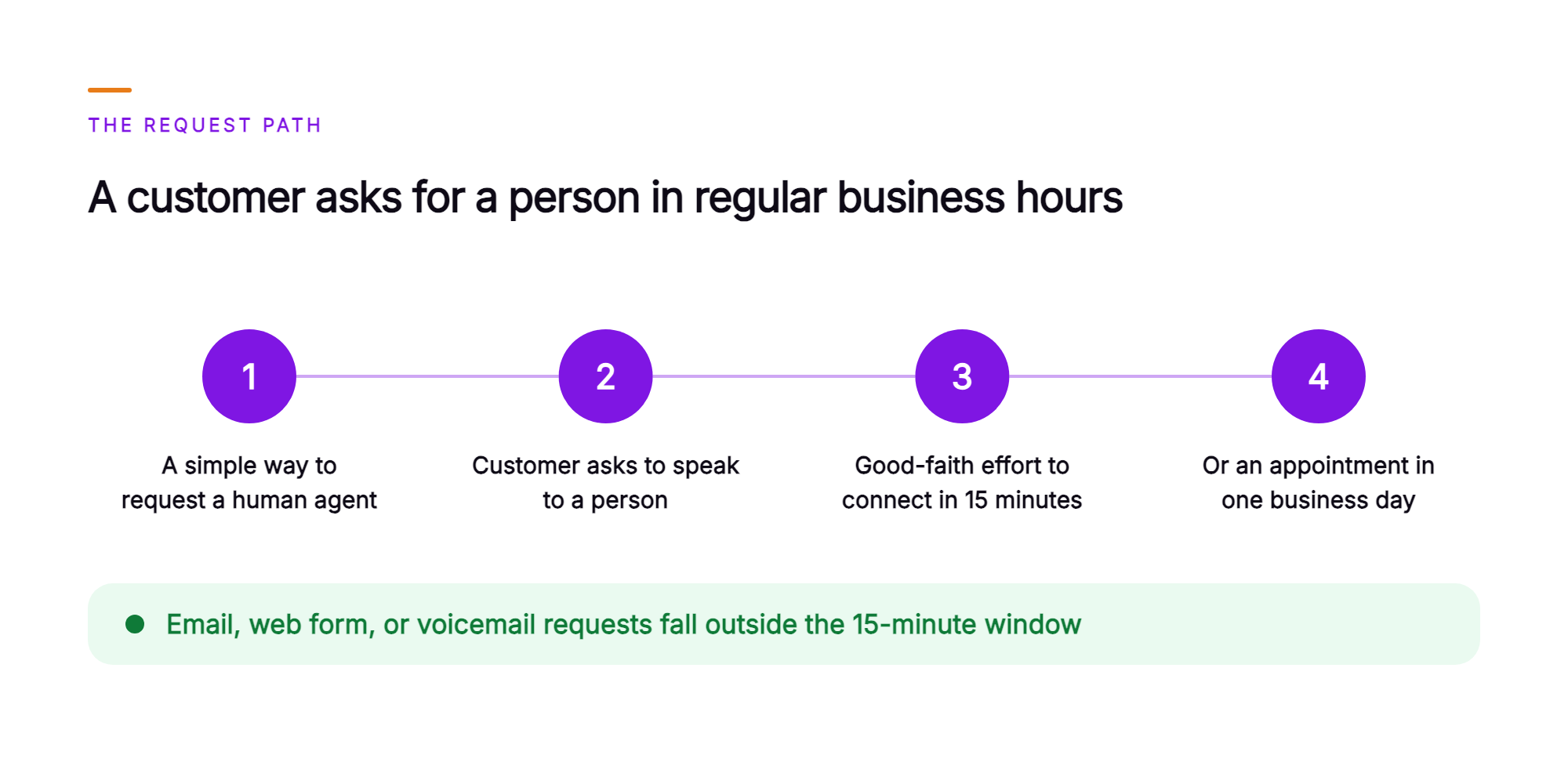
Third, the 15-minute clock does not apply to every intake channel. Requests made by email, web form, or voicemail fall outside the 15-minute window, which is a workable distinction for teams that run asynchronous service alongside real-time channels.
For most contact centers, the operational work is instrumenting the request so the timestamp, the channel, and the outcome are all captured on the same record, then proving the good-faith effort afterward.
How do the hold and escalation-queue limits work once a customer reaches a person?
Once the customer is connected to a person, AB 1609 asks the business to make a good-faith effort to keep any single hold or wait under 15 minutes, and to keep total holds, waits, and escalation queues under one hour for the conversation.
The second limit is the one that reshapes routing design. Total time is cumulative across the whole interaction, so a transfer to a specialist queue counts toward the same hour as the original hold. A conversation that bounces from a generalist to a billing queue to a retention queue accumulates against one shared budget.
That structure rewards a first connection to a person who can actually resolve the issue. Skills-based routing, authority to make the adjustment, and system-of-record access at the desk all matter more under this standard than they did when each transfer reset the perception of wait. Operations teams should map their top California call reasons against the queues those reasons currently touch, then look hard at every hop that exists because the first human rep lacked data or permission.
Measuring cumulative hold time per conversation is the reporting change that follows, because it is the total the law counts.
What does AB 1609 say about telling customers they are talking to AI?
AB 1609 prohibits a business from representing its AI agent as a human, and requires disclosure of the AI where a reasonable person would likely be misled into thinking they are talking to a person.
The prohibition is absolute in one direction. An AI agent may not be presented as a human. The disclosure duty is contextual. It attaches where a reasonable person would likely be misled, which is a judgment the enterprise makes for each channel and each experience it operates.
Voice is where that judgment carries the most weight. Natural-sounding voice AI is now standard in enterprise service, and the more natural the interaction, the more clearly the disclosure earns its place. Chat carries the same duty, applied to the interface the customer sees.
Why does a handoff with full context matter under AB 1609?
A handoff with full context matters because the law measures the connection and the clock, and the customer measures whether they had to start over. A handoff that carries the conversation forward serves both.
- The customer tells the story once. When the AI agent hands a conversation to a person, that person should see what the customer asked, what was verified, and what the AI agent already did. Re-verification and re-explanation cost the customer time, and each extra transfer they cause adds queue time that counts toward the one-hour total.
- A fast connection only helps if the rep can act. Connecting within 15 minutes helps the customer most when the person who picks up can act on the conversation so far, with the account open, the prior steps visible, and the next action ready.
- The rep needs support while the conversation is live. Orvera AI Agent Assist works beside the human rep in real time. It surfaces approved knowledge, recommends next-best actions, flags escalation cues, and generates automated summaries as the conversation runs.
Under AB 1609, the quality of the handoff shapes the time a conversation spends waiting, because a rep who sees the full history can act at once, with fewer holds, fewer transfers, and a clearer path to one resolution.
How does an AI agent platform help a contact center prepare for AB 1609?
An agentic AI platform helps by running the AI interaction and the path to a person as one governed system, so the request, the handoff, the disclosure, and the record all sit on the same rails. Orvera AI is an agentic AI platform for enterprise customer experience, built on 18 plus years of contact-center experience.
Orvera builds, deploys, and runs AI agents on voice, chat, and digital channels, inbound and outbound, on the systems the enterprise already operates. Orvera's AI agents take conversations from greeting to resolution, working in the system of record and completing the action. When a customer asks for a person, that request can be honored on the same platform, on every channel the enterprise configures. The enterprise decides routing, staffing, hours, and disclosure wording.
Proof is built into the run. Orvera keeps full report logs, conversation summaries, and transcripts for every interaction, and AI Quality Management audits every conversation, human-handled and AI-handled, across every channel. That gives compliance reviewers a complete evidence trail.
Full enterprise deployment lands in three to six weeks, with 500 plus enterprise system integrations. Orvera is SOC 2 Type II certified, HIPAA compliant, and GDPR compliant.
What should a contact center measure before January 1, 2027?
Before January 1, 2027, a contact center should be able to report, by channel, how often customers ask for a person, how fast that request is answered, how much total wait a conversation accumulates, and whether the chosen AI disclosure was delivered.
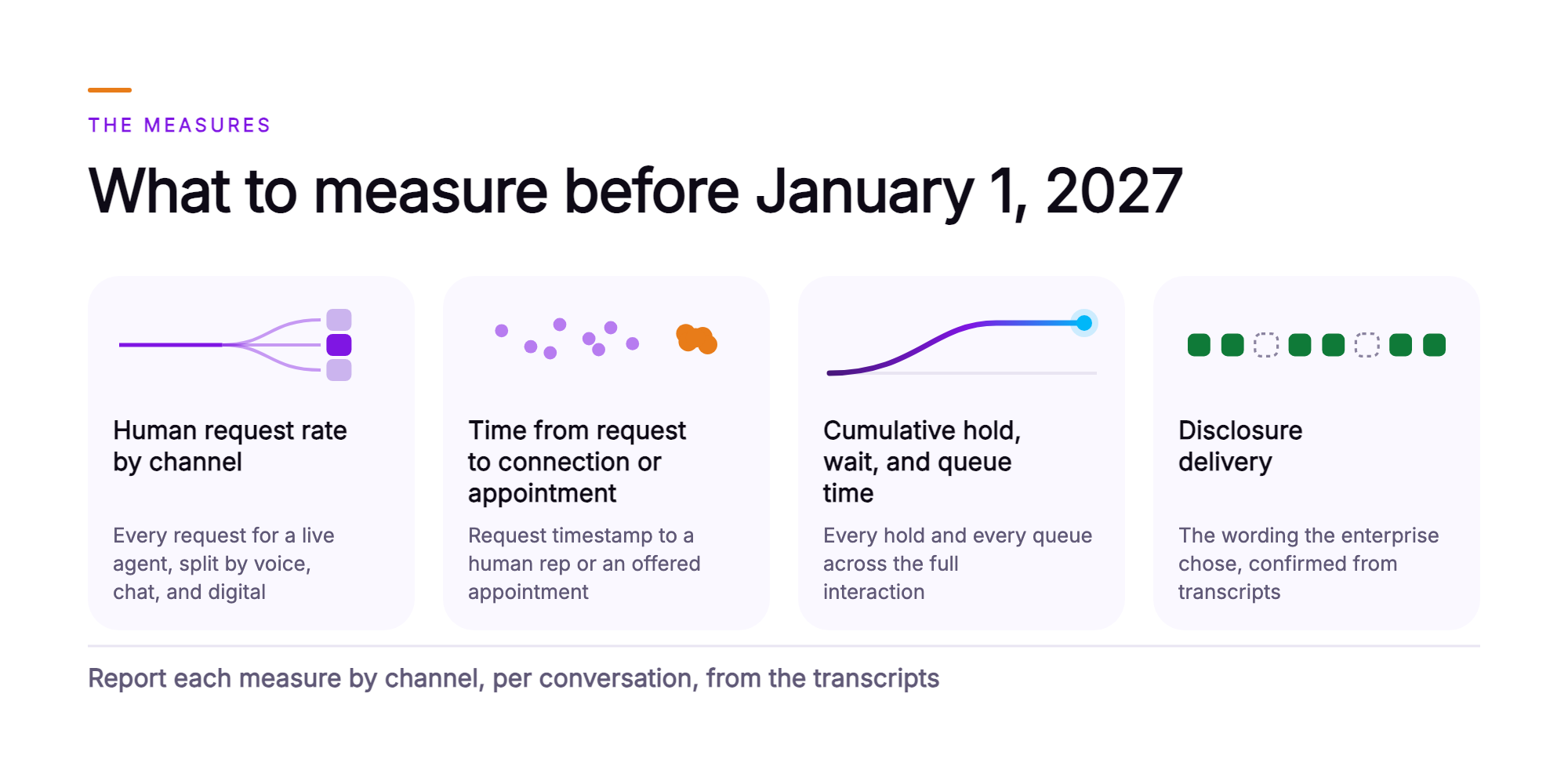
- Human request rate by channel. Count every request for a live customer service agent, split by voice, chat, and digital. This is your demand signal for staffing the California hours you have to cover.
- Time from request to connection or appointment. Measure the interval from the request timestamp to the moment a human rep takes the conversation, or to the moment a specific appointment is offered. Report the full distribution alongside the average.
- Cumulative hold, wait, and escalation-queue time per conversation. Sum every hold and every queue across the full interaction, including transfers. Single-segment hold time will understate what the customer actually experienced.
- Disclosure delivery. Confirm from transcripts that the disclosure wording the enterprise chose was delivered where it was configured to fire. AI Quality Management reviews every conversation, human-handled and AI-handled, where the industry norm is a one to three percent sample.
What are the key takeaways on AB 1609 for enterprise CX leaders?
AB 1609 sets a clear standard for the right to human customer service, and enterprises meet it by designing the path to a person as carefully as they design the AI conversation.
- Coverage is defined by revenue and account address. Businesses above $500 million in gross annual revenue nationally owe these duties to customers whose account address is in California, on every customer service platform they run.
- The clock starts at the request. During regular business hours, make a good-faith effort to connect the customer to a person within 15 minutes, or offer a specific appointment within one business day.
- Wait time is cumulative. Make a good-faith effort to keep any single hold under 15 minutes and total holds, waits, and escalation queues under one hour, counting every transfer against the same total.
- Disclosure and handoff are designed together. Never present an AI agent as a human, disclose the AI where a reasonable person would likely be misled, and give the human rep who picks up the conversation so far.
To work through what this means for your California volume and your routing design, talk to the team (opens in a new tab).
Frequently asked questions
California AB 1609 applies to businesses with more than $500 million in gross annual revenue nationally, for customers whose account address is in California. The threshold counts a company's total national revenue. If your enterprise clears that mark and serves customers whose account address is in California, the law governs your customer service interactions. The duty reaches every platform the business uses for customer service, including chat and phone. During regular business hours, the business must make a good-faith effort to connect a customer who asks for a person within 15 minutes, or offer a specific appointment within one business day, a standard that shapes how every AI-assisted contact is designed and routed.
Governor Newsom signed AB 1609 in September 2026, and it takes effect January 1, 2027. That gives qualifying enterprises the months before January 1, 2027 to review every customer-facing channel and confirm that escalation paths, disclosure language, and routing logic meet the new standard. AB 1609 readiness is present-day work. If your contact center serves California customers and your national revenue clears $500 million, the operational changes need to be in place before that date.
AB 1609 applies to every platform a qualifying business uses for customer service, including chat and phone. The practical distinction to note is the intake channel. If a customer sends an email, submits a web form, or leaves a voicemail, the 15-minute window does not apply to that request. Requests on every other platform, including chat and phone, sit inside it. That scope means your routing logic, disclosure language, and handoff paths need to be reviewed for every channel your contact center runs.
AB 1609 sets a specific timing standard for every qualifying business: when a customer exercises the right to human customer service, the business must make a good-faith effort to connect that customer to a person within 15 minutes of the request during regular business hours. The alternative is to offer the customer a specific appointment within one business day. The timing requirements do not stop at connection. Once a human rep is involved, the business must make a good-faith effort to keep any single hold under 15 minutes and total holds, waits, and escalation queues under one hour. That means your routing logic, queue management, and staffing levels all factor into compliance. A customer who clears the initial 15-minute window but then sits in a sequence of short holds can still push your operation outside the law's limits.
No. AB 1609 does not ban AI agents from customer service. It sets the conditions under which they may operate. Businesses may continue running AI agents across voice, chat, and every digital channel. The law establishes three practical requirements for that to remain lawful. The AI agent may never present itself as a human. When a reasonable person would likely be misled about who or what they are speaking with, the business must make a disclosure. And during regular business hours, every customer service platform must offer a simple way to request a human customer service agent. Contact center AI governance, then, is about building the routing logic, disclosure language, and audit record that confirm those conditions are met on every contact.
Orvera AI runs the AI conversation, supports the human rep who takes over, and keeps a full record of every interaction that your team can review against its AB 1609 obligations. Orvera's AI agents handle contacts across voice, chat, and digital channels. When a customer asks the AI agent for a person and the conversation goes to a human rep, Orvera AI Agent Assist works beside that rep live. It surfaces approved knowledge, recommends next-best actions, flags escalation cues, and generates automated summaries, so the rep picks up with the conversation so far in front of them. Orvera keeps full report logs, conversation summaries, and transcripts for every interaction. AI Quality Management audits every conversation, human-handled and AI-handled, across every channel. Your team can read from the logs and transcripts when a request for a person was made, how long the wait ran, and what disclosure language appeared. The enterprise sets routing rules, staffing hours, and disclosure wording. Confirm your specific obligations with legal counsel before January 1, 2027. Talk to the team to see how Orvera AI runs the AI conversation and the handoff to a person across your contact center.

Written by
Anindita Majumder
Anindita Majumder is a communications professional with nearly four years of experience in public relations, corporate communications, and journalism. She creates content that helps brands communicate their vision, products, and expertise through press releases, thought leadership, and editorial pieces. Outside of work, she is a vocalist, which keeps her creativity flowing.