Cognigy Review 2026: Features, Customer Reviews, and Enterprise CX Fit
Enterprise customer experience teams are now evaluating a broader operating surface: AI agents that can reason and act, voice...

Key highlights
TL;DR — In a Nutshell
- Cognigy in 2026 goes beyond chatbots, combining agentic AI, workflows, voice, enterprise knowledge, integrations, and Agent Copilot for human agents
- User reviews are generally positive on ease of use and support, while recent feedback highlights the planning, technical skills, and learning required for more complex deployments
- Enterprise buyers should evaluate Cognigy on workflow completion, system integrations, voice and digital continuity, governance, and AI-to-human handoffs rather than feature count alone
- Quality evaluation should cover both AI and human conversations, with evidence showing how interactions affect workflows, systems, and customer outcomes
- The post-purchase operating model matters, including who builds, deploys, maintains, governs, and optimizes the system after launch
- Cognigy alternatives should be compared based on production readiness, context continuity, workflow execution, quality management, governance, and ongoing ownership
A Cognigy review in 2026 needs to look beyond whether the platform can build a chatbot or answer a phone call.
Enterprise customer experience teams are now evaluating a broader operating surface: AI agents that can reason and act, voice automation, human-agent assistance, enterprise integrations, knowledge grounding, governance, and the processes required to keep all of those capabilities working after deployment.
Cognigy operates across much of that surface. The company describes Cognigy.AI as an agentic AI platform for customer experience, with AI Agent Studio, Knowledge AI, NLU, Voice Gateway, Agent Copilot, Live Agent, Insights, and orchestration capabilities within the platform.
The company also changed structurally in 2025. NiCE completed its acquisition of Cognigy on September 8, 2025, bringing Cognigy into NiCE's broader CX portfolio. That makes older Cognigy reviews useful, but not always sufficient for understanding the product and vendor relationship buyers encounter today.
This Cognigy review examines the product, what current and historical users report, and the questions enterprise teams should ask before deciding whether Cognigy's approach fits their CX operation.
What Is Cognigy and Where Does It Fit in Enterprise CX?
Cognigy is designed for enterprises that want to automate customer conversations across voice and digital channels while connecting those interactions to existing systems and human-service operations.
Its current platform spans autonomous AI agents, deterministic workflows, enterprise knowledge, voice connectivity, agent assistance, and integrations rather than functioning as a standalone FAQ bot.
Cognigy.AI and NiCE Cognigy in 2026
NiCE closed its acquisition of Cognigy in September 2025. Cognigy now appears across current sources as NiCE Cognigy, while the core product continues to be referred to as Cognigy.AI.
For buyers, the distinction matters mostly when researching the company.
A review written before the acquisition may describe Cognigy as an independent vendor. A current procurement process may instead involve Cognigy within a wider NiCE relationship, especially where an enterprise is already evaluating or using NiCE products.
Organizations specifically interested in that ecosystem can also review Orvera's NiCE integration page (opens in a new tab).
The acquisition itself should not be used to infer changes to product quality, pricing, customer support, roadmap, or commercial structure unless those changes have been separately documented.
Cognigy's AI agent and workflow platform
Cognigy's current architecture combines agentic behavior with structured workflow controls.
Its platform allows enterprises to define AI agent personas, memory, knowledge, jobs, and tools. Those tools can access APIs, retrieve data, invoke workflows, and hand work to other AI agents or humans. Cognigy also describes a composite approach that combines autonomous LLM-driven behavior with deterministic, rule-based interaction within the same conversation.
That combination is relevant for enterprise CX.
Some customer interactions require flexibility. Others need a fixed sequence because identity verification, disclosures, eligibility rules, or system actions cannot be left entirely to open-ended reasoning.
Cognigy also provides Knowledge AI for grounding responses in enterprise information. Its public materials describe retrieval across structured and unstructured sources, response traceability, context-aware conversations, and the ability to combine retrieved knowledge with backend transactions.
Voice Gateway and omnichannel customer service
Voice Gateway is Cognigy's voice connectivity layer.
It supports inbound and outbound calling, SIP connectivity, call routing, barge-in, DTMF handling, answering-machine detection, recording capabilities, speech services, and agent handoff. Cognigy's documentation also covers call monitoring and speech-latency observability.
Digital interactions extend beyond voice. Cognigy's endpoint documentation includes Webchat, Voice Gateway, REST interfaces, and third-party integrations, while the company says its agentic platform supports more than 30 channels.
For an enterprise buyer, however, the useful question is not simply how many channels appear on a feature list.
The more important questions are whether customer context survives a channel change, whether the right backend actions remain available, and whether a conversation can continue without requiring the customer or the next agent to reconstruct what already happened.
Cognigy says its contact-center integrations support continuity across chat, messaging, and voice, including CRM updates and conversation resumption across touchpoints.
Agent Copilot and human-agent support
Cognigy's CX proposition also includes the conversations that stay with people.
Agent Copilot provides real-time support to human service agents. Cognigy's current product material describes contextual handover using CRM data, summaries and interaction history, real-time translation, knowledge assistance, suggested actions, live transcription, call summaries, and post-interaction record updates.
That makes human-agent operations an important part of a Cognigy evaluation.
Automation rarely eliminates every assisted interaction. Enterprise teams should therefore evaluate not just how the AI agent handles the first part of a journey, but what the human receives when that journey changes hands.
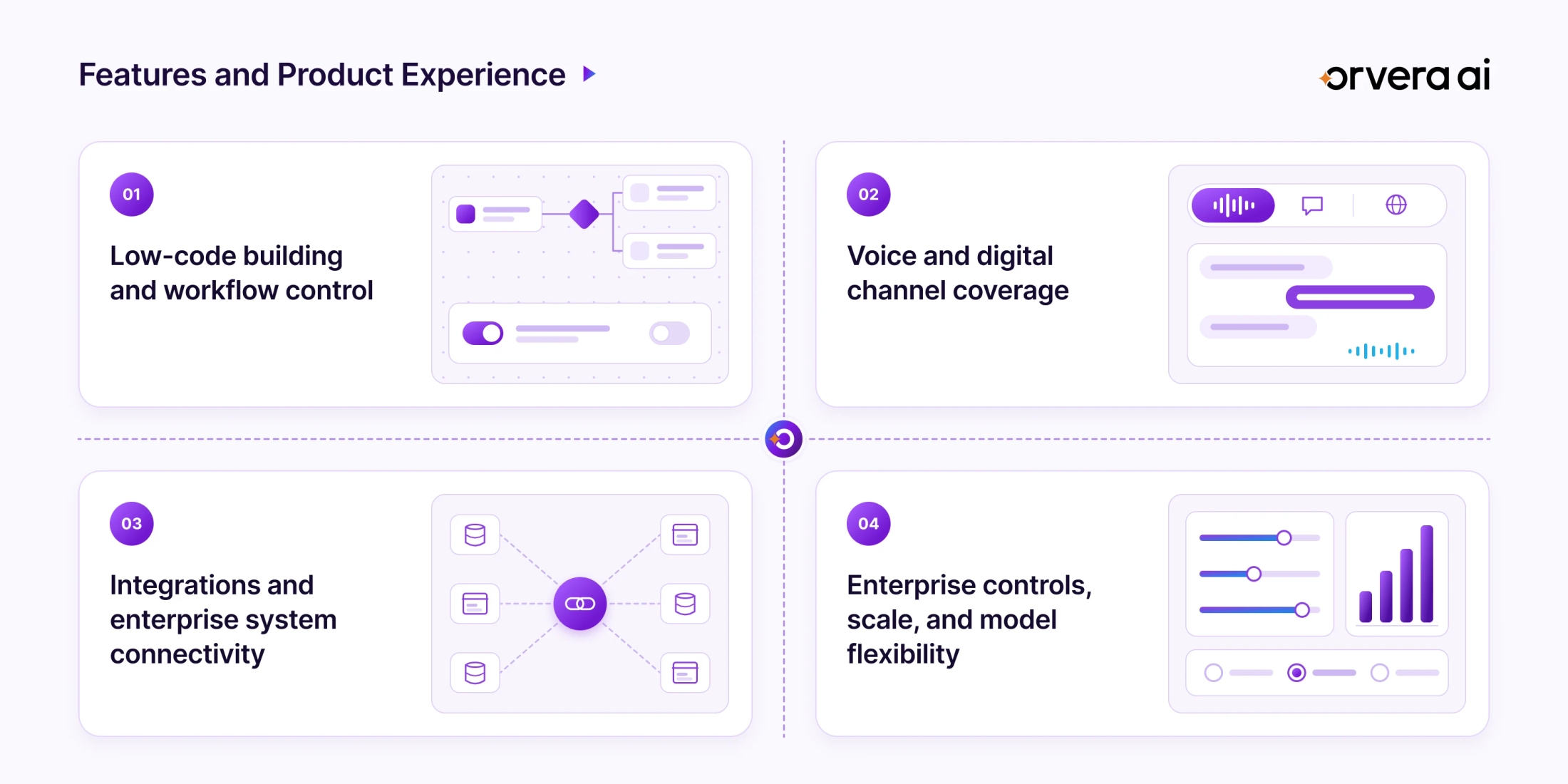
Cognigy Review: Features and Product Experience
Cognigy's feature set is broad. Its practical value depends on how those capabilities translate into the enterprise's actual workflows, systems, channels, and operating model.
User reviews are useful here, provided they are read with context.
Low-code building and workflow control
Ease of building is one of the most consistent themes across Cognigy reviews.
G2 currently lists Cognigy.AI at 4.6 out of 5 from 13 reviews. Its review summaries repeatedly surface ease of use, visual flow building, integrated tools, and the ability to create conversational experiences with relatively little coding.
Capterra shows a similar pattern. As of September 17, 2026, Cognigy.AI has a 4.8 overall rating from 23 reviews and a 4.7 ease-of-use rating. A May 2026 reviewer specifically described the visual flow builder as helpful for organizing conversational workflows, while also noting that advanced capabilities required time to learn.
That distinction matters.
A platform can make initial workflow creation approachable while still requiring technical or architectural expertise as deployments become more complex. Enterprise buyers should test both sides: how quickly a team can create something useful, and what happens when that flow must connect to authentication, business rules, multiple systems, exceptions, human handoffs, and production governance.
Voice and digital channel coverage
Cognigy has substantial voice functionality rather than treating voice as a simple text bot connected to telephony.
Voice Gateway covers call connectivity and control, while the wider platform carries AI agents across digital channels. Cognigy also provides voice-specific tooling for designing and debugging experiences, along with speech and telephony configuration options.
That gives enterprise buyers a meaningful technical surface to evaluate.
A practical proof of concept should go further than measuring whether the agent sounds natural. It should test interruption handling, transfers, identity flows, latency under real call conditions, downstream system actions, edge cases, and what happens when the AI cannot complete the request.
The same principle applies to digital channels. Omnichannel value depends on continuity and execution, not simply the presence of chat, messaging, and voice endpoints.
Integrations and enterprise system connectivity
Cognigy says its agentic platform provides more than 100 prebuilt enterprise integrations and supports MCP for extending AI agents into additional tools and systems. Its contact-center materials also describe integrations across CCaaS and backend environments.
For buyers, connector count is only the beginning of the evaluation.
The stronger test is workflow-specific.
Can the AI retrieve the exact customer state required for this request? Can it perform the required action? Can it update the right system afterward? Can those actions be controlled and audited? And what happens when one of the required systems is proprietary rather than part of the standard connector catalog?
An enterprise integration strategy should therefore be evaluated against real production journeys, not logo coverage.
Enterprise controls, scale, and model flexibility
Cognigy positions itself for enterprise-scale deployments with orchestration, governance, model flexibility, knowledge grounding, and contact-center integration.
Its current materials describe the ability to combine rule-based and LLM-driven behavior, ground agents in approved knowledge, connect external tools and models, and use enterprise systems through integrations.
The important evaluation question is how those controls work in the buyer's environment.
Teams should ask which actions can be constrained, how permissions are enforced, how changes are tested, what evidence exists after an action occurs, and how production behavior is reviewed when workflows evolve.
Feature availability is useful. Operational control is what determines whether that feature can be trusted in a live CX environment.
Cognigy Reviews: What Customers Say About the Platform and Support
Cognigy reviews are generally positive across the major software-review sources we examined, but the review pools differ significantly.
Capterra currently reports 4.8 out of 5 from 23 reviews, while G2 reports 4.6 from 13. Gartner Peer Insights lists Cognigy.AI Platform at 4.8 from more than 150 ratings.
Those scores should not be treated as interchangeable. Each platform has a different review population, methodology, and mix of review dates.
What users say about Cognigy customer support
Cognigy customer support reviews tend to be positive, including recent enterprise feedback.
A Gartner Peer Insights review published in April 2026 described Cognigy as a reliable partner and specifically highlighted support, ongoing product development, production stability, and a smooth cloud migration. Another 2026 review described the platform as reliable for complex enterprise conversational AI, while noting that implementation required planning and skilled resources.
Capterra's current customer-service score is 4.7 out of 5. Historical reviews there also frequently mention responsive support and assistance with development or troubleshooting.
There is still variation.
Individual Capterra reviews have scored support lower than the aggregate, which is normal for any vendor with a mixed customer base. More importantly, many of the visible reviews on Capterra and G2 predate the NiCE acquisition.
For enterprise buyers, current references from organizations with a comparable deployment model, channel mix, and operational scale will usually be more informative than an aggregate support score alone.
What users say about ease of use
Ease of use is one of the clearest positive themes in the available Cognigy customer reviews.
G2 reviewers repeatedly point to the low-code interface, visual flows, and the ability to build without extensive programming for many use cases. Capterra reviewers make similar observations about the platform's interface and workflow-building experience.
But "easy to use" needs context.
An operations team building a straightforward self-service flow and an engineering team integrating a multi-system enterprise process are solving different problems.
The interface can be approachable while the underlying deployment still requires experienced people to design architecture, define integration behavior, manage exceptions, and operate the system after go-live.
Implementation and learning curve
The current review evidence supports a more nuanced picture than either "simple" or "complex."
A May 2026 Capterra reviewer reported that Cognigy was relatively approachable despite its feature depth, but said advanced capabilities required additional learning and documentation. A February 2026 Gartner reviewer similarly described implementation as requiring proper planning and skilled resources while reporting reliable performance once deployed.
Older user reviews also mention documentation gaps or the need for more technical knowledge when extending the platform.
For an enterprise evaluation, that suggests a useful question:
Who will own the complexity?
It may be the vendor, an implementation partner, an internal conversational AI team, a CX operations team, or some combination of them.
The answer affects the deployment just as much as the feature list does.
For a deeper look at this operating-model question, see managed vs. self-serve voice AI platforms (opens in a new tab).
How to read Cognigy reviews critically
Review scores are signals, not product specifications.
G2's Cognigy review pool is relatively small at 13 reviews, and several of the visible reviews date from 2023 or 2024. Capterra has 23 reviews and includes a 2026 review, but many entries are also several years old. Gartner's review base is substantially larger and includes current 2026 enterprise reviews.
That matters because Cognigy's product has changed.
Its agentic AI positioning, current Agent Copilot capabilities, newer platform features, and ownership by NiCE mean a 2021 or 2022 criticism should not automatically be presented as a current limitation.
Older reviews are most useful for identifying recurring operational themes. Current product documentation and recent reference customers are better sources for determining whether a specific capability exists today.
What Enterprise Teams Should Evaluate Before Choosing Cognigy
A useful Cognigy review should end with questions a procurement or CX team can actually test.
The decision should not come down to which demo looks the most polished.
It should come down to how the platform behaves when a real customer request crosses channels, systems, people, rules, and exceptions.
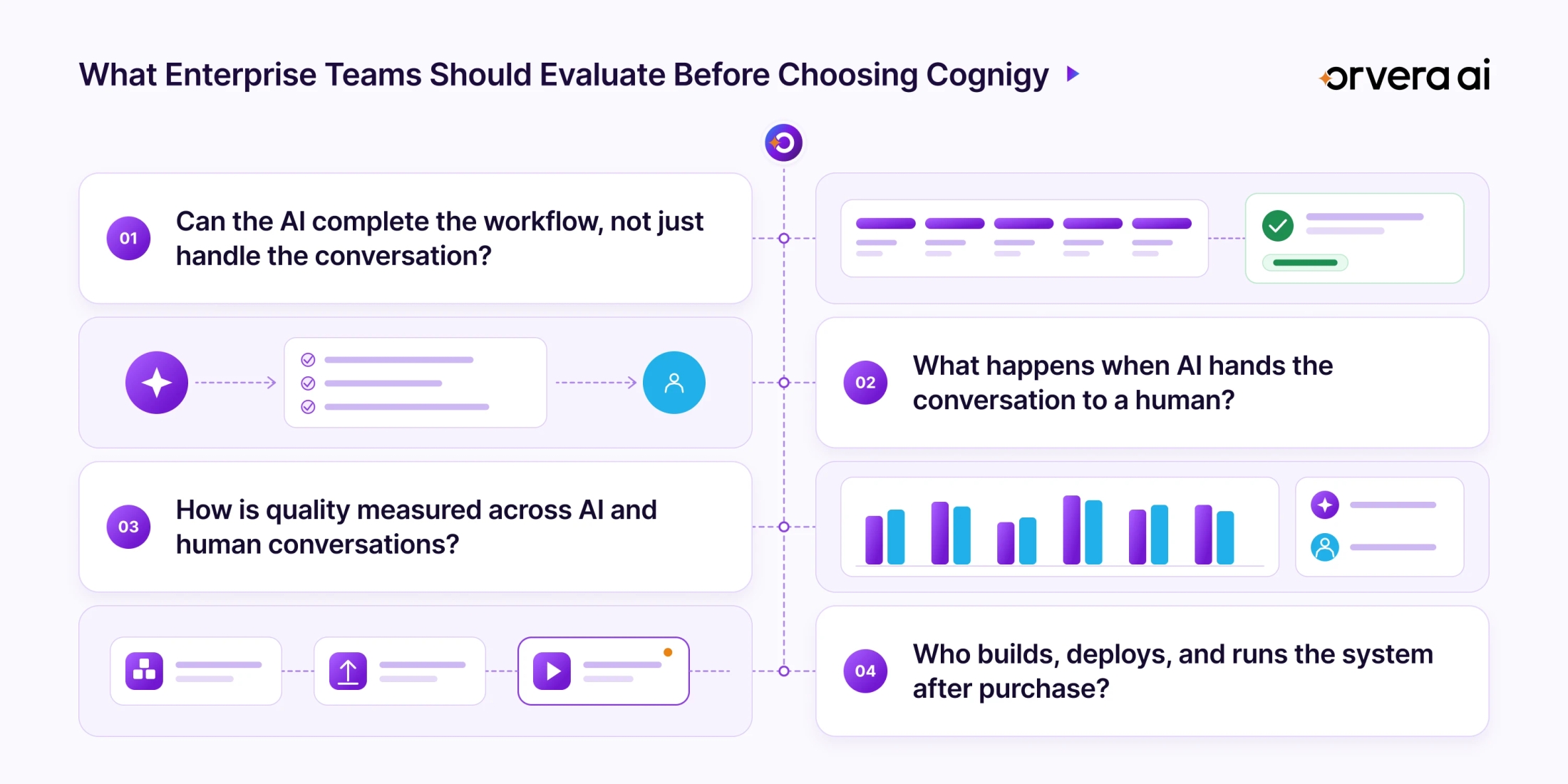
Can the AI complete the workflow, not just handle the conversation?
The first evaluation should be end-to-end resolution.
Choose several representative workflows and test whether the AI can move through the entire process.
For example:
A customer asks about a billing issue. The AI may need to authenticate the customer, retrieve account information, interpret policy, determine what action is allowed, update a system, confirm that the change occurred, and explain the outcome.
Cognigy's public materials describe AI agents that can access APIs, retrieve data, initiate workflows, execute tools, and combine Knowledge AI with transactional queries.
The procurement question is therefore not whether Cognigy supports system actions in principle.
It is whether the exact workflows your organization needs can be completed reliably, governed appropriately, and recovered when something does not go according to plan.
What happens when AI hands the conversation to a human?
Automation should also be tested at the boundary where automation stops.
Cognigy Agent Copilot can provide human agents with customer context, interaction history, summaries, translation, knowledge and post-call assistance.
During evaluation, test what the human actually receives.
Can the agent see what the AI already asked? Can they see what the AI already did? Are relevant system records surfaced? Does the customer have to repeat information? Can the human continue the workflow instead of restarting it?
The handoff should be treated as part of the customer journey, not as the end of the automation demo.
How is quality measured across AI and human conversations?
As enterprises add more AI-handled interactions, quality management becomes a cross-population problem.
It is no longer enough to know how human agents are performing while AI agents are measured on a different dashboard with different standards.
Enterprise teams should ask how conversations are evaluated, whether AI and human interactions can be examined against comparable business criteria, what evidence supports a score, and how findings become changes to workflows, agent behavior, or coaching.
This is one area where Orvera takes a specific architectural position. Orvera's Auto QA audits both human-handled and AI-handled conversations across every channel, within the same platform that runs AI agents and supports human-agent operations.
The purpose of that comparison is not to turn QA coverage into a vendor ranking. It is to make quality architecture part of the buying conversation.
Who builds, deploys, and runs the system after purchase?
The operating model deserves the same scrutiny as the technology.
Ask who will configure workflows; connect the contact platform and systems of record; design governance rules; test and calibrate behavior; maintain knowledge; investigate failures; change workflows after launch; and own ongoing optimization.
The answer may expose a larger difference between platforms than a feature comparison does.
Orvera's model is explicit: Orvera builds the solution, deploys it, integrates it, and then runs it on the customer's behalf. The platform stands on the systems the customer already operates, and the delivery relationship continues through the run phase rather than stopping at implementation.
For organizations evaluating this distinction more broadly, our guide to managed vs. self-serve voice AI platforms (opens in a new tab) goes deeper into the operating-model decision.
Cognigy Alternatives: When Should You Consider Another Platform?
Cognigy covers a substantial part of the enterprise conversational and agentic AI stack.
That does not mean every enterprise needs the same operating model.
Teams should broaden their evaluation when the deciding questions shift from "Does this feature exist?" to "Who owns the outcome once this goes live?"
Orvera AI as an alternative to Cognigy
Orvera AI is an agentic AI platform for enterprise customer experience, built, deployed, integrated, and run by Orvera on the customer's behalf. It combines agentic omnichannel AI agents with a human-agent layer that includes Agent Assist, AI Auto QA and QM, Voice of Customer, and reporting.
The AI-agent and human-agent layers operate as one system, with context retained through handoffs. Orvera's agents can take actions in connected systems and carry workflows through to completion, while the human-agent layer supports the interactions that still require people.
For enterprise teams, the distinction to examine is the operating model.
Orvera does not position implementation as a software handoff. It builds, deploys, integrates, and can operate the platform with the customer after go-live.
You can explore that product surface in more detail on the Orvera omnichannel AI agents page (opens in a new tab).
What to compare beyond the feature checklist
Whether Cognigy, Orvera, or another enterprise platform is under consideration, the shortlist should be tested against the operating questions that appear after the demo:
Can the system complete the workflow?
Does context follow the customer across channels and handoffs?
What happens to conversations that still require a human?
How are AI and human interactions evaluated?
Can the platform safely act against systems of record?
Who owns implementation?
Who owns the system after launch?
How are issues detected, corrected, and measured?
These questions turn a feature comparison into a production-readiness evaluation.
Explore the broader conversational AI market
Cognigy is only one approach to enterprise conversational AI.
Teams building a wider shortlist can review our guide to the best conversational AI platforms (opens in a new tab) to compare how different vendors approach AI agents, voice, orchestration, enterprise integrations, and human-agent operations.
Pricing should also be evaluated separately from product capability. For Cognigy specifically, see our detailed Cognigy pricing guide (opens in a new tab).
Final Takeaway
Cognigy in 2026 is considerably broader than a traditional chatbot platform.
Its current offering spans agentic AI, structured workflows, voice infrastructure, enterprise knowledge, integrations, Agent Copilot, and human-agent tooling. Independent Cognigy reviews are largely positive around usability and support, while recent reviewers also point to the planning, skills, and learning required as deployments become more sophisticated.
For enterprise CX teams, that makes the buying decision less about whether Cognigy has a long feature list and more about whether its architecture and operating model fit the environment it will have to run inside.
Evaluate the real workflows. Test the handoffs. Inspect the system actions. Understand how quality is measured. And determine who will own the platform once the demo is over.
If your evaluation is moving from feature comparison to production design, talk to Orvera (opens in a new tab) about how an operated agentic AI platform can fit into your existing CX environment.
Frequently asked questions
Cognigy is used by enterprises to build and operate AI-driven customer experiences across voice and digital channels. Its platform combines AI agents, structured workflows, enterprise knowledge, Voice Gateway, Agent Copilot, and integrations so customer interactions can connect to business systems and human-service operations.
Yes. NiCE completed its acquisition of Cognigy in September 2025. Current buyers may therefore encounter Cognigy within the broader NiCE CX portfolio, while the core platform continues to be referred to as Cognigy.AI. Older Cognigy reviews may describe the company before that acquisition, so review dates matter when evaluating current information.
Yes. Cognigy supports enterprise voice through Voice Gateway and also connects AI agents to digital customer-service channels. For buyers, the more useful test is not channel count alone but whether context, workflow state, backend actions, and handoffs remain intact as a customer moves between channels or from AI to a human agent.
Independent Cognigy reviews are generally positive about the visual workflow experience, low-code building, and customer support. At the same time, recent reviewers note that advanced enterprise deployments can require planning, technical skill, and time to learn. Because review pools include different product versions and use cases, recent enterprise feedback is the most useful context.
Enterprises should compare more than feature checklists. Key questions include whether the platform can complete real workflows in connected systems, preserve context through AI-human handoffs, support the human-agent layer, measure quality across AI and human conversations, govern system actions, and clearly define who owns implementation and ongoing operation after go-live.
Written by
Anindita Majumder
Anindita Majumder is a communications professional with nearly four years of experience in public relations, corporate communications, and journalism. She creates content that helps brands communicate their vision, products, and expertise through press releases, thought leadership, and editorial pieces. Outside of work, she is a vocalist, which keeps her creativity flowing.